Ancient Greek Courts and Trials: How Justice Was Decided
Ancient Greek courts did not rely on professional judges or lawyers. Legal decisions were made by large citizen juries, and trials worked as structured debates where each side presented its…
Ancient Greek law was not a single system applied across a unified state. Each city-state created and enforced its own laws, and there was no central authority to standardize justice….
Communication in ancient Greece depended on people, not systems. There was no centralized postal network, so messages moved only as fast as a messenger could travel. Most communication was carried…
Travel in ancient Greece was limited, slow, and usually necessary—not optional. Most people did not move frequently, and when they did, it was for clear reasons such as trade, war,…
Athletics in ancient Greece was not built around competition—it was built around training. Before any public contest, there was a structured system focused on developing strength, endurance, and control. Most…
Clothing in ancient Greece was simple in form but precise in meaning. What people wore signaled gender, status, and role within the household and the city. Most garments were based…
Ancient Greek food was simple, but not by choice. What people ate was shaped by limited farmland, a dry climate, and the need to sustain the household over time. The…
Children in ancient Greece were not raised for personal development—they were shaped to serve the needs of the household and the state. From birth, a child’s value depended on acceptance…
Marriage in ancient Greece was not about love or personal choice—it was a controlled arrangement designed to secure inheritance, produce legitimate heirs, and connect families through stable alliances. The decision…
Ancient Greek family structure was built around control, inheritance, and social order—not emotional bonds. At its core was the oikos, a household unit led by a male authority figure who…
Ancient Greek houses were not designed for comfort or display—they were built to control privacy, social roles, and daily behavior. Most homes followed an inward-facing layout centered on a private…
Greek society was not simply divided into social classes—it was organized to control who could participate in public life and who could not. Status determined more than wealth or position….
Greek cultural identity was not tied to a single state or border. There was no unified “Greece” in the modern sense. What held people together was a shared framework that…
Ancient Greek music was not separate from daily life, and it was not used for entertainment alone. It was built into rituals, public performances, and education, shaping how people acted,…
In ancient Greek cities, decisions were not issued from closed offices. They were argued in public. If you wanted to pass a law, defend yourself in court, or influence policy,…
Greek writing did not simply record ideas—it changed how ideas could exist. Before writing, knowledge depended on memory and performance. It had to be spoken, repeated, and carried by people….
Ancient Greek libraries were not designed as public spaces for reading. They were controlled environments for storing and organizing knowledge, used by a limited group of scholars and institutions. Their…
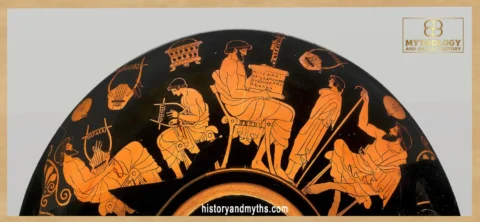
Ancient Greek education was not designed to deliver knowledge in a structured, institutional way. It was built to shape individuals into active participants within the city—people who could speak, compete,…