Sacred Mountains in Greek Mythology: Why Gods Chose Mountains
In Greek mythology, mountains were far more than dramatic features of the landscape. They were places where the ordinary world seemed to give way to something greater. Some served as homes of the gods, others became centers of prophecy, worship, and divine encounters. Their height, isolation, and commanding presence made them natural candidates for locations where mortals believed the boundary between human and divine reality became thinner.
This connection appears throughout Greek myth and religion. Mount Olympus became the symbolic seat of divine authority, while mountains such as Parnassus acquired sacred significance through their association with Apollo, the Muses, and religious tradition. These places were not revered simply because they were impressive. They carried meanings that linked geography to power, knowledge, and the presence of the gods.
Understanding sacred mountains therefore requires looking beyond individual peaks. The deeper question is why Greek culture repeatedly imagined elevated places as centers of divine activity. The answer reveals how mountains functioned within the sacred geography of the ancient Greek world and why they remained powerful symbols of divine presence for centuries.
Why Mountains Were Seen as Sacred
The sacred status of mountains in Greek belief was rooted in more than their physical size. Mountains occupied a unique position within the landscape. They rose above ordinary human settlements, dominated the horizon, and appeared closer to the sky than any other feature of the natural world. For ancient observers, this made them natural locations for encounters with divine power.
Their isolation also played an important role. Unlike cities, markets, or agricultural land, mountain peaks often stood apart from daily life. Reaching them required effort, distance, and sometimes danger. This separation helped create the impression that they belonged to a different realm, one less influenced by ordinary human concerns and more closely connected to the sacred.
Mountains also offered visibility and permanence. They could be seen from great distances and remained largely unchanged across generations. In a world where political powers rose and fell, mountains appeared enduring and stable. These qualities made them suitable symbols for divine authority, which was likewise imagined as enduring and superior to human institutions.
Greek mythology repeatedly reinforces this association. Important divine events occur on mountains, gods choose mountains as dwelling places, and religious traditions develop around elevated locations. The pattern suggests that mountains were not sacred because specific myths happened there. Rather, myths happened there because mountains were already viewed as fitting places for divine presence.
In this sense, sacred mountains functioned as more than geographical features. They represented a physical expression of distance from ordinary life, allowing Greek culture to imagine places where the human world seemed closer to the realm of the gods.
| Mountain | Associated Deity | Sacred Function | Symbolic Meaning |
|---|---|---|---|
| Mount Olympus | The Olympian Gods | Seat of divine authority | Power, order, and divine rule |
| Mount Parnassus | Apollo and the Muses | Prophecy and inspiration | Knowledge and divine insight |
| Mount Othrys | Cronus and the Titans | Titanic stronghold | The older cosmic order |
| Sacred Mountains (General) | Various deities | Contact with the divine | Transcendence and separation |
Mount Olympus and the Idea of Divine Authority
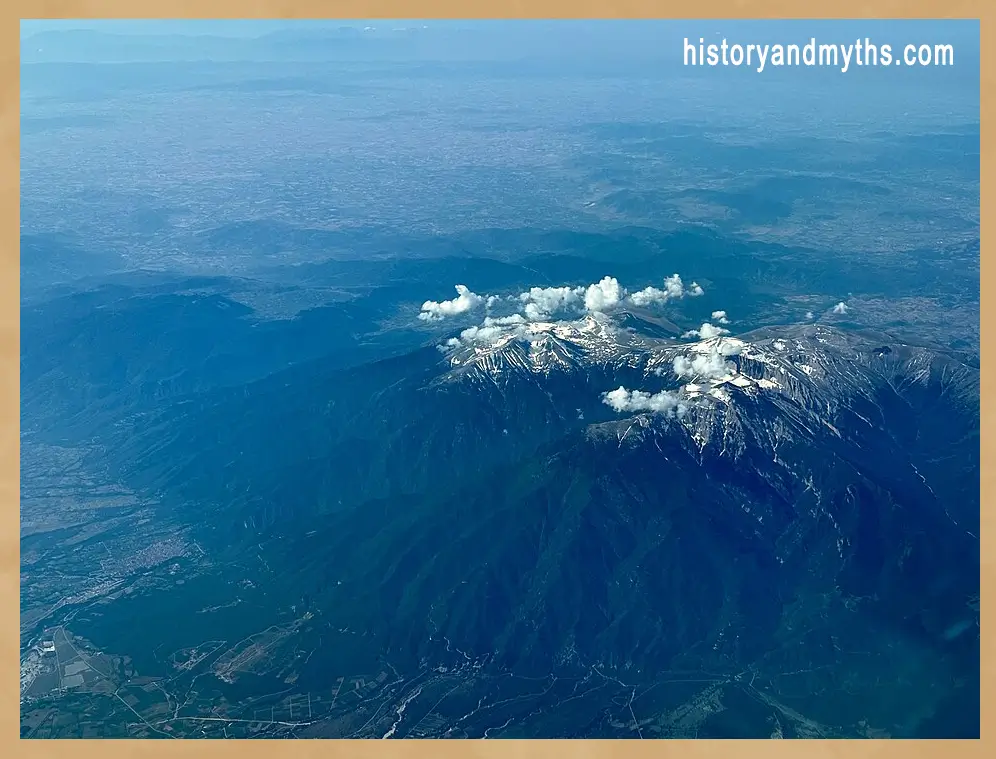
No mountain in Greek mythology carries greater significance than Mount Olympus. Although many mountains were considered sacred, Olympus became the symbolic center of divine authority and the most important geographical expression of the Olympian order.
Its importance lies in what it represented rather than its physical characteristics alone. Olympus was imagined as the place from which Zeus and the Olympian gods governed the cosmos. Decisions affecting gods, mortals, and heroes were often associated with the divine assembly gathered there. As a result, the mountain became a symbol of order, legitimacy, and supreme power.
The choice of a mountain for this role was meaningful. A divine government located above the human world reinforced the idea that the gods occupied a higher level of existence. The elevation of Olympus mirrored the hierarchy of the cosmos itself, placing divine authority literally above human affairs.
At the same time, Olympus was not portrayed as completely inaccessible. Gods regularly descended from the mountain to intervene in mortal life, while heroes occasionally received glimpses of the divine world. This connection allowed Olympus to function as a bridge between the human and divine spheres rather than a realm entirely separated from them.
For Greek audiences, Mount Olympus represented more than a residence for the gods. It embodied the concept of divine rule itself, transforming a mountain into the most recognizable symbol of sacred authority in the Greek mythological landscape.
Mount Parnassus and Sacred Knowledge
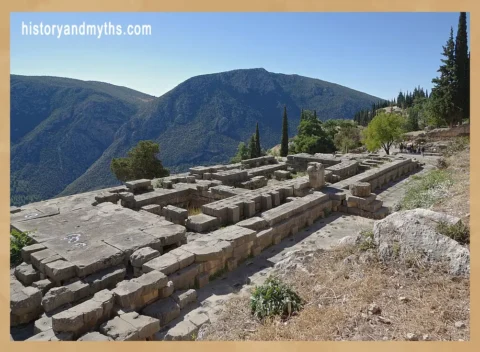
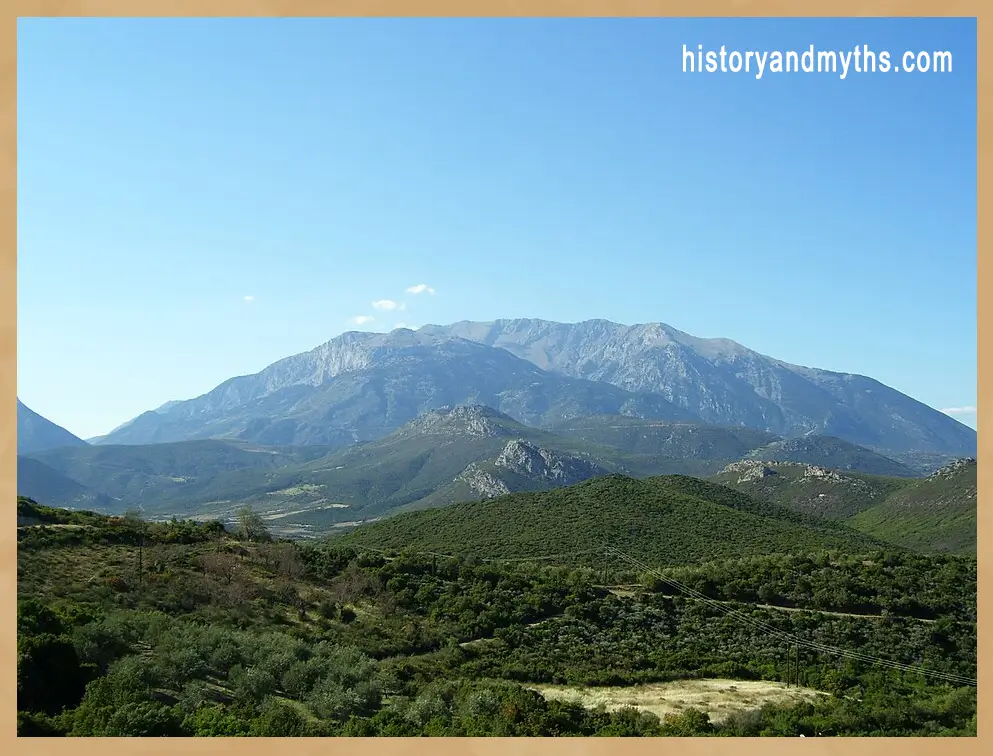
If Olympus symbolized divine authority, Mount Parnassus became associated with divine knowledge. Rising above central Greece, the mountain was closely connected to Apollo, the sanctuary of Delphi, and the traditions of prophecy that shaped some of the most influential religious practices in the Greek world.
Its significance came from more than geography. Parnassus was linked to the belief that certain places offered access to truths unavailable through ordinary human experience. Pilgrims traveled to Delphi seeking guidance because the sanctuary was thought to occupy a privileged position within the sacred landscape, where communication between mortals and divine powers was possible.
The mountain was also connected to the Muses, whose presence reinforced its reputation as a center of inspiration, poetry, and intellectual achievement. This association expanded its role beyond prophecy. Parnassus became a symbolic source of wisdom, creativity, and sacred insight.
Unlike Olympus, which represented the governing power of the gods, Parnassus represented understanding. One mountain embodied authority; the other embodied access to divine knowledge. Together they reveal how Greek sacred geography assigned different religious functions to different locations.
The importance of Parnassus demonstrates that sacred mountains were not simply elevated places. They could become centers of specific forms of divine presence, shaping how people imagined communication with the gods, the pursuit of wisdom, and the search for truths hidden from ordinary human sight.
Why Mountains Became Sacred
Greek sacred mountains were not important simply because they were high. Their elevation, isolation, and permanence made them ideal locations for imagining contact with divine powers. Mountains symbolized the movement away from ordinary life and toward a realm associated with authority, revelation, and sacred presence.
© historyandmyths.com — Educational Use
Mountains as Meeting Points Between Worlds
One of the most important functions of sacred mountains in Greek mythology was their role as places where different realms could intersect. They stood between earth and sky, making them natural settings for encounters between mortals and divine powers.
This idea appears repeatedly throughout Greek tradition. Heroes receive divine guidance on mountains, gods reveal themselves in elevated places, and religious rituals often occur in high or remote landscapes. The mountain does not merely serve as a backdrop. It becomes part of the experience itself, reinforcing the sense that the ordinary world has been left behind.
The symbolism is straightforward but powerful. Ascending a mountain creates physical distance from daily life, and mythology transforms that distance into spiritual significance. The climb represents movement toward a different level of reality, one where divine knowledge, authority, or presence becomes more accessible.
This helps explain why sacred mountains appear across different religious functions. Some are associated with prophecy, others with divine rule, and others with mythological encounters. Their common feature is not a specific deity but their ability to serve as thresholds between human and divine space.
In Greek sacred geography, mountains therefore functioned as more than sacred landmarks. They acted as points of connection where the boundaries separating mortals from the gods became less rigid, allowing communication, revelation, and divine intervention to occur.
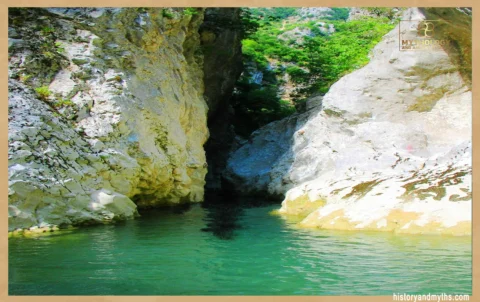
Sacred Mountains vs Sacred Caves
Sacred mountains and sacred caves occupy opposite yet complementary positions within Greek sacred geography. Both were associated with divine presence, but they expressed different ways of imagining contact between the human and supernatural worlds.
Mountains are places of ascent. They draw attention upward toward the sky, visibility, and the realm of the Olympian gods. Their symbolism is linked to revelation, authority, prophecy, and encounters with powers that exist above ordinary human life. The journey to a sacred mountain is often a movement toward elevation and openness.
Caves, by contrast, are places of descent. They lead inward and downward into darkness, secrecy, and hidden forces. Many cave traditions are associated with nymphs, mysteries, divine births, prophetic powers, or entrances to deeper layers of the mythological cosmos. Rather than revealing the divine through height, they reveal it through concealment.
This contrast reflects two different sacred experiences. Mountains suggest approach through visibility and distance, while caves suggest approach through mystery and enclosure. One lifts the visitor away from the human world; the other draws the visitor beneath its surface.
Despite these differences, both serve the same broader purpose. They mark locations where ordinary space becomes sacred space. Whether ascending a mountain path or entering a cave, the individual crosses a boundary that separates everyday life from a realm associated with divine presence.
Together, sacred mountains and sacred caves reveal how Greek mythology used landscape to express spiritual ideas. The sacred could be found both above and below, in exposed heights and hidden depths, each offering a different path toward the world of the gods.
What Sacred Mountains Symbolized
Sacred mountains in Greek mythology symbolized more than physical elevation. They represented the idea that divine reality existed above the ordinary human condition. Their height transformed them into natural images of transcendence, authority, and access to powers beyond everyday experience.
One of their strongest symbolic meanings was separation. Mountains stood apart from cities, political life, and routine activity. This distance made them ideal locations for imagining spaces where divine influence could be encountered more directly. The farther one moved from ordinary society, the closer one seemed to come to the sacred.
They also symbolized stability and permanence. Human kingdoms changed, wars reshaped borders, and generations passed, but mountains remained. Their enduring presence made them fitting representations of divine power, which Greek religion likewise portrayed as greater and more lasting than human institutions.
At the same time, sacred mountains expressed aspiration. They were places that required effort to reach, and mythology often transformed that physical journey into a symbolic movement toward wisdom, revelation, or divine encounter. The act of ascending became associated with leaving the ordinary world behind.
For this reason, sacred mountains occupied a unique place within Greek sacred geography. They were not merely homes of the gods or locations of important myths. They served as enduring symbols of the relationship between the human and divine realms, expressing the belief that some truths, powers, and forms of knowledge existed above the limits of ordinary life.
Sacred mountains played a central role in Greek mythology because they provided a natural way to imagine divine presence within the landscape. Their height, isolation, and permanence made them ideal locations for expressing ideas about authority, wisdom, revelation, and the relationship between mortals and the gods.
Different mountains fulfilled different functions. Olympus became the symbol of divine rule, while Parnassus became associated with prophecy, inspiration, and sacred knowledge. Together they demonstrate that Greek sacred geography was not simply a collection of locations but a system in which places carried distinct religious meanings.
The importance of these mountains also reveals a broader pattern in Greek belief. Sacred spaces were often defined by their ability to separate individuals from ordinary life and bring them closer to divine realities. Mountains achieved this through elevation just as caves achieved it through descent into hidden depths.
Seen in this light, sacred mountains were far more than geographical landmarks. They were symbols of transcendence, places where the Greeks imagined the boundary between human experience and divine power becoming visible within the natural world itself.
Key Takeaways
- Mountains were viewed as natural places for divine presence because they rose above ordinary human space.
- Mount Olympus symbolized divine authority and the rule of the Olympian gods.
- Mount Parnassus became associated with prophecy, inspiration, and sacred knowledge.
- Sacred mountains functioned as meeting points between mortals and the divine.
- Greek mythology linked elevation with transcendence and spiritual separation.
- Mountains and caves represented opposite but complementary forms of sacred space.
- Sacred mountains symbolized permanence, authority, and access to higher realities.
Frequently Asked Questions
Why were mountains considered sacred in Greek mythology?
Mountains were seen as places closer to the divine realm because of their height, isolation, and symbolic separation from ordinary life.
What was the most sacred mountain in Greek mythology?
Mount Olympus was the most sacred mountain because it was believed to be the home of the Olympian gods.
Why was Mount Parnassus important?
Parnassus was associated with Apollo, Delphi, prophecy, and the Muses, making it a center of sacred knowledge and inspiration.
Did Greeks worship mountains themselves?
Generally, mountains were revered because of the divine beings associated with them rather than being worshipped as independent deities.
What did sacred mountains symbolize?
They symbolized divine authority, transcendence, permanence, and communication between humans and gods.
How were sacred mountains different from sacred caves?
Mountains represented ascent and revelation, while caves represented descent, mystery, and hidden sacred power.
Was Mount Olympus a real mountain?
Yes. Mount Olympus exists in northern Greece, although the mythological Olympus was imagined as a divine realm beyond ordinary human access.
Why do sacred mountains appear in many religions?
Their height and isolation naturally encourage associations with divine presence, revelation, and spiritual authority.
Sources & Rights
- Homer. Iliad.
- Homer. Odyssey.
- Hesiod. Theogony.
- Pindar. Pythian Odes.
- Apollodorus. Bibliotheca.
- Pausanias. Description of Greece.
- Strabo. Geographica.
- Walter Burkert. Greek Religion.
- Robert Parker. On Greek Religion.
- Richard Buxton. The Complete World of Greek Mythology.
- Robin Hard. The Routledge Handbook of Greek Mythology.
- Sarah Iles Johnston. Ancient Greek Religion.
- Jennifer Larson. Greek Nymphs: Myth, Cult, Lore.
- Fritz Graf. Greek Mythology.
- Timothy Gantz. Early Greek Myth.
- Oxford Classical Dictionary. Entries on Olympus, Parnassus, and Sacred Geography.
Written by H. Moses — All rights reserved © Mythology and History