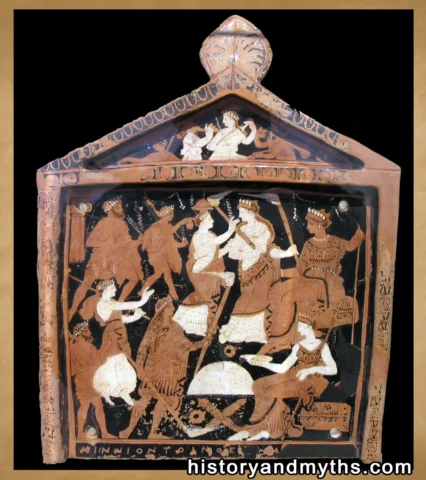
Pentheus and Dionysus: Madness and Tragedy in Greek Mythology
The tragedy of Pentheus is one of the most disturbing stories in Greek mythology. At first glance, it appears to be a conflict between a king and a god. Pentheus, ruler of Thebes, refuses to recognize Dionysus and attempts to suppress the strange rituals spreading through his kingdom. The result is a catastrophe that ends in madness, violence, and one of the most shocking deaths in Greek myth.
Yet the story is about more than divine punishment. Pentheus does not fail simply because Dionysus is powerful. He fails because he believes that authority alone can control forces he does not understand. Throughout the myth, the young king treats Dionysus as a problem to be managed rather than a reality to be confronted, and that mistake gradually draws him toward destruction.
For this reason, the myth of Pentheus remains one of the most important Greek reflections on power, control, and human limitation. It explores what happens when certainty turns into arrogance, when curiosity becomes obsession, and when a ruler discovers that some forces lie beyond the reach of law, reason, and command.
Who Was Pentheus?
Pentheus was the young king of Thebes and a grandson of Cadmus, the legendary founder of the city. In Greek mythology, he is best known for his conflict with Dionysus, the god of wine, ecstasy, transformation, and religious frenzy. His story survives most famously through Euripides’ Bacchae, one of the most influential tragedies of the ancient world.
Unlike many mythological rulers, Pentheus is not introduced as a tyrant driven by cruelty or ambition. He sees himself as a defender of order. When reports spread that women throughout Thebes have abandoned their homes to participate in the ecstatic rites of Dionysus, Pentheus interprets the movement as a threat to law, stability, and royal authority.
This perspective is important because it makes the tragedy more complex than a simple battle between good and evil. Pentheus is not attempting to overthrow the gods or seize divine power for himself. He believes he is protecting his city from chaos. The problem is that he fundamentally misunderstands the force he is confronting.
Dionysus is not merely a foreign cult leader or a disruptive influence. He is a god whose power operates through emotion, transformation, and the breakdown of ordinary boundaries. By treating Dionysus as something that can be arrested, controlled, or dismissed, Pentheus mistakes a divine reality for a political problem.
The tragedy begins with this misunderstanding. Pentheus’s downfall is not caused by weakness, but by confidence in a worldview that leaves no room for forces beyond his control. That certainty shapes every decision he makes and ultimately leads him toward disaster.
| Figure | Represents | Role in the Tragedy |
|---|---|---|
| Pentheus | Order, authority, certainty | Attempts to control what he does not understand |
| Dionysus | Ecstasy, transformation, irrational forces | Challenges the limits of human control |
| The Maenads | Dionysian frenzy | Become instruments of divine punishment |
| Agave | Reversal of family bonds | Kills her own son while under divine madness |
| Madness | Distorted perception | Destroys Pentheus’s ability to understand reality |
Why Pentheus Refused Dionysus
Pentheus rejects Dionysus long before the conflict becomes personal. His resistance grows from a deeper belief about how society should function. As king, he values order, discipline, and clear authority. The reports coming from the mountains—women abandoning their homes, ecstatic rituals, and behavior that appears irrational—seem to threaten everything he is responsible for protecting.
From Pentheus’s perspective, suspicion is understandable. Dionysus arrives as a new and unfamiliar force whose followers ignore many of the social boundaries that normally organize civic life. Rather than seeing divine power, Pentheus sees disorder. Rather than seeing a god, he sees a challenge to his authority.
The tragedy emerges because Dionysus represents something that cannot be evaluated through ordinary political logic. Pentheus assumes every problem has a practical solution: investigate it, control it, punish it, or ban it. That approach works against human opponents, but it becomes dangerous when applied to a divine force whose nature extends beyond law and government.
His refusal therefore reveals more than disbelief. It reflects a conviction that reason and authority are sufficient to explain and manage every aspect of reality. Greek mythology repeatedly questions that assumption. Characters often fail when they mistake the limits of their own understanding for the limits of the world itself.
Pentheus’s conflict with Dionysus begins as an attempt to defend order, but it gradually becomes a refusal to acknowledge that some realities exist outside his framework. The more he insists on interpreting Dionysus according to his own expectations, the less capable he becomes of recognizing the danger before him.
Dionysus as a Force Beyond Human Control
One reason the tragedy of Pentheus remains so powerful is that Dionysus is not presented as a conventional opponent. He does not arrive with an army seeking conquest, nor does he attempt to seize a throne. Instead, he represents a force that operates beneath the structures that rulers depend upon to maintain control.
In Greek mythology, Dionysus governs experiences that resist easy regulation: ecstasy, transformation, intoxication, emotional release, and the temporary dissolution of social boundaries. These aspects of life can be ignored or suppressed for a time, but they cannot be eliminated entirely. They remain part of human nature regardless of laws or political authority.
Pentheus fails because he approaches Dionysus as if he were dealing with a rebellious citizen or a dangerous outsider. He assumes that power comes from the ability to command obedience. Dionysus exposes the limits of that belief by influencing people in ways that authority cannot easily reach. His power works through desire, emotion, and altered perception rather than force.
This is why the conflict becomes increasingly unequal. Pentheus attempts to impose control from above, while Dionysus operates within the minds and emotions of those around him. The king can imprison followers, issue orders, and threaten punishment, but these actions do little against a force rooted in the deepest parts of human experience.
The myth therefore presents Dionysus as more than a deity. He embodies realities that societies may try to regulate but can never fully master. Pentheus’s mistake is believing that authority alone is sufficient to contain such a force. The tragedy unfolds because he confronts something fundamentally different from the challenges a ruler is trained to face.
The Danger of Trying to Control What You Do Not Understand
The tragedy of Pentheus reaches beyond mythology because it explores a mistake that appears throughout human history: the belief that unfamiliar forces can be controlled before they are understood. Pentheus never seriously attempts to learn what Dionysus represents. From the beginning, he assumes he already knows enough to judge, condemn, and suppress him.
This attitude creates a dangerous blind spot. Understanding requires curiosity, patience, and a willingness to question existing assumptions. Pentheus chooses the opposite path. He interprets every event through the same framework and dismisses any evidence that challenges his view. As a result, he becomes increasingly confident at the very moment he should be most cautious.
Greek mythology often portrays ignorance as more dangerous than weakness. A person who recognizes their limits may seek guidance or adapt to changing circumstances. A person who believes they already possess complete understanding rarely does either. Pentheus’s certainty prevents him from recognizing the scale of the force confronting him.
The irony is that his efforts to maintain control actually accelerate the crisis. Every attempt to restrict Dionysus deepens his involvement with him. Every effort to expose the cult draws Pentheus further into its influence. Instead of remaining a distant observer, he becomes personally entangled in the very phenomenon he seeks to dominate.
The myth suggests that power without understanding is fragile. Authority may succeed against ordinary problems, but it becomes unreliable when applied to realities that have not been properly understood. Pentheus’s downfall begins long before madness enters the story. It begins with the assumption that control can replace knowledge.
The Core Message of the Pentheus Myth
The tragedy of Pentheus is not simply a story about a king punished by a god. It is a myth about the dangers of confusing control with understanding. Pentheus believes authority can solve every problem, but Dionysus represents forces that exist beyond law, certainty, and human command. The story explores what happens when confidence becomes arrogance and curiosity becomes obsession.
© historyandmyths.com — Educational Use
Why Pentheus Became Obsessed With Dionysus
One of the most revealing aspects of the myth is that Pentheus gradually becomes fascinated by the very force he claims to oppose. At the beginning of the story, he presents himself as a ruler attempting to protect Thebes from a dangerous influence. As events unfold, however, his attention becomes increasingly focused on Dionysus and his followers.
This shift is important because it exposes a contradiction at the heart of Pentheus’s behavior. He condemns the Dionysian rites, yet he cannot stop thinking about them. He seeks information, demands reports, and becomes consumed by a desire to witness what is happening for himself. The more he tries to distance himself from Dionysus, the more psychologically involved he becomes.
Dionysus exploits this weakness. Rather than confronting Pentheus through direct force, he encourages the king’s curiosity. What begins as opposition slowly turns into fixation. Pentheus becomes less interested in governing Thebes and more interested in uncovering the secrets of the cult he despises.
Greek mythology often portrays obsession as a form of vulnerability. Characters lose perspective when a single idea dominates their attention. Pentheus experiences exactly this process. His judgment becomes increasingly clouded because he can no longer view Dionysus objectively. The god occupies too much of his thoughts.
This development makes the tragedy more complex than a simple conflict between believer and skeptic. Pentheus is not destroyed solely because he rejects Dionysus. He is destroyed because his rejection evolves into an unhealthy fascination that draws him deeper into the god’s influence. By the time he realizes the danger, he has already become part of the drama he hoped to control from a distance.
Madness as Divine Punishment
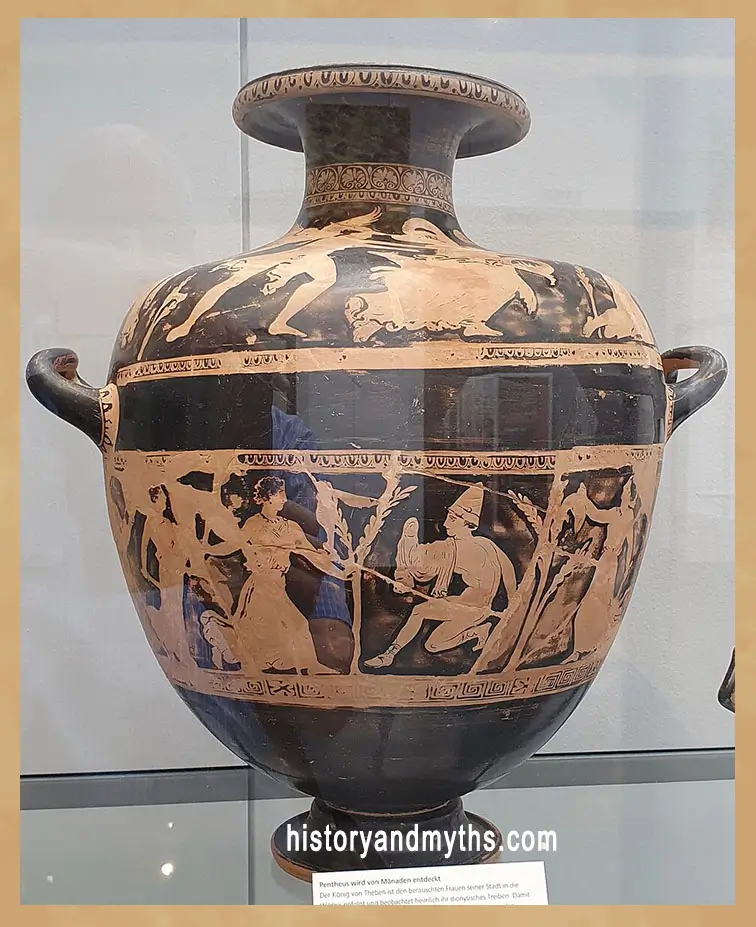
In the tragedy of Pentheus, madness is not portrayed as random chaos. It functions as a form of divine punishment that attacks perception itself. Rather than striking the body, Dionysus targets the ability to distinguish reality from illusion, certainty from deception, and control from vulnerability.
This choice is significant because Pentheus’s greatest flaw is intellectual arrogance. He believes he understands the situation completely and assumes his judgment cannot be compromised. The punishment therefore addresses the exact source of his confidence. As the myth progresses, his grasp on reality becomes increasingly unstable, making him susceptible to manipulation.
Dionysian madness differs from ordinary irrational behavior. It represents a temporary collapse of the boundaries that normally organize human experience. People see what is not there, act against their own interests, and become disconnected from familiar social roles. The force that Pentheus tried to suppress eventually reshapes his own perception.
Greek mythology frequently links punishment to the nature of the offense. A warrior may be defeated through strength, while a deceiver may fall through deception. Pentheus is punished through distorted understanding because his tragedy begins with a failure to understand. The consequence mirrors the mistake.
By presenting madness in this way, the myth explores a deeper fear than physical destruction. Losing control of one’s mind threatens the very ability to navigate reality. Pentheus spends much of the story believing he is the person in command. Dionysus’s punishment demonstrates how fragile that confidence can be when perception itself becomes unreliable.
Why Pentheus’s Own Family Killed Him
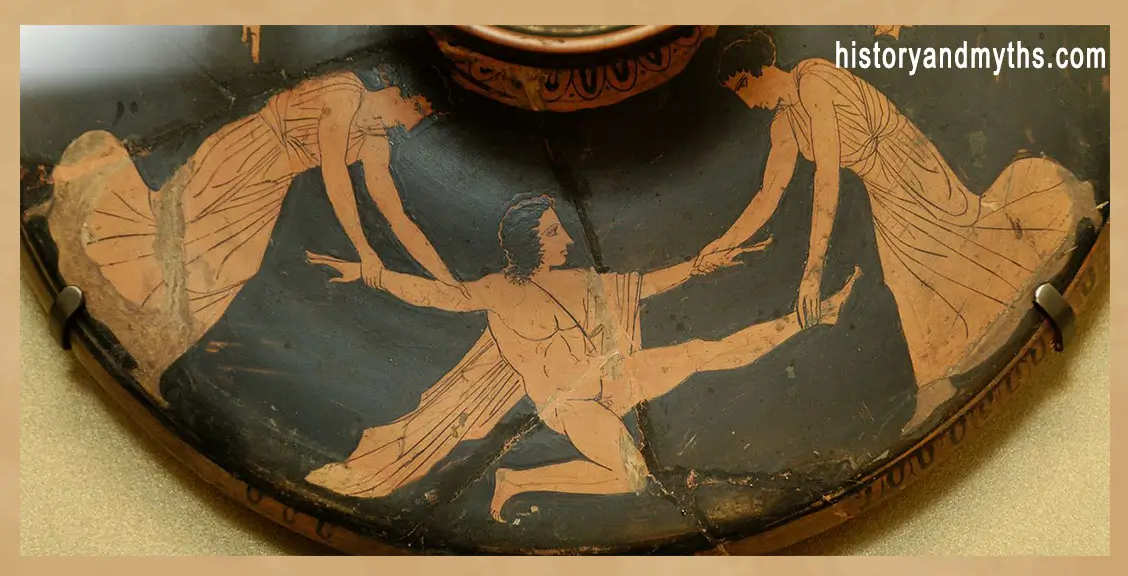
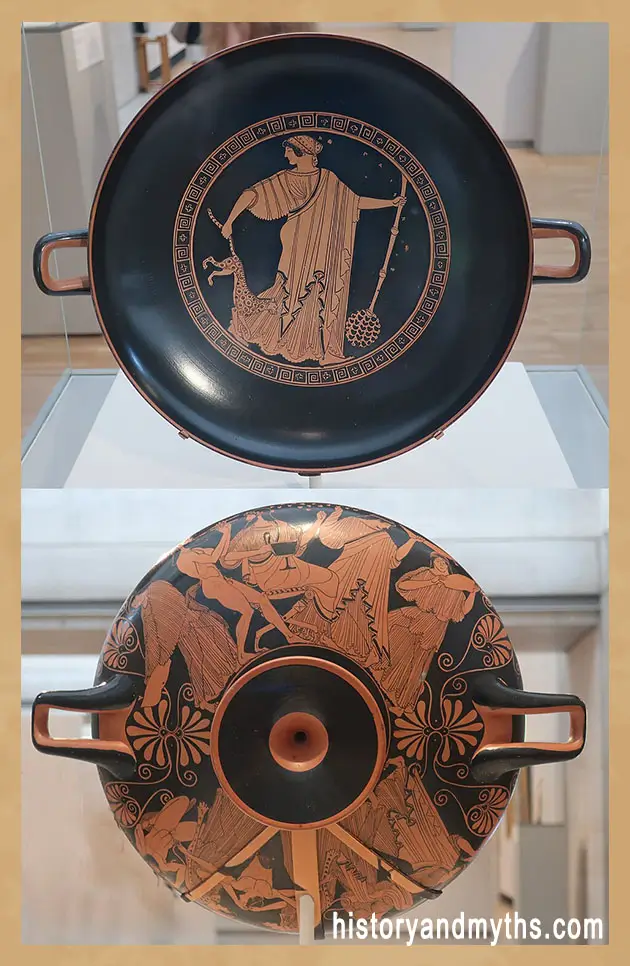
The most shocking element of the myth is not Pentheus’s death itself but the identity of those responsible for it. He is not killed by enemies, rebels, or invading forces. He is torn apart by his own mother, Agave, and other women of Thebes while they are under the influence of Dionysian madness.
This detail transforms the tragedy from a simple act of punishment into a complete reversal of the natural order. Family relationships were among the most important bonds in Greek society. Mothers were expected to protect their children, not destroy them. By turning those bonds upside down, the myth illustrates the overwhelming power of the force Pentheus tried to resist.
The scene also serves a symbolic purpose. Throughout the story, Pentheus believes that authority and social structure can contain every threat. His death demonstrates the opposite. The very institutions that should provide safety—family, kinship, and community—become the instruments of his destruction once Dionysian power takes hold.
Greek tragedy often achieves its greatest impact through reversals of expectation. Pentheus spends the story attempting to control others, only to become the victim of forces operating within his own household. The danger he fears does not arrive from outside Thebes. It emerges from within the city and within his own family.
For this reason, the killing of Pentheus is more than a brutal ending. It represents the collapse of the world he thought he understood. The relationships, assumptions, and structures that once seemed secure prove unable to protect him. The tragedy reaches its climax when the king discovers that the force he dismissed has penetrated the very center of his life.
Pentheus as a Symbol of Human Arrogance
Pentheus is often remembered as a victim of Dionysian madness, but Greek mythology presents him as something more specific: a symbol of the arrogance that emerges when people mistake limited knowledge for complete understanding. His tragedy begins not with ignorance alone but with the certainty that he cannot be wrong.
Throughout the myth, Pentheus repeatedly assumes that his interpretation of events is the only valid one. He dismisses warnings, rejects alternative perspectives, and treats unfamiliar experiences as threats rather than opportunities for understanding. This confidence gives him authority as a ruler, but it also prevents him from recognizing his own limitations.
Greek mythology frequently portrays arrogance as a dangerous form of blindness. Characters become vulnerable when they assume they fully comprehend forces larger than themselves. Pentheus follows this pattern. He does not merely question Dionysus; he assumes that the god can be reduced to categories he already understands. That assumption proves disastrous.
What makes the myth compelling is that Pentheus’s flaw appears reasonable at first. He values order, logic, and stability—qualities generally associated with good leadership. The tragedy occurs when those strengths harden into rigidity. His commitment to control becomes so absolute that he loses the flexibility needed to respond to realities outside his expectations.
For Greek audiences, Pentheus represented a warning about the limits of human certainty. Knowledge has value, but wisdom requires recognizing where knowledge ends. The king’s downfall demonstrates that confidence can become destructive when it eliminates humility. In trying to prove that he understood everything, Pentheus ultimately revealed how little he understood at all.
The Tragedy of a King Who Thought He Was in Control
The story of Pentheus ultimately revolves around a single illusion: the belief that control guarantees safety. From the beginning, the young king assumes that authority, law, and rational judgment are sufficient to manage any threat that emerges within his kingdom. Every decision he makes follows from that conviction.
What he fails to recognize is that control has limits. Some forces cannot be understood solely through political power or administrative authority. Dionysus represents one of those forces. The god’s influence operates through emotion, instinct, transformation, and experiences that resist simple regulation. Pentheus confronts these realities as if they were ordinary problems, and that misunderstanding shapes his fate.
The tragedy becomes especially powerful because Pentheus never sees himself as reckless. He believes he is acting responsibly. He sees himself as the defender of order against chaos. Yet the more determined he becomes to impose control, the less control he actually possesses. His efforts gradually place him in a position where he is manipulated by the very force he seeks to suppress.
Greek tragedy often exposes the gap between appearance and reality. Pentheus appears to be the person directing events, but the audience gradually realizes that he is losing control long before he understands it himself. By the time he recognizes the danger, the process is already irreversible.
This is why the myth remains relevant beyond its ancient setting. Pentheus embodies the human tendency to overestimate the reach of certainty and authority. His downfall serves as a reminder that control is not the same as understanding. The tragedy begins when he confuses the two and ends when reality proves the difference in the most devastating way possible.
The tragedy of Pentheus is far more than a story about divine punishment. At its core, it explores the tension between control and forces that cannot be fully controlled. Pentheus attempts to confront Dionysus through authority, reason, and law, believing these tools are sufficient to explain and manage every challenge facing his kingdom. The myth gradually reveals the limits of that belief.
Through obsession, misunderstanding, madness, and the collapse of family bonds, the story demonstrates how certainty can become a source of vulnerability. Pentheus is not destroyed because he lacks intelligence or courage. He is destroyed because he mistakes confidence for understanding and refuses to acknowledge realities that exist beyond his worldview.
For this reason, Pentheus remains one of Greek mythology’s most powerful tragic figures. His story warns against arrogance, explores the dangers of rigid certainty, and examines what happens when human beings attempt to control forces they do not truly comprehend. The result is a tragedy that continues to resonate because its central question remains timeless: how should people respond to powers greater than their own understanding?
Key Takeaways
- Pentheus was the king of Thebes who refused to recognize Dionysus.
- His resistance stemmed from a desire to preserve order and authority.
- Dionysus represents forces that cannot be fully controlled through political power.
- Pentheus becomes increasingly obsessed with the cult he opposes.
- Madness functions as a punishment that attacks perception rather than the body.
- His death at the hands of his own family symbolizes the collapse of social order.
- The myth warns against arrogance and the illusion of complete understanding.
- Pentheus remains a powerful symbol of human limits and misplaced certainty.
Frequently Asked Questions
Who was Pentheus in Greek mythology?
Pentheus was the king of Thebes and the primary opponent of Dionysus in the myth most famously preserved in Euripides’ Bacchae.
Why did Pentheus reject Dionysus?
He viewed the Dionysian cult as a threat to order, authority, and social stability within Thebes.
What does Dionysus represent in the myth?
Dionysus represents ecstasy, transformation, irrational forces, and aspects of human experience that resist complete control.
Why did Pentheus become obsessed with Dionysus?
His desire to expose and control the cult gradually turned into a fixation that drew him deeper into the god’s influence.
How did Pentheus die?
Under the influence of Dionysian madness, his own mother Agave and other Maenads mistook him for a wild animal and tore him apart.
What is the meaning of Pentheus’s tragedy?
The myth explores the dangers of arrogance, misplaced certainty, and attempting to control forces that are not fully understood.
What role does madness play in the story?
Madness serves as a divine punishment that distorts perception and undermines Pentheus’s confidence in his own judgment.
Why is the myth still important today?
It remains relevant because it examines authority, obsession, human limitations, and the risks of confusing control with understanding.
Sources & Rights
- Euripides. The Bacchae.
- Apollodorus. Library.
- Pausanias. Description of Greece.
- Walter Burkert. Greek Religion.
- Richard Seaford. Dionysos.
- Karl Kerényi. Dionysos: Archetypal Image of Indestructible Life.
- Walter F. Otto. Dionysus: Myth and Cult.
- Sarah Iles Johnston. Ancient Greek Religion.
- Timothy Gantz. Early Greek Myth.
- Robert Graves. The Greek Myths.
- Fritz Graf. Greek Mythology.
- Jennifer Larson. Understanding Greek Mythology.
- Robin Hard. The Routledge Handbook of Greek Mythology.
- William Hansen. Classical Mythology.
- H.J. Rose. A Handbook of Greek Mythology.
- Edith Hall. Introducing the Ancient Greeks.
- Gregory Nagy. The Ancient Greek Hero in 24 Hours.
- Emma Griffiths. Greek Myth: A Very Short Introduction.
- Mark P.O. Morford & Robert Lenardon. Classical Mythology.
- Richard Buxton. The Complete World of Greek Mythology.
Written by H. Moses — All rights reserved © Mythology and History