What Light and Darkness Symbolized in Greek Mythology
In Greek mythology, light and darkness were far more than natural conditions of day and night. They served as powerful symbols that helped the Greeks explain how the universe worked, where knowledge came from, and what lay beyond human understanding. Light was often associated with revelation, order, visibility, and divine insight, while darkness represented mystery, hidden forces, primordial existence, and the boundaries of the known world.
Unlike many later traditions that treated light and darkness as symbols of absolute good and evil, Greek mythology presented a more complex view. Both were necessary parts of the cosmic order, each revealing different aspects of reality. Through myths connected to divine vision, prophecy, night, and the unseen realms beyond mortal perception, the Greeks used these symbols to explore questions about truth, fate, power, and the limits of human knowledge.
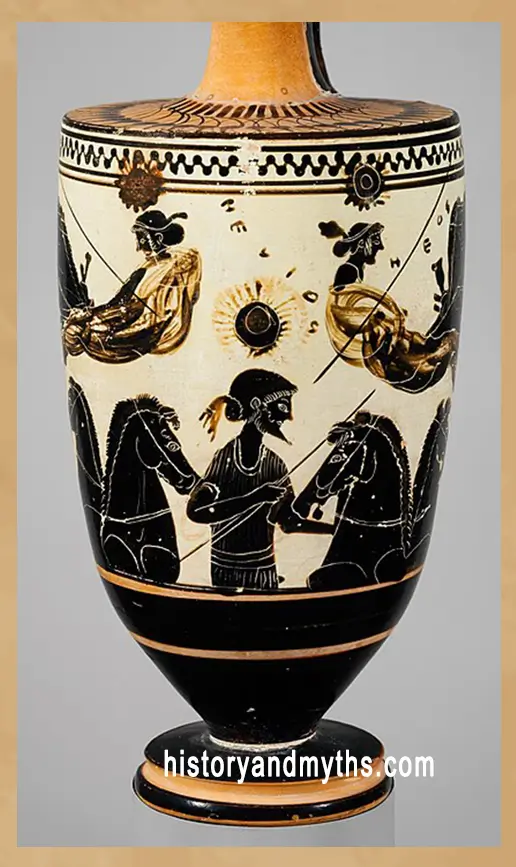
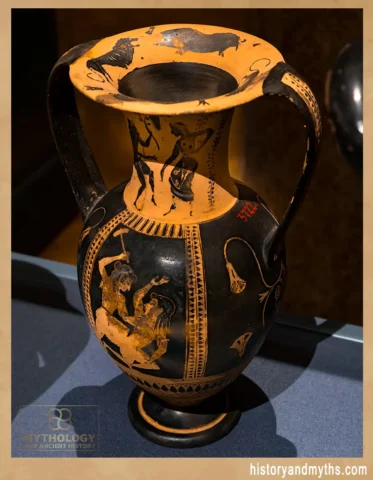
Sappho Painter, Terracotta Lekythos (Oil Flask), Attic black-figure, c. 500 BC. Metropolitan Museum of Art, New York (Accession No. 41.162.29). Open Access image courtesy of The Metropolitan Museum of Art. Public Domain (CC0 1.0).
Why Light and Darkness Became Powerful Symbols in Greek Mythology
Light and darkness became powerful symbols in Greek mythology because they represented two fundamental aspects of human experience: what can be seen and understood, and what remains hidden and uncertain. The Greeks lived in a world where daylight revealed landscapes, roads, communities, and signs from the gods, while darkness concealed dangers, obscured boundaries, and transformed familiar places into unknown territory. These everyday experiences naturally acquired symbolic meaning.
Greek myths extended this contrast beyond the physical world. Light came to represent clarity, awareness, divine presence, and the ability to perceive truth. Darkness, by contrast, symbolized mystery, hidden knowledge, primordial forces, and regions that existed beyond ordinary human perception. Neither symbol was inherently positive or negative. Both were essential elements of the cosmic order and reflected different dimensions of reality.
This symbolic framework also helped the Greeks explain the structure of the universe itself. The visible world occupied only part of existence. Beyond it lay unseen realms, ancient powers, and divine forces that could influence mortal life without being directly observed. By using light and darkness as symbolic languages, Greek mythology provided a way to understand the relationship between the known and the unknown, the human and the divine, and the limits of mortal knowledge.
Light and Darkness Symbolism in Greek Mythology
| Symbol | Meaning | Role in Greek Mythology |
|---|---|---|
| Light | Knowledge | Wisdom, clarity, divine insight, and the ability to understand reality. |
| Light | Revelation | The exposure of hidden truths, crimes, divine signs, and concealed realities. |
| Light | Cosmic Order | The visible, structured, and intelligible side of the universe. |
| Darkness | Mystery | The unknown, hidden knowledge, and forces beyond ordinary human perception. |
| Darkness | Primordial Power | Ancient cosmic forces that existed before the fully ordered world. |
| Darkness | Boundaries | The limits between life and death, mortals and gods, and the visible and invisible worlds. |
| Light and Darkness | Balance | The relationship between what humans can know and what remains concealed. |
Light as a Symbol of Knowledge and Divine Order
In Greek mythology, light often symbolized the ability to understand reality as it truly was. It represented clarity rather than mere brightness, making it a natural symbol for wisdom, prophecy, and divine knowledge. When myths associated certain gods with light, the connection was usually tied to insight, truth, and the power to reveal what was hidden from ordinary human perception.
Light also reflected the idea of cosmic order. The Greeks believed the universe operated according to an underlying structure established by divine forces. What existed within the light was visible, understandable, and part of that ordered world. This association made light a symbol of harmony, reason, and the proper balance of the cosmos.
For this reason, light frequently appeared in myths connected to revelation and guidance. It symbolized the moment when uncertainty gave way to understanding and when hidden truths became visible. Rather than representing simple goodness, light represented knowledge itself—the ability to see, comprehend, and recognize the order that governed both the human and divine worlds.
Light as a Symbol of Revelation and Truth
Beyond its association with knowledge, light symbolized the power to expose what was hidden. In Greek mythology, important truths often emerged when concealment ended and reality became visible. Because light made things seen, it naturally became a symbol of revelation, honesty, and discovery.
This symbolism appears in myths where secrets, crimes, broken oaths, or divine intentions are eventually brought into view. What was hidden could remain concealed for a time, but it rarely escaped exposure forever. The idea that nothing could stay hidden under the gaze of the divine helped connect light with truth and accountability.
As a result, light represented more than understanding. It symbolized disclosure itself—the moment when uncertainty was replaced by evidence and when hidden realities entered the visible world. For the Greeks, truth was not only something that could be known; it was something that could be brought into the light.
What Did Light and Darkness Mean in Greek Mythology?
In Greek mythology, light and darkness were not simple symbols of good and evil. Light represented knowledge, visibility, revelation, and cosmic order. Darkness represented mystery, hidden forces, primordial existence, and the limits of human understanding. Together, they helped explain the relationship between the visible world and the unseen powers that shaped the cosmos.
Darkness as a Symbol of Mystery and the Unknown
In Greek mythology, darkness was not simply the absence of light. It symbolized everything that existed beyond ordinary human knowledge. The unseen parts of the cosmos, the origins of creation, the world of dreams, and the forces that could not be fully explained were often associated with darkness.
This symbolism reflected the limits of human understanding. While light revealed what could be known, darkness marked the point where certainty ended. Many primordial beings and ancient cosmic powers were connected to darkness because they belonged to a reality that existed before the ordered world familiar to mortals.
For this reason, darkness was often treated with respect rather than fear alone. It represented mystery, hidden possibilities, and truths that remained beyond human reach. In Greek thought, not everything was meant to be fully seen or understood, and darkness became a symbol of that unknown dimension of existence.
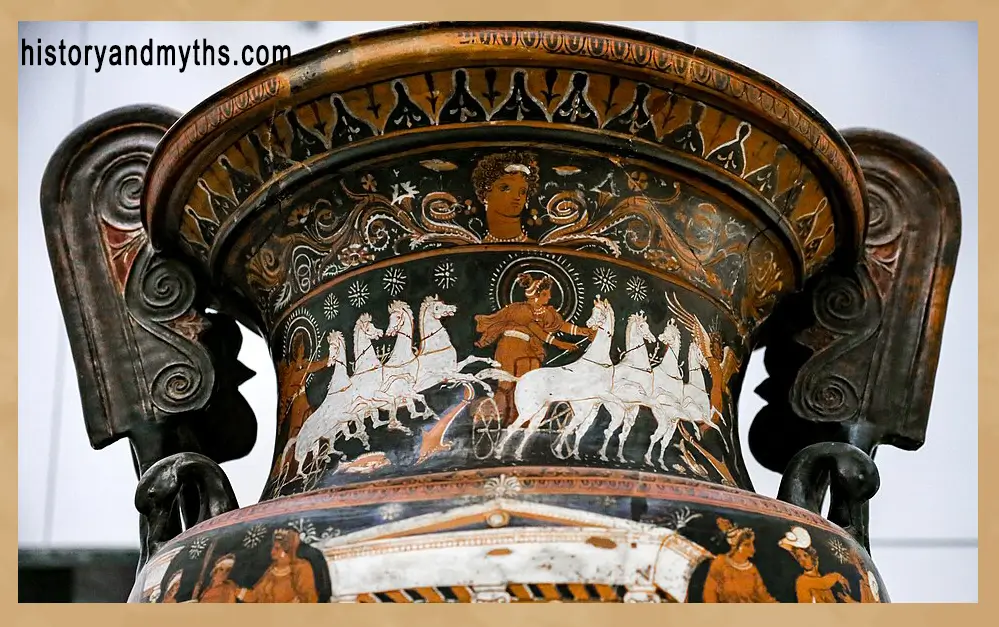
Underworld Painter, Apulian Red-Figure Volute-Krater, c. 330–320 BC. Staatliche Antikensammlungen, Munich (SH 3297 / J. 849). Photograph by ArchaiOptix. Licensed under CC BY-SA 4.0.
Continue Reading
- Fire Symbolism in Greek Mythology: Power, Knowledge, and Punishment
- Water Symbolism in Greek Mythology: Purification, Boundaries, and Divine Power
- Animal Symbolism in Greek Mythology: Wisdom, Power, and Divine Meaning
- Trees and Sacred Plants in Greek Mythology: Symbolism and Meaning
- The Cosmic Structure of Greek Mythology
- Divine Succession Myths in Greek Mythology
Darkness as a Symbol of Cosmic Boundaries
Greek mythology frequently placed darkness at the edges of the known universe. It was associated with regions that separated one realm from another, including the boundaries between the world of the living and the world of the dead, the mortal and divine spheres, and the ordered cosmos and its primordial origins.
Because of this connection, darkness symbolized transition and limitation. It marked places where ordinary rules no longer applied and where human knowledge became unreliable. Myths often located ancient powers, underworld passages, and primordial forces within dark or shadowed realms to emphasize their distance from everyday experience.
This symbolism reveals that darkness was not viewed merely as something hidden. It represented the frontier of existence itself—the point where the familiar world ended and deeper cosmic realities began. By placing important boundaries within darkness, Greek mythology expressed the idea that some parts of the universe remained beyond direct human access, even though they were essential to the structure of the cosmos.
What Light and Darkness Revealed About Greek Beliefs
The symbolism of light and darkness reveals that Greek mythology was less concerned with a struggle between good and evil than with understanding the nature of reality. Light represented what could be seen, understood, and brought into human awareness, while darkness represented what remained hidden, ancient, or beyond complete comprehension.
Together, these symbols reflected a worldview in which knowledge had limits and mystery was a permanent part of existence. The Greeks believed that humans could gain insight into the cosmos, but they could never fully master or understand every force that shaped it. Some truths could be revealed, while others remained concealed within realms beyond mortal reach.
This balance between revelation and mystery helps explain why both light and darkness held important places in Greek mythology. They were not opposing moral forces but complementary symbols that defined the boundaries of human knowledge and illustrated the relationship between the visible world and the deeper realities that lay beyond it.
In Greek mythology, light and darkness functioned as symbolic tools for interpreting the universe rather than simple descriptions of day and night. Light represented knowledge, revelation, and cosmic order, while darkness symbolized mystery, hidden forces, and the limits of human understanding. Together, they expressed a central Greek belief: the world contained both truths that could be discovered and realities that would always remain beyond human sight.
Key Takeaways
- Light symbolized knowledge, truth, revelation, and divine order.
- Darkness symbolized mystery, hidden forces, primordial power, and cosmic boundaries.
- Greek mythology did not reduce light and darkness to good versus evil.
- Light revealed what could be seen, understood, or judged.
- Darkness marked what remained hidden, ancient, or beyond mortal perception.
- Both symbols helped the Greeks explain the limits of human knowledge.
- Together, light and darkness expressed the balance between the known and unknown universe.
Frequently Asked Questions
What does light symbolize in Greek mythology?
Light in Greek mythology symbolizes knowledge, truth, revelation, divine insight, and cosmic order. It is often connected with the ability to see clearly, understand hidden realities, and recognize the structure of the universe.
What does darkness symbolize in Greek mythology?
Darkness symbolizes mystery, hidden forces, primordial existence, and the limits of human understanding. It often marks regions or powers that lie beyond ordinary human perception.
Did the Greeks see light as good and darkness as evil?
Not in a simple moral sense. Greek mythology usually treated light and darkness as complementary forces rather than absolute symbols of good and evil. Light revealed, while darkness concealed; both belonged to the cosmic order.
Why was light connected with divine knowledge?
Light was connected with divine knowledge because it made things visible and understandable. In mythic thought, seeing clearly often suggested insight, truth, prophecy, and the ability to recognize divine order.
Why was darkness important in Greek mythology?
Darkness was important because it represented the unknown side of existence. It was linked with primordial powers, unseen realms, dreams, death, and the boundaries between different parts of the cosmos.
How are light and darkness connected to the Greek cosmos?
Light and darkness helped explain the structure of the Greek cosmos. Light marked the visible and intelligible world, while darkness marked hidden regions, ancient powers, and realities beyond direct human access.
Which Greek gods are associated with light and darkness?
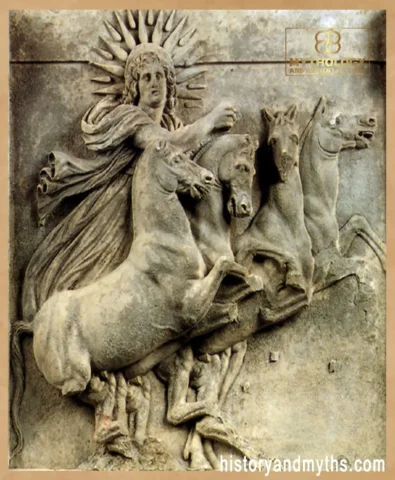
Several figures are associated with these symbols, including Apollo and Helios in relation to light, and Nyx and Erebus in relation to darkness. In symbolism, however, these figures are best understood as examples of broader cosmic ideas.
What is the main meaning of light and darkness symbolism in Greek mythology?
The main meaning is the balance between revelation and mystery. Greek mythology used light and darkness to explore what humans can know, what remains hidden, and how visible and invisible forces shape the world.
Sources and Rights
- Hesiod. Theogony. Translated by Glenn W. Most. Loeb Classical Library. Cambridge, MA: Harvard University Press, 2006.
- Hesiod. Works and Days. Translated by Glenn W. Most. Loeb Classical Library. Cambridge, MA: Harvard University Press, 2006.
- Homer. Iliad. Translated by A. T. Murray. Revised by William F. Wyatt. Loeb Classical Library. Cambridge, MA: Harvard University Press, 1999.
- Homer. Odyssey. Translated by A. T. Murray. Revised by George E. Dimock. Loeb Classical Library. Cambridge, MA: Harvard University Press, 1995.
- Homeric Hymn to Apollo. In Homeric Hymns. Translated by Martin L. West. Cambridge, MA: Harvard University Press, 2003.
- Homeric Hymn to Helios. In Homeric Hymns. Translated by Martin L. West. Cambridge, MA: Harvard University Press, 2003.
- Apollodorus. The Library of Greek Mythology. Translated by Robin Hard. Oxford: Oxford University Press, 1997.
- Pausanias. Description of Greece. Translated by W. H. S. Jones. Loeb Classical Library. Cambridge, MA: Harvard University Press, 1918–1935.
- Aeschylus. Prometheus Bound. Translated by Alan H. Sommerstein. Loeb Classical Library. Cambridge, MA: Harvard University Press, 2008.
- Aeschylus. Oresteia. Translated by Alan H. Sommerstein. Loeb Classical Library. Cambridge, MA: Harvard University Press, 2008.
- Sophocles. Oedipus the King. Translated by Hugh Lloyd-Jones. Loeb Classical Library. Cambridge, MA: Harvard University Press, 1994.
- Euripides. Bacchae. Translated by David Kovacs. Loeb Classical Library. Cambridge, MA: Harvard University Press, 2002.
- Orphic Hymn to Night. In The Orphic Hymns. Translated by Apostolos N. Athanassakis and Benjamin M. Wolkow. Baltimore: Johns Hopkins University Press, 2013.
- Orphic Hymn to the Sun. In The Orphic Hymns. Translated by Apostolos N. Athanassakis and Benjamin M. Wolkow. Baltimore: Johns Hopkins University Press, 2013.
- Burkert, Walter. Greek Religion. Translated by John Raffan. Cambridge, MA: Harvard University Press, 1985.
- Gantz, Timothy. Early Greek Myth: A Guide to Literary and Artistic Sources. Baltimore: Johns Hopkins University Press, 1993.
- Graf, Fritz. Greek Mythology: An Introduction. Translated by Thomas Marier. Baltimore: Johns Hopkins University Press, 1993.
- Buxton, Richard. The Complete World of Greek Mythology. London: Thames & Hudson, 2004.
- Johnston, Sarah Iles. Restless Dead: Encounters between the Living and the Dead in Ancient Greece. Berkeley: University of California Press, 1999.
- Vernant, Jean-Pierre. Myth and Thought among the Greeks. London: Routledge & Kegan Paul, 1983.
- Detienne, Marcel. The Masters of Truth in Archaic Greece. New York: Zone Books, 1996.
- Dowden, Ken. The Uses of Greek Mythology. London: Routledge, 1992.
- Hornblower, Simon, Antony Spawforth, and Esther Eidinow, eds. The Oxford Classical Dictionary. 4th ed. Oxford: Oxford University Press, 2012.
Written by H. Moses — All rights reserved © Mythology and History