Water Symbolism in Greek Mythology: Life, Purification, Boundaries
In Greek mythology, water is far more than a physical element. It appears at the beginning of the world, surrounds the boundaries of the cosmos, marks the entrance to the Underworld, and plays a role in rituals of purification and renewal. Wherever important transitions occur, water is often present, suggesting that the Greeks viewed it as a force connected to change, movement, and transformation.
This symbolic role helps explain why rivers, springs, seas, and cosmic waters appear so frequently in Greek myths. Water can sustain life, separate worlds, cleanse pollution, and define sacred boundaries. It is both a source of creation and a marker of limits, capable of connecting different realms while also keeping them apart.
By examining the symbolic meanings attached to water, a consistent pattern emerges. Greek mythology repeatedly uses water to represent transition—between life and death, purity and pollution, the mortal world and the divine. Understanding this symbolism reveals why water occupied such an important place in the Greek imagination and why it remained one of the most powerful recurring symbols throughout their myths.
Why Water Was Sacred in Greek Mythology
Water held a sacred status in Greek mythology because it was associated with both life and transition. Unlike many other natural elements, water constantly changes form and location. Rivers flow, springs emerge from hidden places, and seas connect distant lands. This sense of movement made water an ideal symbol for processes that involved change, passage, or transformation.
Its sacred character also came from its connection to survival. Every community depended on reliable sources of water, making rivers, springs, and fountains essential parts of daily life. Greek mythology reflected this dependence by treating many bodies of water as divine beings or as places connected to gods, nymphs, and supernatural forces.
Water also occupied an important place in religious practice. Before entering sacred spaces or performing rituals, purification was often required. Water served as a means of removing ritual pollution and restoring a state of order. In this role, it symbolized renewal rather than simple cleanliness.
Another reason for its sacred status was its presence at important boundaries. Mythological rivers separated worlds, marked transitions, and defined spaces that ordinary people could not cross freely. Water frequently appeared where one condition ended and another began, reinforcing its symbolic connection to change.
For the Greeks, water was therefore much more than a physical necessity. It represented movement, purification, renewal, and the crossing of boundaries, making it one of the most meaningful and versatile symbols in Greek mythology.
| Symbolic Meaning | How Water Functions | Mythological Example |
|---|---|---|
| Source of Life | Creation, fertility, continuity | Oceanus |
| Boundary | Separates worlds and realms | Styx, Acheron |
| Purification | Removes ritual pollution | Sacred springs and rites |
| Transformation | Represents change and renewal | Flowing rivers and cosmic waters |
| Oaths and Order | Guarantees divine promises | River Styx |
Water as the Source of Life
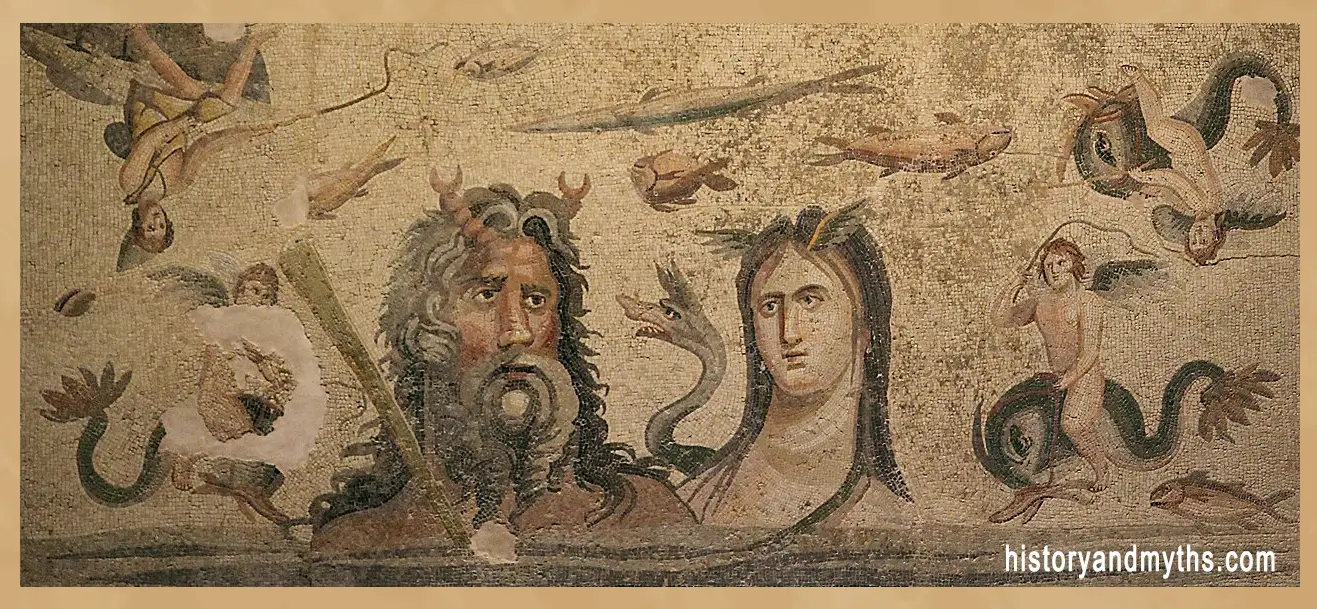
One of the oldest symbolic meanings of water in Greek mythology is its association with origin and creation. Long before water became linked to purification or boundaries, it was connected to the idea that life emerges from a primordial and life-giving source. This belief appears most clearly in the figure of Oceanus, the vast cosmic river that was imagined as surrounding the known world.
Oceanus was not simply a sea god in the later sense. He represented the immense waters believed to exist at the edges of the cosmos. From these waters came rivers, springs, and countless forms of life. The symbolism is clear: water serves as the foundation from which the living world develops and continues to exist.
This connection between water and creation reflects an observation shared by many ancient cultures. Life depends on water, and places rich in water support growth, fertility, and survival. Greek mythology transformed this practical reality into a symbolic principle, presenting water as a force that sustains existence itself.
The importance of water as a life-giving power also explains why many rivers and springs were treated as divine beings. They were not merely parts of the landscape but active sources of vitality. Their presence supported communities, agriculture, and travel, making them natural symbols of abundance and continuity.
For the Greeks, water represented more than physical nourishment. It symbolized the ongoing flow of life from its origins to the present, linking the natural world to a deeper mythological vision of creation, fertility, and renewal.
Water as a Boundary Between Worlds
In Greek mythology, water often appears where different realms meet. Rivers, seas, and surrounding cosmic waters frequently mark the edges of known spaces, separating one state of existence from another. Because of this role, water became one of the most important symbols of boundaries in the Greek mythological imagination.
The clearest examples appear in the rivers associated with the Underworld. These waters do not simply provide routes of travel; they define the transition between life and death. Crossing them means leaving one condition behind and entering another. The river itself becomes a symbolic threshold rather than a geographical feature.
This idea extends beyond the Underworld. Oceanus was imagined as encircling the inhabited world, creating a boundary between the familiar human realm and the unknown regions beyond. Water repeatedly appears at the limits of the cosmos, reinforcing its association with separation and transition.
The symbolism works because water is both a connector and a divider. Rivers can link distant places, yet they can also prevent movement. Seas allow travel but simultaneously create obstacles and isolation. Greek mythology embraced this dual nature, using water to represent spaces that can be crossed but never ignored.
For the Greeks, water marked moments of passage. Whether separating worlds, defining sacred spaces, or distinguishing one stage of existence from another, it symbolized the boundaries that structure the cosmos and the transitions required to move beyond them.
Water and Ritual Purification
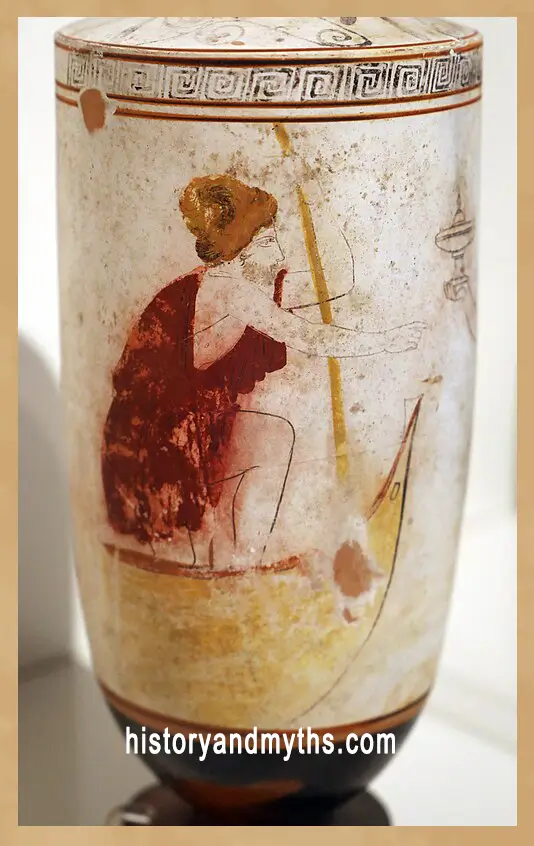
Water became a powerful symbol of purification in Greek mythology because it was associated with renewal and the restoration of order. In religious thought, certain actions, deaths, or violations could create ritual pollution, a condition that separated individuals from sacred spaces and divine favor. Water was frequently used as the means of removing this impurity.
The symbolic importance of purification extends beyond physical washing. Greek rituals treated water as a force capable of marking a transition from one state to another. After purification, a person was no longer considered spiritually contaminated and could once again participate in religious activities. Water therefore represented restoration rather than cleanliness alone.
This role reflects a broader mythological pattern. Water often appears at moments when change is required. Just as rivers separate different worlds, purification rites separate a previous condition from a new one. The act of washing symbolically leaves something behind and prepares the individual for a different stage or status.
Sacred springs and fountains became particularly important because they embodied this idea of renewal. Their flowing water suggested continuity, regeneration, and the possibility of beginning again. In mythological symbolism, moving water was especially effective because it carried away what no longer belonged.
For the Greeks, water purified because it represented transformation. It provided a symbolic means of crossing from disorder to order, impurity to purity, and exclusion to participation within the sacred world.
Water Meant Transition
In Greek mythology, water rarely functions as a simple landscape feature. Rivers, seas, springs, and cosmic waters repeatedly appear at moments of change. Water creates life, separates worlds, purifies pollution, and marks the boundaries between different states of existence. More than any individual river or deity, water symbolizes transition itself.
© historyandmyths.com — Educational Use
Water as Change and Transformation
Few natural elements express change as effectively as water. It flows, shifts course, takes different forms, and never remains completely still. Greek mythology frequently draws upon these qualities, using water as a symbol of transformation and the constant movement from one state of existence to another.
This symbolism appears in myths where important transitions take place near rivers, springs, or the sea. Water often accompanies moments of departure, renewal, rebirth, or passage into unfamiliar conditions. Its presence signals that change is occurring, even when the transformation itself is not directly caused by the water.
Unlike stone or earth, which suggest permanence and stability, water represents fluidity. It adapts to its surroundings while remaining fundamentally unchanged. This dual nature made it a powerful metaphor for personal and cosmic transformation. Individuals, societies, and even worlds could change while preserving an underlying continuity.
The association between water and transformation also reflects its role in nature. Seasonal floods, flowing rivers, and changing coastlines continually reshape the landscape. Greek mythology transformed these observations into symbolic ideas about growth, transition, and the passage of time.
For the Greeks, water represented more than movement. It symbolized the reality that life itself is defined by change. Whether marking a new beginning, a spiritual transition, or a shift between different realms, water served as one of mythology’s most enduring symbols of transformation.
Continue Reading
Sacred Rivers and Divine Oaths
Among the many symbolic roles of water in Greek mythology, one of the most distinctive is its connection to truth, obligation, and divine authority. This idea appears most clearly in the sacred rivers associated with oaths, where water functions not as a physical barrier but as a witness to promises that cannot be broken without consequences.
The most famous example is the river Styx. Unlike other mythological rivers known primarily for their connection to the Underworld, Styx also served a unique role in the divine order. The gods themselves swore their most binding oaths by its waters. Breaking such an oath carried severe penalties, emphasizing the river’s extraordinary authority.
This symbolism reflects a broader belief that water represents permanence beneath constant movement. Rivers flow continuously, yet they maintain their identity across time. As a result, they became powerful symbols of continuity, reliability, and the enduring force of agreements. Water could therefore serve as a natural witness to promises intended to outlast individual actions or desires.
The association between sacred rivers and oaths also reinforces the recurring connection between water and boundaries. An oath establishes a line that should not be crossed, just as a river can define the limits of a territory or realm. In both cases, water symbolizes the existence of rules that structure relationships and maintain order.
For the Greeks, sacred rivers represented more than geographical features or routes to the Underworld. They embodied trust, obligation, and the authority of the cosmic order itself, making water a symbol not only of change and transition but also of stability and commitment.
Why Water Appears at the Edges of the Greek Cosmos
A recurring pattern in Greek mythology is the placement of water at the boundaries of the known world. Oceanus surrounds the inhabited earth, rivers separate the realms of the living and the dead, and sacred waters often appear at points of transition between different states of existence. This repetition is not accidental. It reflects a deeper symbolic understanding of what water represented.
Water occupies a unique position because it is neither completely stable nor entirely chaotic. It has form but constantly changes. It can connect distant places while simultaneously separating them. These qualities made it an ideal symbol for the limits of the cosmos, where one realm ends and another begins.
The Greeks often imagined important boundaries not as walls but as zones of passage. Water suited this concept perfectly. Crossing a river, sailing beyond familiar shores, or approaching the waters that encircled the world all symbolized movement into something unknown. Water therefore marked the threshold between certainty and mystery.
This symbolism also unifies many of the roles explored throughout Greek mythology. Water gives life, purifies, transforms, and defines borders because all of these functions involve transition. Whether a person moves from impurity to purity, from life to death, or from one stage of existence to another, water frequently serves as the medium through which that change occurs.
For this reason, water became one of the most powerful symbolic elements in Greek mythology. More than any specific river or deity, it represented the idea of passage itself—the movement between worlds, conditions, and possibilities that shaped both the cosmos and human experience.
Water occupies a central place in Greek mythology because it symbolizes far more than a natural resource. Across myths, rituals, and cosmological traditions, it represents life, purification, transformation, boundaries, and transition. Its recurring presence reflects the Greek belief that movement from one state to another is a fundamental part of both the human experience and the structure of the universe.
The symbolic roles of Oceanus, sacred rivers, purification rites, and boundary waters all point toward a common theme. Water appears wherever change occurs. It marks the passage between worlds, removes ritual pollution, sustains life, and defines the limits of the known cosmos. In each case, its meaning extends beyond its physical form.
Understanding water symbolism therefore reveals an important aspect of Greek mythological thought. Water was not simply something that existed within the world. It was a force that connected, separated, renewed, and transformed. More than any individual river or sea, it represented the continuous movement between beginnings and endings that lies at the heart of Greek mythology.
Key Takeaways
- Water symbolized life, renewal, and creation in Greek mythology.
- Oceanus represented the primordial waters surrounding the cosmos.
- Mythological rivers often marked boundaries between different worlds.
- Water played an important role in purification and religious rituals.
- Flowing water symbolized change, movement, and transformation.
- The River Styx connected water with divine oaths and cosmic order.
- Water repeatedly appeared at transitions between life, death, purity, and renewal.
Frequently Asked Questions
What does water symbolize in Greek mythology?
Water symbolizes life, purification, transformation, boundaries, renewal, and passage between different states of existence.
Why was water considered sacred in Greek mythology?
Water was associated with creation, religious purification, divine beings, and important cosmic boundaries.
Who was Oceanus in Greek mythology?
Oceanus was the Titan associated with the great cosmic river believed to surround the inhabited world.
Why are rivers important in Greek mythology?
Rivers often function as sacred boundaries, especially between the world of the living and the Underworld.
What role did water play in purification rituals?
Water symbolically removed ritual pollution and restored a person to a purified state.
Why did the gods swear oaths by the River Styx?
Because Styx represented an unbreakable divine boundary and carried exceptional authority within the cosmic order.
How does water symbolize transformation?
Its constant movement and changing forms made it a natural symbol of renewal, change, and transition.
What is the main symbolic meaning of water in Greek mythology?
The most consistent symbolic meaning of water is transition—the movement between different worlds, conditions, and stages of existence.
Sources & Rights
- Hesiod. Theogony.
- Homer. Iliad.
- Homer. Odyssey.
- Apollodorus. Bibliotheca.
- Pausanias. Description of Greece.
- Ovid. Metamorphoses.
- Walter Burkert. Greek Religion.
- Richard Buxton. The Complete World of Greek Mythology.
- Robin Hard. The Routledge Handbook of Greek Mythology.
- Sarah Iles Johnston. Ancient Greek Religion.
- Timothy Gantz. Early Greek Myth.
- Fritz Graf. Greek Mythology.
- Jennifer Larson. Greek Nymphs: Myth, Cult, Lore.
- Oxford Classical Dictionary. Entries on Oceanus, Styx, Rivers, and Greek Religion.
- Jean-Pierre Vernant. Myth and Thought Among the Greeks.
Written by H. Moses — All rights reserved © Mythology and History