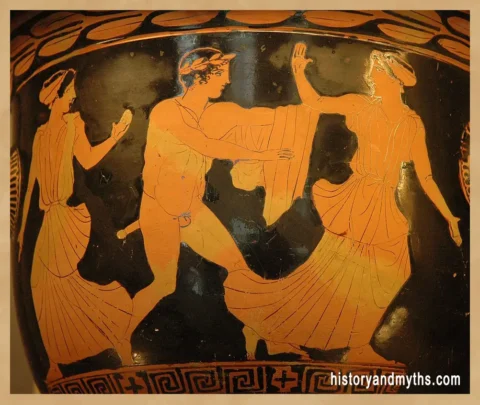
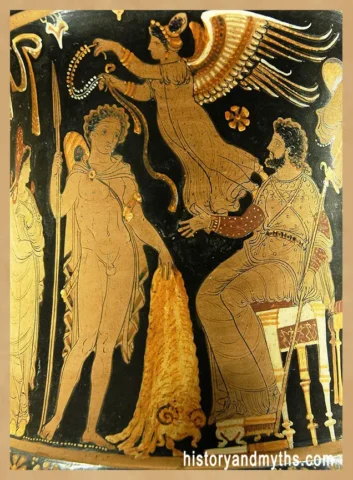
Delphi: Why the Greeks Called It the Center of the World
Delphi was far more than a sanctuary, an oracle, or a religious city. In Greek mythology, it was believed to occupy the very center of the world itself. According to ancient tradition, Zeus determined this sacred location by releasing two eagles from opposite ends of the earth. Their paths crossed at Delphi, marking the point where the world’s spiritual and cosmic balance converged.
This belief transformed Delphi into something unique within the Greek imagination. It was not simply a place where people sought prophecy. It became a symbolic center connecting gods, mortals, and the wider structure of the universe. At its heart stood the famous Omphalos, or “navel stone,” which represented Delphi’s status as the world’s sacred midpoint.
Understanding Delphi therefore requires looking beyond the oracle that made it famous. The site reveals how the Greeks imagined sacred geography, how they organized the world through myth, and why certain places were believed to hold a special position within the cosmic order. Delphi was not merely a destination on a map—it was a place where mythology gave meaning to space itself.
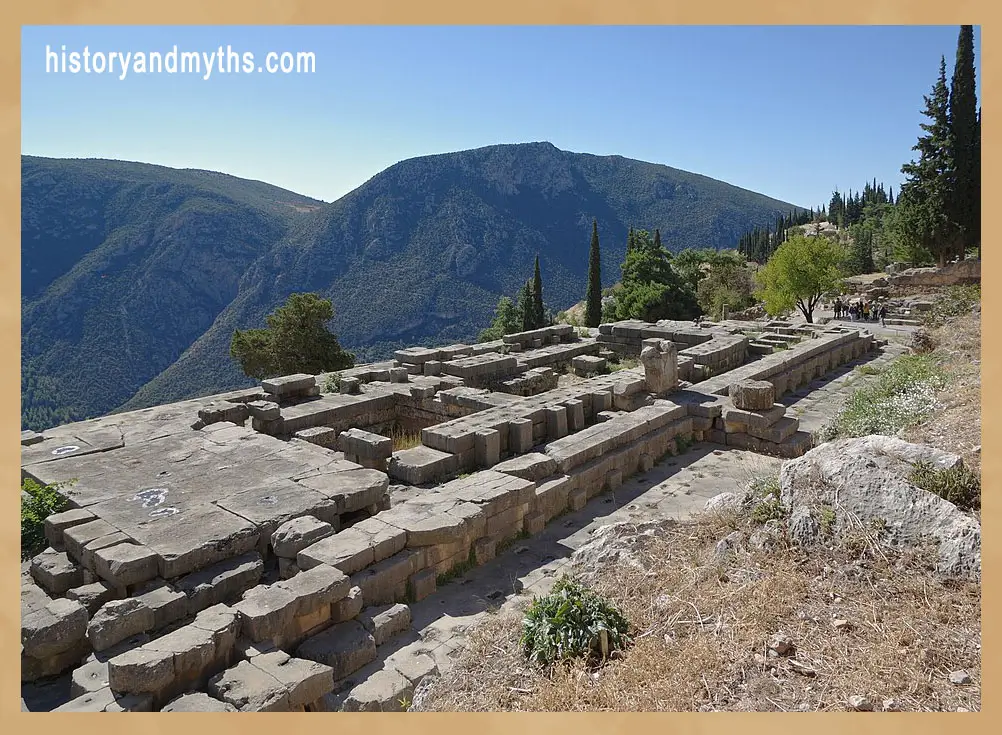
Why the Greeks Needed a Center of the World
The idea that Delphi stood at the center of the world was not a geographical claim in the modern sense. The Greeks were not trying to calculate the physical midpoint of the earth. Instead, they were expressing a deeper belief about order, meaning, and the relationship between humanity and the divine.
Ancient societies often organized the world around sacred centers. These locations served as symbolic points where communication between mortals and gods seemed most direct. By identifying a center, a culture could transform an otherwise vast and uncertain world into a meaningful and structured space.
For the Greeks, Delphi fulfilled this role. It was a place where divine knowledge could be sought, where major decisions were legitimized, and where communities from different regions interacted through shared religious traditions. Its significance came not from political power or military strength but from the belief that it occupied a uniquely sacred position within the cosmic order.
This idea also helped unify the Greek world. Independent city-states often disagreed with one another, yet many recognized Delphi’s special status. The concept of a common sacred center created a point of connection that transcended local identities and regional rivalries.
When the Greeks called Delphi the center of the world, they were therefore describing more than a location. They were identifying a place where religion, mythology, and collective identity converged. The center mattered because it provided a symbolic anchor for how the world itself was understood.
| Concept | Meaning | Connection to Delphi |
|---|---|---|
| Zeus’s Eagles | Mythical measurement of the world | Established Delphi as the world’s center |
| Omphalos | The “navel” of the world | Physical symbol of Delphi’s cosmic status |
| Apollo | God of prophecy and order | Made Delphi a sacred point of divine contact |
| Sacred Geography | Religious meaning attached to places | Placed Delphi at the heart of the Greek sacred landscape |
| Cosmic Center | Symbolic center of the universe | Defined Delphi’s unique role in mythology |
The Myth of Zeus’s Two Eagles
The belief that Delphi marked the center of the world was supported by one of the most famous geographical myths in Greek tradition. According to the story, Zeus released two eagles from opposite ends of the earth and instructed them to fly toward one another. The point where they met would reveal the world’s true center.
Their paths eventually crossed above Delphi. This meeting was interpreted as a divine confirmation that the sanctuary occupied a unique position within the cosmic order. The myth did not attempt to prove Delphi’s importance through political influence or historical events. Instead, it grounded the site’s status in the direct action of the king of the gods.
The choice of eagles was significant. In Greek symbolism, the eagle was closely associated with Zeus and represented divine authority. By using his sacred birds to determine the world’s center, Zeus himself became the source of Delphi’s legitimacy. The location was not chosen by priests or rulers; it was revealed through a mythological act of cosmic measurement.
What makes the story especially important is that it transformed geography into sacred meaning. The center of the world was not defined by distance or mathematics. It was defined by divine recognition. Delphi became important because mythology declared it to be the place where the structure of the world was symbolically anchored.
For ancient Greeks, the myth of the two eagles provided a simple explanation for an extraordinary claim. It connected Delphi’s sacred status directly to Zeus and reinforced the idea that the sanctuary occupied a position unlike any other place in the Greek world.
The Omphalos: The Navel of the World
At the heart of Delphi stood one of the most important sacred objects in Greek religion: the Omphalos. The word means “navel,” and the stone was believed to mark the exact point where the world’s spiritual center was located. More than any myth or story, the Omphalos gave physical form to the idea that Delphi occupied a unique place within the cosmos.
The stone served as a visible reminder of the tradition connected to Zeus’s two eagles. If the birds identified Delphi as the center of the world, the Omphalos marked the precise location where that center could be recognized. Pilgrims visiting the sanctuary encountered not only an oracle but also a symbol of cosmic order itself.
Its significance extended beyond geography. In many ancient cultures, the navel symbolized origin, connection, and life. By describing Delphi as the world’s navel, the Greeks implied that the sanctuary functioned as a point linking different realms—human and divine, local and universal, earthly and sacred.
The Omphalos also reinforced Delphi’s authority without relying on political power. The sanctuary’s influence came partly from the belief that it occupied a privileged position within the structure of the world. The stone transformed that belief into something tangible that visitors could see and contemplate.
For this reason, the Omphalos became one of the most recognizable symbols of Greek sacred geography. It represented more than a sacred object. It embodied the idea that certain places possess a significance that extends beyond their physical location, shaping how an entire civilization understands the world around it.
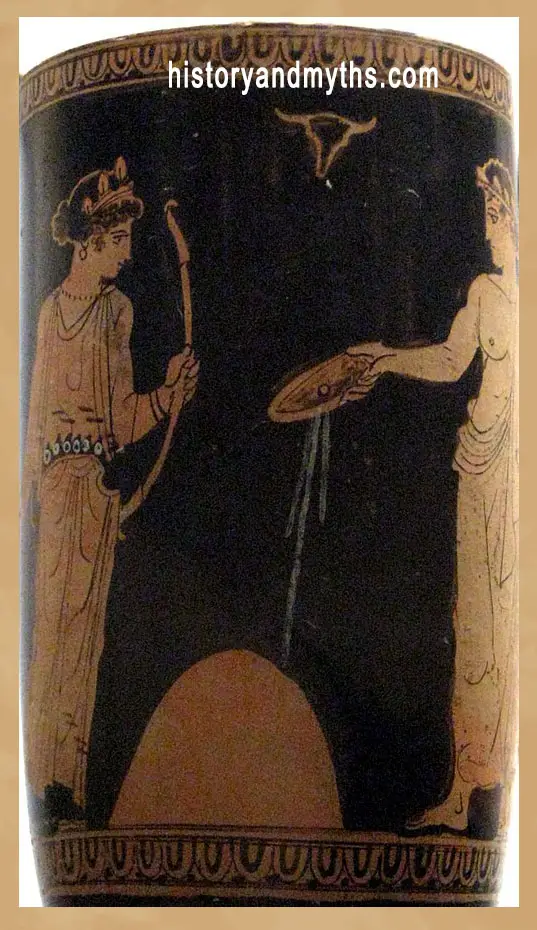
Delphi as the Cosmic Center of Greek Mythology
Delphi’s importance in Greek mythology cannot be explained solely through its oracle, temples, or religious ceremonies. What made the sanctuary exceptional was the belief that it occupied a central position within the structure of the cosmos itself. The site was imagined as a point where divine order became visible within the human world.
This role placed Delphi in a category different from most sacred locations. Many sanctuaries were associated with specific gods, local traditions, or regional communities. Delphi was understood as having significance that extended beyond any single city or cult. Its authority rested on the idea that it belonged to the entire Greek world.
The concept of a cosmic center also shaped how people interpreted the sanctuary’s functions. Pilgrims did not travel there simply to receive information about the future. They came to a place believed to stand closer to the divine order governing the universe. Seeking guidance at Delphi therefore carried a symbolic meaning that went beyond prophecy.
This broader role explains why Delphi remained influential for centuries. Its prestige did not depend entirely on political alliances, military power, or economic resources. Instead, it was sustained by a mythological framework that positioned the sanctuary at the heart of the world’s sacred structure.
In Greek mythology, Delphi represented more than a location where gods and mortals communicated. It symbolized the idea that the universe possessed an underlying order and that certain places allowed human beings to approach that order more closely than others. This belief transformed Delphi from a sanctuary into one of the most important sacred spaces in the Greek imagination.
Why Delphi Was Called the Center of the World
In Greek mythology, Delphi was believed to occupy the world’s sacred midpoint. This idea originated from the myth of Zeus’s two eagles and was symbolized by the famous Omphalos stone. More than a religious sanctuary, Delphi became a place where mythology, geography, and divine order converged, giving it a unique position within the Greek imagination.
© historyandmyths.com — Educational Use
Sacred Geography and the Greek View of Space
The Greeks did not view space as purely physical. Mountains, islands, rivers, and sanctuaries often carried religious meaning that shaped how people understood the world. Geography was not just a matter of distance; it was also a matter of sacred significance.
Within this framework, Delphi functioned as more than a city on a map. It became a symbolic center that organized the surrounding landscape. Routes of pilgrimage, religious festivals, political consultations, and mythological traditions all converged there, reinforcing the sense that the sanctuary occupied a special position within Greek space.
This way of thinking appears throughout Greek mythology. Olympus represented the realm of the gods, Elysium represented a blessed destination beyond ordinary life, and Hyperborea marked a sacred frontier beyond the known world. Delphi added another dimension by serving as a center rather than an edge. It anchored the sacred landscape instead of lying beyond it.
The idea also had practical consequences. Because many Greek communities recognized Delphi’s importance, the sanctuary became a meeting point where regional identities could interact within a shared religious framework. Sacred geography helped create connections that were stronger than simple political boundaries.
Understanding Delphi through sacred geography therefore reveals why the site mattered so deeply. Its significance was not limited to the oracle. The sanctuary became part of a larger mental map in which certain places carried extraordinary meaning and helped define how the Greeks imagined the structure of their world.
Delphi vs Olympus: Two Different Sacred Centers
At first glance, Delphi and Olympus might appear to serve similar roles because both occupy central positions within Greek religious thought. In reality, they represent two very different kinds of sacred space.
Olympus was the home of the gods. It existed above the human world and functioned as the divine center of power. Major decisions among the Olympian deities took place there, and the mountain symbolized the authority of the gods over the cosmos. For most mortals, Olympus remained distant and inaccessible.
Delphi occupied a different position. Rather than serving as the center of divine government, it acted as the point where humans could approach sacred knowledge. It was a place of communication rather than residence. The gods lived on Olympus, but people traveled to Delphi seeking guidance, legitimacy, and connection to the divine order.
This distinction reflects two complementary ideas within Greek mythology. Olympus represented the source of divine authority, while Delphi represented access to that authority. One belonged primarily to the gods; the other existed within the human world as a bridge between mortal and divine realms.
The comparison also highlights why Delphi became so influential. It offered something Olympus could not: direct participation. Pilgrims could visit Delphi, consult the sanctuary, see the Omphalos, and engage with the sacred traditions associated with the site. The cosmic center was not merely imagined—it could be experienced.
For this reason, Delphi and Olympus should not be viewed as competing centers. Together they formed different parts of the same sacred landscape. Olympus embodied where divine power resided, while Delphi embodied where that power could be approached and understood.
Why Delphi Became More Than a Religious Sanctuary
Many sanctuaries in the Greek world were dedicated to important gods, attracted pilgrims, and hosted religious festivals. Delphi became something more. Its influence expanded beyond worship because the site acquired a reputation as a place where sacred authority, collective identity, and cosmic meaning converged.
Part of this transformation came from the belief that Delphi occupied the center of the world. A sanctuary associated with such a claim naturally gained significance beyond local religious practice. Visiting Delphi meant entering a place that many Greeks regarded as central to the structure of the universe itself.
The sanctuary also benefited from its panhellenic character. Unlike religious sites tied primarily to a single city-state, Delphi belonged symbolically to the wider Greek world. Communities that competed politically could still recognize the prestige of the sanctuary. This broad acceptance strengthened its position as a shared sacred landmark.
Equally important was the accumulation of myths, monuments, offerings, and traditions surrounding the site. Over generations, Delphi became a repository of cultural memory. People did not visit solely for a prophecy or a ritual. They encountered a place layered with stories that reinforced its reputation as one of the most meaningful locations in Greek civilization.
As a result, Delphi evolved beyond the role of a religious sanctuary. It became a symbolic center where mythology, religion, identity, and geography intersected. This combination explains why the site retained its influence for centuries and why it remains one of the most famous sacred places of the ancient world.
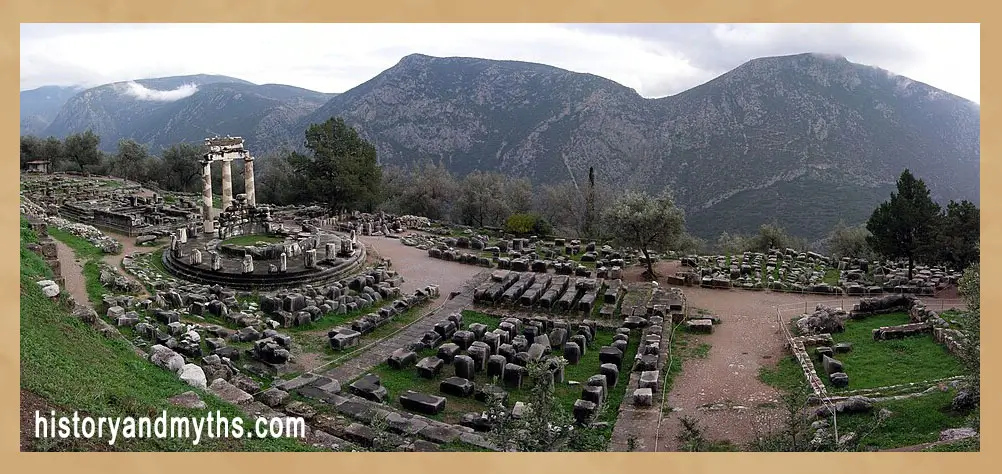
Why the Idea of a World Center Appears Across Cultures
The belief that Delphi marked the center of the world was not unique to Greece. Many civilizations developed traditions about sacred centers that connected their communities to a larger cosmic order. These locations often functioned as symbolic points where heaven, earth, and human society were believed to meet.
Such ideas emerge because people naturally seek orientation within a vast and often uncertain world. Identifying a sacred center provides a sense of order. It creates a focal point around which religious beliefs, cultural identity, and collective memory can be organized.
The Greek version of this idea took the form of Delphi and the Omphalos. Other cultures developed different sacred centers, but the underlying purpose was similar. These places helped transform geography into meaning, allowing societies to see themselves as part of a structured and purposeful universe.
What makes Delphi particularly interesting is the way mythology supported this concept. The story of Zeus’s eagles, the symbolism of the Omphalos, and the sanctuary’s reputation all worked together to reinforce the belief that the world’s center could be identified and experienced.
Seen from this perspective, Delphi was part of a broader human pattern. Its significance reveals not only how the Greeks understood their world but also how many cultures have used sacred geography to explain humanity’s place within the cosmos.
Delphi’s importance in Greek mythology extends far beyond its famous oracle. The sanctuary became one of the most influential places in the ancient world because it was believed to occupy the center of the cosmos itself. Through the myth of Zeus’s eagles, the symbolism of the Omphalos, and its role within Greek sacred geography, Delphi acquired a significance that transcended ordinary religious practice.
Rather than serving merely as a destination for prophecy, the site functioned as a symbolic anchor for how the Greeks understood space, order, and the relationship between mortals and the divine. It connected local worship to a larger vision of the universe and transformed geography into sacred meaning.
For this reason, Delphi was not simply a city, a sanctuary, or an oracle. It was a mythological center—a place where the Greeks imagined the structure of the world becoming visible. That idea explains why Delphi remained one of the most revered locations in Greek civilization and why it continues to fascinate scholars, historians, and readers today.
Key Takeaways
- Delphi was believed to be the center of the world in Greek mythology.
- The myth of Zeus’s two eagles explained how this sacred center was identified.
- The Omphalos stone symbolized Delphi’s status as the world’s navel.
- Delphi served as a cosmic center rather than merely a religious sanctuary.
- The site played a central role in Greek sacred geography.
- Its importance extended beyond prophecy and religious consultation.
- Delphi and Olympus represented different kinds of sacred centers.
- The concept reflects a broader human tendency to imagine sacred centers of the world.
Frequently Asked Questions
Why was Delphi considered the center of the world?
Greek mythology claimed that Zeus released two eagles from opposite ends of the earth and that they met at Delphi, revealing the world’s sacred center.
What is the Omphalos?
The Omphalos was a sacred stone at Delphi believed to mark the navel, or center, of the world.
Who was the main god associated with Delphi?
Apollo was the principal deity of Delphi and the god whose sanctuary dominated the site.
Was Delphi only important because of its oracle?
No. The sanctuary also held significance as a cosmic center and one of the most important locations in Greek sacred geography.
What is the myth of Zeus’s two eagles?
According to tradition, Zeus sent two eagles from opposite ends of the world, and their meeting point identified Delphi as the center of the earth.
How is Delphi different from Mount Olympus?
Olympus was the home of the gods, while Delphi served as a place where humans could approach divine knowledge and sacred order.
What does Delphi reveal about Greek mythology?
It demonstrates how the Greeks connected geography, religion, and cosmic order through sacred places.
Is the Omphalos stone still preserved?
Ancient examples of Omphalos stones survive, and one of the most famous is displayed in the Archaeological Museum of Delphi.
Sources & Rights
- Pausanias. Description of Greece.
- Herodotus. Histories.
- Strabo. Geographica.
- Plutarch. Moralia: The Oracles at Delphi.
- Diodorus Siculus. Library of History.
- Homeric Hymn to Apollo.
- Walter Burkert. Greek Religion.
- Joseph Fontenrose. Python: A Study of Delphic Myth and Its Origins.
- Michael Scott. Delphi: A History of the Center of the Ancient World.
- Robin Lane Fox. Travelling Heroes.
- Sarah Iles Johnston. Ancient Greek Religion.
- Jennifer Larson. Greek Nymphs: Myth, Cult, Lore.
- Fritz Graf. Greek Mythology.
- Richard Buxton. The Complete World of Greek Mythology.
- Emma Griffiths. Greek Myth: A Very Short Introduction.
- Timothy Gantz. Early Greek Myth.
- Robert Parker. On Greek Religion.
- H.W. Parke. A History of the Delphic Oracle.
- Edith Hall. Introducing the Ancient Greeks.
- Robin Hard. The Routledge Handbook of Greek Mythology.
Written by H. Moses — All rights reserved © Mythology and History