Hyperborea: The Lost Land Beyond the North Wind in Greek Mythology
Hyperborea was one of the most mysterious places in Greek mythology. Located beyond the realm of the North Wind, far outside the boundaries of the known world, it was described as a land of extraordinary happiness where suffering, disease, and old age did not exist. Unlike many famous mythological locations, however, Hyperborea was not part of the Underworld and was not reserved for the dead. It was imagined as a distant paradise that existed somewhere beyond ordinary human reach.
Ancient Greek writers associated Hyperborea with Apollo, divine favor, and a way of life untouched by the hardships that defined the human condition. Because of its remote location, the land occupied a unique place in the Greek imagination. It stood at the edge of geography, where real landscapes gradually gave way to myth, speculation, and sacred tradition.
For this reason, Hyperborea is more than a lost mythical land. It offers insight into how the Greeks imagined perfection, how they mapped sacred places onto the world around them, and why some of their most enduring myths were located beyond the limits of known reality. Understanding Hyperborea means exploring not only a legendary paradise but also the broader relationship between geography, religion, and imagination in Greek mythology.
What Was Hyperborea in Greek Mythology?
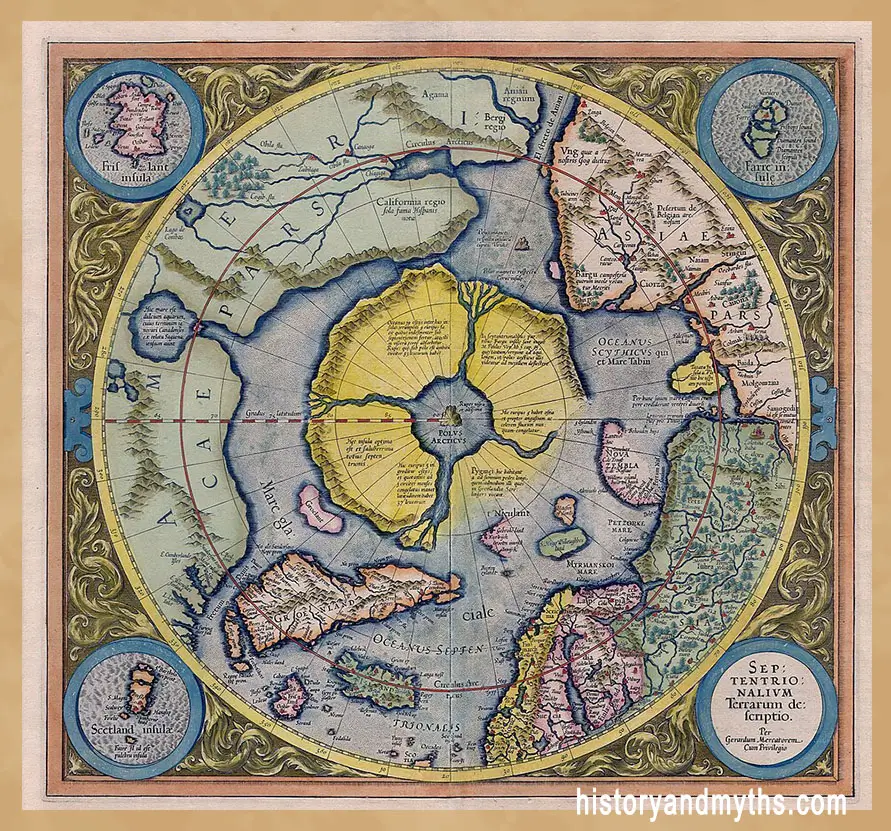
Hyperborea was a legendary land believed to exist beyond Boreas, the North Wind. Ancient Greek writers described it as a remote region located far beyond the northern limits of the known world, in a place so distant that ordinary travel could not reach it. Unlike cities, kingdoms, or islands that appeared on Greek maps, Hyperborea occupied a space where geography and mythology merged.
The inhabitants of this land, known as the Hyperboreans, were portrayed as exceptionally fortunate. They lived free from many of the hardships that shaped normal human life. Disease, warfare, and extreme suffering rarely appear in descriptions of their society. Instead, ancient sources emphasize harmony, celebration, music, and a close relationship with the gods.
What makes Hyperborea unusual is that it was not an afterlife destination. The Greeks already had places such as Elysium for blessed souls after death. Hyperborea belonged to the living world, at least in theory. It was imagined as a real place located somewhere beyond human reach rather than a realm entered after mortality ended.
The land also occupied a unique position within Greek thought because it existed at the edge of knowledge. Ancient authors could describe its people and customs, yet few claimed direct knowledge of its location. This uncertainty allowed Hyperborea to function both as a geographical mystery and as a symbolic vision of an ideal society.
For Greek audiences, Hyperborea represented more than a distant northern region. It embodied the possibility that somewhere beyond the familiar world there existed a place untouched by many of the limitations and struggles that defined ordinary human existence.
| Aspect | Hyperborea | Significance |
|---|---|---|
| Location | Beyond the North Wind (Boreas) | Marks the edge of the known world |
| People | The Hyperboreans | A blessed population living in harmony |
| Associated God | Apollo | Links the land to Greek religion and prophecy |
| Type of Place | Sacred Geography | Not an afterlife realm |
| Symbolism | Perfection beyond reach | Represents the ideal world imagined by the Greeks |
Why the Greeks Imagined a Perfect Land Beyond the North Wind
Hyperborea reveals something important about the Greek imagination. The land was not created merely to fill an empty space on a map. It reflected a broader desire to imagine a world free from the problems that shaped ordinary life. By placing this ideal society beyond the reach of known geography, Greek writers could describe perfection without needing to reconcile it with everyday reality.
The location of Hyperborea was crucial to its meaning. It existed beyond Boreas, the fierce North Wind, in a region where normal human experience no longer applied. Distance itself became part of the myth. The farther Hyperborea was from the familiar world, the easier it became to imagine it as untouched by war, political conflict, disease, and scarcity.
This pattern appears elsewhere in Greek mythology. Extraordinary beings, sacred lands, and divine encounters are often placed at the edges of the known world. These distant regions functioned as spaces where the ordinary rules of life could be suspended. Hyperborea became the northern expression of this idea—a place where harmony seemed possible because it existed beyond the limitations of human society.
The myth also reflects a common tendency found in many cultures: the belief that somewhere beyond the horizon lies a better world. Rather than locating perfection in the future, the Greeks projected it onto a distant landscape that could be imagined but never fully reached.
For this reason, Hyperborea is not simply a mythical location. It represents an idealized vision of what life might look like if the burdens of ordinary existence could be left behind. Its significance comes as much from what it symbolizes as from where it was believed to be.
Apollo and the Sacred Connection to Hyperborea
No god was more closely associated with Hyperborea than Apollo. Ancient Greek traditions frequently described the northern land as a place especially favored by him, and some sources even suggested that he spent part of the year among the Hyperboreans before returning to the Greek world. This relationship transformed Hyperborea from a distant curiosity into one of the most sacred locations in Greek mythology.
The connection makes sense when Apollo’s character is considered. He was a god of music, prophecy, harmony, and divine order. The Hyperboreans were often portrayed as a people who lived in peace, celebrated through song, and maintained a close relationship with the gods. In many ways, the land reflected the qualities Apollo himself represented.
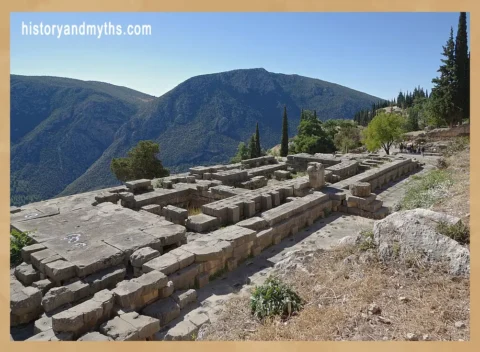
The association also linked Hyperborea to important religious centers in Greece. Ancient traditions claimed that sacred offerings were sent from Hyperborea to Apollo’s sanctuary at Delos, one of the most important cult sites in the Greek world. These stories created a symbolic bridge between a remote mythical land and real religious practices known to Greek communities.
What is striking is that Hyperborea was not presented as Apollo’s permanent home in the same way Olympus belonged to the Olympian gods. Instead, it functioned as a sacred destination connected to renewal, purity, and divine favor. This distinction helped preserve the mystery of the place while strengthening its religious significance.
For many Greeks, Hyperborea mattered not because it could be reached, but because it stood within Apollo’s sacred geography. Through the god’s presence, the distant northern paradise became part of the wider spiritual landscape of Greek mythology.
Hyperborea and the Edge of the Known World
To understand Hyperborea, it is important to remember how the ancient Greeks viewed geography. Large portions of the world remained unexplored, and the boundaries of known territory were often filled with mythological peoples, sacred lands, and extraordinary phenomena. Hyperborea occupied one of these distant frontiers.
Its location beyond the North Wind was not merely a directional detail. Boreas marked a natural limit in the Greek imagination. Beyond that boundary lay a region removed from ordinary experience, a place where the familiar rules of climate, society, and human life no longer applied. Hyperborea existed on the far side of that threshold.
This placement gave the land a special role within Greek cosmology. Just as Oceanus surrounded the known world and Ethiopia represented a blessed region at the southern extreme, Hyperborea symbolized the sacred north. Together, these distant locations helped define the edges of the mythical map through which Greeks understood their place in the universe.
The significance of Hyperborea therefore came partly from its inaccessibility. A paradise located nearby could be visited, measured, and tested. A paradise beyond the limits of known geography remained permanently mysterious. Its distance protected its perfection.
In this sense, Hyperborea was not simply a place on the edge of the world. It was a way of imagining what might exist beyond the horizon of human knowledge. The farther it stood from the familiar, the more powerful its symbolic role became within Greek mythology.
The Hyperborean Gifts Sent to Delos
One of the most intriguing traditions connected to Hyperborea involves a series of sacred offerings said to have traveled from the distant northern land to the island of Delos, the birthplace of Apollo. Ancient writers recorded stories describing how these gifts passed through multiple peoples and regions before finally reaching the sanctuary dedicated to the god.
What makes this tradition remarkable is that it links a mythical location to a real religious center. Hyperborea may have existed beyond the known world, but Delos was an actual place visited by pilgrims from across the Greek world. Through these offerings, the myth created a symbolic connection between distant sacred geography and everyday religious practice.
The stories also reinforced Apollo’s special relationship with the Hyperboreans. The gifts were not random exchanges; they represented respect, devotion, and a continuing bond between the northern paradise and the god’s most important sanctuary. This connection helped make Hyperborea feel less like a fantasy and more like a distant participant in the sacred life of Greece.
Ancient audiences were not necessarily expected to verify whether such offerings truly originated in a remote northern land. The significance lay in what the tradition communicated. It suggested that Apollo’s influence extended beyond the boundaries of the known world and that Hyperborea occupied a privileged place within his divine network.
As a result, the Hyperborean gifts became one of the strongest links between mythology and religious reality. They transformed Hyperborea from a distant legend into a meaningful part of Greek sacred tradition.
Why Hyperborea Matters
Hyperborea was not simply a mythical paradise. It represented a uniquely Greek idea: that somewhere beyond the limits of the known world existed a place untouched by war, disease, aging, and human suffering. Unlike Elysium, it belonged to the world of the living. Unlike Atlantis, it was never a fallen civilization. Hyperborea functioned as a sacred frontier where geography merged with religion, imagination, and the search for perfection.
© historyandmyths.com — Educational Use
Was Hyperborea a Real Place?
Ancient Greek writers did not completely agree on how Hyperborea should be understood. Some treated it as a genuine region located somewhere beyond the northern frontier of the known world, while others approached it with skepticism. This uncertainty is one reason the land remained such a persistent mystery throughout antiquity.
Herodotus, writing in the fifth century BC, discussed Hyperborean traditions but expressed doubts about many of the stories surrounding them. His account is valuable because it shows that questions about Hyperborea’s reality already existed in the ancient world. The debate was not created by modern historians; it was part of the tradition itself.
The challenge was geographical. Greek explorers had little reliable knowledge of the far north, leaving large areas open to speculation. In such environments, reports about distant peoples and extraordinary lands could easily blend observation with myth. Hyperborea emerged from this intersection between limited information and imaginative storytelling.
Over time, various theories attempted to identify Hyperborea with real locations. Some connected it to Scythia, others to northern Europe, and still others to regions near the Arctic. None of these proposals gained universal acceptance because the ancient descriptions were symbolic as much as geographical.
For this reason, asking whether Hyperborea was real may not have a simple answer. The land mattered less as a precise location than as an idea. It represented a distant realm of harmony, divine favor, and mystery—a place situated beyond the boundaries of ordinary knowledge. Whether it existed on a map was ultimately less important than the role it played in the Greek imagination.
Hyperborea vs Elysium: Two Different Greek Paradises
Because both Hyperborea and Elysium are associated with happiness and freedom from suffering, they are often treated as versions of the same idea. In Greek mythology, however, they served very different purposes.
Elysium belonged to the afterlife. It was a destination for selected souls after death, a reward granted to heroes and individuals favored by the gods. Entry depended on what happened after mortal life ended. The land functioned as part of Greek beliefs about death, judgment, and eternal existence.
Hyperborea occupied a different category. It was not an afterlife realm and was not reserved for the dead. Ancient traditions described it as a distant place within the living world, located beyond the northern boundaries of ordinary geography. The Hyperboreans themselves were not deceased heroes but a legendary people who lived in exceptional conditions.
The distinction reveals two separate Greek ideas about perfection. Elysium answered the question of what might await worthy individuals after death. Hyperborea answered a different question: whether a perfect society could exist somewhere beyond the known world. One was connected to destiny beyond life; the other was connected to sacred geography and unexplored space.
Understanding this difference helps explain why both places existed side by side in Greek mythology. They addressed different hopes, served different symbolic roles, and belonged to different parts of the mythological landscape. Hyperborea was not the northern version of Elysium. It was a separate vision of perfection shaped by geography rather than the afterlife.
Hyperborea vs Atlantis: Mythical Land or Lost Civilization?
Modern readers often compare Hyperborea and Atlantis because both are associated with lost lands located beyond the boundaries of ordinary geography. Despite this similarity, the two myths serve very different functions.
Atlantis is fundamentally a story about decline. In Plato’s account, it begins as a powerful and prosperous civilization but eventually falls because of moral corruption and excessive ambition. The narrative operates as a warning about power, pride, and political decay.
Hyperborea follows the opposite pattern. It is not remembered for destruction or collapse. Ancient traditions portray it as a land that remains harmonious, blessed, and closely connected to the gods. Rather than illustrating how perfection can be lost, Hyperborea explores the possibility that perfection might exist somewhere beyond the known world.
The relationship between humanity and the divine also differs. Atlantis is a human society whose fate is shaped by its own choices. Hyperborea is presented as a sacred landscape where divine favor is already woven into daily life. The focus is less on political organization and more on spiritual and symbolic meaning.
These distinctions explain why the two places occupied different roles in the ancient imagination. Atlantis functioned as a moral and political lesson. Hyperborea functioned as an idealized vision of sacred geography. One looked backward toward a civilization that disappeared; the other looked outward toward a paradise that remained beyond reach.
For this reason, Hyperborea is better understood as a mythical paradise than as a lost civilization. Its importance lies not in what happened to it, but in what it represented to those who imagined it.
Why Hyperborea Remained One of Greek Mythology’s Greatest Mysteries
Many mythological places eventually became attached to specific stories, heroes, or historical traditions. Hyperborea remained different. Its mystery endured precisely because no single explanation ever defined it. Ancient writers described it, debated it, connected it to Apollo, and speculated about its location, yet its true nature remained unresolved.
Part of its appeal came from this uncertainty. A place that could be precisely located would eventually become ordinary. Hyperborea retained its fascination because it always existed just beyond the reach of certainty. It occupied a space between geography and imagination, between religious belief and speculation.
The myth also survived because it addressed questions that had no simple answers. What lies beyond the known world? Can a perfect society exist? Is there a place untouched by the struggles of ordinary life? Hyperborea provided a symbolic response without claiming to offer a definitive one. Its power came from possibility rather than proof.
Unlike many myths centered on conflict, monsters, or heroic quests, Hyperborea focused on an ideal. It represented a vision of harmony, divine favor, and distance from human suffering. That vision remained attractive even as geographical knowledge expanded and ancient ideas about the world changed.
For the Greeks, Hyperborea was more than a northern land. It was a reminder that the world might contain realities beyond human understanding. That sense of wonder explains why the myth continued to capture attention for centuries and why it remains one of the most intriguing locations in Greek mythology today.
Hyperborea occupies a unique place within Greek mythology because it stands at the intersection of geography, religion, and imagination. Unlike Elysium, it was not an afterlife destination. Unlike Atlantis, it was not a fallen civilization. It was a sacred land imagined beyond the North Wind, a place where divine favor and human happiness appeared to exist in perfect balance.
Its connection to Apollo, its role in Greek sacred geography, and its location at the edge of the known world transformed it into far more than a distant paradise. Hyperborea became a way for the Greeks to explore ideas about perfection, mystery, and the limits of human knowledge. The land mattered not because people could reach it, but because it represented possibilities that ordinary experience could not provide.
This combination of religious significance and geographical uncertainty explains why Hyperborea remained one of the most enduring mysteries of the ancient world. Even today, it continues to fascinate readers because it invites the same question that captivated the Greeks themselves: what might exist beyond the boundaries of the known world?
Key Takeaways
- Hyperborea was a legendary land located beyond Boreas, the North Wind.
- It was imagined as a blessed society free from many human hardships.
- Hyperborea was closely associated with Apollo and his sacred traditions.
- The land occupied the northern edge of Greek sacred geography.
- Ancient stories linked Hyperborea to offerings sent to Apollo’s sanctuary at Delos.
- Greek writers disagreed on whether Hyperborea was a real location or a symbolic idea.
- Hyperborea differs from Elysium because it belongs to the world of the living.
- Its enduring appeal comes from its mystery and its vision of unattainable perfection.
Frequently Asked Questions
What was Hyperborea in Greek mythology?
Hyperborea was a legendary land located beyond the North Wind, inhabited by a blessed people who lived in harmony with the gods.
Where was Hyperborea believed to be?
Ancient Greek sources placed it somewhere far beyond the northern limits of the known world, though no exact location was agreed upon.
Who were the Hyperboreans?
The Hyperboreans were the mythical inhabitants of Hyperborea, often described as peaceful, prosperous, and favored by the gods.
Why was Hyperborea associated with Apollo?
Many traditions connected Apollo to Hyperborea and claimed that sacred offerings traveled from the land to his sanctuary at Delos.
Was Hyperborea part of the afterlife?
No. Unlike Elysium, Hyperborea was imagined as a place within the living world rather than a destination for the dead.
Was Hyperborea a real place?
Ancient and modern writers have proposed real-world locations, but there is no consensus. Many scholars view it as a symbolic mythical land.
What is the difference between Hyperborea and Atlantis?
Atlantis is a story about a lost civilization, while Hyperborea is a vision of a distant paradise connected to divine favor and sacred geography.
Why is Hyperborea still important today?
It remains one of Greek mythology’s most fascinating mysteries and offers insight into ancient ideas about perfection, geography, and the unknown.
Sources & Rights
- Herodotus. Histories, Book IV.
- Pindar. Pythian Odes.
- Diodorus Siculus. Library of History.
- Strabo. Geographica.
- Pausanias. Description of Greece.
- Apollonius Rhodius. Argonautica.
- Walter Burkert. Greek Religion.
- Fritz Graf. Greek Mythology.
- Robin Hard. The Routledge Handbook of Greek Mythology.
- Timothy Gantz. Early Greek Myth.
- Jennifer Larson. Understanding Greek Mythology.
- Richard Buxton. The Complete World of Greek Mythology.
- Sarah Iles Johnston. Ancient Greek Religion.
- Karl Kerényi. The Gods of the Greeks.
- Emma Griffiths. Greek Myth: A Very Short Introduction.
- H.J. Rose. A Handbook of Greek Mythology.
- Gregory Nagy. The Ancient Greek Hero in 24 Hours.
- Mark P.O. Morford & Robert Lenardon. Classical Mythology.
- William Hansen. Classical Mythology: A Guide to the Mythical World of the Greeks and Romans.
- Edith Hall. Introducing the Ancient Greeks.
Written by H. Moses — All rights reserved © Mythology and History