The Tuatha Dé Danann: The Supernatural Race of Irish Mythology
The Tuatha Dé Danann are among the most important supernatural beings in Irish mythology. Medieval Irish texts describe them as a powerful people associated with magic, warfare, healing, skilled craftsmanship, kingship, and the Otherworld. Figures such as the Dagda, Lugh, the Morrígan, Brigid, and Nuada all belong to this tradition.
They are often introduced simply as the “gods of Ireland” or as the “people of the goddess Danu,” but both descriptions need qualification. The surviving sources do not present one perfectly consistent picture of who they were, and even the meaning of their name is more complicated than many modern retellings suggest.
Their story includes mysterious origins, four legendary treasures, conflicts with the Fir Bolg and the Fomorians, the rule of Bres, the rise of Lugh, and the eventual loss of political control of Ireland to the Milesians. Later tradition also connects them closely with the Aos Sí and the supernatural landscape of Ireland.
Who Were the Tuatha Dé Danann?
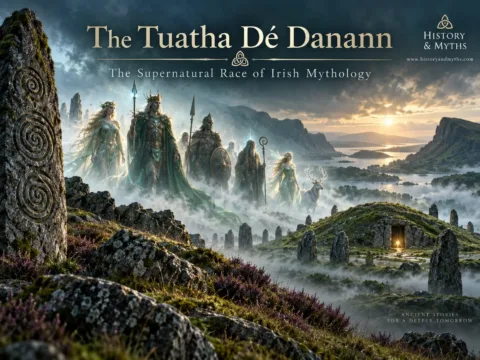
The Tuatha Dé Danann were a supernatural people at the center of medieval Irish myth. Rather than appearing as a loose collection of unrelated deities, they are often presented as an organized society with kings, warriors, healers, smiths, poets, druids, and other specialists.
Their stories connect them through kinship, political alliances, shared conflicts, and claims to rule Ireland. This gives them a collective identity that is easy to lose when they are treated only as individual gods.
The modern word “race” is useful only in a broad mythological sense. The texts present them as a distinct supernatural people, not as an ethnic population that can be identified archaeologically.
Cath Maige Tuired gives one of the clearest pictures of this society, showing how warfare, healing, craftsmanship, magic, and specialized knowledge all work together. Their power lies not only in extraordinary individuals, but in the way different members contribute different skills.
This is why reducing the Tuatha Dé Danann to either “Irish fairies” or a simple list of Celtic gods misses much of what the medieval tradition actually preserves.
What Does “Tuatha Dé Danann” Actually Mean?
The name Tuatha Dé Danann is usually translated as “the people” or “tribes of the goddess Danu.” That translation is familiar, but the linguistic history behind it is less certain than it sounds.
The Old Irish word túath means a people or tribe, with túatha as the plural. Earlier Irish texts often refer to the supernatural group simply as Túath Dé or Túatha Dé, without the final Danann.
The difficult part is Danann. Modern retellings often assume that it is the genitive form of a goddess named Danu, making her the divine ancestor of the group. But Danu is not clearly preserved as a major character in the early Irish narratives in the way figures such as the Dagda or the Morrígan are.
Scholars have therefore proposed that the longer name developed later within the medieval manuscript tradition. One explanation is that Danann helped distinguish the pagan supernatural people from biblical uses of Túath Dé, which could also mean the “people of God.”
So “people of the goddess Danu” remains a useful conventional translation, but it should not be mistaken for a completely settled fact. The history of the name itself shows how Irish mythology was reshaped as older traditions passed through medieval scholars and scribes.
Were the Tuatha Dé Danann Gods?
Calling the Tuatha Dé Danann “the gods of Ireland” is convenient, but the medieval sources do not fit them neatly into a single category.
Many of their members clearly have divine characteristics. They control forces connected with war, kingship, healing, craftsmanship, fertility, poetry, and supernatural knowledge. Figures such as the Dagda, Lugh, Brigid, and the Morrígan behave much more like deities than ordinary legendary heroes.
At the same time, the surviving texts were written down in Christian Ireland. Medieval authors often tried to place older supernatural traditions inside a historical framework, presenting the Tuatha Dé as a people who once ruled Ireland rather than simply as gods. Some texts even debate whether such beings should be understood as powerful humans, fallen spirits, or something else.
This creates an important distinction. The Tuatha Dé Danann probably preserve memories of pre-Christian divine figures, but the stories we possess have already passed through centuries of reinterpretation.
So the most accurate description is not that they were “just gods” or “just fairies.” They are a supernatural people whose major members retain clear divine features, even though medieval Irish literature often recasts them as rulers, ancestors, and inhabitants of the Otherworld.
What Sources Tell Their Story?
The story of the Tuatha Dé Danann does not come from one ancient Irish book. It survives across several medieval texts, each preserving a different part of the tradition.
Two sources are especially important. Lebor Gabála Érenn, often called The Book of Invasions, places the Tuatha Dé within a sequence of peoples said to have occupied Ireland. It preserves traditions about their arrival, kings, conflicts, and eventual defeat by the Milesians.
Cath Maige Tuired, The Battle of Mag Tuired, gives a much richer picture of the group itself. It shows their rulers, craftsmen, healers, warriors, poets, magical abilities, family relationships, and struggle with the Fomorians. Many details that make the Tuatha Dé feel like a functioning supernatural society come from this text.
Other poems, genealogies, place-name traditions, and later tales add further layers, sometimes agreeing with these accounts and sometimes preserving different versions.
This matters because medieval Irish mythology was not a fixed canon. The texts were written down centuries after Ireland became Christian, so they preserve older traditions through the language, interests, and historical frameworks of later scribes.
Where Did the Tuatha Dé Danann Come From?
The medieval sources do not give the Tuatha Dé Danann a simple geographical homeland.
In Cath Maige Tuired, they are said to have lived in the “northern islands of the world,” where they studied druidry, magic, secret knowledge, and other supernatural arts. The same tradition connects them with four legendary cities: Falias, Gorias, Murias, and Findias.
Lebor Gabála Érenn also preserves a northern origin, while placing the Tuatha Dé within a wider pseudo-historical sequence of peoples said to have settled Ireland. This reflects the way medieval writers fitted supernatural traditions into a broader history of conquest and succession.
The “northern islands” should not be treated as a securely identifiable real-world location. In the texts, they belong to mythic geography rather than conventional geography.
Their importance lies mainly in what the Tuatha Dé are said to have acquired there: exceptional knowledge, magical skill, and the traditions that distinguish them before their arrival in Ireland.
The Four Cities and the Four Treasures
The Tuatha Dé Danann are said to have brought four extraordinary treasures to Ireland, each linked to one of the northern cities where they had learned their arts.
The Four Cities and the Four Treasures
| City | Treasure | Associated Figure | What It Represents |
|---|---|---|---|
| Falias | Lia Fáil | Kingship tradition | Legitimate rule and sovereignty |
| Gorias | Spear of Lugh | Lugh | Warfare and supernatural power |
| Findias | Sword of Nuada | Nuada | Kingship and martial authority |
| Murias | Cauldron of the Dagda | The Dagda | Abundance and provision |
These associations summarize the role of the four treasures in the medieval tradition. Later retellings often add symbolic meanings or powers that are not stated as clearly in the surviving texts.
From Falias came the Lia Fáil, the Stone of Fál, associated with legitimate kingship. Gorias was linked with the Spear of Lugh, while Findias supplied the Sword of Nuada. From Murias came the Cauldron of the Dagda, a vessel closely associated with abundance and provision.
These objects matter because they reflect the structure of Tuatha Dé society itself. Kingship, warfare, sustenance, and supernatural skill are all represented through treasures connected with leading figures of the group.
Later retellings often add elaborate powers or symbolic meanings to the four treasures. The medieval sources are more restrained, so it is better to separate what the texts actually preserve from interpretations added much later.
Read More
How Did the Tuatha Dé Danann Arrive in Ireland?
The surviving sources do not preserve one single version of the Tuatha Dé Danann’s arrival.
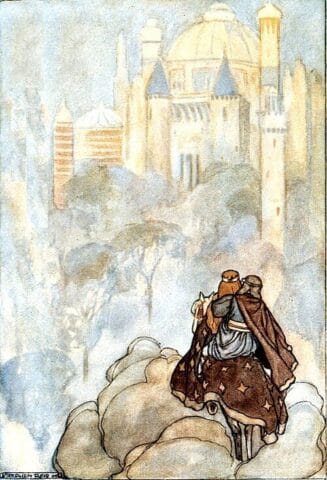
In Cath Maige Tuired, they come to Ireland in a large fleet to challenge the Fir Bolg. After landing, they burn their own ships so retreat will no longer be an option. The smoke and mist from the burning vessels fills the surrounding air, which the text says may explain the tradition that they arrived in clouds or mist.
Other medieval accounts preserve different details, and that is where later retellings often become misleading. The familiar image of the Tuatha Dé descending from the sky in “flying ships” is not a simple statement found consistently across the sources.
What the tradition does preserve clearly is the sense of a dramatic arrival from elsewhere, followed almost immediately by a struggle for control of Ireland. The mist, the burning of the ships, and the refusal to retreat all serve the same narrative purpose: the Tuatha Dé enter Ireland as a people intending to stay and rule.
The First Battle of Mag Tuired and the Fir Bolg
After arriving in Ireland, the Tuatha Dé Danann fought the Fir Bolg for control of the island in what later tradition remembers as the First Battle of Mag Tuired.
The Tuatha Dé won, but the victory came at a serious political cost. Their king, Nuada, lost his hand to the Fir Bolg warrior Sreng. Dian Cécht, assisted by the craftsman Crédne, later provided him with a silver replacement.
The injury mattered because physical wholeness was tied to legitimate kingship. Nuada could no longer remain king, opening the way for Bres to take the throne and altering the balance between the Tuatha Dé and the Fomorians.
The Fir Bolg were defeated, but they did not disappear from the mythic tradition. Survivors are said to have withdrawn to islands including Arran, Islay, Man, and Rathlin.
Bres and the Problem of Fomorian Rule
When Nuada could no longer remain king, the Tuatha Dé Danann chose Bres, son of the Fomorian king Elatha, partly because his rule promised an alliance between the two peoples. That decision quickly became a political problem.
Under Bres, Fomorian rulers imposed heavy tribute on Ireland, while leading members of the Tuatha Dé were reduced to labor. The Dagda was made to build fortifications, and Ogma carried firewood.
Bres also failed one of the most important expectations of Irish kingship: generosity. When the poet Coirpre received poor hospitality at his court, he responded with a satire condemning Bres. The text says Bres’s prosperity began to fail from that moment, and the Tuatha Dé eventually judged him unfit to rule.
The episode is important because Bres is not simply a foreign villain. He is both Tuatha Dé and Fomorian by ancestry, and his kingship begins as an attempted political settlement. His failure turns that attempted alliance into the crisis that leads toward the Second Battle of Mag Tuired.
The Mabinogion Explained: The Great Stories of Welsh Mythology
Why the Fomorians Were Not Simply “Evil Monsters”
The Fomorians are often described as the dark or evil opposite of the Tuatha Dé Danann, but the medieval tradition is more complicated than that.
They are certainly dangerous opponents. In Cath Maige Tuired, Fomorian rulers demand tribute, dominate Ireland under Bres, and eventually fight the Tuatha Dé in the Second Battle of Mag Tuired. But the two groups are also connected by blood and marriage.
Bres himself has a Tuatha Dé mother and a Fomorian father. Lugh, one of the greatest champions of the Tuatha Dé, is the grandson of the Fomorian leader Balor through his mother. The conflict therefore takes place partly within an interconnected supernatural world rather than between two completely separate races.
The texts also give individual Fomorians different roles and qualities instead of presenting them as a single class of demons.
It is more accurate to see the Fomorians as a rival supernatural people, associated with dangerous power, tribute, and political domination, than as a simple embodiment of evil. That distinction also makes the later battle more interesting: the Tuatha Dé are fighting enemies who are, in some cases, their own relatives.
Read Also
Cernunnos: Who Was the Celtic Horned God?
Who was Cernunnos, and what did his antlers symbolize? Explore the ancient Celtic carvings, mysterious religious imagery, and archaeological evidence behind the horned god.
The Second Battle of Mag Tuired
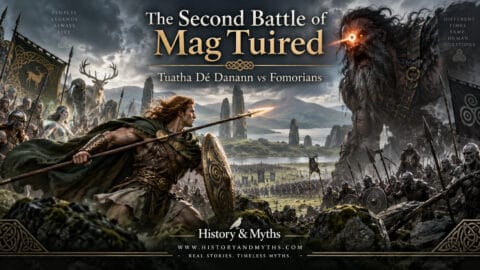
The Second Battle of Mag Tuired is the central conflict in the Tuatha Dé Danann tradition. It follows the failure of Bres’s rule and brings the Tuatha Dé into open war with the Fomorians.
By this point, Nuada has regained the kingship, but Lugh emerges as the decisive figure. Before the battle, he brings together the different specialists of the Tuatha Dé, including warriors, healers, smiths, poets, and magicians. The episode shows that their strength lies in coordinated knowledge as much as in supernatural power.
The battle ends with the defeat of the Fomorian forces. Lugh kills Balor, his own grandfather, removing one of their most dangerous leaders. Nuada, however, is also killed during the fighting.
The importance of the battle goes beyond victory. Cath Maige Tuired presents the Tuatha Dé as a complete supernatural society, where kingship, craftsmanship, healing, magic, and warfare all contribute to survival. That is one reason the text is so valuable for understanding who they were, rather than treating them as a simple list of individual gods.
Who Were the Most Important Members of the Tuatha Dé Danann?
Several figures appear repeatedly across the Tuatha Dé Danann tradition, each with a distinct role.
The Dagda is associated with authority, abundance, magic, and immense physical power. Lugh is the master of many skills and becomes central in the struggle against the Fomorians. Nuada represents kingship and legitimacy, while the Morrígan is closely linked with battle, fate, and sovereignty.
Brigid is associated with poetry, healing, and skilled craft. Ogma appears as a champion and figure of learning, Dian Cécht as the great healer, and Goibniu as the divine smith. Aengus is strongly connected with love, youth, and the Otherworld, while Manannán mac Lir becomes especially important in later traditions linked with the sea and the supernatural realm.
Their stories overlap, but each figure has a separate identity and body of tradition. That is why individual articles are useful for understanding them beyond the broader label of the Tuatha Dé Danann.
Read More
- The Dagda: Chief God of the Tuatha Dé Danann | Irish God
- Who Were the Druids and What Did They Believe?
- The Four Celtic Festivals: How Druids Shaped Samhain to Lughnasadh
- The Fomorians in Irish Mythology: Giants, Monsters, and Rivals
- The Morrígan: Irish Goddess of War, Fate and Sovereignty
- The Second Battle of Mag Tuired: Tuatha Dé Danann vs Fomorians
What Made the Tuatha Dé Danann Supernatural?
The Tuatha Dé Danann are not defined by one shared magical power. Their supernatural nature appears through prophecy, healing, transformation, enchanted objects, exceptional knowledge, and abilities beyond ordinary human limits.
In the medieval stories, these powers are rarely presented as fixed abilities possessed in the same way by every member. Different figures are associated with different forms of knowledge and supernatural influence, depending on their role and the story in which they appear.
They are also closely connected with the Otherworld, magical places, powerful weapons, and acts that blur the boundary between ordinary skill and supernatural power.
This is why modern “power lists” can be misleading. The texts present a much less mechanical picture, where supernatural ability is tied to identity, knowledge, status, and circumstance rather than a fixed catalogue of powers.
The Milesians and the End of Their Rule
The Tuatha Dé Danann do not remain the final rulers of Ireland in the medieval pseudo-historical tradition. Their political supremacy ends with the arrival of the Milesians, the people later associated with the ancestors of the Gaels.
In Lebor Gabála Érenn, the conflict is not presented as a simple extermination of one people by another. After confrontation and negotiation, the Milesians gain possession of the surface of Ireland, while the Tuatha Dé lose their position as its visible rulers.
That marks the end of their rule in the pseudo-history of Ireland, but not the end of their presence in Irish tradition.
- What If the Tuatha Dé Danann Had Defeated the Milesians?
- Goibniu: Divine Smith of the Tuatha Dé Danann
- Fionn mac Cumhaill (Finn McCool): Hero of Irish Mythology
Did the Tuatha Dé Danann Become the Aos Sí?
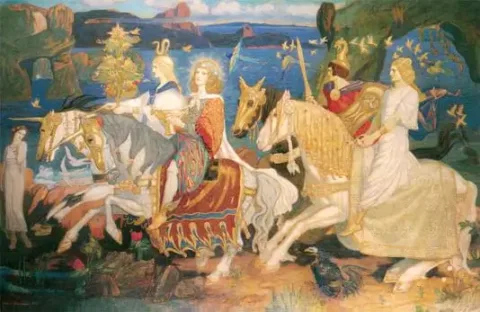
Later tradition increasingly connects the Tuatha Dé Danann with the síd, the supernatural mounds and dwellings associated with the Irish Otherworld.
Many former Tuatha Dé figures become linked with these hidden places, while the term Aos Sí comes to describe supernatural inhabitants of the landscape. This is why modern summaries often say that the Tuatha Dé simply “became fairies.”
That explanation is too simple. The medieval tradition does not preserve one clear moment when the Tuatha Dé are transformed into another race of beings. Older divine figures, mound traditions, local supernatural beings, and later folklore gradually overlap across centuries.
The connection between the Tuatha Dé and the Aos Sí is real, but it is better understood as a long development in Irish tradition than as a single transformation after the Milesian victory.
The Tuatha Dé Danann and the Irish Landscape
The Tuatha Dé Danann are deeply connected with specific places in Ireland, especially ancient mounds, hills, lakes, and prominent ritual landscapes.
Figures such as the Dagda and Aengus are associated in medieval tales with Brú na Bóinne, while other members of the Tuatha Dé become linked with particular síd throughout the country. These places help anchor supernatural stories in a recognizable Irish landscape.
But mythology and archaeology must be kept separate. Neolithic monuments such as Newgrange were already thousands of years old when medieval Irish texts were written. Their later association with the Tuatha Dé tells us how Irish tradition understood these ancient places, not who actually built them.
That distinction preserves both the mythology and the archaeology without forcing one to prove the other.
Were They Celtic Gods, Irish Gods, or Something Else?
Calling the Tuatha Dé Danann “Celtic gods” is not entirely wrong, but it is broader than the evidence allows.
Their surviving stories belong specifically to medieval Irish tradition. Some members have convincing parallels with divine figures elsewhere in the Celtic-speaking world, but the Tuatha Dé Danann as a named supernatural people are an Irish literary tradition.
For that reason, Irish gods or supernatural figures of Irish mythology are usually more precise descriptions.
“Celtic mythology” remains a useful umbrella term, but it should not imply that Ireland, Wales, Gaul, and other Celtic-speaking cultures shared one fixed pantheon or identical mythology.
Dian Cécht: Healer of the Tuatha Dé Danann in Irish Mythology
The Children of Lir: The Tragic Swan Legend of Irish Mythology
Popular Claims vs What the Sources Actually Say
What the sources suggest: The traditional translation links the name with Danu, but her identity is far less securely documented in the early Irish texts than modern summaries often imply.
Claim: They arrived in Ireland in flying ships
What the sources suggest: Medieval accounts preserve different arrival traditions, including fleets, burning ships, mist, and clouds. There is no single consistent account of “flying ships.”
Claim: The Fomorians were simply evil monsters
What the sources suggest: They are dangerous rivals, but they are also linked to the Tuatha Dé through blood, marriage, and shared ancestry. Bres and Lugh both show how closely the two groups are connected.
Claim: The Tuatha Dé Danann were simply the Celtic pantheon
What the sources suggest: Their surviving tradition is specifically Irish. Some figures have parallels elsewhere in the Celtic-speaking world, but the Tuatha Dé Danann as a named group belong to Irish mythology.
Claim: They became fairies after losing Ireland
What the sources suggest: Their later association with the Aos Sí developed gradually. The tradition does not preserve one clear moment when the Tuatha Dé are transformed into another supernatural race.
What Modern Retellings Often Get Wrong
The biggest problem with modern versions of the Tuatha Dé Danann is not that every detail is false, but that uncertainty disappears.
Different arrival traditions become one story. Danu becomes a securely documented mother goddess. The Fomorians become pure evil. The Tuatha Dé become a fixed pantheon of Celtic gods, then supposedly turn into fairies after losing Ireland.
The medieval material is less tidy and more interesting. It preserves competing versions, mixed genealogies, political conflicts, divine characteristics, and later reinterpretations layered over older traditions.
Reading those layers separately gives a clearer picture of the Tuatha Dé Danann than forcing every source into one seamless modern narrative.
Frequently Asked Questions
Who were the Tuatha Dé Danann?
They were a supernatural people at the center of medieval Irish mythology, associated with kingship, magic, warfare, healing, craftsmanship, and the Otherworld.
Were the Tuatha Dé Danann gods?
Many members clearly preserve divine characteristics, but medieval Irish texts also present the group as rulers and supernatural people. Calling them simply “gods” does not capture the full tradition.
Who was Danu?
Danu is commonly described as the goddess behind the name Tuatha Dé Danann, but her identity is much less clearly documented in the early Irish texts than modern retellings often suggest.
What were the four treasures of the Tuatha Dé Danann?
The tradition names the Lia Fáil, the Spear of Lugh, the Sword of Nuada, and the Cauldron of the Dagda, each linked with one of the four legendary northern cities.
Did the Tuatha Dé Danann become fairies?
Not in one simple transformation. Later tradition increasingly connected them with the Aos Sí and supernatural mounds, but this developed gradually across centuries of Irish folklore.
Academic Sources & Primary Texts
Cath Maige Tuired: The Second Battle of Mag Tuired
Edited and translated by Elizabeth A. Gray, Irish Texts Society, 1982.
>One of the most important primary texts for the Tuatha Dé Danann, including their northern origins, four cities and treasures, Bres, Lugh, the Fomorians, and the Battle of Mag Tuired.
Lebor Gabála Érenn: The Book of the Taking of Ireland
Edited and translated by R. A. Stewart Macalister, Irish Texts Society, 1938–1956.
>A major medieval source for the pseudo-history of Ireland, including the arrival and rule of the Tuatha Dé Danann and their later conflict with the Milesians.
John Carey, “The Name ‘Tuatha Dé Danann’”
Éigse, Vol. 18, No. 2, 1981, pp. 291–294.
>A focused scholarly study of the history and interpretation of the name Tuatha Dé Danann, particularly important for understanding the uncertainty surrounding Danu and the earlier form Túath Dé.
Elizabeth A. Gray, “Tuatha Dé and Fomoiri in Cath Maige Tuired”
In Myth and History in Celtic and Scandinavian Traditions, 2021, pp. 49–70.
>An academic analysis of the complex relationships between the Tuatha Dé and Fomorians, including kinship, marriage, political rivalry, and the role of specialized members of Tuatha Dé society.
Mark Williams, Ireland’s Immortals: A History of the Gods of Irish Myth
Princeton University Press, 2016.
>A major modern study of Ireland’s divine figures and how the Tuatha Dé Danann were reshaped from pre-Christian supernatural beings into characters of medieval literature and later Irish tradition.
Copyright & Use
Written by H. Moses for
History & Myths.
This article is original content created for History & Myths.
Reproduction, republication, or full redistribution of this content is not permitted
without prior permission.
Short quotations may be used for educational, academic, or commentary purposes
with clear attribution and a link back to the original article.