The Morrígan: Irish Goddess of War, Fate and Sovereignty
The Morrígan is one of the most complex figures in Irish mythology. She is usually associated with war, fate, prophecy, and sovereignty, yet the surviving sources do not present her in one fixed form.
Sometimes she appears as an individual goddess. Elsewhere, she is closely connected with figures such as Badb and Macha, whose identities can overlap without being completely interchangeable. This makes the familiar description of the Morrígan as a simple “triple goddess” more complicated than it first appears.
Her stories also extend beyond the battlefield. She is linked with the Tuatha Dé Danann, the Dagda, and Cú Chulainn, appearing at moments of conflict, prophecy, kingship, transformation, and approaching death.
Was the Morrígan one goddess, three goddesses, or part of a wider group of related supernatural figures? The medieval Irish sources give a more interesting answer than the modern label suggests.
Who Was the Morrígan in Irish Mythology?
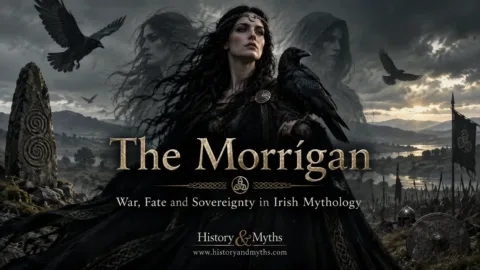
The Morrígan belongs to the mythological world of the Tuatha Dé Danann and is closely associated with conflict, prophecy, kingship, and the fate of warriors and communities. In Cath Maige Tuired, she is identified as a daughter of Ernmas and takes an active role in the struggle between the Tuatha Dé Danann and the Fomorians.
Calling her simply a war goddess is therefore too narrow. Her stories connect battle with foresight, political power, victory, and the consequences that follow it. She can influence events directly, foretell what is coming, and appear at moments when the balance of power is about to change.
She also appears in traditions involving Cú Chulainn, where her role becomes more personal and dangerous. Even there, however, she is not simply a goddess of death. The medieval texts present a much broader figure whose power touches war, prophecy, transformation, and fate.
Was the Morrígan One Goddess or Three?
There is no single answer that fits every surviving Irish source.
In Cath Maige Tuired, the Morrígan appears as an individual figure. She is called a daughter of Ernmas, speaks and acts in her own right, supports the Tuatha Dé Danann before battle, and later announces their victory. The same text also shifts to the name Badb, showing how closely these figures could overlap in the tradition.
Other genealogical sources complicate the picture. The Book of Leinster names Badb, Macha and Anand as three daughters of Ernmas, while elsewhere Anand is identified with the Morrígan. This is one reason the Morrígan is often associated with a group of three related goddesses.
What the medieval texts do not give us is a fixed doctrine in which three goddesses are always three aspects of one being. The names and relationships vary, and figures such as Badb, Macha, Anand and sometimes Nemain can overlap without becoming completely interchangeable.
The Morrígan is therefore best understood as a goddess who can appear in her own right while also belonging to a wider, fluid group of closely related female powers. The familiar modern image of a perfectly fixed “triple goddess” is much more orderly than the medieval evidence.
Badb, Macha, Anand and the Morrígna
In Lebor Gabála Érenn, Badb, Macha and Anand are listed as daughters of Ernmas. Another passage names Badb, Macha and Morrígu, then identifies Morrígu with Anand. The variation shows that the names were not used in exactly the same way across the tradition.
Badb and Macha also appear as figures in their own right. Badb is strongly associated with battle, terror, and ominous appearances, while Macha belongs to several distinct Irish traditions and cannot simply be treated as another name for the Morrígan.
The plural Morrígna can refer to a wider group of related female powers associated with battle. Nemain is sometimes included within this broader circle, although she is not consistently listed among Ernmas’s three daughters.
These names therefore describe a closely connected group rather than a perfectly fixed trio. Their roles overlap, but the medieval sources still preserve distinctions between them.
What Does the Name Morrígan Mean?
The meaning of the name Morrígan is debated, and two translations appear most often.
One interpretation connects the first element with Old Irish mór, meaning “great,” and rígan, meaning “queen,” giving the familiar translation “Great Queen.” This reading fits her associations with authority and sovereignty.
Another interpretation links the first element to an older root associated with terror, supernatural beings, or nightmare-like figures. On that reading, the name is closer to “Phantom Queen” or “Queen of Terrors.”
Both translations reflect different sides of the figure preserved in Irish tradition. “Great Queen” emphasizes power and sovereignty, while “Phantom Queen” fits her darker associations with battle, fear, and supernatural presence.
War, Fate and Sovereignty: What Was Her Role?
The Morrígan is most clearly associated with war, but not simply with fighting. Her presence often marks moments when the outcome of conflict matters for the future of warriors, rulers, or entire communities.
Her link with fate comes largely through prophecy. She does not control destiny in the same way as a formal fate goddess, but she repeatedly appears when victory, defeat, death, or political change are approaching. Her role is often to reveal or announce what those events will mean.
Sovereignty is more difficult to define. The Morrígan is frequently connected with rulership, land, and the fortunes of Ireland, but the medieval texts do not present her as a straightforward goddess who simply grants kingship. The idea works best when understood through her connection with control of the land, warfare, and the survival of a people.
Taken together, these roles explain why the Morrígan cannot be reduced to a single label. She belongs to the point where battle, prophecy, political power, and the fate of communities meet.
The Morrígan and the Dagda Before Mag Tuired
One of the Morrígan’s most important appearances comes shortly before the Second Battle of Mag Tuired. In Cath Maige Tuired, the Dagda meets her near the River Unshin around Samhain. The two unite at a place later called the “Bed of the Couple,” but the encounter quickly becomes part of the preparations for war.
The Morrígan tells the Dagda where the Fomorians will land and instructs him to gather the skilled people of Ireland. She also promises to confront Indech mac Dé Domnann, one of the Fomorian leaders, and later returns with his blood.
The episode connects several sides of her character at once. Sexuality, prophecy, military strategy, and violence all appear in the same scene. Her meeting with the Dagda is therefore not simply a romantic episode, but part of the chain of events leading to the Tuatha Dé Danann’s victory.
The Morrígan in the Second Battle of Mag Tuired
When the battle begins, the Morrígan takes a direct role. Cath Maige Tuired says that she comes to the Tuatha Dé Danann and strengthens them to fight “resolutely and fiercely,” accompanying them with a battle chant.
After the Fomorians are defeated, she travels across Ireland announcing the victory to its royal heights, supernatural hosts, waters, and river mouths. Her role has shifted from encouraging the warriors to carrying news of their triumph through the land.
She then proclaims peace and abundance, before turning to prophecy and foretelling a future of social disorder, failed harvests, false judgement, and broken relationships.
Within a single sequence, the Morrígan moves from battle to victory and then to prophecy. The episode shows particularly clearly why her role extends beyond warfare to the fate of the society that survives it.
The Morrígan and Cú Chulainn
The Morrígan’s relationship with Cú Chulainn is one of the most personal and hostile encounters associated with her in Irish tradition. In the Táin Bó Cúailnge, she intervenes directly against him while he is defending Ulster.
During his combat with Lóch, the Morrígan attacks in several forms. She appears as a heifer, a black eel, and a she-wolf, each time trying to disrupt him while he is already fighting another warrior. Cú Chulainn wounds her in each form and still defeats Lóch.
Later, she approaches him disguised as an injured old woman milking a cow. Cú Chulainn asks for milk and blesses her as she gives it to him. With each blessing, one of her wounds is healed, and only afterward does he realize whom he has helped.
Their encounters combine hostility, disguise, injury, and healing. Rather than fitting neatly into a simple story of revenge, the relationship shows the Morrígan repeatedly entering Cú Chulainn’s path at moments when his strength, judgement, and survival are being tested.
Shapeshifting, Crows and Omens of Death
Shapeshifting is one of the Morrígan’s clearest supernatural abilities. The Táin Bó Cúailnge shows her taking animal forms to intervene directly in human conflict, making transformation an active part of her power rather than a later symbolic addition.
Her association with birds requires more care. Modern retellings often describe the Morrígan as a raven goddess, but the medieval material more strongly connects her with Badb, a figure associated with the battle-crow. In The Wooing of Emer, Badb is identified with the Morrígan and described as the “Battle-Crow.”
Crow imagery fits naturally with the world in which the Morrígan appears: battlefields, approaching danger, and violent death. That does not mean every crow or raven in Irish heroic literature represents her, nor that the two birds should automatically be treated as interchangeable.
Her reputation as an omen also extends beyond birds. The Morrígan appears repeatedly when death, defeat, or major changes in fortune are approaching, making her presence itself a warning that the balance of events is about to shift.
Read More
What Symbols Are Actually Connected to the Morrígan?
Many modern sources give the Morrígan a long list of symbols, but only a few have a strong basis in medieval Irish tradition.
The clearest are images already tied to her stories: battlefields, blood, crows, prophecy, and transformation. These are not decorative additions. They grow directly from the roles she plays in conflict, omen, and shapeshifting.
By contrast, symbols such as the cauldron, moon, black and red candles, crystals, or a fixed sacred number three belong mostly to later interpretation and modern religious practice. They may have meaning in contemporary devotion, but they should not be presented as if medieval Irish texts consistently identified them as ancient symbols of the Morrígan.
Was the Morrígan Worshipped in Ancient Ireland?
The short answer is that there is no clear archaeological evidence for a formal cult of the Morrígan in ancient Ireland.
Medieval Irish texts preserve her as a powerful supernatural figure from the pagan past, and place names such as Dá Chích na Morrígna, “the two breasts of the Morrígan,” connect her name with the Irish landscape. Neither literary references nor place names, however, prove the existence of temples, priests, or an organized cult comparable to those documented for some Greek and Roman deities.
No securely identified Irish sanctuary dedicated specifically to the Morrígan has been found. A Gallo-Roman inscription from continental Europe refers to a goddess called Cathubodua, whose name has been linked with the idea of the “battle-crow,” but this is not direct evidence for the worship of the Irish Morrígan.
The surviving evidence therefore tells us far more about how medieval tradition remembered her than about how she may have been worshipped before Christianization. Any reconstruction of her ancient rituals remains uncertain, and modern devotional practices should not be treated as evidence for pre-Christian custom.
How Modern Tradition Changed the Morrígan
Modern Pagan and neopagan traditions have given the Morrígan a more defined identity than the medieval Irish sources provide.
She is now often presented as a fixed triple goddess, sometimes through the Maiden, Mother, and Crone model. That framework belongs largely to modern goddess spirituality and should not be read back into medieval Irish texts, where the relationships between Morrígan, Badb, Macha, and other figures are far less fixed.
Modern devotion has also developed its own symbols, rituals, and interpretations around her. Some draw on older themes such as battle, prophecy, and crow imagery, while others reflect later religious reconstruction rather than documented medieval tradition.
The distinction matters because the modern Morrígan and the Morrígan of medieval Irish literature are not identical. Contemporary traditions show how she is understood today, but they cannot by themselves tell us how she was viewed or worshipped in pre-Christian Ireland.
Who Was the Morrígan Really?
The Morrígan resists a simple definition. Medieval Irish tradition presents her sometimes as an individual goddess and sometimes within a wider circle of related female figures whose identities overlap without becoming identical.
What remains consistent is the kind of moments in which she appears: war, prophecy, political change, approaching death, and shifts in the fortunes of warriors or communities.
For that reason, “war goddess” is useful but incomplete. The Morrígan is better understood as a figure who stands at the meeting point of conflict, fate, sovereignty, and supernatural warning.
Academic Sources
Primary Medieval Sources
- Gray, Elizabeth A., ed. and trans.
Cath Maige Tuired: The Second Battle of Mag Tuired.
Irish Texts Society, Vol. 52, 1982.
Used for the Morrígan’s role before and during the battle,
her encounter with the Dagda, the defeat of the Fomorians,
and her prophecies after victory. - O’Rahilly, Cecile, ed. and trans.
Táin Bó Cúalnge.
Dublin Institute for Advanced Studies.
Used for the Morrígan’s encounters with Cú Chulainn,
including her animal transformations, attacks, injuries, and healing. - Macalister, R. A. Stewart, ed. and trans.
Lebor Gabála Érenn: The Book of the Taking of Ireland.
Irish Texts Society, 1938-1956.
Used for the genealogical traditions connecting Badb, Macha,
Anand, Morrígu, Ernmas, and the wider Morrígna.
Modern Academic Studies
- Clark, Rosalind.
The Great Queens: Irish Goddesses from the Morrígan to Cathleen Ní Houlihan.
Colin Smythe, 1991.
A major scholarly study of the Morrígan and other Irish female supernatural figures,
especially their connections with war, sovereignty, sexuality, and later literary interpretation. - Clarke, Michael.
“Demonology, Allegory and Translation: The Furies and the Morrígan.”
In Classical Literature and Learning in Medieval Irish Narrative,
Cambridge University Press, 2023.
Useful for understanding how the Morrígan was represented and interpreted
within medieval Irish literary culture rather than treating later labels as fixed ancient doctrine.
This article distinguishes between evidence preserved in medieval Irish texts
and later interpretations of the Morrígan. Claims about her identity, functions,
symbolism, and relationships are based primarily on the surviving literary sources
and modern academic scholarship.
© 2026 History & Myths. All rights reserved.
This article is original content and may not be copied, republished, adapted, or redistributed without prior written permission.