The Second Battle of Mag Tuired: Tuatha Dé Danann vs Fomorians
The Second Battle of Mag Tuired, also known as the Second Battle of Moytura, was one of the most important conflicts in Irish mythology. It was fought between the Tuatha Dé Danann and the Fomorians and ended with the defeat of Fomorian power in Ireland.
The battle grew out of a political crisis rather than a simple clash between rival supernatural peoples. After Nuada lost his hand in the first battle, Bres became king, Fomorian influence increased, and resentment eventually pushed the Tuatha Dé toward open conflict.
The war brought together major figures including Lugh, Balor, Nuada, the Dagda, the Morrígan, Bres, and Ogma. Its most famous moment is Lugh’s defeat of Balor, but the outcome depended on far more than one duel.
At its core, the story of Mag Tuired is about failed kingship, divided loyalties, family ties across enemy lines, and the combined skills that allowed the Tuatha Dé Danann to win.
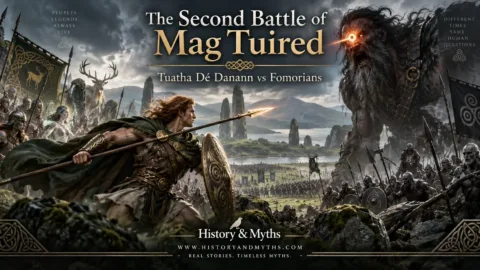
What Was the Second Battle of Mag Tuired?
The Second Battle of Mag Tuired was the decisive conflict between the Tuatha Dé Danann and the Fomorians in Irish mythology. In the medieval Irish tale Cath Maige Tuired, it marks the end of a period in which Fomorian power had grown over the Tuatha Dé and tribute had been imposed on them.
The battle is also known as the Second Battle of Moytura, an older English form of the place name. It is traditionally associated with Mag Tuired near Lough Arrow in County Sligo. It should not be confused with the First Battle of Mag Tuired, which was fought between the Tuatha Dé Danann and the Fir Bolg at a different site.
By the time the second battle begins, the struggle is about kingship, tribute, and political control as much as warfare. The two sides are also connected by family ties: Bres has both Tuatha Dé and Fomorian ancestry, while Lugh is the grandson of Balor.
First Battle vs Second Battle of Mag Tuired
The two battles of Mag Tuired are often confused, but they involve different enemies and play different roles in the story of the Tuatha Dé Danann.
The First Battle of Mag Tuired is fought between the Tuatha Dé Danann and the Fir Bolg. The Tuatha Dé win, but their king Nuada loses his hand, an injury that prevents him from continuing as ruler under the standards of kingship in the tale.
The Second Battle of Mag Tuired takes place later and pits the Tuatha Dé against the Fomorians. By then, the conflict is no longer about conquering Ireland, but about Fomorian power, Bres’s kingship, and the political crisis that follows.
How the First Battle Created the Next Crisis
Nuada’s injury left the Tuatha Dé Danann with a succession problem. Within the logic of the tale, a king with a physical blemish could no longer rule.
They chose Bres, whose father was the Fomorian Elatha and whose mother, Ériu, belonged to the Tuatha Dé. His mixed ancestry made him a politically useful choice at a time when relations with the Fomorians still mattered.
During Bres’s reign, Dian Cécht fitted Nuada with a silver hand, but his son Míach later restored the injured hand to flesh. After Bres lost the kingship, Nuada was able to rule the Tuatha Dé once again.
The decision to appoint Bres had solved the immediate problem of the throne, but created a deeper one. Under his rule, Fomorian influence over the Tuatha Dé grew, turning a succession crisis into the conflict that would eventually lead to war.
Bres Becomes King and Fomorian Power Grows
Bres did not fail because of his ancestry alone. The problem was how he ruled. Under his kingship, the Tuatha Dé Danann were increasingly burdened by Fomorian demands and tribute, while Bres failed to meet the expectations attached to a generous and legitimate king.
The tale shows this failure through hospitality and status. Important figures are treated poorly, and the court lacks the generosity expected of a ruler. The poet Cairbre eventually satirizes Bres, damaging his authority and helping turn dissatisfaction into open rejection of his rule.
Bres ultimately loses the kingship, ending his rule but not the political crisis it had created.
Why the Fomorians Went to War
After losing the kingship, Bres turned to his Fomorian relatives for support. Nuada returned to power, but Bres sought to reverse the change by drawing the Fomorians directly into the dispute.
He first appealed to his father Elatha, who directed him toward the powerful Fomorian leaders Balor and Indech. A large force was then gathered to challenge the Tuatha Dé Danann and restore Fomorian power in Ireland.
The war grew directly from the collapse of Bres’s rule and the Fomorians’ attempt to recover the influence they had gained during his reign.
Lugh Arrives at Tara
The balance begins to change when Lugh arrives at Tara and asks to join the court of Nuada.
The gatekeeper challenges him to name a skill the Tuatha Dé do not already possess. Lugh answers with one ability after another: warrior, smith, craftsman, poet, harpist, healer, and more. Each time, he is told that Tara already has someone who can perform that role.
What sets Lugh apart is that he possesses all of these skills together. He is admitted to the court, and as war approaches, Nuada gives him a leading role in preparing the Tuatha Dé Danann for the conflict with the Fomorians.
How Lugh Prepared the Tuatha Dé for War
Before the battle, Lugh asks the leading figures of the Tuatha Dé what each of them can contribute to the war.
The smith Goibniu, the bronze-worker Credne, and the carpenter Luchta prepare weapons and equipment. Dian Cécht takes responsibility for healing the wounded, while warriors, poets, druids, and other specialists offer their own skills. The Dagda and Morrígan also take on important roles in the preparations.
Under Lugh’s direction, craft, healing, magic, strategy, and fighting skill become parts of the same war effort.
The Dagda and the Morrígan Before the Battle
Before the fighting begins, the Dagda and the Morrígan take part in preparing for the Fomorian attack.
In Cath Maige Tuired, the Dagda meets the Morrígan near the River Unshin, where she tells him where the Fomorians are expected to land. She also promises to act against Indech, one of their leading kings, while the Tuatha Dé prepare for war.
Lugh then sends the Dagda to spy on the Fomorians and delay them until the Tuatha Dé are ready.
The Morrígan later joins the battle itself and, after the victory, proclaims the defeat of the Fomorians across Ireland.
Who Fought at the Second Battle of Mag Tuired?
On the side of the Tuatha Dé Danann were Lugh, Nuada, the Dagda, the Morrígan, Ogma, Goibniu, Dian Cécht, Credne, and Luchta, supported by warriors, druids, healers, and craftsmen.
The Fomorian side included major figures such as Balor, Indech, Bres, and Elatha.
The two sides were also connected by family ties. Bres had both Tuatha Dé and Fomorian ancestry, while Lugh was Balor’s grandson. The conflict was therefore shaped not only by war, but also by divided loyalties, kinship, and competing claims to power in Ireland.
The Second Battle of Mag Tuired Begins
When the battle begins, the Fomorians advance in force, while the Tuatha Dé rely on the preparations made before the fighting.
At first, Lugh is kept away from the front line because the Tuatha Dé do not want to risk someone whose many skills are too valuable to lose. Meanwhile, Goibniu, Luchta, and Credne keep replacing weapons, while Dian Cécht and the other healers restore wounded warriors at the well known as Sláine.
The Fomorians soon recognize the advantage this gives their enemies. They send Rúadán, the son of Bres, to discover how the system works and attack Goibniu, but the attempt fails to disrupt the Tuatha Dé’s preparations.
Balor Kills Nuada
As the fighting intensifies, Balor enters the battle with the deadly eye that makes him one of the Fomorians’ most feared figures.
During the clash, he kills Nuada, king of the Tuatha Dé Danann, along with Macha.
Soon afterward, Lugh confronts Balor directly, setting up the battle’s most famous duel.
Lugh vs Balor
After Nuada’s death, Lugh faces Balor, his maternal grandfather and one of the most dangerous leaders of the Fomorians.
Balor’s power comes from a deadly eye that must be lifted open before it can be used. As his attendants raise the eyelid, Lugh strikes first, hurling a sling stone into the eye.
The blow drives the eye through the back of Balor’s head, turning its destructive power against the Fomorian army behind him. Balor is killed, and the loss of their most powerful champion helps turn the battle against the Fomorians.
The duel also carries a personal tension at the heart of the story: Lugh defeats his own maternal grandfather while fighting for the Tuatha Dé Danann.
The Defeat of the Fomorians
After Balor’s death, the battle turns decisively in favor of the Tuatha Dé Danann.
The Fomorian forces collapse, and the survivors are driven from the battlefield toward the sea. The Morrígan later proclaims the victory across Ireland, marking the end of Fomorian domination over the Tuatha Dé.
The fighting is over, but one important question remains. Bres has been captured alive, and the Tuatha Dé must decide what to do with the former king.
What Happened to Bres After the Battle?
After the Fomorians were defeated, Bres was captured alive. The Tuatha Dé considered killing him, but he tried to bargain for his life by offering them benefits in return.
He first promised that Ireland’s cows would always give milk, then offered repeated harvests throughout the year. Both proposals were rejected. What finally saved him was practical agricultural knowledge: Bres explained when the people of Ireland should plough, sow, and reap.
Bres was spared. The former king who had helped bring Fomorian power over the Tuatha Dé survived by offering knowledge that remained useful after the war.
What Changed After the Battle?
The victory at Mag Tuired ended Fomorian domination over the Tuatha Dé Danann and settled the political crisis that had begun with Nuada’s injury and Bres’s kingship.
With Nuada dead and Bres removed from power, Lugh emerged as the figure most closely associated with the victory. The Fomorians, however, did not disappear from Irish mythology and continued to appear as a supernatural people in later tradition.
The battle therefore changed both the political balance and the leadership of the Tuatha Dé Danann.
Read More
Was the Second Battle of Mag Tuired a Real Historical Battle?
There is no evidence that the Second Battle of Mag Tuired was a documented historical battle fought exactly as the story describes.
The surviving account belongs to medieval Irish literature and includes supernatural peoples, magical weapons, prophecy, healing, and figures such as Lugh and Balor. It is therefore better understood as a mythological narrative than as a literal record of warfare in ancient Ireland.
The tale may preserve older traditions and ideas about kingship, conflict, and social order, but those elements cannot be securely reconstructed as a confirmed historical event.
It is more useful as evidence for medieval Irish ideas about power, legitimate rule, kinship, and authority than as a record of a specific ancient battle.
Why the Second Battle of Mag Tuired Matters
The Second Battle of Mag Tuired is one of the central stories of Irish mythology because it brings together kingship, family loyalty, warfare, magic, and political legitimacy in a single conflict.
The story also resists a simple division between good and evil. The two sides are connected by blood, and several of the main figures belong to both worlds through ancestry.
At its core, Mag Tuired is a story about who has the right to rule, what makes that rule legitimate, and how power is gained, challenged, and lost.
Academic Sources
Primary Text and Critical Edition
- Gray, Elizabeth A., ed. and trans.
Cath Maige Tuired: The Second Battle of Mag Tuired.
Irish Texts Society, 1982.
Electronic edition published by CELT, University College Cork.
This is the principal source for the narrative of Bres, Nuada, Lugh,
Balor, the Dagda, the Morrígan, the craftsmen, the healers,
and the battle itself. - Stokes, Whitley, ed. and trans.
“The Second Battle of Moytura.”
Revue Celtique, Vol. 12, 1891, pp. 52–130, 306–308.
An earlier scholarly edition and translation of the same medieval Irish
tale, useful for comparison with later critical editions.
Modern Academic Scholarship
- Gray, Elizabeth A.
“Tuatha Dé and Fomoiri in Cath Maige Tuired.”
In Myth and History in Celtic and Scandinavian Traditions,
edited by Emily Lyle, Amsterdam University Press, 2021, pp. 49–70.
A focused study of kinship, hostility, kingship, and the cooperation
of the Tuatha Dé against the Fomorians. - Carey, John.
“The Nature of the Fomoiri: The Dark Other in the Medieval Irish Imagination.”
In Myth and History in Celtic and Scandinavian Traditions,
edited by Emily Lyle, Amsterdam University Press, 2021, pp. 25–48.
Important for understanding why the Fomorians should not be reduced
to a simple race of evil or chaotic beings. - Nagy, Joseph Falaky.
“How Time Flies in the Cath Maige Tuired.”
In Myth and History in Celtic and Scandinavian Traditions,
edited by Emily Lyle, Amsterdam University Press, 2021, pp. 95–116.
Examines the tale as medieval Irish myth and pseudohistory,
with particular attention to Lugh, the Dagda, and the broader meaning
of the conflict.
This article follows the medieval Irish narrative preserved in
Cath Maige Tuired while distinguishing the story itself from
modern historical reconstruction. Interpretations of kingship, kinship,
the Fomorians, and the social meaning of the battle are supported by
modern scholarship in Celtic studies.
© 2026 History & Myths. All rights reserved.
This article is original content and may not be copied, republished, adapted, or redistributed without prior written permission.