Oisín and Tír na nÓg: The Irish Hero Who Returned 300 Years Later
Oisín and Tír na nÓg is one of the best-known stories in Irish mythology. It follows Oisín, the warrior-poet son of Fionn mac Cumhaill, who leaves Ireland with the mysterious Niamh and travels to Tír na nÓg, the legendary Land of Youth.
There, Oisín finds a life untouched by ordinary aging. He marries Niamh and remains in the Otherworld for centuries, but eventually begins to long for Ireland, Fionn, and the Fianna.
Niamh allows him to return on one condition: he must never touch the ground. When Oisín reaches Ireland, he discovers that the world he knew has disappeared. The Fianna are gone, centuries have passed, and the country he left behind survives only in memory.
The familiar version of the story is simple, but the surviving tradition is more complicated. Some details repeated in modern retellings, including how long Oisín stayed in Tír na nÓg and who Niamh’s father was, do not match the surviving lay exactly.
The story also preserves episodes that are often left out today, making Oisín’s journey more than a tale about eternal youth. It is also a story about time, memory, and what it means to return to a world that has moved on without you.
Who Was Oisín?
Oisín was a warrior and poet of the Fianna, the legendary band of fighters led by his father, Fionn mac Cumhaill. He is one of the central figures of the Fenian Cycle, the group of Irish stories built around Fionn, the Fianna, and their adventures.
Oisín is remembered not only as a warrior, but also as a storyteller connected with the memory of the Fianna. Later tradition often places him in conversation with Saint Patrick, recalling the companions, hunts, and battles of an age that has already passed.
That connection to the old heroic world is important in the story of Tír na nÓg. When Oisín leaves Ireland, he leaves behind Fionn, the Fianna, and the life he has always known. His attachment to them will eventually draw him back.
His journey begins when a mysterious woman named Niamh comes looking for him.
How Did Oisín Meet Niamh?
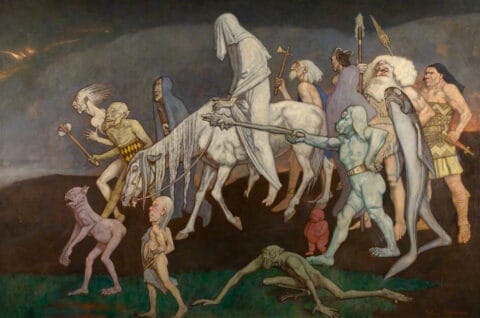
Oisín meets Niamh of the Golden Hair while hunting with Fionn and a small group of the Fianna near Loch Léin. She arrives from the west on a white horse, immediately drawing the attention of the hunting party.
Niamh tells Fionn that she has come from Tír na nÓg, where her father is king. She has heard of Oisín’s courage and reputation and says she crossed the sea specifically to find him.
Oisín is quickly drawn to her, and Niamh asks him to leave Ireland and travel with her to the Land of Youth.
She describes Tír na nÓg as a place without sickness or decline, filled with music, wealth, horses, feasting, and lasting youth. She also promises that they will live there together as husband and wife.
Why Did Oisín Leave Ireland for Tír na nÓg?
Oisín leaves Ireland because Niamh offers him a life he cannot have among the Fianna: marriage with her in a land free from sickness, old age, and decline.
His decision is not a rejection of Fionn or his companions. He remains deeply attached to them, which is why he will later want to return. But at this moment, Niamh offers him youth, adventure, and a new life beyond Ireland.
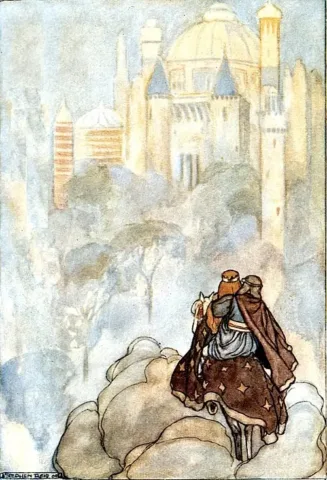
Oisín accepts her invitation, mounts the white horse behind her, and rides west across the sea.
Many modern retellings make the journey seem direct, but the surviving story gives Oisín another adventure before he reaches Tír na nÓg.
The Journey to Tír na nÓg
Oisín and Niamh ride west across the sea on her white horse. Along the way, Oisín sees strange islands, palaces, animals moving across the water, and riders passing through the supernatural landscape around them.
Before reaching Tír na nÓg, they enter another otherworldly land ruled by Fomhor Builleach, a giant who has imprisoned the daughter of the King of the Land of Life. He cannot marry her unless he first defeats a champion in single combat.
Oisín accepts the challenge, fights Fomhor Builleach, and kills him, freeing the princess.
Only after this encounter do Oisín and Niamh continue toward Tír na nÓg. This episode is often omitted from modern retellings, which usually present the journey as a direct ride from Ireland to the Land of Youth.
What Was Tír na nÓg Like?
Tír na nÓg, the Land of Youth, is described as a place beyond the ordinary limits of human life. Its people remain young, sickness and decline are absent, and life is marked by music, feasting, horses, wealth, and abundance.
For Oisín, its greatest difference is simple: he does not grow old there. Time passes, but it does not affect him as it would in Ireland.
The true cost of that difference only becomes clear when he eventually returns home.
Oisín and Niamh’s Life in the Land of Youth
Oisín is welcomed into Tír na nÓg and marries Niamh of the Golden Hair.
They have three children: two sons and a daughter. Niamh names the boys Finn and Oscar, after Oisín’s father and his dead son, while their daughter is called Flower-of-Women.
The surviving lay says that Oisín remains in Tír na nÓg for three hundred years and more, without growing old.
Eventually, his thoughts turn back to Fionn, the Fianna, and Ireland. After centuries in the Land of Youth, he asks Niamh to let him return home.
Why Did Oisín Want to Return to Ireland?
Oisín’s life in Tír na nÓg never erases his attachment to Ireland. After centuries away, he wants to know what became of Fionn, the Fianna, and the places he once knew.
The surviving story does not present his return as a rejection of Niamh or dissatisfaction with the Land of Youth. His motive is simpler: he wants to see the world he left behind.
Niamh knows that Ireland has changed far more than Oisín realizes, but he remains determined to go back.
She eventually agrees to let him return on the white horse, with one condition that will decide whether he can ever come back to Tír na nÓg.
Niamh’s Warning Before Oisín Returned
Niamh agrees to let Oisín return to Ireland, but she warns him three times not to dismount from the white horse or allow his feet to touch Irish soil. If he does, he will lose any chance of returning to Tír na nÓg.
She also tells him that Ireland is no longer the country he remembers. Fionn and the Fianna are gone, and a new Christian age of priests and saints has taken their place.
Oisín promises to obey her and leaves Tír na nÓg still young and strong, riding the same white horse that carried him away centuries earlier.
What Did Oisín Find When He Returned to Ireland?
When Oisín finally reaches Ireland, the country is familiar only in name.
The people he meets are strangers to him, and they are just as astonished by his size, his appearance, and the white horse beneath him. Oisín immediately asks about Fionn and the Fianna.
He is told that Fionn and the last of the Fianna have been dead for about three hundred years. Their deeds survive only in stories and songs.
Oisín is still young and unchanged, but the Ireland he knew is gone.
He continues through the country searching for traces of the old world until he reaches Gleann na Smól, where a group of men struggling with a massive stone asks for his help.
How Did Oisín Fall from the Horse?
At Gleann na Smól, Oisín sees men struggling to move a large stone and decides to help without dismounting.
He leans down from Niamh’s white horse and lifts the stone, but the saddle-girth breaks and throws him to the ground.
The moment he touches Irish soil, Niamh’s warning comes true.
Oisín’s youth vanishes at once. The centuries that passed while he remained unchanged in Tír na nÓg catch up with him, leaving him old, weak, and unable to return to the Land of Youth.
The men who had seen a powerful warrior on horseback now find an aged stranger before them.
Oisín and Saint Patrick
After his fall, Oisín tells his story to Saint Patrick, who serves as the listener within the surviving lay.
Their meeting belongs to a wider Irish tradition in which survivors of the Fianna encounter Patrick and recall the heroic age. In the medieval Acallam na Senórach, Oisín and especially Caílte mac Rónáin are among the figures who preserve stories of Fionn and his companions.
In Laoi Oisín ar Thír na nÓg, Oisín recounts his journey with Niamh, his life in the Land of Youth, and his return to Ireland. The lay ends within this conversation and does not narrate Oisín’s death as part of the Tír na nÓg story.
Which Version of Oisín and Tír na nÓg Did We Just Read?
The story above follows Laoi Oisín ar Thír na nÓg, the Irish lay that preserves Niamh’s arrival, Oisín’s journey west, his life in the Land of Youth, his return to Ireland, the broken saddle-girth, and his conversation with Saint Patrick.
The lay survives through later editions and translations, including those associated with Bryan O’Looney and Tomás Ó Flannghaile. It is traditionally attributed to Micheál Coimín, although that attribution is not completely secure.
Modern retellings often combine this lay with details from other Fenian traditions or later versions. Here, the lay remains the main narrative source, so those additions can be separated from what the surviving text actually preserves.
Was Niamh Really the Daughter of Manannán mac Lir?
Not in Laoi Oisín ar Thír na nÓg.
In the surviving lay, Niamh introduces herself as the daughter of the King of Tír na nÓg. Her father is never identified as Manannán mac Lir.
The connection with Manannán appears in later retellings and summaries, probably because of his strong association with the sea and the Irish Otherworld.
So in the version followed here, Niamh is the daughter of the King of the Land of Youth, not Manannán.
Read Also
The Celtic Otherworld: Tír na nÓg, Sídhe and Annwn Explained
Did Oisín Really Spend Only Three Years in Tír na nÓg?
The familiar version says that Oisín believed he had spent only three years in Tír na nÓg while three hundred years passed in Ireland.
That is not how the surviving lay presents it. In O’Looney’s translation of Laoi Oisín ar Thír na nÓg, Oisín says he had lived in the Land of Youth for “three hundred years and more” before longing to see Fionn and the Fianna again.
The three-years-versus-three-hundred-years version appears in later retellings such as P. W. Joyce’s, where Niamh corrects Oisín after he says he thinks only three years have passed.
So the three-hundred-year absence belongs to the story, but the idea that Oisín experienced only three years is a later reshaping rather than a detail stated in the surviving lay.
How Old Is the Story of Oisín and Tír na nÓg?
The version of Oisín and Tír na nÓg most people know today is not preserved as a medieval Irish tale. Laoi Oisín ar Thír na nÓg is usually treated as a much later Ossianic lay, probably composed in the eighteenth century.
The story, however, draws on much older Irish traditions. Tales of heroes entering the Otherworld with supernatural women, unusual differences in time, and encounters between survivors of the Fianna and Saint Patrick were already part of Irish storytelling long before this lay appeared.
The familiar Oisín-and-Niamh narrative is relatively late, but many of the traditions behind it are much older.
Calling it simply an “ancient Celtic myth” is too broad, while treating it as a purely eighteenth-century invention misses the older material it draws from.
Was the Story Really Written by Micheál Coimín?
Laoi Oisín ar Thír na nÓg is traditionally attributed to Micheál Coimín, an Irish-language writer from County Clare who lived from about 1680 to 1760. The lay is usually dated to around 1750.
The attribution is plausible, but not certain. The Dictionary of Irish Biography notes that Coimín’s authorship has been questioned and that the evidence is largely circumstantial.
Part of the uncertainty comes from the text’s later publication history. Brian O’Looney published an edition of the lay in 1859, more than a century after Coimín’s lifetime, leaving some distance between the supposed author and the surviving printed tradition.
For that reason, Coimín is best treated as the traditional attribution, not as an authorship that can be proved beyond doubt.
Popular Retelling vs. the Surviving Lay
Several details in the version commonly told today differ from what
Laoi Oisín ar Thír na nÓg actually preserves.
| Popular Retelling | What the Surviving Lay Says |
|---|---|
| Niamh is the daughter of Manannán mac Lir. | Niamh identifies herself as the daughter of the King of Tír na nÓg. |
| Oisín rides directly from Ireland to Tír na nÓg. | His journey includes another supernatural land, a battle with Fomhor Builleach, and the rescue of a captive princess. |
| Oisín spends only three years in the Land of Youth. | The lay says he remains there for three hundred years and more. |
| Oisín and Niamh simply live together in eternal youth. | They marry and have three children: Finn, Oscar, and Flower-of-Women. |
| Oisín falls because the horse stumbles. | The saddle-girth breaks while he is helping men move a heavy stone. |
| The story ends when Oisín becomes an old man. | The surviving lay continues within Oisín’s conversation with Saint Patrick. |
| The familiar story is simply an ancient Celtic myth. | The surviving Oisín-and-Niamh lay is relatively late, although it draws on much older Irish traditions. |
Why Does Time Work Differently in Tír na nÓg?
The story never explains exactly how time works in Tír na nÓg. It simply presents the Land of Youth as a place where ordinary human aging does not operate in the same way.
That idea appears elsewhere in Irish Otherworld tradition, where a visitor may remain unchanged while generations pass in the mortal world.
Oisín’s case makes the contrast especially clear. As long as he remains in Tír na nÓg, he does not age. Once he returns to Ireland and touches the ground, the centuries that passed outside the Otherworld are suddenly reflected in his body.
Tír na nÓg is not simply a distant land. It is a place where time and human life follow different rules from those of the mortal world.
What Does Oisín’s Return Really Mean?
Oisín’s return is about more than losing eternal youth. He comes back to Ireland and finds that the world he knew has disappeared.
Fionn and the Fianna are gone, their deeds survive in memory, and Ireland has entered a different age. Oisín has returned to the same country, but no longer to the society he once belonged to.
His loss is double. He cannot return to Tír na nÓg, and he cannot recover the life he came home hoping to find.
His conversation with Saint Patrick sharpens that contrast. Oisín becomes a voice from the vanished world of the Fianna, remembering an age that now survives through stories.
Why Oisín and Tír na nÓg Still Matters
The story endures because it turns a fantasy about eternal youth into a question about time and belonging.
Tír na nÓg offers freedom from aging, but Oisín’s return reveals the cost of stepping outside ordinary human life: the world continues changing even when you do not.
That tension between youth, memory, and loss is what gives the story its lasting power.
Academic Sources
This article draws on the surviving Oisín and Tír na nÓg lay, together with academic studies of the Fenian tradition, Oisín’s relationship with Saint Patrick, and the later literary history of the tale.
Bryan O’Looney (ed. and trans.), “Laoi Oisín i dTír na nÓg: The Land of Youth.”
Transactions of the Ossianic Society, Vol. IV, Dublin, 1859. The principal nineteenth-century edition and English translation of the lay followed in this article, including Niamh’s arrival, Oisín’s journey, his life in Tír na nÓg, return to Ireland, and conversation with Saint Patrick.
Máirtín Ó Briain, “Some Material on Oisín in the Land of Youth.”
In Donnchadh Ó Corráin, Liam Breatnach, and Kim McCone (eds.), Sages, Saints and Storytellers: Celtic Studies in Honour of Professor James Carney, Maynooth: An Sagart, 1989, pp. 181–199. A specialist study directly concerned with the Oisín and Land of Youth tradition.
Kevin Murray, The Early Fenian Corpus.
Cork Studies in Celtic Literatures 5, University College Cork, 2021. A scholarly catalogue and study of early Fenian texts, including the traditions surrounding Fionn, Oisín, Oscar, and the Fianna.
Síle Ní Mhurchú, “Agallamh Oisín agus Phádraig: Composition and Transmission.”
In Sharon J. Arbuthnot and Geraldine Parsons (eds.), The Gaelic Finn Tradition, Four Courts Press, 2012, pp. 195–208. A peer-reviewed study of the Oisín and Saint Patrick dialogue tradition that forms an important background to the ending of the Tír na nÓg lay.
Gerard Murphy, The Ossianic Lore and Romantic Tales of Medieval Ireland.
Cork, 1955; revised edition 1971. A major scholarly study of Fenian and Ossianic literature, useful for placing Oisín within the broader development of Irish heroic and romantic storytelling.
Vincent Morley, “Comyn, Michael (Micheál Coimín).”
Dictionary of Irish Biography, Royal Irish Academy. A scholarly biographical reference for Micheál Coimín, the traditional attribution of Laoi Oisín ar Thír na nÓg, and the uncertainty surrounding that authorship.
Copyright Notice
© 2026 History & Myths. All rights reserved.
This article is original editorial content created for HistoryAndMyths.com.
Unauthorized reproduction, republication, or substantial copying of the text,
structure, or original analysis is prohibited without prior written permission.
Brief quotations are permitted for commentary, research, or educational use
when accompanied by clear attribution and a link to the original article.