Goibniu: Divine Smith of the Tuatha Dé Danann
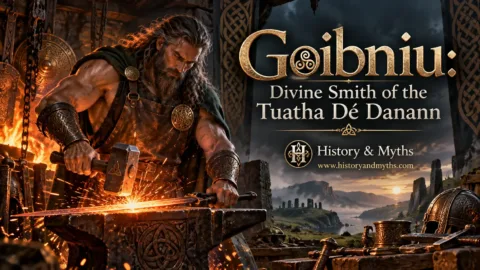
Goibniu is the great smith of the Tuatha Dé Danann and one of the craftsmen whose skills help shape the outcome of the war against the Fomorians. In Cath Maige Tuired, his value lies in what he can produce: reliable weapons made quickly enough to keep the Tuatha supplied during battle.
He works alongside Luchta and Crédne, whose crafts complete the weapon-making process, and his importance becomes clear when the Fomorians send Ruadán to kill him. Goibniu survives the attack, kills Ruadán with the same spear used against him, and is later healed at the Well of Sláine.
Later traditions connect Goibniu with a supernatural feast and a drink associated with freedom from sickness and aging. These traditions come from a different layer of the sources, so his earliest and most secure identity remains that of the divine smith whose craft gives the Tuatha Dé Danann a practical advantage in war.
Who Was Goibniu?
Goibniu was the smith of the Tuatha Dé Danann. In Cath Maige Tuired, he stands among the specialists who prepare the Tuatha for battle, alongside figures such as Dían Cécht, Luchta, and Crédne.
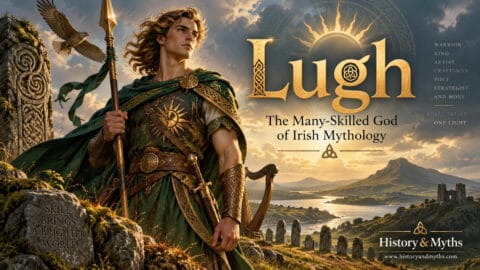
When Lugh asks what he can contribute to the coming conflict, Goibniu promises to replace broken swords and spears and declares that weapons made by him will not fail in battle. His role is therefore clear from the start: he is not a ceremonial figure, but one of the people whose skill directly supports the Tuatha Dé Danann’s ability to fight.
What Does the Name Goibniu Mean?
Goibniu’s name is directly connected with his craft. It belongs to the same Celtic word family as Old Irish gobae , meaning “smith,” making metalworking part of his identity at the level of the name itself.
Related forms appear elsewhere in the Celtic world. Welsh tradition has Gofannon, while Gaulish evidence preserves Gobannus. The linguistic connection points to an older Celtic smith tradition, although it does not mean that these figures should be treated as identical versions of the same deity.
Goibniu and the Divine Craftsmen of the Tuatha Dé Danann
In Cath Maige Tuired , Goibniu works as part of a group of specialist craftsmen preparing the Tuatha Dé Danann for war.
Goibniu forges the metal parts of weapons, Luchta makes shafts and shields, and Crédne produces fittings such as spear rivets, sword hilts, shield bosses, and rims. Their work is divided by craft, with each specialist completing a different stage of production.
This division of labor gives the story a surprisingly organized view of divine warfare. The Tuatha Dé Danann depend not only on warriors, but also on craftsmen and healers whose skills keep the army equipped and functioning.
Goibniu at the Second Battle of Mag Tuired
Goibniu’s importance becomes clearest during the war against the Fomorians. When Lugh asks what each member of the Tuatha Dé Danann can contribute, Goibniu promises to replace broken swords and spearheads and says that weapons made by him will not fail in battle.
Once the fighting begins, that promise becomes part of the Tuatha Dé Danann’s advantage. Goibniu continues producing swords, spears, and javelins while Luchta and Crédne complete the other stages of weapon production.
His contribution is logistical rather than heroic in the usual sense. Goibniu does not lead charges or defeat famous enemies in combat. He keeps the Tuatha supplied with weapons while the battle continues.
How Did Goibniu Forge Weapons So Quickly?
Cath Maige Tuired describes Goibniu’s skill in strikingly simple terms: he could make swords, spears, and javelins with only three strokes in the forge.
Luchta and Crédne work with comparable speed, allowing the craftsmen to turn out complete weapons with extraordinary efficiency. The point is not that Goibniu creates one unique magical weapon, but that he can repeatedly produce effective weapons fast enough to meet the needs of an army.
This makes speed one of the defining features of his smithcraft. His supernatural ability lies as much in rapid production as in the quality of what he makes.
Why Did the Fomorians Target Goibniu?
The Fomorians target Goibniu after learning how the Tuatha Dé Danann are sustaining themselves in battle.
In Cath Maige Tuired , Ruadán is sent to discover the source of their advantage. He reports on the work of Goibniu, Luchta, Crédne, and the healers at the Well of Sláine. The Fomorians then send him back with orders to kill Goibniu.
The choice makes sense strategically. Removing the smith would disrupt the production of weapons and weaken one of the systems keeping the Tuatha Dé Danann effective in war.
Goibniu and the Death of Ruadán
Ruadán approaches the craftsmen and obtains the parts of a spear from them: Goibniu provides the spearhead, Crédne the rivets, and Luchta the shaft.
Once the weapon is assembled, Ruadán turns it against Goibniu and wounds him. Goibniu pulls the spear from his body and throws it back, striking Ruadán fatally.
The scene gives Goibniu one of his few direct moments of violence in the story. The smith who normally supports the battle from the forge survives an assassination attempt and kills the man sent to remove him.
How Was Goibniu Healed at the Well of Sláine?
After Ruadán wounds him, Goibniu goes to the Well of Sláine and is restored to health. Cath Maige Tuired describes the recovery briefly: he enters the well and “became whole.”
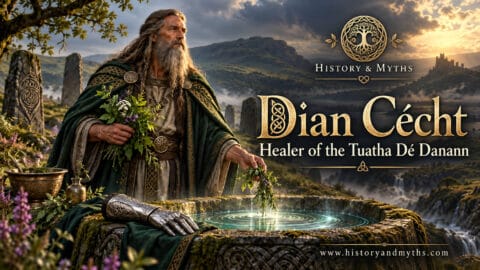
The well is associated with Dían Cécht and the healers of the Tuatha Dé Danann, who use it to restore wounded fighters. The text also calls it Loch Luibe, linking it with the herbs placed there by Dían Cécht.
Goibniu’s recovery shows how quickly the Tuatha Dé Danann could restore important members of their force. The Fomorians eventually recognize the threat posed by the well and attempt to disable it by filling it with stones.
Was Goibniu Related to Nuada and Dían Cécht?
Goibniu’s relationship with Dían Cécht is explicit in Lebor Gabála Érenn . One recension names Goibniu, Crédne, Dían Cécht, and Luichne as the four sons of Esarg, making Goibniu and Dían Cécht brothers in that tradition.
Cath Maige Tuired also places Goibniu and Dían Cécht among Nuada’s close kin, although translations differ in how precisely that relationship is rendered. Elizabeth Gray translates the passage as describing them as Nuada’s “kinsmen,” while the older translation by Whitley Stokes calls them his brothers.
The safest conclusion is therefore that Goibniu belonged to Nuada’s close divine kin group, while the surviving traditions should not be forced into one perfectly consistent family tree.
Did Goibniu Make Nuada’s Silver Hand?
No. Cath Maige Tuired attributes Nuada’s silver hand to Dían Cécht, with Crédne assisting him. After Sreng cuts off Nuada’s hand, Dían Cécht fits him with a silver replacement that moves like a natural hand. Goibniu is not named as its maker.
Modern retellings sometimes assign the hand to Goibniu because he is the best-known smith among the Tuatha Dé Danann, but the surviving text gives the work to Dían Cécht and Crédne.
Later, Dían Cécht’s son Míach restores Nuada’s natural hand, replacing the silver prosthesis altogether.
What Was the Feast of Goibniu, and Did His Ale Grant Immortality?
Later Irish tradition associates Goibniu with fled Goibnenn , the “Feast of Goibniu,” a supernatural banquet linked with freedom from sickness and old age.
The feast is especially associated with ale or drink consumed by the people of the síd. Later tradition presents it as part of the reason they do not suffer normal aging and disease, which is why modern retellings sometimes describe Goibniu’s drink as granting immortality.
That wording is stronger than the surviving evidence. The tradition is better understood as describing protection from aging and sickness rather than a clearly defined potion of immortality.
The dating also matters. The Feast of Goibniu is not part of the main battle narrative in Cath Maige Tuired , and it is attested in later medieval tradition. It should therefore be treated as a later layer of Goibniu’s character rather than as part of the same early portrayal that presents him primarily as the smith of the Tuatha Dé Danann.
Goibniu in the St Gall Incantations
Goibniu also appears outside the mythological battle narratives. In an Old Irish incantation preserved in the St Gall manuscript Cod. 1395, his name is invoked in a charm used against a thorn or splinter.
The charm combines Christian language with an appeal to Goibniu’s skill. It calls on the “science” of Goibniu to remove the offending object, while butter is applied around the affected area.
The text does not prove that Goibniu still had an organized cult in medieval Ireland. It does show that his name remained associated with specialized skill and practical protection long after the mythological stories in which he appears.
Was Goibniu a Fire God?
Goibniu is sometimes described as a fire god, but the Irish sources do not clearly support that label.
Fire is essential to smithing, and Goibniu naturally works through the forge, but Cath Maige Tuired presents him as a smith and craftsman rather than as a deity who rules fire itself.
He is better described as the divine smith of the Tuatha Dé Danann, with fire belonging to his craft rather than forming a separate divine domain.
Goibniu, Gofannon, and Gobannus
Goibniu belongs to a wider Celtic smith tradition that extends beyond medieval Irish mythology.
His closest Welsh parallel is Gofannon, a master smith in Middle Welsh tradition. Their names are linguistically related to the Celtic word for “smith,” which supports a genuine connection between the two figures rather than a resemblance based only on profession.
Continental Celtic evidence also preserves the name Gobannus or Cobannus in Roman-period inscriptions. The related names in Irish, Welsh, and Gaulish traditions suggest that the divine smith had deep roots across the Celtic-speaking world.
These figures should not be merged into a single mythology. Their names and functions are related, but each survives within a different regional tradition with its own stories and development.
Which Medieval Sources Mention Goibniu?
The fullest account of Goibniu appears in Cath Maige Tuired . It presents him as the smith of the Tuatha Dé Danann, describes his work with Luchta and Crédne, recounts Ruadán’s attack, and records his recovery at the Well of Sláine.
Lebor Gabála Érenn preserves genealogical material connecting Goibniu with other members of the Tuatha Dé Danann, although the surviving traditions do not always produce a single consistent family tree.
The St Gall material preserves a different kind of evidence. There, Goibniu appears in an Old Irish incantation, showing that his name remained associated with specialized skill outside narrative mythology.
Later medieval sources, including Acallam na Senórach and Altram Tige Dá Medar , preserve traditions connected with the Feast of Goibniu and protection from sickness and old age. These sources belong to different periods and contexts, so they are best read as separate layers in the development of his character rather than as parts of one continuous biography.
Conclusion
Goibniu is one of the clearest examples of a divine specialist among the Tuatha Dé Danann. In Cath Maige Tuired , his importance comes from his craft: he produces weapons rapidly, works with other craftsmen, survives an attempt on his life, and returns to the conflict after being healed.
Later traditions expand his character through feasting, protective associations, and wider Celtic parallels, but the forge remains the most secure starting point for understanding him.
Academic Sources and Primary Texts
Elizabeth A. Gray, ed. and trans., Cath Maige Tuired: The Second Battle of Mag Tuired.
Irish Texts Society, 1982. Digital edition hosted by the CELT Project, University College Cork. This is the principal source for Goibniu’s role as smith, his work with Luchta and Crédne, Ruadán’s attack, and the Well of Sláine.
University College Cork, CELT
R. A. Stewart Macalister, ed. and trans., Lebor Gabála Érenn: The Book of the Taking of Ireland.
Irish Texts Society, 1938-1956. Important for the genealogical traditions surrounding Goibniu, Dían Cécht, Crédne, and other members of the Tuatha Dé Danann.
CELT Online Index, University College Cork
John Carey, Magic, Metallurgy and Imagination in Medieval Ireland: Three Studies.
Celtic Studies Publications, 2019. A major modern study of smithcraft, magical knowledge, Goibniu, medieval Irish charms, and the later traditions surrounding the Feast of Goibniu.
University College Cork Research Portal
Whitley Stokes and John Strachan, eds., Thesaurus Palaeohibernicus, Vol. II.
Cambridge University Press, 1903. Contains the Old Irish St Gall material, including the incantation in which Goibniu’s name is invoked in connection with the removal of a thorn or splinter.
Digitized edition
John T. Koch, ed., Celtic Culture: A Historical Encyclopedia.
ABC-CLIO, 2006. Scholarly reference work useful for Goibniu, Gofannon, Celtic smith traditions, and the wider linguistic and cultural context of divine craftsmen across the Celtic-speaking world.
University of Wales Centre for Advanced Welsh and Celtic Studies
Further reading: Gregory R. Darwin, review of John Carey’s Magic, Metallurgy and Imagination in Medieval Ireland, The Medieval Review, 2021. The review is especially useful for the scholarly discussion of Goibniu, smithcraft, magical knowledge, and the later dating of the Feast of Goibniu tradition.
The Medieval Review, Indiana University