Norse Creation Myth: Ginnungagap, Ymir and the Birth of the World
The Norse creation myth does not begin with gods building a finished universe from nothing. It begins with a vast empty space called Ginnungagap, bordered by forces of cold and heat. From that meeting came Ymir, the primordial being whose body would later become the material of the world.
The familiar story continues with Auðhumla, Búri, Odin and his brothers, the death of Ymir, and the creation of earth, sea, sky, and humanity. But the surviving sources do not preserve one single, perfectly consistent version of these events.
Some details come from early Eddic poems, while others are explained more fully by Snorri Sturluson centuries later. Even the identity of the gods who create the first humans changes between sources.
To understand the Norse creation myth properly, we need to separate the older poetic traditions from later medieval reconstruction and distinguish what the sources clearly say from what modern retellings often add.
What Existed Before the Norse World?
The earliest surviving poetic account begins before Odin, Asgard, or any familiar landscape has taken shape.
In Völuspá, there is no earth, no sea, no heaven above, and no grass. Ymir already exists, while the cosmos is described around a vast “yawning gap”, later known as Ginnungagap.
The poem leaves that primordial setting largely undefined.
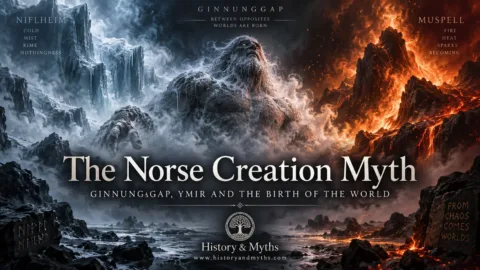
Snorri Sturluson’s Prose Edda gives Ginnungagap a more detailed place in the cosmos. He places Niflheim, a region of cold and mist, to the north and Muspell, a region of heat and fire, to the south. Ginnungagap lies between them, becoming the space where the conditions for the first living beings develop.
Modern retellings sometimes call Ginnungagap “chaos,” but that can suggest more than the sources actually say. It is better understood as an open, unformed cosmic space before the world is divided into recognizable realms.
The important distinction is that the older poem gives us the basic primordial setting, while Snorri later supplies much of the geography and sequence that make the creation story feel continuous.
Niflheim, Muspell and the Birth of Ymir
The familiar story of Ymir’s birth comes most clearly from Snorri Sturluson’s Prose Edda.
To the north of Ginnungagap lies Niflheim, a region of cold, mist, and ice. From it flow the rivers called Élivágar, whose frozen waters spread into the gap. To the south lies Muspell, a region of intense heat and fire.
Where the cold rime reached the warmer part of Ginnungagap, it began to melt. According to Snorri, the resulting drops were quickened by the heat and formed a living being: Ymir.
Ymir was not a god in the same sense as Odin or Thor. He was a primordial being and the ancestor of the frost giants, existing before the later divine order had taken shape.
This is often reduced to the phrase “fire and ice created Ymir,” but that can hide an important source issue. Völuspá already knows Ymir as a figure from the earliest age, yet it does not narrate this detailed sequence of Niflheim, Muspell, melting rime, and living drops.
That fuller account belongs mainly to Snorri’s medieval reconstruction of the creation story.
Was Ymir the First God?
Ymir is sometimes described as the “first Norse god,” but that is not the most accurate way to understand him.
In Snorri’s creation account, Ymir is the first living being formed in Ginnungagap. He exists before Odin and the later gods, but he belongs to a different category. The tradition presents him as a primordial being and the ancestor of the jötnar, the beings commonly translated as giants.
This distinction matters because Ymir does not rule an early pantheon or perform the role of a creator god. He is part of the raw beginning of the cosmos itself. Life emerges through him before the divine order represented by Odin and his family appears.
The later gods will eventually kill Ymir and use his body to shape the world, making him both an ancestor of living beings and the physical material from which much of the cosmos is formed.
So Ymir is better described as the primordial ancestor of the giants and one of the first beings in Norse cosmogony, rather than simply the first god.
Auðhumla and the Strange Birth of Búri
Ymir was not the only being to emerge from the melting rime. In Snorri Sturluson’s Prose Edda, the same process also produces Auðhumla, a great cow who becomes essential to the survival of the first beings.
Ymir feeds on four streams of milk flowing from her udders. Auðhumla, meanwhile, survives by licking salty blocks of ice.
Over three days, something unexpected emerges from the ice. On the first day, hair appears. On the second, a head. By the third, the complete figure of Búri is revealed.
Búri becomes important because he stands at the beginning of the divine family that will eventually produce Odin. His son Borr later fathers Odin, Vili, and Vé.
The story is striking because the first divine ancestor is not born in the usual sense. He is uncovered from the ice itself, almost as if the primordial world already contains the possibility of the gods before they fully appear.
An important source distinction remains, however. The detailed story of Auðhumla licking Búri from the ice is preserved most clearly in Snorri’s Gylfaginning. It should not be presented as though every early Norse poem tells the same sequence.
From Búri to Odin, Vili and Vé
Búri does not create the later gods directly. In Snorri’s Gylfaginning, he has a son named Borr, who marries Bestla, the daughter of the giant Bölthorn.
Their children are Odin, Vili, and Vé.
That genealogy is important because it joins two sides of the early cosmos. Through Búri and Borr, the brothers belong to the emerging divine line. Through Bestla, they are also connected by blood to the giants.
So when Odin and his brothers later turn against Ymir, the story is not simply about gods fighting a completely separate race. The divine and giant families are already intertwined.
Snorri presents Odin, Vili, and Vé as the generation that transforms the primordial world into an ordered one. Their first decisive act is the killing of Ymir, whose body becomes the material from which the world is shaped.
Why Did Odin, Vili and Vé Kill Ymir?
The surviving sources tell us clearly that Odin, Vili, and Vé killed Ymir. They are much less clear about why.
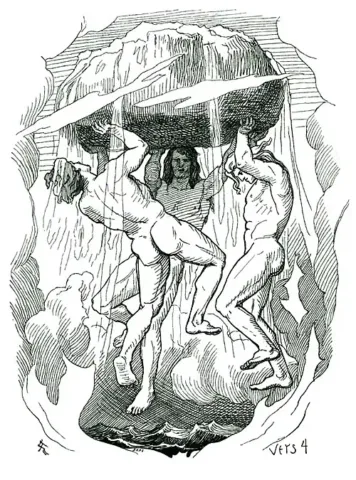
In Snorri’s Gylfaginning, the sons of Borr simply turn against Ymir and kill him. His death unleashes so much blood that nearly all the frost giants are drowned, after which the brothers use his body to construct the world.
What Snorri does not give us is a detailed motive. He does not say that Ymir was evil, that he threatened the gods, or that Odin had already planned to create the world from his body.
That matters because modern retellings often turn the episode into a simple battle between good gods and a chaotic monster. The medieval source is more restrained.
Ymir belongs to the primordial world that exists before the cosmos is ordered. His death marks the transition from that older state into a structured world, but the texts explain the consequences of the killing far more clearly than the reason for it.
So the safest conclusion is simple: Odin and his brothers kill Ymir, and his body becomes the material of creation. Any more detailed motive is interpretation, not something the surviving sources state directly.
How the World Was Made from Ymir’s Body
After Ymir’s death, the sons of Borr use his body to shape the world.
In Snorri’s Gylfaginning, Ymir’s flesh becomes the earth, his blood the seas and lakes, his bones the mountains, and his teeth and broken bones the stones. His skull is raised above the world to form the sky, while his brain becomes the clouds.
The same basic idea also appears in Grímnismál, which gives a poetic list of the world’s parts made from Ymir’s body. This is important because it shows that the body-to-cosmos motif is not simply a detail invented by Snorri.
What Snorri does is arrange the material into a more continuous creation narrative.
The result is a very different kind of creation from making the universe out of nothing. The gods reshape existing matter. Ymir’s body becomes the physical structure of the world itself.
That is one of the defining ideas of Norse cosmogony: the ordered world is built from the remains of a primordial being.
What Happened to the Other Giants?
Ymir’s death does not end the race of giants.
In Snorri’s Gylfaginning, so much blood pours from Ymir’s wounds that almost all of the frost giants are drowned. One survivor, Bergelmir, escapes with his wife and becomes the ancestor of later generations of giants.
The older poem Vafþrúðnismál also knows Bergelmir, placing him several generations after the primordial giant Aurgelmir. That means Bergelmir was not simply a character invented by Snorri to explain the survival of the giants.
What becomes less certain is the exact manner of his escape. Some translations describe him surviving in a boat or ark, while the underlying Old Norse word has been interpreted in other ways as well.
So the safest point is not that Norse mythology preserves a direct equivalent of Noah’s flood. It is that Ymir’s death creates a catastrophic flood of blood, Bergelmir survives it with his household, and the giant line continues through him.
Were Ymir and Aurgelmir the Same Being?
In Snorri Sturluson’s Prose Edda, the answer is yes. He says that the primordial being is called Ymir, while the frost giants call him Aurgelmir.
The older poetic evidence is less straightforward.
In Vafþrúðnismál, Aurgelmir appears as the early ancestor of the giants, while Ymir is named elsewhere in the poem as the figure from whose body the world is made. The poem itself does not pause to explain that the two names belong to the same being.
Snorri resolves that tension by identifying them directly.
That may preserve a genuine older tradition, but it also shows how his prose account works: separate poetic references are often combined into a smoother and more unified story.
So the safest conclusion is that Ymir and Aurgelmir are treated as the same figure in Snorri’s account, while the surviving poems preserve the names in a less explicitly unified way.
How Were the Sun, Moon and Stars Placed in the Sky?
After the earth and sky were formed, the cosmos still needed light, movement, and a way to measure time.
The older poems already know Sól and Máni, the Sun and Moon, as figures who travel across the heavens. In Vafþrúðnismál, both are said to be the children of Mundilfari, and their daily journeys help mark the passage of time.
Snorri gives the story a fuller narrative. In Gylfaginning, the gods place Sól and Máni in the sky and assign them their courses. Sól drives the chariot of the sun, while Máni governs the moon’s movement and its waxing and waning.
Snorri also says that the sun’s light comes from glowing material taken from Muspell, extending the earlier creation story into a more detailed cosmic system.
The important point is that the Sun and Moon are not merely objects in Norse tradition. They are personified beings whose movement gives order to time.
The surviving sources agree on their importance, but the more elaborate explanation of how they were placed in the heavens comes mainly from Snorri’s prose account.
How Was Midgard Created?
Midgard was not simply another name for the whole universe. In the surviving creation tradition, it is the protected human world within the larger cosmos.
Grímnismál says that the gods made Midgard from Ymir’s eyebrows “for the sons of men.” Snorri develops the image further in Gylfaginning, describing Midgard as a fortified enclosure built around the inhabited world against the giants beyond it.
That makes Midgard more than a piece of geography. Its defining feature is the boundary between the human realm and the dangerous outer world associated with the giants.
The detail also shows again how Ymir’s body becomes architecture as well as landscape. His flesh becomes earth, his skull the sky, and his brows form the barrier around the human domain.
So Midgard is best understood as the ordered space prepared for humanity, not simply as a generic synonym for Earth.
Who Actually Created Ask and Embla?
The first humans in Norse tradition are Ask and Embla, but the surviving sources do not agree completely on which gods created them.
In Völuspá, three gods find Ask and Embla without breath, spirit, or the qualities needed for human life. The poem names them as Odin, Hœnir, and Lóðurr. Each contributes something different, including breath or spirit, mental capacity, and physical vitality.
Snorri’s Gylfaginning tells a similar story but changes the divine trio. There, the creators are the sons of Borr, usually understood as Odin, Vili, and Vé. They find two pieces of wood, shape them into human beings, and give them life, intelligence, movement, appearance, speech, hearing, and sight.
That difference is important. Modern summaries often say simply that Odin, Vili, and Vé created the first humans, as though the sources preserve one fixed version.
They do not.
What remains consistent is the larger idea: humanity begins when divine beings find lifeless material and give it the qualities that make human life possible. The identity of Odin remains stable, but the names of his companions vary between the poetic and prose traditions.
Read More
- What If Ragnarök Never Happened? Norse Mythology Reimagined
- What If Loki Had Never Turned Against the Gods? Norse Myth Scenarios
- Odin: All-Father, Chief of the Norse Gods and God of Wisdom
- Thor: Norse God of Thunder, Mjölnir and Viking-Age Worship
- Yggdrasil: The World Tree of Norse Mythology Explained
- The Nine Worlds of Norse Mythology Explained: Asgard to Hel
- Ragnarök Explained: How the Norse World Ends and What Comes After
Did the Gods Create All Nine Worlds at Once?
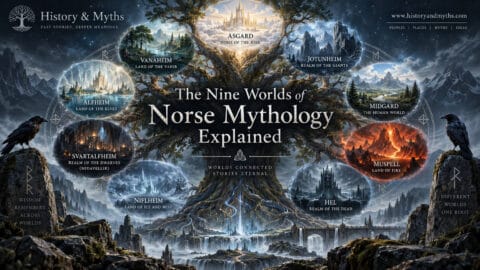
Norse mythology does speak of nine worlds, but the surviving sources never give us a single creation scene in which the gods build nine named realms one after another.
Völuspá mentions “nine worlds” very early in the poem, yet it does not list them. Other Eddic poems and Snorri’s Prose Edda refer to places such as Asgard, Midgard, Jötunheim, and the realms connected with fire, ice, gods, giants, and the dead, but they do not combine them into one universally agreed nine-item catalogue.
That means the familiar modern list of the Nine Worlds is partly a reconstruction from references scattered across different sources.
The creation story itself focuses much more clearly on shaping the earth, sky, seas, Midgard, and the celestial order from pre-existing material.
So it is safer to say that the Norse cosmos contained multiple interconnected worlds, with the number nine carrying clear importance, than to claim that the sources preserve one fixed map showing exactly which nine realms were created at the same moment.
Was Norse Creation Really a Battle Between Order and Chaos?
Modern retellings often describe the creation myth as a struggle between order and chaos, but the surviving sources are less explicit.
Ymir belongs to the primordial world before the cosmos is fully structured, and his death allows Odin and his brothers to shape earth, sea, sky, and Midgard. That can reasonably be read as a movement from an unformed state toward order.
What the texts do not clearly say is that Ymir represents evil chaos or that the gods kill him as part of a moral battle.
The contrast between disorder and structure is useful as an interpretation, but it should not be presented as a literal doctrine stated by the sources.
What the Poetic Edda Says vs What Snorri Adds
The Norse creation story survives in fragments spread across several poems rather than in one complete early narrative.
Völuspá gives the primordial setting, Ymir, the shaping of the world, and the creation of humanity. Vafþrúðnismál preserves details about Ymir, Aurgelmir, Bergelmir, the Sun, Moon, and origins of the giants. Grímnismál describes how parts of Ymir’s body became the world.
Snorri Sturluson’s Prose Edda gathers this material into a more continuous story and adds much of the detail about Niflheim, Muspell, Auðhumla, Búri, and the sequence of creation.
That makes Snorri essential, but not identical to the older poetic tradition.
How Much of the Story Is Really Pre-Christian?
Much of the material in the Norse creation myth clearly preserves traditions older than the surviving medieval manuscripts, especially where the same ideas appear across Eddic poems and later prose.
But the texts we have were written down in Christian Iceland, and Snorri was writing in the thirteenth century.
That means we cannot simply treat every detail in the Prose Edda as a direct transcript of Viking Age belief.
The safest approach is to distinguish between older poetic material, later medieval organization, and modern reconstruction. The creation myth is rooted in pre-Christian tradition, but the exact form in which we know it today is the product of several layers of transmission.
What We Can Say with Confidence About the Norse Creation Myth
Strongly Attested
The surviving Eddic tradition clearly preserves Ymir as a primordial being, the use of his body to form parts of the world, the creation of Ask and Embla, and references to a cosmos of multiple worlds.
Reasonable Interpretation
The creation story can reasonably be read as a movement from an unformed primordial state toward an ordered cosmos shaped by the gods from pre-existing material.
Uncertain or Later Reconstruction
The fully connected sequence involving Niflheim, Muspell, Auðhumla, Búri, and a neatly organized creation of the Nine Worlds depends heavily on Snorri’s later prose synthesis and modern reconstruction rather than one complete early poetic account.
Frequently Asked Questions
Who created the world in Norse mythology?
Odin, Vili, and Vé are said in Snorri’s account to have shaped the world from Ymir’s body, creating the earth, seas, mountains, and sky from his remains.
Was Ymir the first god?
Not exactly. Ymir is better described as a primordial being and ancestor of the giants rather than the first god of the Norse pantheon.
What existed before the Norse world?
The earliest poems describe an unformed cosmic state centered on a vast yawning gap, later identified as Ginnungagap. Snorri places Niflheim and Muspell on opposite sides of it.
Who created Ask and Embla?
The answer depends on the source. Völuspá names Odin, Hœnir, and Lóðurr, while Snorri’s prose tradition associates their creation with Odin and his brothers.
Are the Nine Worlds listed in the Norse sources?
No surviving source gives one definitive list of nine named worlds. The familiar modern lists are reconstructed from places mentioned across different Norse texts.
Academic Sources & Primary Texts
The Poetic Edda
Translated by Carolyne Larrington, 2nd revised edition, Oxford University Press, 2014.
Especially relevant are Völuspá, Vafþrúðnismál, and
Grímnismál, which preserve major poetic traditions concerning Ymir,
the primordial cosmos, the creation of the world, and the first humans.
Snorri Sturluson, Edda: Prologue and Gylfaginning
Edited by Anthony Faulkes, 2nd edition, Viking Society for Northern Research, 2005.
This is the principal prose source for the connected creation narrative involving
Ginnungagap, Niflheim, Muspell, Ymir, Auðhumla, Búri, and the shaping of the cosmos.
John Lindow, Old Norse Mythology
Oxford University Press, 2021.
A modern scholarly study of Old Norse mythology that examines the gods,
giants, cosmology, surviving sources, and the problems involved in reconstructing
pre-Christian Scandinavian belief from medieval texts.
Rudolf Simek, Dictionary of Northern Mythology
Translated by Angela Hall, D. S. Brewer, 2007.
A scholarly reference work useful for the major figures and concepts discussed
in the creation tradition, including Ymir, Ginnungagap, Búri, the giants,
Midgard, and the structure of the Norse cosmos.
Margaret Clunies Ross, Prolonged Echoes: Old Norse Myths in Medieval Northern Society, Vol. 1: The Myths
Odense University Press, 1994.
An important academic study for understanding the structure and interpretation
of Old Norse myth, including the relationships between gods, giants, cosmic
creation, and the medieval transmission of pre-Christian traditions.
Copyright & Use
Written by H. Moses for
History & Myths.
This article is original content created for History & Myths.
Reproduction, republication, or full redistribution of this content is not permitted
without prior permission.
Short quotations may be used for educational, academic, or commentary purposes
with clear attribution and a link back to the original article.