The Dagda: Chief God of the Tuatha Dé Danann | Irish God
The Dagda was one of the most important divine figures in early Irish mythology and a leading member of the Tuatha Dé Danann. He appears as a king, warrior, druid, provider, and master of powerful magical objects, yet the surviving stories never reduce him to a single role.
He is often described online as a “Celtic father god” or simply a god of fertility and abundance, but the medieval Irish texts present a more complicated figure. The Dagda can be wise and formidable in one scene, comic and deliberately excessive in another. His cauldron, great club, harp, family ties, and role in the Battle of Mag Tuired all reveal different sides of the same character.
Understanding the Dagda therefore means separating what the Irish texts actually say from later interpretations and modern attempts to fit him into a neat Celtic pantheon.
Who Was the Dagda in Irish Mythology?
The Dagda was one of the leading figures of the Tuatha Dé Danann, the supernatural people at the center of much of Ireland’s early mythological tradition.
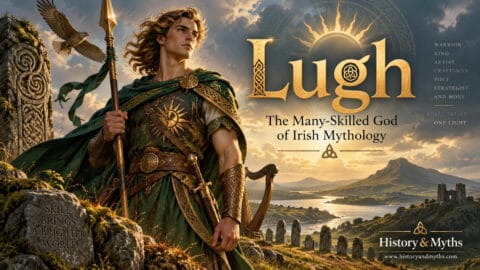
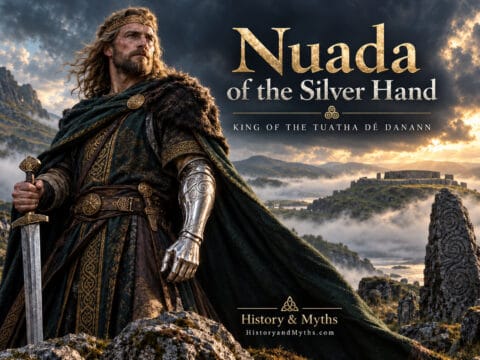
In Cath Maige Tuired, he appears alongside figures such as Nuada, Lugh, Ogma, Goibniu, and the Morrígan. He takes part in preparations for war against the Fomorians, uses magic, fights with immense physical force, and performs tasks that place him close to the center of the Tuatha Dé Danann’s affairs.
His importance does not come from one fixed office. Depending on the story, the Dagda can appear as a ruler, warrior, druid, provider, or figure of exceptional knowledge.
He is therefore best understood as one of the major divine figures of Irish mythology, rather than as a direct Celtic equivalent of Zeus, Odin, or another ruler of a neatly organized pantheon.
What Does the Name “Dagda” Actually Mean?
“Dagda” is usually translated as “the Good God,” but “good” here should not be understood simply as morally virtuous.
In Cath Maige Tuired, the name is linked to ability. During preparations for battle, the Dagda claims that he can perform the skills offered by the other specialists. He is then identified as the “Good God,” suggesting excellence, competence, or mastery rather than kindness.
That meaning fits the surviving stories. The Dagda can be generous and protective, but also violent, cunning, sexual, and deliberately comic.
Other names and titles include Eochaid Ollathair, commonly interpreted as “All-Father,” and Ruad Rofhessa, associated with great knowledge. These titles reinforce his authority and wide-ranging abilities without establishing him as the permanent ruler of every Celtic deity.
Was the Dagda Really the Chief God of the Tuatha Dé Danann?
Describing the Dagda as the “chief god” of the Tuatha Dé Danann is reasonable shorthand, but it should not be taken as evidence of a fixed divine hierarchy.
Several traditions give him exceptional status. He is called Ollathair, and some accounts place him among the rulers of the Tuatha Dé Danann. The National Museum of Ireland also describes him as their chief god.
The myths themselves, however, distribute leadership among several figures. Nuada holds kingship, while Lugh takes command before the Second Battle of Mag Tuired. The Dagda remains one of the most powerful and influential members of the group, but he is not consistently shown ruling above everyone else.
“Chief god” therefore describes his importance better than it describes a formal position. The surviving tradition does not present the Tuatha Dé Danann as a rigid pantheon with one permanent ruler at the top.
The Dagda Was More Than a “God of” List
Modern summaries often describe the Dagda as a god of fertility, agriculture, magic, strength, life, death, and abundance. The medieval Irish texts are less tidy.
Rather than assigning him one fixed divine department, they show his importance through action. In Cath Maige Tuired, he demonstrates a wide range of abilities, uses magic and physical force, and plays an essential role in supporting the Tuatha Dé Danann.
His cauldron, harp, great club, and involvement in war, hospitality, kingship, and knowledge all point in the same direction: the Dagda is a highly multifunctional divine figure.
It is therefore more accurate to describe him through the roles he performs in the surviving stories than to reduce him to a modern checklist of things he supposedly “ruled.”
The Dagda’s Cauldron: Abundance, Hospitality and Power
The Dagda’s cauldron is one of the clearest symbols of his role as a provider.
In Cath Maige Tuired, the cauldron is said to have been brought from Murias, one of the four legendary cities from which the Tuatha Dé Danann acquired their great treasures. Its defining quality is simple: no company ever left it unsatisfied.
That wording is more precise than the common claim that the cauldron produced an endless supply of food. The text emphasizes satisfaction and abundance, not an explicit mechanism of infinite production.
In early Irish tradition, the ability to feed and sustain a household or community was closely connected with status and authority. The cauldron therefore fits the Dagda’s wider image as a figure whose power includes provision as well as magic and physical strength.
It is not simply a decorative magical object. Its importance lies in what it represents: Its importance lies in what it represents: the Dagda’s ability to provide abundance and satisfy those who depend on his hospitality.
The Dagda’s Great Club: Destruction and Restoration
The Dagda’s club is usually described as a weapon that could kill with one end and restore life with the other. That idea is genuine, but it does not come entirely from the same source that describes his role in the Second Battle of Mag Tuired.
In Cath Maige Tuired, the emphasis is on sheer destructive power. The Dagda promises to smash the enemy so thoroughly that their bones will lie across the battlefield like hailstones. His weapon is also described as enormous, heavy enough to leave a deep track behind him as he moves.
The famous power to kill and revive appears more clearly in other Irish traditions. In the story often called How the Dagda Got His Magic Staff, one end of the staff kills while the other restores the dead to life. A similar description survives in Mesca Ulad, where the rough end kills and the smooth end revives. Academic comparison of these traditions confirms that the reversible power belongs to the wider Dagda tradition, not simply to one passage in Cath Maige Tuired .
That distinction matters. The club is not just a symbol of brute strength. Across the surviving tradition, it combines destruction with restoration, making it one of the clearest expressions of the Dagda’s unusual ability to operate on both sides of the boundary between life and death.
But it would be misleading to imply that every medieval text gives the weapon exactly the same powers. The details vary, and the strongest account of resurrection comes from traditions outside the battle narrative itself.
The Dagda’s Harp and the Three Magical Strains
The Dagda’s harp is more than a magical instrument. In Cath Maige Tuired, it becomes a weapon of control.
After the battle, the Fomorians take the Dagda’s harper, Úaithne, and carry off the harp. The Dagda, Lugh, and Ogma pursue them to a banqueting hall, where the instrument hangs on the wall. When the Dagda calls it by its two names, Daur Dá Bláo and Cóir Cetharchair, the harp tears itself free and returns to him.
He then plays three distinct strains of music. One causes sorrow and makes the listeners weep. Another produces joy and laughter. The third brings sleep, leaving the Fomorian host unable to stop the escape.
These three strains are often presented as if they were simply built-in magical settings, but the episode says something broader about the Dagda. He does not merely possess the harp. He controls emotion, attention, and the rhythm of the scene through music.
There is also an important naming problem. Modern retellings often call the harp itself Uaithne, but the Irish text can be read as referring to Úaithne as the Dagda’s harper rather than the instrument. The harp itself is explicitly given the names Daur Dá Bláo and Cóir Cetharchair.
So “Uaithne, the Dagda’s harp” is useful shorthand, but it should not be presented as an uncontested fact from the source.
Why Is Such a Powerful God Portrayed as Ridiculous?
One of the strangest things about the Dagda is that the same text which presents him as powerful, skilled, and essential to the Tuatha Dé Danann also makes him look deliberately comic.
In Cath Maige Tuired, the Fomorians force him to consume an enormous quantity of porridge. His belly swells, his clothes are described as short and awkward, and his appearance becomes an object of laughter. Soon afterward, he is even mocked and physically overpowered in a comic encounter.
It would be easy to read these scenes as simple humiliation, but that interpretation is too narrow.
Scott A. Martin has argued that the Dagda’s portrayal in this tale deliberately connects him with the briugu, a high-status host or hospitaller in early Irish society. A briugu gained prestige through generosity, food, hospitality, and the ability to sustain others. The Dagda’s exaggerated appetite and association with abundance therefore fit a recognized social role rather than merely turning him into a joke.
The comedy may also make his power more distinctive. The Dagda does not need to look elegant or heroic in the conventional sense. His authority survives grotesque clothing, excessive eating, sexual humor, and physical absurdity.
That contrast is part of what makes him unusual. He can be ridiculous without becoming weak, and comic without losing his status as one of the most formidable figures among the Tuatha Dé Danann.
Read Also
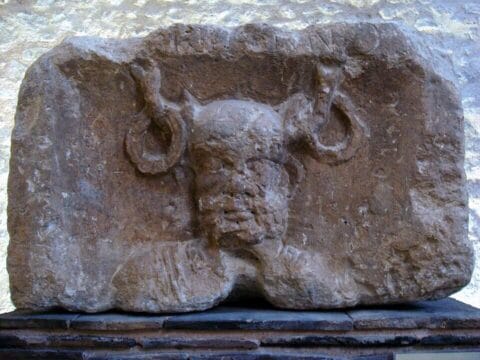
Cernunnos: Who Was the Celtic Horned God?
Who was Cernunnos, and what did his antlers symbolize? Explore the ancient Celtic carvings, mysterious religious imagery, and archaeological evidence behind the horned god.
The Dagda and the Morrígan Before the Battle of Mag Tuired
One of the Dagda’s most important encounters takes place shortly before the Second Battle of Mag Tuired, when he meets the Morrígan beside the River Unshin.
Cath Maige Tuired describes the Morrígan standing across the river with nine loosened tresses. The Dagda speaks with her, and the two unite at a place that the story later calls the “Bed of the Couple.”
The scene matters because of what happens next.
The Morrígan tells the Dagda where the Fomorians are expected to land and instructs him to summon Ireland’s skilled specialists to meet her at the ford. She then declares that she will attack Indech mac Dé Domnann, one of the Fomorian kings, and strip him of the blood of his heart and the “kidneys of his valour.” The forces waiting at the ford then use spells against the Fomorian host.
So the encounter is not simply a sexual episode inserted into the story. It forms part of the military preparation for the battle. The Dagda gains crucial information, while the Morrígan takes on an active role in weakening the enemy before the main confrontation.
The episode also shows how the Dagda’s power operates through alliance as much as individual strength. He is formidable on his own, but the victory of the Tuatha Dé Danann depends on cooperation between warriors, druids, craftsmen, and other divine figures with specialized powers.
Boann, Aengus and the Day That Lasted Nine Months
The story of Aengus’s birth gives the Dagda one of his clearest displays of control over time and circumstance.
In Tochmarc Étaíne, Boann is the wife of Elcmar, lord of Brú na Bóinne. The Dagda desires her, but Elcmar’s presence makes the relationship dangerous. Dagda therefore sends him away on a journey and places powerful spells on him so that hunger, thirst, and the passage of time no longer affect him normally.
The crucial detail is that nine months pass as though they were a single day. During that interval, Boann conceives and gives birth to Aengus before Elcmar returns .
A related version in the Metrical Dindshenchas describes the sun itself being held in place until the nine months were complete, showing that the tradition could imagine the episode in explicitly cosmic terms.
The episode reveals more than Dagda’s sexual cunning. His magic alters the normal relationship between time, daylight, and human experience, allowing an entire pregnancy to unfold inside what appears to be a single day.
It also establishes one of his most important family connections. Aengus, later called Mac Óc, becomes a major figure in his own right and remains closely tied to Brú na Bóinne in later tradition.
The Dagda and Brú na Bóinne: What the Myths Say
Brú na Bóinne occupies an important place in the Dagda’s mythology, but the stories do not present it in one simple, consistent way.
In The Wooing of Étaín, the site belongs to Elcmar when the Dagda fathers Aengus with Boann. Years later, after Aengus learns his true parentage, the Dagda helps him gain possession of the Brug through the famous request to rule it for “a day and a night.” Aengus then argues that all time is made of days and nights, allowing him to claim the place permanently.
Other traditions connect the Dagda even more directly with the site. The Metrical Dindshenchas describes the Brug as a royal dwelling built by the Dagda and preserves local features associated with him, including the “Bed of the Dagda.”
The National Museum of Ireland also notes that Newgrange was known in later Irish mythology as An Brug, a dwelling of the Tuatha Dé Danann, and specifically links the Dagda, Boann, and Aengus with the place.
So the safest conclusion is clear: Brú na Bóinne became one of the Dagda’s major mythological landscapes. What varies is exactly how the stories explain his relationship to it, whether as builder, ruler, father of Aengus there, or the figure who helps transfer the site to his son.
Was Newgrange Really a Temple of the Dagda?
Newgrange is strongly connected with the Dagda in later Irish mythology, but there is no archaeological evidence that it was originally built as his temple.
The monument dates to around 3200 BCE, placing its construction in the Middle Neolithic, thousands of years before the medieval manuscripts that preserve stories about the Dagda and the Tuatha Dé Danann. Archaeology identifies Newgrange as a passage tomb within the wider ritual landscape of Brú na Bóinne. Its chamber was deliberately aligned so that the rising sun enters the passage around the winter solstice.
What the builders believed cannot be reconstructed with certainty. The National Museum of Ireland explicitly notes that we can only speculate about their religious system and the meaning they gave to the monument’s solar alignment and decoration.
The Dagda connection belongs to a much later layer of Irish tradition. Medieval stories associated Brú na Bóinne with the Dagda, Boann, Aengus, and the Tuatha Dé Danann, showing that the ancient landscape had acquired a powerful mythological identity long after it was built.
So calling Newgrange “the Dagda’s temple” goes beyond the evidence. A more accurate statement is that Newgrange became one of the most important landscapes associated with the Dagda in Irish mythology, while its original Neolithic religion remains unknown.
Read Also
- Who Were the Druids and What Did They Believe?
- The Four Celtic Festivals: How Druids Shaped Samhain to Lughnasadh
- The Tuatha Dé Danann: The Supernatural Race of Irish Mythology
- Lugh: The Many-Skilled Irish God of the Tuatha Dé Danann
- The Fomorians in Irish Mythology: Giants, Monsters, and Rivals
- The Morrígan: Irish Goddess of War, Fate and Sovereignty
Who Were the Dagda’s Children and Family?
The Dagda’s family is important across Irish mythology, but there is no single medieval genealogy that neatly settles every relationship attributed to him.
Aengus is one of the clearest cases. The Wooing of Étaín explicitly makes him the son of the Dagda and Boann. The Dagda secretly fathers him while Boann’s husband Elcmar is away, then sends the child to Midir to be fostered. Aengus later learns his true parentage and becomes closely associated with Brú na Bóinne.
Other texts name Aed and Cermait alongside Aengus as sons of the Dagda. The Metrical Dindshenchas, for example, lists the three directly, while Cermait becomes important genealogically as the father of Mac Cuill, Mac Cecht, and Mac Gréine.
Brigid is also identified in the Lebor Gabála Érenn tradition as a daughter of the Dagda, linking two of the most prominent divine figures in later Irish tradition.
The difficulty begins when modern family trees try to combine every version into one system. Medieval Irish texts preserve different genealogies, relationships, and local traditions, and figures who are close relatives in one source may be described differently elsewhere.
So the safest picture is not a fixed divine dynasty. The Dagda stands at the center of a broad mythological family network, with Aengus, Aed, Cermait, and Brigid among the strongest relationships preserved in the surviving tradition.
How Did the Dagda Die?
The surviving traditions do not preserve one completely consistent account of the Dagda’s death.
The Annals of the Four Masters say that he died at Brú na Bóinne after an eighty-year reign from the venom of a wound inflicted by Cethlenn, wife of Balor. The annal places that wound in the “first battle of Mag Tuired,” although this creates a problem with other traditions that associate Cethlenn and Balor with the later conflict against the Fomorians.
Geoffrey Keating’s History of Ireland gives the same basic cause of death but says that the Dagda ruled for seventy years. Keating simply refers to the Battle of Mag Tuired without specifying the first or second battle.
Meanwhile, Cath Maige Tuired, the surviving narrative of the Second Battle, does not portray the Dagda as dying there. After the fighting, he joins Lugh and Ogma in pursuing the Fomorians and recovering his stolen harp.
The safest conclusion is therefore that later Irish tradition remembered the Dagda as receiving a wound from Cethlenn and dying from its effects much later at Brú na Bóinne. The exact battle and the length of his reign vary between sources, so neither detail should be treated as part of one fixed chronology.
Was the Dagda Actually Worshipped in Pre-Christian Ireland?
The Dagda is widely understood as preserving a pre-Christian Irish deity, but direct evidence for his specific worship is limited.
Modern scholarship generally treats the Tuatha Dé Danann as literary descendants of earlier divine figures. Mark Williams, in Ireland’s Immortals, examines how such figures were preserved and reshaped within medieval Christian literature. The Dagda’s prominence within that tradition makes a pre-Christian religious origin highly plausible.
What we do not have is a securely identified temple, inscription, priesthood, festival, or offering that can be tied specifically to the Dagda by name.
This is important because most of the surviving evidence for him comes from medieval texts written after Ireland’s conversion to Christianity. Those works may preserve older religious traditions, but they also reflect later storytelling, interpretation, and literary development.
The most cautious conclusion is that the Dagda probably preserves the memory of a pre-Christian deity, while the details of any cult, rituals, sacred places, or forms of worship dedicated specifically to him cannot be reconstructed with confidence.
Did Ancient Art Actually Depict the Dagda?
There is no securely identified ancient image of the Dagda.
Modern websites sometimes use figures from the Gundestrup Cauldron as if they were confirmed depictions of him, but the archaeological evidence does not support that identification. The National Museum of Denmark describes one famous figure simply as an antlered god surrounded by animals and does not identify it as the Dagda. Some scholars have associated that figure with Cernunnos, but that remains an interpretation rather than a named identification on the object itself.
This leaves an important limitation. The Dagda is known primarily through medieval Irish literature, not through inscriptions or ancient images that can be confidently matched to his name.
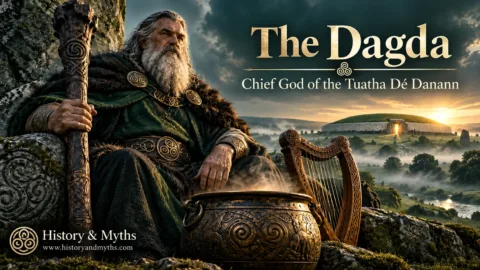
Modern portraits of him, often showing a bearded man with a club, cauldron, or harp, are therefore artistic reconstructions based on the surviving stories rather than verified ancient representations.
So when an image is labeled “the Dagda” in modern media, it should be treated as interpretation, not archaeological identification.
What We Can Say with Confidence About the Dagda
Strongly Attested
The Dagda is a major figure of the Tuatha Dé Danann and is associated in medieval Irish texts with the cauldron, harp, great club, magic, warfare, and Brú na Bóinne.
Reasonable Interpretation
The Dagda probably preserves the memory of a pre-Christian Irish deity, and parts of his portrayal may reflect older ideas connected with abundance, authority, hospitality, and divine power.
Uncertain or Modern Claim
There is no secure evidence for a temple, cult site, priesthood, or ancient image specifically identified as belonging to the Dagda. Claims that Newgrange was his temple or that particular ancient artworks depict him go beyond the available evidence.
Frequently Asked Questions About the Dagda
Is the Dagda an Irish god or a Celtic god?
The Dagda is most specifically an Irish god. He belongs to the tradition of the Tuatha Dé Danann preserved in medieval Irish literature, although he is often discussed more broadly within Celtic religion and mythology.
Is the Dagda the father of all the Irish gods?
No. Titles such as Ollathair, often translated as “All-Father,” should not be read as a literal claim that every Irish deity was his child. Medieval texts preserve several different divine genealogies.
Are the Dagda and Cernunnos the same god?
There is no reliable evidence that they were the same deity. The Dagda belongs primarily to Irish literary tradition, while Cernunnos is known mainly from inscriptions and images from other parts of the ancient Celtic world.
Was the Dagda’s cauldron an endless source of food?
The medieval text says that no company left the cauldron unsatisfied. Describing it as producing infinite food is a common modern simplification rather than the exact wording of the source.
Was Newgrange built for the Dagda?
There is no archaeological evidence for that claim. Newgrange was built in the Neolithic period thousands of years before the surviving medieval stories, although Brú na Bóinne later became strongly associated with the Dagda, Boann, and Aengus in Irish tradition.
Academic Sources
- University College Cork, CELT: Cath Maige Tuired: The Second Battle of Mag Tuired, translated by Elizabeth A. Gray.
- University College Cork, CELT: Tochmarc Étaíne (The Wooing of Étaín).
- Edward Gwynn: The Metrical Dindshenchas, Dublin Institute for Advanced Studies, digital edition through UCC CELT.
- Mark Williams: Ireland’s Immortals: A History of the Gods of Irish Myth, Princeton University Press, 2016.
- Scott A. Martin: “Following a Fork in the Text: the Dagda as briugu in Cath Maige Tuired,” University of Michigan.
- National Museum of Ireland: archaeological and mythological discussion of Newgrange and Brú na Bóinne.
- National Museum of Denmark: archaeological interpretation of the figures on the Gundestrup Cauldron.
Medieval Irish texts preserve traditions written and transmitted in different periods. Where accounts conflict, this article distinguishes between the primary sources, later interpretations, and archaeological evidence rather than combining them into a single fixed version.
Copyright & Use
Written by H. Moses. This article is original content created for History & Myths.
Reproduction, republication, or full redistribution of this article is not permitted without prior permission.
Short quotations may be used for educational, academic, or commentary purposes when accompanied by clear attribution and a link to the original article.