Fionn mac Cumhaill (Finn McCool): Hero of Irish Mythology
Fionn mac Cumhaill, also known as Finn McCool, was a legendary Irish warrior, poet, and leader of the Fianna, a band of hunters and fighters celebrated in the Fenian Cycle of Irish mythology. His stories follow a boy raised in hiding after his father’s death who gains extraordinary wisdom from the Salmon of Knowledge and eventually rises to command the Fianna.
Fionn was also the father of Oisín, another major figure in Irish legend. In later folklore, he became a giant associated with landmarks such as the Giant’s Causeway. These different portrayals developed over centuries, and although Fionn became one of Ireland’s most enduring legendary heroes, his existence as a historical person remains unproven.
Who Was Fionn mac Cumhaill?
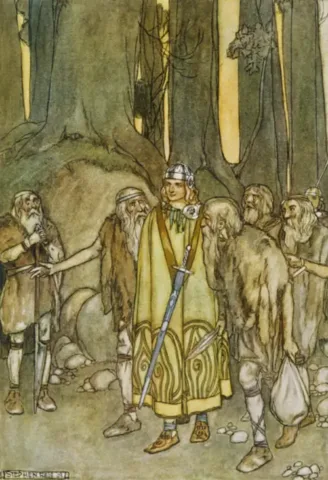
The name Fionn comes from the Old Irish find, meaning “fair” or “white,” while mac Cumhaill means “son of Cumhall.” Find is an Old Irish form of the name, Fionn is its modern Irish spelling, and Finn McCool is a familiar English rendering.
His stories belong to fiannaíocht, known in English as the Fenian or Finn Cycle. Unlike a single continuous epic, this tradition consists of tales and poems written and transmitted over many centuries. They follow Fionn and his companions through battles, hunts, rivalries, and encounters with supernatural beings. Many place their adventures during the legendary reign of Cormac mac Airt, the High King associated with Tara.
Fionn’s reputation changed as these stories developed. One early reference, possibly dating to the seventh century, associates him with a dangerous band of warriors. Later medieval literature increasingly celebrates his leadership and knowledge. In Acallam na Senórach (The Colloquy of the Ancients), the surviving warriors Caílte and Oisín recount the deeds of Fionn and the Fianna to Saint Patrick.
These accounts do not present an entirely consistent character. Fionn can be a respected leader and poet, but some stories also portray him as proud, jealous, or vengeful. His contradictions are part of the tradition, not simply differences introduced by modern retellings.
The Birth and Childhood of Fionn mac Cumhaill
Fionn’s father, Cumhall mac Trénmóir, was killed at the Battle of Cnucha before his son was born. In Macgnímartha Find (The Boyhood Deeds of Finn), the battle arose from a struggle for leadership of the fían. Goll mac Morna killed Cumhall, beginning a feud between their families. Another early tale, Fotha Catha Cnucha, connects the conflict to Cumhall’s seizure of Muirne, daughter of the druid Tadg, against her father’s wishes.
Muirne was pregnant when Cumhall died. She gave birth to a boy named Demne, but his father’s enemies made it dangerous for her to keep him. The druidess Bodhmall and the warrior woman Liath Luachra took the child into the forests of Sliabh Bladma, the Slieve Bloom Mountains, where they raised him in secret. His mother visited him after six years, leaving him in their care until he was old enough to fight.
Demne grew into an exceptional hunter and athlete. The tales describe him catching wild deer, defeating groups of boys at hurling, and displaying extraordinary strength. His exploits were not always harmless: during one confrontation at a lake, he drowned nine youths who had challenged him.
His name changed during these encounters. After Demne defeated a group of young players, they described him to a local chief as a handsome, fair-looking boy. The chief called him Finn, meaning “fair,” and the name eventually replaced Demne.
As the sons of Morna continued to threaten him, his foster mothers urged him to leave their protection. He entered the next stage of his life already skilled in hunting and combat.
How Did Fionn Gain the Salmon of Knowledge?
Fionn gained his legendary wisdom through an encounter with the Salmon of Knowledge, a magical fish associated with the River Boyne. According to The Boyhood Deeds of Finn, he went to study poetry under Finnéces, a poet who had spent seven years watching the salmon in Féc’s Pool. A prophecy had led Finnéces to believe that eating the fish would grant him extraordinary knowledge.
When the salmon was finally caught, Finnéces instructed his young pupil to cook it without tasting any. While preparing the fish, Fionn burned his thumb and instinctively put it into his mouth. When Finnéces questioned him, the boy explained what had happened. The poet realized that the prophecy had been fulfilled through his pupil rather than himself and allowed Fionn to eat the salmon.
From then on, Fionn could access hidden knowledge by placing his thumb in his mouth and performing teinm láida, a form of inspired poetic utterance. The tale also describes his mastery of traditional poetic arts, making wisdom and poetry essential parts of his legendary abilities.
How Did Fionn Become Leader of the Fianna?
One account of Fionn’s rise to leadership appears in Acallam na Senórach (The Colloquy of the Ancients), which places the events at the court of Conn Cétchathach.
After Cumhall’s death, command of the Fianna had passed to Goll mac Morna, the warrior who killed him. Fionn eventually appeared at the royal assembly at Tara, where he identified himself as Cumhall’s son and offered his service to King Conn Cétchathach.
Tara faced a supernatural threat. Every Samhain, Aillén mac Midgna emerged from Síd Fionnachaidh and played enchanted music that put everyone to sleep. He then breathed fire over Tara, leaving its defenders powerless to stop him. Conn promised to restore the rightful inheritance of anyone who could protect the royal seat until morning. Fionn accepted the challenge.
Fiacha mac Congha, a former supporter of Cumhall, supplied Fionn with a deadly spear in exchange for a share of his future gains and a place among his trusted advisers. He instructed Fionn to uncover its point and hold it against his forehead to resist Aillén’s magic.
When Aillén arrived, his music sent everyone else to sleep. Fionn remained awake and deflected the creature’s fire with his cloak. Aillén fled toward his supernatural dwelling, but Fionn pursued him and struck him with the spear as he reached its entrance. He cut off Aillén’s head and carried it back to Tara.
The assembled nobles awarded Fionn command of the Fianna. Conn then gave Goll a choice: leave Ireland or acknowledge Fionn as leader. Goll chose to submit, ending his command and restoring the position once held by Fionn’s father.
Who Were the Fianna?
The Fianna were bands of hunters and warriors in Irish legend, best known through the stories of Fionn mac Cumhaill. The singular Irish word fían referred to a warrior band, while fianna was its plural. In the Fenian Cycle, these groups travelled through forests and mountains, hunted wild animals, fought battles, and sometimes served the kings of Ireland.
Fionn’s followers included warriors from different families, particularly Clann Baiscne, his own lineage, and Clann Morna, associated with his former rival Goll. Their adventures also involved poetry, storytelling, and encounters with supernatural beings. The Fianna were celebrated for their fighting abilities, but physical strength was not their only qualification.
A tale called The Enumeration of Finn’s People describes demanding tests for new members. Candidates were expected to master poetry, defend themselves against thrown spears, and run through woodland without breaking a branch or disturbing their braided hair. These extraordinary trials reflect the idealized abilities of legendary warriors, not necessarily historical recruitment practices.
The Fianna had a basis in early Irish society. Medieval law texts refer to fíana composed partly of young men who had not yet inherited land or established independent households. Such groups could develop hunting and fighting skills outside their family communities. They were not always admired, however. Some religious sources portrayed them as raiders and troublemakers.
Fionn’s Powers, Wisdom and Legendary Adventures
Fionn’s abilities extended beyond physical strength. The Boyhood Deeds of Finn credits him with three forms of poetic knowledge: teinm láida, imbas forosnai, and díchetal do chennaib. These arts were associated with inspired understanding and the ability to uncover hidden information. The same tale preserves a poem attributed to Fionn celebrating the arrival of summer, presenting him as an accomplished poet as well as a warrior.
His adventures frequently involved hunting and encounters with supernatural beings. In The Enchanted Cave of Keshcorran, Fionn travels with his celebrated hounds, Bran and Sceólang, while the Fianna hunt across the surrounding countryside. Their presence angers Conaran, a supernatural lord associated with the Tuatha Dé Danann, who sends his three daughters to punish them.
The women spin enchanted yarn at a cave entrance. When Fionn and his companion Conán approach, the spell strips them of their strength. Other members of the Fianna fall into the same trap and are imprisoned inside the cave. Goll mac Morna, despite his family’s longstanding rivalry with Fionn, comes to their rescue. He kills two of the sorceresses and compels the third to release the captives.
Another major adventure appears in The Battle of Ventry (Cath Finntrágha). Here, Fionn and the Fianna defend Ireland against an invading army led by Dáire Donn, described as the King of the World. The conflict grows into an enormous legendary battle involving warriors from distant lands and supernatural allies. The surviving extended narrative belongs to a later stage of the Fenian tradition, showing how Fionn’s exploits developed into increasingly elaborate heroic tales.
Fionn’s Family, Allies and Rivals
In a widely told legend, he falls in love with Sadhbh, a woman transformed into a deer by supernatural magic. She becomes the mother of his son Oisín, whose name means “little deer.” The story survives in different forms, and an earlier tradition names Oisín’s deer-mother Blaí Derg. Oisín later becomes a celebrated poet and warrior of the Fianna, while his own son, Oscar, earns a reputation for exceptional courage.
Among Fionn’s closest companions was Caílte mac Rónáin, renowned for his speed and knowledge of Ireland’s landscapes. In Acallam na Senórach, Caílte and Oisín survive into the age of Saint Patrick, preserving memories of Fionn and his warriors through their stories.
A more bitter conflict developed with Diarmuid Ua Duibhne, one of Fionn’s own followers. In The Pursuit of Diarmuid and Gráinne, Gráinne, the daughter of King Cormac mac Airt, is promised in marriage to Fionn but flees with Diarmuid instead. Fionn pursues the couple across Ireland, and even after their reconciliation, resentment remains. When Diarmuid is fatally wounded during a boar hunt, Fionn delays using his healing power to save him. His actions turn a dispute over loyalty and marriage into one of the most tragic episodes of the Fenian Cycle.
Was Finn McCool Really a Giant?
Fionn mac Cumhaill was not originally portrayed as a giant. In the medieval Fenian tales, he was an extraordinary human warrior whose reputation rested on his strength, wisdom, and leadership. His gigantic size became a prominent feature of later Irish and Scottish folklore, particularly in stories explaining unusual landscapes.
The best-known example is the Giant’s Causeway on the northern coast of Ireland. According to one popular legend, Finn McCool built a stone pathway across the sea to confront Benandonner, a Scottish giant. But when he realized how enormous his opponent was, Finn retreated to Ireland.
In a widely told version, Finn’s wife Oonagh saves him by disguising him as a baby. When Benandonner arrives and sees the enormous infant, he imagines that its father must be even larger. Terrified, he flees to Scotland, destroying much of the causeway behind him.
Other versions give Finn different reasons for building the crossing, including a desire to visit a Scottish woman. These variations belong to the character’s later folklore rather than the early medieval accounts of his adventures.
The Giant’s Causeway itself is a natural formation of approximately 40,000 interlocking basalt columns, created by volcanic activity around 60 million years ago. The legend reflects how Finn’s growing reputation became attached to one of Ireland’s most distinctive landscapes.
How Did Fionn mac Cumhaill Die?
Irish tradition preserves several accounts of Fionn mac Cumhaill’s death. One widely recorded version places his final battle at Áth Brea on the River Boyne, where he fights the Lúagni Temrach. A warrior named Aiclech mac Dubdrenn kills Fionn and cuts off his head. This account appears in Aided Finn (The Death of Finn) and is also mentioned in medieval poetry and annals.
Another version, preserved in two damaged manuscript fragments, gives Fionn a very different ending. As he grows old, his warriors gradually abandon him until only one remains. Determined to test his fading strength, he travels to a place on the Boyne known as Léim Finn, or Finn’s Leap.
The fragments mention a prophecy concerning his death after drinking from a horn, although part of the story is missing. When Fionn attempts his leap, he falls between two rocks, strikes his forehead, and dies. Four fishermen discover his body, including Aiclech, who beheads him. Unlike the battle narrative, this version makes Fionn’s fall the cause of his death. His severed head later speaks when the fishermen fail to give it a share of their meal.
Later folklore offers another possibility. In a tale recorded in County Leitrim, Fionn and the Fianna lie sleeping inside a cave at Sheemore, waiting to awaken when Ireland needs them. This tradition preserves the expectation of the hero’s return rather than describing his death.
Read Also
Was Fionn mac Cumhaill a Real Person?
There is no reliable historical evidence confirming that Fionn mac Cumhaill existed as a real individual. Irish tradition places him during the reigns of legendary kings such as Cormac mac Airt, often associated with the third century CE, but these accounts cannot establish when, or whether, he lived.
Fionn appears in Irish literature centuries after the period in which his adventures are set. One of the earliest possible references occurs in a poem attributed to Senchán Torpéist, perhaps dating to the seventh century. Unlike later heroic tales, it associates him with a threatening band of warriors. His appearance in medieval genealogies and annals reflects his established place in Irish tradition rather than independent proof of his existence.
The legendary Fianna had a recognizable social background. Early Irish law texts describe fíana, groups of young warriors whose activities included hunting and fighting. Their existence helps explain the setting of Fionn’s stories, but it does not establish that he commanded an actual historical band.
His origins may also be older than the surviving narratives. Historian Ailbhe Mac Shamhráin has argued that Fionn developed from an earlier divine figure who was subsequently incorporated into Irish heroic genealogies. This remains an interpretation rather than a demonstrated historical origin.
Fionn is therefore best understood as a legendary hero shaped by Irish storytelling, social traditions, and possibly older religious beliefs, not as a historically verified warrior.
Conclusion
Fionn mac Cumhaill’s stories celebrate his courage, skill, and wisdom, but they also reveal his jealousy and capacity for revenge. The legendary leader of the Fianna was never a flawless hero.
No historical evidence confirms his existence. What survives is a collection of stories that changed over centuries, from medieval tales of warriors and poets to the giant Finn McCool of later folklore. Through these different portrayals, Fionn remained one of the central figures of Irish storytelling, admired for his achievements without being free of human failings.
Academic Sources & Primary Texts
This article draws on medieval Irish tales, scholarly translations, and academic studies of Fionn mac Cumhaill, the Fianna, and the development of the Fenian Cycle.
Primary Irish Texts
- Macgnímartha Find (The Boyish Exploits of Finn).
Translated by Kuno Meyer, Ériu, Vol. 1 (1901), pp. 180–190. Digital edition, CELT, University College Cork.
Primary source for Fionn’s childhood, fosterage, early adventures, and the Salmon of Knowledge.
Read the English translation - Acallam na Senórach (The Colloquy of the Ancients).
Medieval Irish narrative. Selected passages presented by Irish Sagas Online, University College Cork, based on Whitley Stokes’s edition.
Important for Fionn’s defeat of Aillén at Tara, his leadership of the Fianna, and the traditions preserved by Caílte and Oisín.
Read the selected passages - Áirem Muintire Finn (The Enumeration of Finn’s People).
Translated by Standish Hayes O’Grady, Silva Gadelica, Vol. II (1892), pp. 99–101. Digital edition, CELT, University College Cork.
Describes the legendary Fianna, their obligations, and the demanding qualifications expected of their members.
Read the English translation - The Enchanted Cave of Keshcorran.
Translated by Standish Hayes O’Grady. Digital edition, CELT, University College Cork.
Primary narrative for Fionn’s supernatural captivity and Goll mac Morna’s rescue of the Fianna.
Read the English translation - Cath Finntrágha (The Battle of Ventry).
Edited by Cecile O’Rahilly (1962). Medieval Irish text available through CELT, University College Cork.
An important example of the later heroic literature surrounding Fionn and the Fianna.
Read the Irish text and edition details - The Death of Finn Mac Cumaill.
Edited and translated by Kuno Meyer, Zeitschrift für Celtische Philologie, Vol. 1 (1897), pp. 462–465. Digital edition, CELT, University College Cork.
Preserves fragmentary evidence for alternative accounts of Fionn’s death.
Read the English translation
Academic Studies
- Nagy, Joseph Falaky (1985).
The Wisdom of the Outlaw: The Boyhood Deeds of Finn in Gaelic Narrative Tradition. University of California Press.
A major scholarly study of Fionn’s origins, education, poetic knowledge, and place within Gaelic heroic tradition.
View National Library of Ireland catalogue record - Mac Shamhráin, Ailbhe.
“Find (Mod. Ir. Fionn; Arch. Ir. Vind; Celt. Vindos).” Dictionary of Irish Biography, Royal Irish Academy.
Examines the figure’s early literary history, genealogy, possible divine origins, and development in Irish tradition.
Read the biographical study - Ní Mhurchú, Síle (2017).
“The High Deeds of Fionn.” Dublin Review of Books, Issue 93, October 2017.
A scholarly review of research on the Fenian Cycle, including the historical background of the fían, the development of Fionn’s character, and the transmission of the tales.
Read the review
Research Note: The Fenian Cycle developed across many centuries and does not preserve a single consistent biography of Fionn. Different medieval texts and later folklore sometimes present conflicting accounts of his adventures, family relationships, and death. These variations are distinguished where relevant.