Manannán mac Lir: Irish God of the Sea and the Otherworld
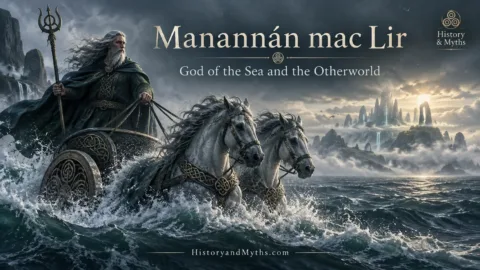
Manannán mac Lir is one of the most distinctive figures in Irish mythology. Best known as a god of the sea, he also appears in stories of the Otherworld, supernatural journeys and the Isle of Man.
Yet the medieval sources do not give him one fixed identity. Some present him as a powerful supernatural ruler and guide, while others explain him in surprisingly human terms.
So who was Manannán mac Lir really, and how did one figure acquire so many different roles across Irish and Manx tradition?
Who Was Manannán mac Lir?
Manannán mac Lir is a major supernatural figure in Irish mythology whose stories connect the sea, the Otherworld and the Isle of Man.
He is commonly described as a sea god, but the medieval tradition gives him a much broader role. He can appear as a ruler of supernatural realms, a guide, a protector and a figure associated with extraordinary journeys. His stories also connect him with major figures such as Lugh and Cú Chulainn.
Manannán is best understood primarily as an Irish mythological figure rather than a sea god shared in the same form across the entire Celtic world. His identity also changes between texts, which is why the surviving sources do not always agree about his ancestry, status or even the nature of his divinity.
What Does the Name Manannán mac Lir Mean?
The name Manannán mac Lir reflects two of the strongest associations surrounding the character: the sea and the Isle of Man.
Mac Lir literally means “son of Lir.” Because Lir is associated with the sea in Irish tradition, the name is often rendered more freely as “son of the sea,” a fitting description for a figure so closely connected with maritime travel and supernatural waters.
The origin of Manannán is less certain. His name has long been linked with Manann, the Irish name associated with the Isle of Man. Some medieval traditions treated Manannán as the figure from whom the island took its name, while scholars have also argued the reverse, that his own name developed from the name of the island.
What is certain is that Manannán became deeply rooted in both Irish and Manx tradition, making the connection between his name and the Isle of Man one of the most enduring parts of his identity.
Was Manannán Really One of the Tuatha Dé Danann?
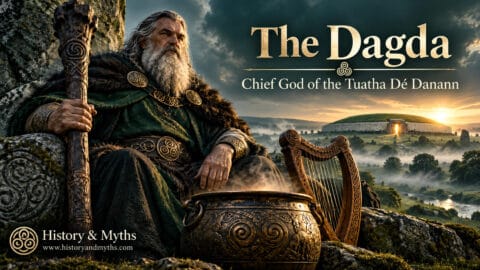
Manannán is commonly associated with the Tuatha Dé Danann, but the surviving Irish tradition does not give a single, consistent account of his place among them.
Later genealogical traditions include him within their supernatural family. Geoffrey Keating, drawing on earlier Irish material, gives Manannán an ancestry through Allód and Elatha, while other stories connect him closely with figures such as Lugh and the wider world of the Tuatha Dé Danann.
Earlier texts are less concerned with placing him inside a fixed genealogy. Manannán often appears instead as an independent supernatural ruler with his own domain, especially in stories involving the sea and the Otherworld.
There are also sources that explain him in very different terms. Sanas Cormaic, for example, presents a rationalized version of Manannán as a remarkable seafarer rather than simply as an immortal god.
It is therefore accurate to say that Manannán became closely associated with the Tuatha Dé Danann, especially in later tradition. What the sources do not support is the idea that every Irish text treats him as a straightforward member with the same ancestry and status.
Manannán as God of the Sea
Calling Manannán a sea god is accurate, but his connection with the sea goes beyond control of waves or storms.
In Irish tradition, he is especially associated with movement across water. He travels over the sea with supernatural ease, knows routes hidden from ordinary sailors and is repeatedly linked with islands and realms that cannot be reached by normal means.
The sea around Manannán often acts as more than a physical landscape. It can separate the human world from supernatural places, conceal what lies beyond sight and provide a route into the Otherworld.
This is what makes his maritime role distinctive. Manannán is not simply a ruler of water, but a figure who understands the sea as a boundary, and knows how to cross it.
Read More
Manannán and the Otherworld
Manannán is closely associated with the Otherworld, but calling him simply “king of the Celtic Otherworld” is misleading. Early Irish literature does not describe one supernatural kingdom ruled by a single figure. Instead, it presents several otherworldly lands and dwellings, often reached across water, through mist or through unusual journeys.
One realm strongly connected with Manannán is Tír Tairngire, the Land of Promise. In The Adventure of Cormac, he is identified as its king. Another tradition tells how he takes the infant Mongán to Tír Tairngire and raises him there until the age of twelve.
What makes Manannán important is his ability to move between these supernatural places and the human world. He can bring mortals into the Otherworld, guide them through it and, in some stories, return them again.
His role is therefore less that of a universal ruler and more that of a powerful figure with access to realms beyond ordinary human experience.
The Voyage of Bran: When the Sea Becomes Another World
One of Manannán’s most revealing appearances comes in The Voyage of Bran, an early Irish tale of supernatural travel. After Bran and his companions have spent two days and nights at sea, they see a man approaching in a chariot. He identifies himself as Manannán mac Lir.
Manannán describes the water beneath Bran’s boat as a fertile plain filled with flowers, horses and people. Bran sees the sea, while Manannán experiences the same place as another landscape entirely. The scene suggests that the Otherworld is not necessarily somewhere remote, but can exist alongside the human world and remain hidden from ordinary perception.
During the encounter, Manannán also foretells the birth of Mongán mac Fiachnai, a figure later closely associated with him, and tells Bran that his voyage will continue toward Emain, one of the supernatural destinations in the tale.
The episode is brief, but it captures one of Manannán’s defining qualities: he moves through a world that mortals can enter only under extraordinary circumstances.
Manannán and Cormac in the Land of Promise
Manannán plays a different role in Cormac’s Adventure in the Land of Promise. He first approaches King Cormac in disguise, carrying a silver branch with golden apples whose music can put people to sleep.
Cormac wants the branch, and the stranger gives it to him in exchange for three favors to be claimed later. He eventually takes Cormac’s daughter, son and wife. Cormac follows them and enters a strange land where he encounters sights he cannot immediately understand.
There he sees a magical cup that breaks when a lie is spoken and becomes whole again when the truth is told. He is reunited with his family, and his mysterious host finally reveals himself as Manannán mac Lir, king of Tír Tairngire, the Land of Promise.
Manannán explains what Cormac has seen and allows him to return home with the cup and the silver branch, warning that both will disappear when Cormac dies.
In this tale, Manannán acts less as a sea god than as the ruler and orchestrator of Cormac’s journey, testing him before revealing the nature of the world he has entered.
Manannán, Fand and Cú Chulainn
Manannán enters the story of Cú Chulainn through Fand, a supernatural woman who had once been his wife. In Serglige Con Culainn, Fand becomes involved with Cú Chulainn after the hero is drawn into the affairs of the Otherworld.
When Manannán learns that Fand is with Cú Chulainn, he comes to meet her. Fand sees him, remembers their former life together and ultimately chooses to return with him.
The separation leaves Cú Chulainn and his wife Emer deeply distressed. According to the tale, druids give them drinks of forgetfulness to erase the pain of what has happened. Manannán then shakes his cloak between Cú Chulainn and Fand so that the two can never meet again.
The episode presents Manannán without battle or open confrontation. He arrives, Fand makes her choice, and his final act closes the relationship between her and Cú Chulainn permanently.
Manannán and Lugh
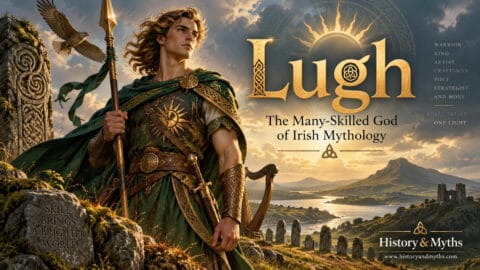
Manannán is closely connected with Lugh, although Irish tradition does not give one consistent account of their relationship.
Some later stories describe Manannán as Lugh’s foster-father and associate Lugh with objects belonging to him. In The Fate of the Children of Tuireann, Lugh rides Aonbharr, Manannán’s horse, which can travel over land and sea. When the sons of Tuireann ask to borrow it, Lugh refuses because the horse itself has only been lent to him.
Other medieval traditions name Tailtiu as Lugh’s foster-mother, so the surviving accounts should not be forced into a single version of his upbringing.
What remains consistent is the close link between the two figures. Manannán’s horse and other possessions sometimes pass into stories centered on Lugh, showing how strongly later tradition connected them.
Manannán’s Magical Possessions
Several magical objects became associated with Manannán, although they come from different layers of Irish tradition.
Among the best known is Aonbharr, his supernatural horse, said to travel over sea as easily as over land. Another is Scuabtuinne, the “Sweeper of the Waves,” a magical boat or curragh used for extraordinary journeys across the sea.
Manannán is also linked with the Crane Bag, traditionally made from the skin of Aoife after she had been transformed into a crane. The bag contained a collection of valuable and mysterious objects, and some accounts connect its contents with the movement of the tide.
The sword Fragarach, usually translated as “the Answerer,” is also associated with Manannán in later tradition and becomes closely linked with Lugh. Its connection with Manannán, however, is not as consistently attested in the earlier material as some of his other possessions.
Together, these objects helped shape the later image of Manannán as a figure of supernatural travel, wealth and power.
Manannán and the Isle of Man
Few places are as closely associated with Manannán as the Isle of Man, in the Irish Sea between Ireland and Britain. Medieval Irish tradition already connects him with the island, while Cormac’s Glossary presents Man as a base from which the legendary navigator and merchant Manannán operated.
The link became even stronger in Manx folklore. Later tradition remembered Manannán Beg mac y Leir as an early ruler and supernatural protector of the island. One of the best-known stories says he concealed Man from enemies by covering it in mist.
These traditions should not be treated as straightforward history. There is no evidence that a historical king named Manannán ruled the island in the form described by later folklore. What they do show is how deeply the figure became embedded in Manx tradition.
That association remains visible today. The House of Manannan in Peel uses him as a central figure in presenting the island’s Celtic, Viking and maritime past.
Was Manannán a God or a Deified Navigator?
Not every medieval source presents Manannán in the same way.
In Cormac’s Glossary, he is described as a famous merchant and skilled seaman associated with the Isle of Man. According to this account, his knowledge of weather and navigation was so remarkable that the Irish and Britons came to regard him as a god of the sea.
That explanation differs sharply from tales such as The Voyage of Bran, where Manannán is clearly supernatural rather than an exceptional human sailor.
The contrast reflects a wider habit of medieval Christian writers, who sometimes reinterpreted older supernatural figures as remarkable humans later mistaken for gods. Cormac’s Glossary should therefore be read as one medieval explanation of Manannán’s origins, not as evidence that a historical navigator was actually deified.
The tradition preserves both versions: Manannán as a supernatural figure of Irish myth, and Manannán as a legendary seafarer explained in more human terms by later scholars.
Manannán and the Welsh Manawydan
Manannán mac Lir has a close Welsh parallel in Manawydan fab Llŷr, a major figure in the Mabinogi. Their names are strikingly similar, and both are described as sons of Lir or Llŷr.
That resemblance led some earlier scholars to treat them as versions of the same older Celtic figure. The comparison is understandable, but their surviving stories are very different.
Manawydan is not portrayed in Welsh tradition as a sea god equivalent to Manannán. In the Third Branch of the Mabinogi, he survives the expedition to Ireland, marries Rhiannon and becomes involved in the enchantment of Dyfed. His story centers on survival, practical skill and the breaking of that enchantment rather than on the sea or rule over the Otherworld.
The two figures should therefore be compared with caution. Their names and parentage suggest a meaningful connection, but the surviving Irish and Welsh traditions developed them into very different characters.
What Manannán Represents in Irish Mythology
Manannán is difficult to reduce to a single role. Across Irish tradition, he appears as a sea god, ruler of supernatural realms, guide, protector and keeper of powerful objects.
What connects these different roles is his association with passage and access. Manannán can move where ordinary humans cannot, whether across the sea, into hidden lands or between the human world and supernatural realms.
That makes him more than a deity of water. He is one of the figures through whom Irish mythology explores what lies beyond the familiar world and who is able to cross its boundaries.
Academic Sources
This article draws on medieval Irish texts alongside modern scholarship on Manannán mac Lir, Irish mythology and medieval Welsh tradition.
-
- Joseph Vendryes. “Manannán mac Lir.” Études Celtiques, Vol. 6, No. 2, 1953, pp. 239–254.
A major scholarly study of Manannán, his name, his relationship with the Isle of Man and the comparison with the Welsh Manawydan. - Charles W. MacQuarrie. “Manannán and His Neighbors.” In The Medieval Cultures of the Irish Sea and the North Sea, edited by Joseph Falaky Nagy and Charles MacQuarrie. Amsterdam University Press, 2019.
Useful for Manannán’s connection with the Isle of Man, the Irish Sea world and the rationalized account preserved in Cormac’s Glossary. - Gerard Murphy, ed. “Manannán, God of the Sea, Describes his Kingdom to Bran and Predicts the Birth of Mongán.” In Early Irish Lyrics, Eighth to Twelfth Century. Oxford: Clarendon Press, 1956. Digital edition: CELT, University College Cork.
Primary source for Manannán’s meeting with Bran and his description of the sea as another landscape. - Whitley Stokes and Vernam Hull, eds. and trans. Echtra Cormaic i Tír Tairngirí [Cormac’s Adventure in the Land of Promise]. Digital resources: Irish Sagas Online, University College Cork.
Primary source for Manannán’s role as ruler of Tír Tairngire, the silver branch and Cormac’s journey. - Myles Dillon, ed. Serglige Con Culainn [The Sick-Bed of Cú Chulainn]. Dublin Institute for Advanced Studies; digital edition: CELT, University College Cork.
Primary source for the story of Manannán, Fand and Cú Chulainn.
- Joseph Vendryes. “Manannán mac Lir.” Études Celtiques, Vol. 6, No. 2, 1953, pp. 239–254.