Ogma: God of Eloquence and Champion of the Tuatha Dé Danann
Ogma is one of the most distinctive figures among the Tuatha Dé Danann, remembered as both a formidable warrior and a master of speech. In Cath Maige Tuired, he is their champion, a figure of exceptional strength who fights in the war against the Fomorians and tests himself against Lugh.
Other medieval traditions give him a different kind of importance. They connect Ogma with eloquence, poetry, and the invention of Ogham, the early Irish writing system. He is also frequently compared with the Gaulish Ogmios, another figure associated with the power of speech.
So was Ogma primarily a warrior, a god of eloquence, or the mythic inventor of Ogham? The surviving sources preserve all of these roles, but not always in the same texts or in the same way.
Who Was Ogma?
Ogma was one of the leading members of the Tuatha Dé Danann and is repeatedly presented as their champion.
His status did not protect him from humiliation under Bres, however. In Cath Maige Tuired, Ogma is forced to carry bundles of firewood for the household during Bres’ harsh rule, even though he remains one of the strongest warriors among the Tuatha Dé Danann.
Ogma is not simply a distant divine figure defined by a title. He appears inside the political and military struggles of the group, suffering under Bres and later taking an active role in the conflict with the Fomorians.
Across the surviving traditions, his identity develops in several directions, but his earliest narrative role is clear: Ogma is a champion first, a warrior whose strength and status place him close to the center of the Tuatha Dé Danann.
Why Was Ogma the Champion of the Tuatha Dé Danann?
In Cath Maige Tuired, Ogma holds the recognized role of champion of the Tuatha Dé Danann.
The title is more than an honorific. Before the battle with the Fomorians, Lugh asks the leading figures what each can contribute. Ogma answers as a frontline warrior, claiming that he can face the enemy king and twenty-seven of his companions while taking a major share of the fighting.
His role was therefore clear: Ogma was the warrior expected to meet the strongest opponents directly. His reputation rested on strength, combat ability, and his place among the principal defenders of the Tuatha Dé Danann.
Ogma and the Arrival of Lugh
Ogma becomes especially important when Lugh arrives at Tara and asks to enter the court of the Tuatha Dé Danann.
Lugh offers one skill after another, but each time the doorkeeper replies that someone inside already possesses it. When Lugh says he is a champion, the answer is that Ogma already fills that role.
After Lugh is admitted, Ogma tests his strength. He hurls a huge flagstone through the wall of the hall, a stone the text says required eighty yoke of oxen to move. Lugh throws it back and repairs the damage.
The scene establishes Ogma as the existing measure of physical strength at Tara, while Lugh proves that his importance comes from mastering many skills at once, not from replacing Ogma as champion.
Ogma’s Role in the Second Battle of Mag Tuired
Ogma takes a direct part in the Second Battle of Mag Tuired, where the Tuatha Dé Danann confront the Fomorians.
During the fighting, Cath Maige Tuired places him in single combat with the Fomorian leader Indech mac Dé Domnann. The text says that the two “fell together,” an ambiguous phrase because Ogma appears again later in the narrative.
After the Fomorians are defeated, Ogma remains active alongside Lugh and the Dagda, pursuing the retreating enemy.
He also comes into possession of Orna, the sword of the Fomorian king Tethra, leading to one of the most unusual episodes in the story.
Orna: The Sword That Could Speak
After the battle, Ogma finds Orna, the sword of Tethra. When the weapon is drawn, it begins to recount the deeds that had been performed with it.
Cath Maige Tuired explains that swords in that age could reveal their histories when unsheathed, and that weapons might carry charms or other supernatural qualities.
Orna is therefore more than a trophy taken from a defeated enemy. It is a weapon with its own voice and remembered history, giving Ogma one of the strangest magical objects associated with any member of the Tuatha Dé Danann.
Was Ogma Really the God of Eloquence?
Calling Ogma the god of eloquence is useful, but it simplifies a more complicated tradition.
In the medieval Ogam Tract, Ogma is described as highly skilled in speech and poetry, and the same tradition connects him with the invention of Ogham. This is the clearest Irish evidence behind his later reputation as a figure of eloquence and learned language.
But Cath Maige Tuired presents him mainly as a champion and warrior, not as a deity defined primarily by speech.
Ogma’s reputation as a god of eloquence therefore comes from combining different strands of medieval tradition. He is better understood as a figure who joins martial strength, skilled speech, and learned knowledge rather than as a simple Celtic counterpart to a classical god of rhetoric.
Did Ogma Invent Ogham?
Medieval Irish tradition does credit Ogma with inventing Ogham, but this is a mythic origin story rather than a historical explanation of how the script developed.
The Book of Ogham presents Ogma as the creator of the system and even calls him its “father,” with his hand or knife described as its “mother.”
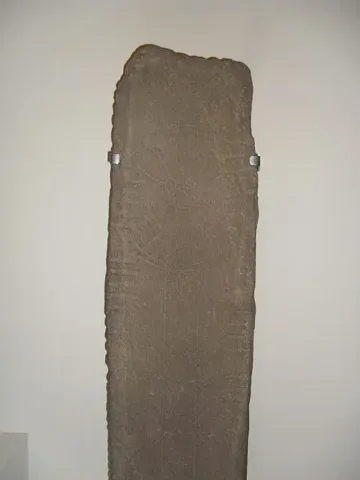
Other medieval traditions tell the story differently. The Auraicept na nÉces, for example, attributes the invention of Ogham to Fénius Farsaid, showing that more than one explanation circulated in learned Irish literature.
Historically, the origins of Ogham remain uncertain. The earliest securely datable inscriptions belong roughly to the late fourth and fifth centuries CE, long before the medieval texts that explain its creation through mythic figures.
Ogma can therefore be described as the mythic inventor of Ogham in one important medieval tradition, but not as its historical creator.
Read More
The Tuatha Dé Danann: The Supernatural Race of Irish Mythology
Nuada of the Silver Hand: King of the Tuatha Dé Danann
Ogma and Ogmios: Were They the Same God?
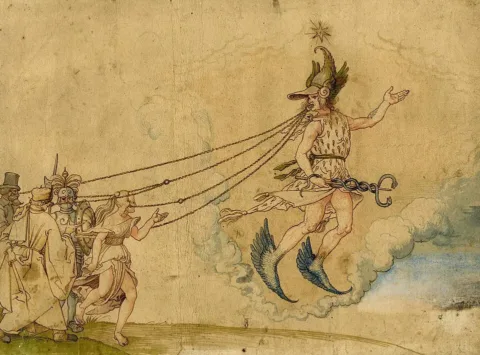
Ogma is often compared with Ogmios, a Gaulish figure described by the second-century writer Lucian. Ogmios appears as an aged Heracles whose tongue is connected by delicate chains to the ears of willing followers, an image built around the power of speech and persuasion.
The comparison with Ogma is understandable. Their names are closely related, and both became associated with unusual forms of verbal power. Some scholars have therefore treated them as regional expressions of an older Celtic figure.
But the evidence does not allow a simple identification. Ogmios belongs to a Gaulish context recorded by a classical author, while Ogma belongs to medieval Irish tradition, separated by geography, time, and literary setting.
Modern scholarship still treats the relationship between Ogma, Ogmios, and the name of Ogham as an open question rather than a settled one. The comparison is compelling, but the surviving evidence does not prove that Ogma and Ogmios were simply the same deity in two regions.
What Do Ogma’s Names and Epithets Mean?
Ogma appears with several names and epithets in Irish tradition, and they emphasize different sides of his character.
One of the best known is Grianainech, usually understood as “sun-faced” or “radiant-faced.” The epithet describes brightness or appearance, but it does not by itself make Ogma a solar god.
In Cath Maige Tuired, he is also called Trénfer, meaning “strong man” or “champion,” a title that fits his established role as the principal warrior of the Tuatha Dé Danann. The text itself uses this epithet when Ogma finds the sword Orna after the battle.
The name Ogma is harder to explain. Linguist David Stifter connects its older form with a Celtic root associated with a track, line, or groove, while also noting the obvious resemblance to both Ogam and the Gaulish Ogmios. Exactly how those names are historically related remains uncertain.
So his epithets tell us more securely about how medieval tradition imagined him than the etymology of his name does: radiant in appearance, formidable in strength, and closely connected with learned speech in later tradition.
Who Were Ogma’s Parents and Family?
Ogma’s genealogy varies across the medieval Irish sources.
In the Ogam Tract, he is called Ogma son of Elatha, and Cath Maige Tuired likewise names him as a son of Elathu. In that tradition, this also links him closely with Bres, another son of Elatha.
Other texts connect Ogma with the Dagda as a brother, while later genealogical material gives him a wife, Étan, daughter of Dian Cécht, and sons including Cairpre and Delbaeth.
These traditions do not form one perfectly consistent family tree. What they do show is that Ogma belonged to the central divine network of the Tuatha Dé Danann, closely connected with several of its most important figures.
Did Ogma Die at Mag Tuired?
Ogma’s fate at the Second Battle of Mag Tuired is not entirely clear.
Cath Maige Tuired says that Ogma and the Fomorian leader Indech mac Dé Domnann “fell together” in single combat, wording that can sound as though both were killed.
But later in the same text, Ogma is still active. He finds Orna, the sword of Tethra, and then joins Lugh and the Dagda in pursuing the retreating Fomorians.
The contradiction makes it difficult to read the earlier passage as a straightforward account of Ogma’s death. His fate at Mag Tuired remains textually uncertain, and later summaries that state he definitely died there simplify a much less consistent tradition.
Why Ogma Matters in Irish Mythology
Ogma stands out because Irish tradition does not confine him to a single role.
He is a warrior of exceptional strength, but also a figure later associated with eloquence, poetry, and Ogham. Those traditions place physical power and intellectual skill side by side rather than treating them as opposites.
That makes Ogma especially important within the Tuatha Dé Danann. His character shows how medieval Irish tradition could preserve several identities around the same figure without reducing him to one simple function.
Ogma’s significance lies in the way these traditions bring together warfare, eloquence, and learned knowledge in a single figure.
Academic Sources
This article draws on medieval Irish texts, classical evidence, and modern scholarship on Ogma, Ogham, and Celtic mythology.
Elizabeth A. Gray (ed.), Cath Maige Tuired: The Second Battle of Mag Tuired.
Irish Texts Society, 1982. The principal medieval Irish source for Ogma as champion of the Tuatha Dé Danann, his treatment under Bres, his encounter with Lugh, the battle with Indech, and the sword Orna.
CELT, University College Cork
George Calder (ed.), Auraicept na nÉces: The Scholars’ Primer.
John Grant, Edinburgh, 1917. A major edition of medieval Irish grammatical and Ogham material, including traditions concerning the origins and interpretation of the script.
CELT, University College Cork
Damian McManus, A Guide to Ogam.
Maynooth Monographs 4, An Sagart, 1991. A standard scholarly study of Ogham inscriptions, their language, chronology, letter names, and the medieval traditions surrounding the script.
Google Books
David Stifter, “Insular Celtic: Ogam.”
Published in the proceedings of the International Conference on Palaeoeuropean Languages and Epigraphic Cultures, 2020. A linguistic and epigraphic study discussing the origins of Ogham and the uncertain relationship between the names Ogam, Ogma, and Ogmios.
Maynooth University Research Archive
David Stifter, Ogam: Language, Writing, Epigraphy.
Prensas de la Universidad de Zaragoza, 2022. A modern academic overview of the Ogham writing system, its inscriptions, historical development, and use in Primitive Irish.
Maynooth University Research Archive
Lucian of Samosata, Heracles (Ogmios).
The principal classical literary source for the Gaulish Ogmios, describing an aged Heracles whose followers are linked to his tongue through chains, an image associated with the power of eloquence.
Perseus Digital Library
Copyright Notice
© 2026 History & Myths. All rights reserved.
This article is original editorial content created for HistoryAndMyths.com.
Unauthorized reproduction, republication, or substantial copying of the text,
structure, or original analysis is prohibited without prior written permission.
Brief quotations are permitted for commentary, research, or educational use
when accompanied by clear attribution and a link to the original article.