Aengus Óg: Irish God of Love, Youth and the Dream of Caer
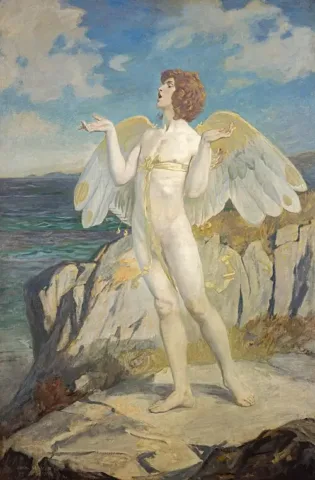
Aengus Óg is one of the best-known figures in Irish mythology, the son of the Dagda and Boann and a member of the Tuatha Dé Danann. He is closely associated with youth, love, Brú na Bóinne, and the famous dream of Caer Ibormeith.
His best-known tale, Aislinge Óenguso, begins when a mysterious woman appears to him in a dream. The search for her leads to one of the most memorable stories of love and transformation in medieval Irish literature.
Aengus is often described today as the god of love, youth, and dreams. The first two associations are strongly rooted in the texts, while his connection with dreams comes mainly from the story of Caer rather than from a clearly defined divine role as a “god of dreams.”
Who Was Aengus Óg?
Aengus appears in the Irish texts under several names, including Óengus and Mac Óc. In Tochmarc Étaíne, he is fostered by Midir, another important figure among the Tuatha Dé Danann.
He is also closely linked with Brú na Bóinne, which becomes his supernatural residence in the tradition.
Unlike figures whose stories center mainly on warfare or kingship, Aengus appears most often in tales involving courtship, transformation, cleverness, and the supernatural world. His mythology is therefore defined less by a fixed divine function than by the recurring themes that surround him.
What Does the Name Aengus Óg Mean?
Aengus appears in Irish texts under several forms, including Óengus, Aengus, and Mac Óc.
The clearest of these is Mac Óc, meaning “the Young Son.” In Tochmarc Étaíne, the title is linked directly to the unusual circumstances of his birth: he is conceived at the beginning of the day and born before evening.
This gives Aengus’s association with youth a firm basis in the medieval tradition rather than making it only a later interpretation.
The name Óengus itself is harder to translate with certainty. Modern retellings sometimes offer neat meanings, but the sources are much clearer about Mac Óc. For that reason, “the Young Son” is the safer and better-attested title.
The Strange Birth of Aengus
In Tochmarc Étaíne, Boann, the wife of Elcmar, conceives Aengus with the Dagda while Elcmar is away.
To conceal what has happened, the Dagda alters the passage of time so that the period from conception to birth passes within what seems to be a single day.
Aengus is therefore born under circumstances that are supernatural even by the standards of Irish myth. The story ties his birth from the beginning to youth and altered time, themes that help explain the identity later attached to Mac Óc.
How Did Aengus Gain Brú na Bóinne?
Aengus’s connection with Brú na Bóinne is not simply a matter of inheritance. In Tochmarc Étaíne, he gains the site through a carefully worded bargain.
After learning that the Dagda is his father, Aengus asks for land of his own. The Dagda directs him toward the Brú, then held by Elcmar. At Samhain, Aengus asks to control it for “a day and a night.” Elcmar agrees, expecting the arrangement to be temporary.
Aengus then exploits the wording. Since time is made up of days and nights, he argues that the agreement gives him permanent possession. The Dagda supports his claim, while Elcmar receives other land.
The episode establishes Brú na Bóinne as one of Aengus’s defining residences and reveals a side of him often lost in modern summaries: he can win through cleverness and precise use of words, not force.
Was Aengus Really the God of Love, Youth and Dreams?
The familiar description of Aengus as the god of love, youth and dreams is useful, but the medieval Irish texts are less systematic.
His association with youth has strong textual support, especially through the title Mac Óc, “the Young Son.”
His link with love is equally clear in the stories. Aengus appears in courtship narratives, and Aislinge Óenguso centers on his pursuit of Caer Ibormeith.
The connection with dreams is more specific. Aengus encounters Caer through a dream, and dream and sleep imagery remain important throughout the tale. But the surviving texts do not clearly define him as a formal, universal “god of dreams.”
So the modern label is useful shorthand, but it should not be treated as an exact list of ancient divine offices.
The Dream of Aengus and Caer Ibormeith
A Woman Appears in His Dreams
In Aislinge Óenguso, Aengus’s most famous love story begins while he is asleep.
A young woman appears beside his bed, but disappears when he reaches for her. She returns the following night carrying a timpán, a small stringed instrument, and plays music for him. The visits continue until Aengus becomes physically ill from longing for someone he cannot identify.
For a full year he keeps the experience to himself. Eventually the physician Fingen recognizes the cause of his illness: Aengus has fallen in love with someone who is absent.
The dream is therefore not a brief vision. It becomes the event that drives the entire story.
The Search for Caer
Boann orders a search across Ireland, but after a year the mysterious woman has still not been found. The Dagda then turns to Bodb, ruler of the síd of Munster.
Bodb spends another year searching before locating her at Loch Bél Dracon, near Crotta Cliach. When Aengus is taken there, he sees 150 young women and immediately recognizes one of them as the woman from his dreams.
She is Caer Ibormeith, daughter of Ethal Anbuail.
Finding her does not mean that Aengus can simply claim her. Bodb says he has no authority to give Caer away, and Ailill and Medb later reach the same conclusion. The story presents her as a supernatural figure whose fate is not controlled by the people around her.
Why Does Caer Become a Swan?
Caer’s bird form is not a punishment or a spell placed on her at the end of the tale. Her father explains that she alternates between forms, spending one year as a woman and the next as a bird.
At the following Samhain, Aengus is told he will find her at Loch Bél Dracon among 150 swans. The birds are described as white and linked by silver chains, with golden ornaments around them.
This is the pattern of Caer’s own existence. Aengus cannot remove it or break it. If he wants to be with her, he has to enter that world himself.
Aengus and Caer Become Swans
At Samhain, Aengus goes to the lake and calls to Caer. She agrees to come with him after he promises that she will be free to return.
Aengus then takes swan form with her, and the two fly together to Brú na Bóinne.
As they return, they sing, and their music causes people to fall asleep for three days and three nights.
The ending brings together the central elements of the tale: love, transformation, music, and sleep. It also explains why later tradition associated Aengus so strongly with dreams, even though the medieval text does not formally describe him as a “god of dreams.”
Read More
Explore more figures and traditions from Irish mythology:
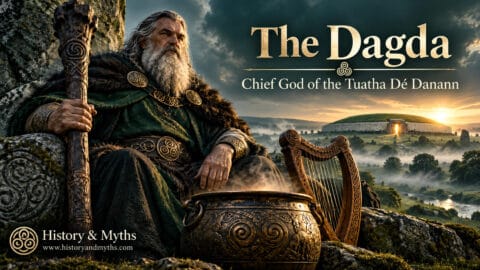
The Dagda: The Great God of Irish Mythology
Aengus and Étaín
Aengus also appears in Tochmarc Étaíne, one of the major tales of the Irish mythological cycle.
In the story, Midir wishes to marry Étaín, and Aengus acts on his behalf. Étaín’s father demands difficult tasks before the marriage can proceed, including the clearing of land. With help from the Dagda, Aengus completes them and makes the marriage possible.
His role continues after Fuamnach, Midir’s wife, transforms Étaín and drives her away. Aengus becomes involved again in the events surrounding her fate.
The tale places him once more in a story shaped by desire, marriage, transformation, and the supernatural world, showing that his connection with these themes extends beyond his own romance with Caer.
Was Aengus a Pre-Christian Irish God?
Aengus is usually described as an Irish god, but most of what survives about him comes from medieval literature rather than direct evidence of pagan worship.
The tales were written down by Christian scribes centuries after Ireland’s conversion. Aislinge Óenguso, for example, survives in later manuscripts, although linguistic evidence points to a much earlier composition.
These texts preserve older mythological material, but they do not tell us exactly how Aengus was worshipped before Christianity.
There is no strong evidence for a dedicated priesthood, formal festival, or standardized set of rituals associated specifically with him. Such details sometimes appear in modern retellings, but they cannot be treated as securely attested ancient practice.
Aengus can therefore be understood as a pre-Christian divine figure preserved through medieval Irish tradition, while the details of any historical cult remain largely unknown.
What Symbols and Motifs Are Associated with Aengus?
The medieval stories do not give Aengus a fixed set of sacred emblems, but several images and motifs recur around him.
Brú na Bóinne is one of the strongest associations, serving as his supernatural residence in Tochmarc Étaíne.
Swans are closely linked with him through the story of Caer Ibormeith, where both figures take bird form. Their importance comes from that specific tale rather than from evidence of a formal cult symbol.
Other recurring motifs include music, dreams, sleep, youth, and transformation.
It is therefore more accurate to speak of mythic associations and recurring motifs than of an official ancient list of sacred symbols.
Conclusion
Aengus Óg is more complex than the familiar label “Irish god of love and dreams” suggests.
The medieval tales present him as Mac Óc, the Young Son, a figure closely tied to Brú na Bóinne, Caer Ibormeith, and stories of desire and transformation.
What makes him distinctive is not a fixed list of divine powers, but the way his stories bring together love, cleverness, altered forms, dreams, and the supernatural world.
Academic Sources
This article draws on medieval Irish texts, manuscript evidence, and modern scholarship on Aengus, Caer Ibormeith, Brú na Bóinne, and the interpretation of early Irish mythology.
- Tochmarc Étaíne (The Wooing of Étaín).
A major medieval Irish source for the birth of Aengus, his title Mac Óc, his fosterage by Midir, his acquisition of Brú na Bóinne, and his role in the story of Étaín.
Corpus of Electronic Texts, University College Cork
- Aislinge Óenguso (The Dream of Óengus).
The principal medieval tale behind Aengus’s association with Caer Ibormeith, dreams, love, swan transformation, music, and sleep.
Irish Sagas Online, University College Cork
- Irish Sagas Online, “Aislinge Óenguso: Sources.”
Manuscript history and bibliography for the tale, including the 1934 edition by Francis Shaw and earlier scholarly editions and translations.
University College Cork
- Tomás Ó Cathasaigh, “Knowledge and Power in Aislinge Óenguso.”
A scholarly analysis of the structure and meaning of Aengus’s dream, the search for Caer, and the distribution of knowledge and power within the tale.
Coire Sois: The Cauldron of Knowledge, University of Notre Dame Press
- Tomás Ó Cathasaigh, “The Wooing of Étaín.”
A modern scholarly discussion of one of the principal early Irish narratives in which Aengus, Midir, Étaín, and the supernatural world intersect.
Coire Sois: The Cauldron of Knowledge, University of Notre Dame Press
- Tomás Ó Cathasaigh, “Pagan Survivals: The Evidence of Early Irish Narrative.”
Useful for understanding the limits of using medieval Irish literature to reconstruct pre-Christian religion and cult practice.
Coire Sois: The Cauldron of Knowledge, University of Notre Dame Press