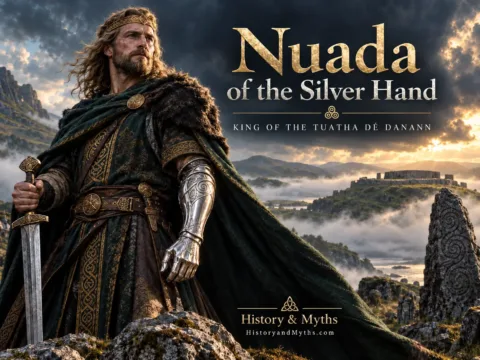
Nuada of the Silver Hand: King of the Tuatha Dé Danann
Nuada was one of the major divine figures of the Tuatha Dé Danann in Irish mythology and is best known as their king with the famous Silver Hand.
His story centers on a problem that went far beyond injury. After losing a hand in battle, Nuada was no longer considered physically fit to rule, and the kingship passed to Bres. A silver replacement was later made for him, giving rise to the name Nuada Airgetlám, usually translated as “Nuada of the Silver Hand.” His natural hand was eventually restored, allowing him to return to the throne.
Nuada’s story also connects him to several of the most important figures in Irish myth, including Dian Cécht, Miach, Lugh and Balor. He appears in the battles of Mag Tuired, possesses one of the great treasures of the Tuatha Dé Danann, and ultimately dies in their struggle against the Fomorians.
More than a warrior king, Nuada became a figure closely tied to kingship, legitimacy and the conditions under which authority could be held in Irish mythological tradition.
Who Was Nuada Airgetlám?
Nuada Airgetlám was a divine king of the Tuatha Dé Danann, the supernatural people at the center of many early Irish mythological traditions.
The surviving medieval narratives present him primarily as a ruler rather than assigning him a single fixed role such as “god of war” or “god of kingship.” His importance lies in his position within the Tuatha Dé Danann and in the stories surrounding their struggle for power in Ireland.
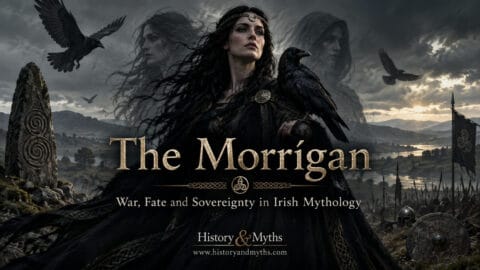
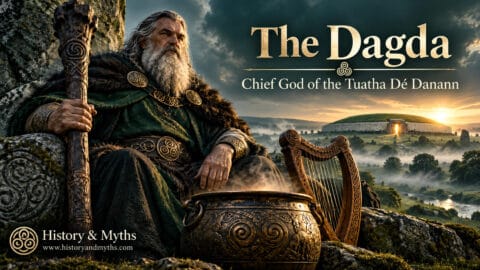
Nuada should not be treated as a “chief god” in the tidy sense found in some modern pantheon charts. The Tuatha Dé Danann include other major figures such as the Dagda, Lugh, Brigid and the Morrígan, each with distinct traditions of their own.
What sets Nuada apart is his close connection with royal authority. His mythology repeatedly turns on who is qualified to rule, how kingship can be lost, and whether legitimacy can be restored.
His name Airgetlám, meaning “Silver Hand” or “Silver Arm,” comes from the episode that made him one of the most recognizable figures in Irish mythology.
Why Was He Called Nuada of the Silver Hand?
Nuada earned the name Airgetlám, “Silver Hand” or “Silver Arm,” after losing his hand in battle.
In Cath Maige Tuired, the physician Dian Cécht and the craftsman Crédne provide him with a silver replacement that could move like a natural hand.
The artificial limb became the feature by which Nuada was remembered and gave him one of the most distinctive names in Irish mythology.
The story did not end with the silver hand. Miach, Dian Cécht’s son, later restored Nuada’s natural hand, allowing his recovery to go beyond the remarkable metal replacement that made him famous.
The First Battle of Mag Tuired
Nuada lost his hand during the First Battle of Mag Tuired, fought between the Tuatha Dé Danann and the Fir Bolg for control of Ireland.
The surviving account presents the battle as a victory for the Tuatha Dé Danann, though both sides suffered heavily. The Fir Bolg king, Eochaid mac Eirc, was killed during the fighting.
Nuada himself was wounded by Sreng son of Sengann, who struck off his hand. The injury did not cost the Tuatha Dé Danann the battle, but it cost Nuada the throne.
Why Losing His Hand Cost Nuada the Kingship
In Cath Maige Tuired, Nuada’s injury creates a dispute over the sovereignty of Ireland because he is no longer considered physically fit for kingship.
The issue was not his courage, experience or military standing. The problem was the condition of the ruler himself. A king was expected to meet certain physical requirements, and the loss of a limb was enough to exclude Nuada from the throne.
That left the Tuatha Dé Danann without an eligible king and forced them to choose a replacement.
Their solution was Bres, whose Fomorian ancestry made him an attractive political choice at a moment when the balance of power was uncertain.
Bres Takes the Throne
With Nuada unable to rule, the Tuatha Dé Danann chose Bres, the son of the Fomorian king Elatha. His mixed background offered a possible bridge between the two peoples at a time when the kingship was unsettled.
Bres accepted the throne under terms that allowed his rule to be ended if he proved unfit.
Problems soon followed. Fomorian tribute weighed heavily on Ireland, while major figures among the Tuatha Dé Danann were reduced to menial work. The Dagda was made to build fortifications, and Ogma carried firewood.
Bres also failed in hospitality, one of the qualities expected of a successful ruler. Guests were poorly treated, poets and entertainers were neglected, and his court became associated with scarcity rather than generosity.
His reign showed that physical fitness alone was not enough to make a legitimate king. Bres had the body Nuada lacked, but not the conduct expected from someone who held the throne.
Miach Restores Nuada’s Hand
The silver hand was remarkable, but Miach, the son of Dian Cécht, accomplished something greater.
In Cath Maige Tuired, Miach restores Nuada’s injured arm as living flesh. The healing takes place over nine days and nights, progressing in stages until the hand is whole again.
For Nuada, the restoration removes the physical condition that had kept him from the throne and makes his return to kingship possible.
Miach’s success also leads to one of the darker episodes in the story. Dian Cécht, angered by his son’s achievement, attacks him repeatedly. Miach heals the earlier wounds, but Dian Cécht eventually strikes a fatal blow that Miach cannot repair.
Nuada’s recovery is therefore complete, but it comes through an act of healing that ends in conflict and death within the family responsible for restoring him.
Nuada Returns to the Kingship
Bres eventually lost the support of the Tuatha Dé Danann, and his rule came to an end.
By then, Nuada’s natural hand had been restored, removing the condition that had once excluded him from kingship. Cath Maige Tuired states that he returned to the throne after Bres.
His restoration did more than bring back a former king. It ended the period of Bres’s rule and returned leadership to a figure already established within the Tuatha Dé Danann.
Nuada’s second reign, however, soon faced a new challenge from the Fomorians and brought another major figure to the center of the story: Lugh.
Nuada and Lugh
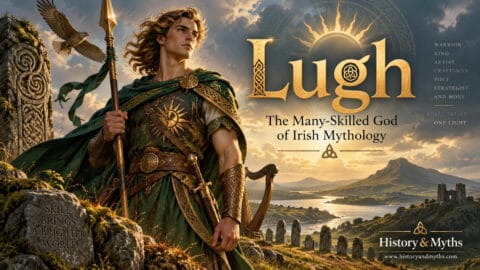
During Nuada’s second reign, Lugh arrived at Tara and asked to join the court of the Tuatha Dé Danann.
He was required to prove what skill he could offer. Lugh claimed mastery of many arts, and his unusual combination of abilities set him apart from the specialists already present.
Nuada recognized his value and allowed him to take the king’s seat for thirteen days while the Tuatha Dé Danann considered how best to resist the Fomorians.
The episode does not show Nuada surrendering the kingship. It shows him recognizing that Lugh possessed skills the coming conflict required.
That decision prepares the way for Lugh’s rise as the central strategist and warrior in the Second Battle of Mag Tuired.
Read More
Nuada’s Death at the Second Battle of Mag Tuired
Nuada’s final appearance comes during the Second Battle of Mag Tuired, when the Tuatha Dé Danann confront the Fomorians in a decisive struggle.
During the fighting, Balor, the powerful Fomorian warrior with the destructive eye, kills Nuada. The text also places Macha daughter of Ernmas among those who fall to Balor in the battle.
Nuada’s death ends his second reign, but the battle continues. Lugh then confronts Balor and kills him with a sling stone driven through his deadly eye.
Nuada therefore dies at the point where the story’s focus shifts fully toward Lugh and the final defeat of the Fomorians.
Nuada’s Sword and the Four Treasures
Nuada was associated with one of the great treasures of the Tuatha Dé Danann: a sword brought from Findias, one of the four mysterious cities linked to their supernatural learning.
In Cath Maige Tuired, the sword is described as a weapon from which no one could escape once it had been drawn from its sheath.
It belonged to the same group of treasures as Lugh’s spear, the Lia Fáil and the Dagda’s cauldron.
The four treasures were linked to four cities: the Stone of Fál from Falias, Lugh’s spear from Gorias, Nuada’s sword from Findias and the Dagda’s cauldron from Murias.
The sword strengthens Nuada’s image as a warrior king and ties him directly to one of the most powerful objects in the Tuatha Dé Danann tradition.
What Was Nuada the God Of?
Nuada is often described today as a god of kingship, war or sovereignty, but the surviving Irish texts do not give him a single fixed divine domain.
They present him primarily as a divine king of the Tuatha Dé Danann. His mythology repeatedly connects him with rulership, sovereignty and warfare, but not in the tidy categories often used in modern pantheon lists.
His link with warfare is clear. Nuada fights in the battles of Mag Tuired, possesses a formidable sword and dies in combat against the Fomorians. That makes war an important part of his story, but it does not prove that he functioned simply as an Irish “war god.”
The Silver Hand can also make him seem connected with healing, yet the healers in his story are Dian Cécht and Miach. Nuada receives their skill; he is not presented as the divine healer himself.
The most accurate description is therefore that Nuada was a divine ruler strongly associated with kingship, sovereignty and warfare, rather than a god confined to one clearly defined domain.
Nuada, Nodens and Lludd
Nuada is sometimes compared with Nodens, a Romano-Celtic god worshipped in Britain, and with the Welsh figure Lludd Llaw Eraint, whose name means “Lludd of the Silver Hand.”
The comparison is understandable. All three figures preserve names or traditions involving the hand, and scholars have long explored whether they reflect related Celtic material. Nodens is independently attested in Roman Britain, including at the sanctuary at Lydney Park in Gloucestershire, while Nuada belongs to medieval Irish tradition.
That does not mean they can simply be treated as the same god under different names. They come from different regions, periods and literary settings, and the surviving evidence does not preserve a single continuous tradition linking them.
The more useful approach is to treat them as related points of comparison. Nuada may belong to a wider Celtic pattern involving rulership, supernatural power and the image of the silver hand, but his identity is best understood first through the Irish sources.
What Nuada’s Story Means in Irish Mythology
Nuada’s story is ultimately about the conditions that make authority legitimate.
His mythology treats kingship as something that depends on more than power or military success. A ruler must also meet the expectations attached to the office, and legitimacy can be lost when those expectations are no longer met.
The Silver Hand matters because it turns that idea into a visible symbol. Nuada’s injury changes his right to rule, while his restoration allows him to reclaim a position he had lost.
His dealings with Bres and Lugh deepen the same theme from different directions: one ruler can fail despite holding the throne, while another figure can gain influence because his abilities are needed at a moment of crisis.
That is why Nuada remains important in Irish mythology. He is not remembered only as the king with the Silver Hand, but as a figure through whom the tradition explores sovereignty, fitness to rule and the limits of royal authority.
Academic Sources
This article draws on primary medieval Irish material and modern scholarship on
Nuada, the Tuatha Dé Danann, Irish divine kingship and Celtic mythology.
- Gray, Elizabeth A., ed. and trans. (1982).
Cath Maige Tuired: The Second Battle of Mag Tuired.
Irish Texts Society.
The principal scholarly edition and English translation used for Nuada’s kingship,
the silver hand, Bres, Miach, Lugh, Balor and the treasures of the Tuatha Dé Danann.
An academic electronic edition is also available through CELT, University College Cork.
- Williams, Mark (2016).
Ireland’s Immortals: A History of the Gods of Irish Myth.
Princeton University Press.
A major modern study of the divine figures of Irish mythology and the transformation
of the Tuatha Dé Danann within medieval and later Irish tradition.
- Koch, John T., ed. (2006).
Celtic Culture: A Historical Encyclopedia.
ABC-CLIO.
Large scholarly reference work covering Celtic religion, mythology, literature,
language and historical traditions across Ireland, Britain and the wider Celtic world.
- Mac Cana, Proinsias (1970).
Celtic Mythology.
Hamlyn.
Classic scholarly introduction to Celtic mythology, including the Tuatha Dé Danann,
Irish divine figures, kingship and the relationship between Irish and wider Celtic traditions.