Cernunnos: The Horned God of the Celtic World
Cernunnos was an antlered deity of ancient Gaul, commonly described as the Celtic god of nature, animals, and fertility. Yet no surviving ancient myth explains his powers, tells his story, or establishes how widely he was worshipped.
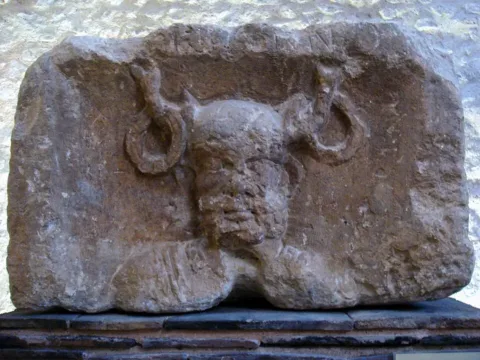
His name appears on the first-century CE Pillar of the Boatmen in Roman Paris, beside a figure with stag antlers adorned with torcs. Similar figures appear on the Reims altar and the famous Gundestrup Cauldron, although neither identifies its subject as Cernunnos by name.
These monuments offer clues to his possible connections with animals and prosperity, but they leave much of his religious identity unresolved.
Who Was Cernunnos?
Cernunnos belonged to the religious traditions of ancient Gaul, particularly the Celtic-speaking communities of what is now France. After the Roman conquest, local gods continued to receive recognition alongside Roman deities. In cities such as Lutetia, the two traditions could appear together on public religious monuments.
Celtic peoples shared cultural and linguistic connections, but their religious practices were not uniform. Individual communities worshipped local deities whose names and roles were not necessarily known elsewhere.
Cernunnos is securely attested in Gaulish religion. Whether communities across the wider Celtic world recognized him under the same name remains unknown.
What Does the Name Cernunnos Mean?
The name Cernunnos is generally interpreted as “the Horned One,” drawing on a Celtic root associated with horns or antlers. Although its exact linguistic formation is debated, the meaning corresponds to the god’s distinctive appearance.
The name survives on the first-century CE Pillar of the Boatmen in Paris. Its inscription is damaged, and the initial letter is now missing. Eighteenth-century records give the reading Cernunnos, though scholars have questioned the restoration of the opening letter.
Similar names appear elsewhere. A bronze votive inscription from Steinsel, Luxembourg, addresses a god called Cerunincus. Another Gaulish inscription, from Montagnac in southern France, contains the name Carnonos, which has also been interpreted as a personal name. Neither inscription establishes a connection with the antlered deity of Paris.
The Pillar of the Boatmen: Cernunnos in Roman Paris
The Pillar of the Boatmen was erected in Lutetia, ancient Paris, during the reign of Emperor Tiberius (14–37 CE). Its Latin inscription records that the city’s boatmen commissioned the monument in honour of Jupiter.
The carved blocks were discovered beneath Notre-Dame Cathedral in 1710–1711, reused in a late Roman wall. They depict Roman deities, including Jupiter and Vulcan, alongside Gaulish figures such as Esus, Smertrios, and Cernunnos.
Cernunnos is shown as a bearded figure with animal-like ears and stag antlers, each supporting a hanging torc, a rigid metal neck ornament. Only his upper body survives. Some scholars have proposed that the complete figure was seated, but its original posture cannot be established with certainty.
The blocks are preserved at the Musée de Cluny in Paris. Their original setting remains unknown, although the monument provides direct evidence of Gaulish and Roman deities appearing together in the religious art of Lutetia.
Cernunnos and the Gundestrup Cauldron
The Gundestrup Cauldron is a decorated silver vessel discovered in a Danish peat bog in 1891. Probably made between 150 BCE and the beginning of the Common Era, it carries one of the best-known images associated with Cernunnos.
An interior panel depicts an antlered figure seated cross-legged among animals. He wears a torc around his neck, holds another in his right hand, and grasps a ram-horned serpent in his left. A stag, bulls, and other creatures surround him.
The figure resembles later representations associated with Cernunnos, but the cauldron contains no inscription identifying the deity.
The vessel’s craftsmanship points toward Thracian metalworking traditions, while its decoration includes Celtic elements. The National Museum of Denmark considers southwestern Romania or northwestern Bulgaria a likely place of manufacture, where Celtic and Thracian cultures interacted. How the cauldron reached Denmark remains unknown.
The Reims Altar and Other Possible Depictions
A Gallo-Roman limestone altar discovered at Reims, France, in 1837 depicts an antlered deity seated between Apollo and Mercury. Apollo stands on the left holding a lyre, while Mercury appears on the right with a caduceus and purse.
The central figure wears a torc and sits cross-legged on a throne. From a bag resting on his lap, he releases what may be grain or coins toward a stag and a bull below. The altar, now held at the Musée Saint-Remi, bears no inscription naming the deity.
A bronze statuette from Bouray-sur-Juine, near Paris, shows another cross-legged figure wearing a torc. Its lower legs end in deer-like feet, but it has no surviving antlers or identifying inscription. Its connection with Cernunnos remains uncertain.
At Val Camonica in northern Italy, an Iron Age rock engraving depicts a large antlered figure beside a smaller human figure. The image has also been associated with Cernunnos, although its subject is unnamed.
What Do Cernunnos’s Antlers and Symbols Mean?
Cernunnos’s stag antlers may symbolize renewal, since deer shed and regrow them each year. This interpretation is plausible, although no surviving Gaulish text explains what the antlers meant to his worshippers.
The torc, a rigid metal neck ring, was associated with status and prestige in Celtic societies. Such ornaments also appeared in religious offerings and representations of deities. Their presence in images of Cernunnos may express divine authority or sacred power.
The ram-horned serpent is another recurring symbol. This hybrid creature appears elsewhere in Gallo-Roman religious art and was not exclusive to antlered deities. Scholars have suggested connections with the earth and regeneration, but its original religious meaning is uncertain.
Stags, bulls, and other animals accompany several figures associated with Cernunnos. Their presence connects the imagery with both wild and domesticated creatures, although it does not establish whether the god protected animals, hunters, or livestock.
Read More: Celtic Gods & Mythology
The Dagda: Chief God of the Tuatha Dé Danann
Discover the powerful Irish deity associated with abundance, authority, and magic, and why he should not be confused with Cernunnos.
The Tuatha Dé Danann: The Supernatural Race of Irish Mythology
Explore the divine figures of Irish mythology and how their traditions differ from those of ancient Gaul.
Brigid: Irish Goddess of Poetry, Healing, Fire and Imbolc
Learn how ancient religious traditions surrounding Brigid developed through medieval sources and later beliefs.
Was Cernunnos a God of Nature, Fertility, or Wealth?
Cernunnos is often called a god of nature, but no ancient source identifies him specifically as a protector of forests or a patron of hunting. These interpretations arise largely from his appearance and the animals depicted around him.
The connection with prosperity has more tangible support. On the Reims altar, the antlered deity releases what may be grain or coins from a bag. A bronze statuette from Étang-sur-Arroux shows a similar seated figure holding a bag of coins, while a relief from Vendœuvres also features a pouch. These recurring images suggest an association with wealth or abundance.
Fertility is another possible function. The Musée Saint-Remi interprets the Reims altar as probably connected with a fertility cult. However, no surviving evidence establishes that people invoked Cernunnos specifically for childbirth, successful harvests, or the reproduction of livestock.
How Was Cernunnos Worshipped?
No ancient account describes a ritual performed for Cernunnos, and no sanctuary has been securely identified as dedicated specifically to him. The surviving evidence reveals his place in religious settings but little about the ceremonies themselves.
The boatmen of Lutetia included Cernunnos on a monument dedicated to Jupiter and Emperor Tiberius. His presence shows that the deity was recognized within the city’s public religious life, although it does not establish what offerings, if any, were made to him.
The Reims altar provides another possible context for worship, but its central figure is unnamed. At Steinsel in Luxembourg, a bronze tablet records a man named Soltrius Pruscus fulfilling a vow to Cerunincus. The similar name has invited comparisons with Cernunnos, though the two cannot be securely identified as the same deity.
There is no specific ancient evidence linking Cernunnos to seasonal festivals, forest ceremonies, or rituals conducted by druids.
Is Cernunnos the Same as the Modern Horned God?
Cernunnos is associated with the Horned God in modern Paganism, particularly Wicca. Some practitioners identify the two, while others draw inspiration from Pan, the Greek god of the wild, or Herne the Hunter from English folklore.
The modern connection owes much to Margaret Murray, who argued in The God of the Witches (1931) that European witchcraft preserved an ancient religion centred on a horned deity. Her ideas influenced Gerald Gardner and the development of Wicca in the mid-twentieth century, where the Horned God became an important divine figure alongside the Goddess.
Historians have rejected Murray’s theory of a continuously surviving pagan witch cult. There is no documented line of worship connecting ancient Cernunnos with modern Wiccan traditions. His place in contemporary Paganism reflects the reinterpretation of ancient religious imagery rather than an established continuity of ritual practice.
What Do We Really Know About Cernunnos?
The Pillar of the Boatmen preserves Cernunnos’s name and distinctive appearance, but tells us little about his religious role. Other monuments offer possible parallels, particularly through their animal imagery and associations with abundance, without establishing that they depict the same deity.
Cernunnos remains an important figure in the study of Gaulish religion. His surviving images reveal aspects of ancient religious art, even as the beliefs and ceremonies associated with him remain largely beyond our reach.
Academic Sources & Historical References
This article draws on archaeological evidence, scholarly research into Gaulish religion, and museum records of surviving monuments associated with Cernunnos.
Scholarly Studies
Alexandre Léonet (2022)
Cernunnos: approche historiographique d’une figure emblématique gauloise
Ausonius Éditions. A detailed examination of the ancient inscriptions, disputed identifications, and the history of scholarly interpretations of Cernunnos.
Phyllis Fray Bober (1951)
Cernunnos: Origin and Transformation of a Celtic Divinity
American Journal of Archaeology, 55(1), 13–51. A foundational study of Cernunnos’s iconography and its interpretation.
Miranda J. Green (1986)
The Gods of the Celts
Alan Sutton Publishing. A scholarly study of Celtic religious traditions, divine imagery, animal symbolism, and regional cults. Link to the National Library of Ireland catalogue.
Ronald Hutton (1999)
The Triumph of the Moon: A History of Modern Pagan Witchcraft
Oxford University Press. Historical research on the development of modern Paganism and Wicca, providing context for the modern Horned God.
Archaeological & Museum Sources
French Ministry of Culture
The Boatmen’s Pillar
Official archaeological documentation of the Roman-era monument from Paris, including its inscriptions, surviving reliefs, and historical setting.
Musée Saint-Remi, Reims
Autel de Cernunnos
Official museum record of the Gallo-Roman altar showing the antlered deity between Apollo and Mercury, with iconographic and archaeological details.
Musée d’Archéologie nationale, France
Divinité de Bouray-sur-Juine
Archaeological catalogue of the bronze seated deity from Bouray-sur-Juine, including its construction, deer-like legs, and comparisons with other Celtic divine figures.
National Museum of Denmark
The Pictures on the Gundestrup Cauldron
Museum documentation of the cauldron’s decorated panels, including the antlered figure surrounded by animals.
National Museum of Denmark
The Dating and Origin of the Silver Cauldron
An assessment of the vessel’s chronology, Thracian metalworking influences, Celtic imagery, and possible Balkan origins.
Research Note
Cernunnos is securely named on the Pillar of the Boatmen, but many other antlered figures remain unidentified. Interpretations concerning nature, fertility, wealth, and ritual practice are distinguished from direct archaeological evidence throughout this article. Modern Pagan traditions are discussed separately from documented ancient religion.
Copyright Notice
© 2026 History & Myths. All rights reserved. The original written content of this article is protected by copyright. Unauthorized reproduction or republication of substantial portions is not permitted, except as allowed by applicable law.
Historical artifacts, referenced publications, and third-party images remain subject to their respective rights and licenses. Sources are acknowledged for research and educational purposes.