What If the Tuatha Dé Danann Had Defeated the Milesians?
In Irish mythological tradition, the Tuatha Dé Danann do not rule Ireland forever. Their conflict with the Milesians, or Sons of Míl, ends with the newcomers taking control of the island while the Tuatha gradually become associated with the síd and the hidden world.
But that outcome depends on one decisive event: the defeat of the Tuatha at Tailtiu.
What if that battle had gone the other way?
If Mac Cuill, Mac Cecht, and Mac Gréine had defeated the Milesians, the Tuatha Dé Danann could have remained the visible rulers of Ireland. The Milesian claim to the island would fail, later traditions of royal ancestry would look very different, and the boundary between human rule and the supernatural world might develop along another path.
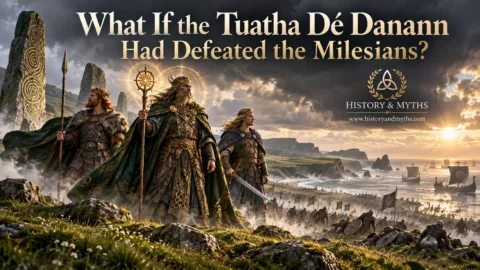
What Actually Happened Between the Tuatha Dé Danann and the Milesians?
In Lebor Gabála Érenn, the Milesians, or Sons of Míl, come to Ireland after the death of Íth, who had been killed following an earlier visit to the island. Their arrival leads to the final struggle for control of Ireland between the newcomers and the Tuatha Dé Danann.
At this point in the narrative, the Tuatha are ruled by three kings: Mac Cuill, Mac Cecht, and Mac Gréine. Their queens, Banba, Fódla, and Ériu, each ask that the island bear her name, with Ériu’s becoming the most enduring.
Rather than fight immediately, the Milesians agree to withdraw beyond nine waves from the coast. The Tuatha then raise a supernatural storm to prevent their return. Amergin, the Milesian poet and judge, answers with an invocation that helps the invaders reach land again.
The conflict continues on Irish soil. At Tailtiu, the Tuatha suffer their decisive defeat, their three kings are killed, and the Milesians secure control of the island.
That victory becomes a major dividing line in the medieval Irish mythological scheme. Human dynasties descended from the Sons of Míl take possession of Ireland, while the Tuatha Dé Danann cease to rule it openly. Our alternate scenario changes only that final result: at Tailtiu, the Tuatha win.
The Point of Divergence: The Tuatha Win at Tailtiu
The cleanest point of divergence is the battle at Tailtiu.
In the surviving narrative, this is where the Tuatha Dé Danann lose their three kings and the Milesians secure control of Ireland. Our alternate version changes only that result.
Mac Cuill, Mac Cecht, and Mac Gréine survive, while the Milesian forces are broken before they can establish lasting control. The defeat could come through better use of the Tuatha’s supernatural advantages, the loss of key Milesian leaders, or a collapse in the invaders’ battle line.
The Milesians are defeated after reaching Ireland, not destroyed before the conflict begins. That keeps the scenario close to the original narrative while giving us one clear change at the decisive moment.
The Alternate Scenario: The Tuatha Dé Danann Keep Ireland
With the Milesian army defeated at Tailtiu, the Tuatha Dé Danann retain control of Ireland.
Mac Cuill, Mac Cecht, and Mac Gréine remain kings, while the surviving Milesians lose their immediate claim to sovereignty. Some may retreat overseas, others could remain as subordinate groups, and a smaller number might eventually be absorbed into local communities.
Ireland therefore never passes into the hands of dynasties descended from the Sons of Míl. The Tuatha continue to rule openly, with their queens, royal centers, and supernatural authority still tied directly to the land.
That would also reshape the later division between the human and supernatural worlds. The Tuatha would not begin this new age as a defeated people pushed out of visible rule.
Could the Tuatha Dé Danann Realistically Have Won?
Within the logic of the myth, yes.
The Tuatha Dé Danann had already survived major conflicts, including their war with the Fomorians, and the tradition repeatedly associates them with powerful warriors and supernatural abilities. Their attempt to stop the Milesian fleet with a magical storm shows that they still possessed formidable advantages when the invaders arrived.
The Milesians also depended heavily on their leaders. Amergin’s ritual knowledge helps them overcome the storm and reach Ireland, while Éber and Éremón later become central to Milesian rule. Losing several key figures at Tailtiu could have broken the invasion before it became permanent.
Nothing in the narrative presents the Tuatha as hopelessly outmatched. A different result at Tailtiu is therefore plausible within the myth’s own logic.
What Happens to Mac Cuill, Mac Cecht and Mac Gréine?
If the Tuatha win at Tailtiu, Mac Cuill, Mac Cecht, and Mac Gréine remain the three ruling kings of Ireland.
Their survival matters because the original narrative kills all three in the battle, clearing the way for Milesian rule. In this alternate version, that transfer of sovereignty never takes place.
The three kings could continue their joint rule, while Banba, Fódla, and Ériu retain their place within the ruling order rather than becoming figures associated mainly with the memory and naming of the land.
The Tuatha would therefore emerge from the war with their existing royal structure intact, giving them political continuity after the Milesian defeat.
What Happens to the Milesians After Their Defeat?
A defeat at Tailtiu would not necessarily destroy the Milesians as a people.
Some survivors would probably retreat by sea, especially if their fighting strength had been badly damaged. Others might remain in Ireland without the power to claim sovereignty.
The Tuatha Dé Danann would then have several options: expel the survivors, reduce them to a subordinate status, or absorb some of them through alliance and intermarriage. Within the logic of Irish myth, the last possibility is entirely plausible.
Some Milesians could therefore survive, but without becoming the ancestors of Ireland’s ruling human dynasties. Their political role would be greatly reduced under continued Tuatha rule.
Would Éber, Éremón and Amergin Survive?
That would depend on how complete the defeat at Tailtiu was.
Éber and Éremón later become the principal rulers of Milesian Ireland. If either survived, he could lead a retreat, preserve the claim to the island, or organize another attempt to return.
Amergin would be equally important. In Lebor Gabála Érenn, his ritual knowledge helps the Milesians overcome the supernatural storm raised against them. His survival would give any remaining Milesian group both authority and a strong symbolic leader.
If all three died at Tailtiu, the invasion would be far less likely to recover. If even one escaped, the Milesian claim to Ireland could remain alive.
Would the Tuatha Still Retreat into the Síd, and What Happens to the Aos Sí?
Probably not in the same way.
In later Irish tradition, the Tuatha Dé Danann become closely associated with the síd, the supernatural dwellings beneath hills and mounds. Their defeat by the Milesians helps explain why they no longer rule Ireland openly.
If they win at Tailtiu, that political explanation disappears. The Tuatha would have no immediate reason to abandon their royal centers or withdraw from visible rule.
Their connection with the síd could still remain important, because those otherworldly places are not dependent on the Milesian victory alone. The difference is that the síd would be more likely to function as sacred or supernatural centers within a living Tuatha realm rather than as refuges for a defeated people.
The later Aos Sí tradition could also develop differently. Instead of being remembered mainly as hidden beings associated with an older displaced order, the supernatural inhabitants of the síd might remain tied to a ruling sacred landscape that had never fully passed into human hands.
What Role Would Manannán mac Lir Play?
Manannán mac Lir becomes especially important in later traditions that describe the Tuatha Dé Danann after their defeat.
In texts such as Altram Tige Dá Medar, he is associated with guiding the Tuatha into a new supernatural order and with their life in the síd. That role fits a world in which they have lost open control of Ireland.
If the Tuatha win at Tailtiu, Manannán would not need to help reorganize a defeated people in the same way. His links with the Otherworld, protection, and supernatural knowledge could remain, but they would operate within a realm where the Tuatha still ruled openly.
He might therefore remain an important mediator between ordinary and supernatural worlds without being defined by the Tuatha’s withdrawal from visible rule.
Would Ireland Still Be Called Éire?
Probably yes.
In Lebor Gabála Érenn, Ériu, Banba, and Fódla each ask the Milesians that the island bear her name. Ériu’s name becomes the most enduring, but her association with the land is not created by the Milesian victory itself.
If the Tuatha Dé Danann win at Tailtiu, Ériu remains one of the ruling queens. That could strengthen rather than weaken her connection with the island.
Banba and Fódla might also retain greater prominence as alternative poetic names for Ireland if all three queens remained part of the visible ruling order.
A Tuatha victory would therefore not require the name Éire to disappear. If anything, Ériu could remain an even more direct symbol of sovereignty and the land itself.
What Happens to Human Communities Under Tuatha Rule?
Human communities would still exist under continued Tuatha rule.
The most plausible outcome is coexistence. Human groups could farm, trade, form settlements, and maintain local leadership while the Tuatha remained the dominant political and supernatural authority.
Over time, the boundary between rulers and subjects might become less rigid. Marriage, alliance, tribute, and local agreements could draw some human families into the existing order.
Instead of inheriting Ireland after the Tuatha withdraw, human society would develop within a realm where supernatural authority remained part of everyday political life.
What Happens to the Milesian Ancestry of Ireland’s Kings?
A Tuatha victory would undermine one of the central claims of the Milesian tradition: that Ireland’s later ruling dynasties descend from the Sons of Míl.
If Éber and Éremón never establish their rule, later kings could no longer ground their legitimacy in a successful Milesian conquest.
Royal ancestry might instead develop around surviving Tuatha rulers, mixed Tuatha-human lineages, or local families accepted into the ruling order.
That matters because genealogy in medieval Irish tradition was closely tied to political legitimacy. Without Milesian victory, later claims to kingship would need a different mythic foundation.
How Would Later Irish Mythology Change?
Later Irish mythology would lose one of its clearest transitions: the movement from divine rulers to human dynasties.
The Tuatha Dé Danann could still appear in stories about the síd, sovereignty, marriage, rivalry, and the Otherworld, but they would occupy a different position. Instead of belonging mainly to an older displaced order, they could remain active rulers within Ireland itself.
That would change the meaning of later encounters between humans and the Tuatha. Journeys into the síd and marriages with otherworldly figures would take place alongside a political world in which supernatural authority had never fully disappeared.
Irish myth would therefore remain more deeply shaped by the coexistence of human and divine powers, rather than moving toward a landscape dominated by dynasties descended from the Sons of Míl.
Could the Milesians Return for Another Invasion?
Yes. A defeat at Tailtiu would not necessarily end the Milesian claim to Ireland.
If Éber, Éremón, Amergin, or other leaders escaped, they could regroup overseas, rebuild their forces, and attempt another invasion.
The Tuatha Dé Danann would be better prepared the second time. A victory at Tailtiu would strengthen their position and give them a clearer understanding of Milesian tactics, landing routes, and leadership.
A second invasion is therefore plausible, but it would face a stronger and more alert Tuatha kingdom than the first.
What the Sources Support, and What Is Speculation
The narrative framework for this scenario comes from medieval Irish literature, especially Lebor Gabála Érenn. The text presents the Milesian arrival, the supernatural storm, the fighting in Ireland, and the final defeat of the Tuatha Dé Danann at Tailtiu.
That gives us a clear starting point. The three Tuatha kings, the Milesian leaders, and the transfer of sovereignty all belong to the surviving tradition.
Everything after a Tuatha victory is necessarily speculative.
The sources do not tell us how Mac Cuill, Mac Cecht, and Mac Gréine would have ruled after defeating the Milesians, whether the invaders would have been expelled or absorbed, or how later traditions about the síd and the Aos Sí would have changed.
For that reason, this alternate scenario stays close to the logic of the myths: the Tuatha remain in power, some Milesians survive, and the transfer of sovereignty never takes place.
Conclusion
If the Tuatha Dé Danann had defeated the Milesians at Tailtiu, Ireland would not pass into the hands of dynasties descended from the Sons of Míl.
Mac Cuill, Mac Cecht, and Mac Gréine would remain kings, while the Tuatha would continue to rule openly and retain their connection with the síd and the supernatural landscape.
The result would be an Irish mythological world in which human communities and supernatural rulers remained politically intertwined for far longer than they do in the surviving tradition.
Academic & Primary Sources
Lebor Gabála Érenn, digital edition, Taylor Editions, University of Oxford.
>A scholarly digital edition of the medieval text that preserves the narrative framework for the Milesian arrival, the Tuatha Dé Danann, and the transfer of sovereignty in Ireland.
View the Oxford edition
R. A. Stewart Macalister, ed. and trans., Lebor Gabála Érenn: The Book of the Taking of Ireland, Irish Texts Society, 5 vols., 1938–1956.
>The standard major edition and translation of the text, including the sections concerning the Sons of Míl and the defeat of the Tuatha Dé Danann.
National Library of Ireland catalogue
John Carey, ed., Lebor Gabála Érenn: Textual History and Pseudohistory, Irish Texts Society, 2009.
An important scholarly study of the composition, manuscript history, and pseudohistorical character of Lebor Gabála Érenn.
Irish Texts Society
Lilian Duncan, ed. and trans., “Altram Tige Dá Medar,” Ériu, Vol. 11, 1932, pp. 184–225.
>A primary medieval narrative source for later traditions concerning Manannán mac Lir, the Tuatha Dé Danann, and their association with the síd after the Milesian victory.
View on JSTOR
Mark Williams. Ireland’s Immortals: A History of the Gods of Irish Myth. Princeton University Press, 2016.
>A major modern study of the Tuatha Dé Danann and the changing presentation of Ireland’s supernatural beings across medieval and later literature.
View on JSTOR
Kim McCone. Pagan Past and Christian Present in Early Irish Literature. An Sagart, 1990.
>A foundational study of how pre-Christian traditions were reshaped within medieval Irish Christian literature, useful for interpreting the mythological material without treating it as straightforward history.
Read the academic work
