The Fomorians in Irish Mythology: Giants, Monsters, and Rivals
The Fomorians are often introduced as the monstrous enemies of the Tuatha Dé Danann, a race of giants associated with darkness, chaos, and the sea. Medieval Irish tradition, however, presents a much less simple picture.
The Fomorians, or Fomoire, appear throughout Ireland’s Mythological Cycle as supernatural rivals, raiders, rulers, and tribute-takers. Some are portrayed as monstrous, while others appear as kings, warriors, and members of families closely connected to the Tuatha Dé Danann.
Their story is not simply a battle between gods and monsters. It is a story of rivalry, kinship, political power, and competing claims over Ireland.
Who Were the Fomorians?
The Fomorians were a supernatural people who appear repeatedly in medieval Irish mythology. They are best known for their conflict with the Tuatha Dé Danann, but Irish tradition places them in much earlier stories as well, where they confront peoples who were said to have settled Ireland before the Tuatha Dé arrived.
They are not described in one consistent way. Depending on the text, Fomorians can appear as warriors, kings, raiders, or powerful supernatural figures. Their role also changes from one story to another, which makes it misleading to treat them simply as a fixed race of monsters.
What remains consistent is their importance as a recurring rival power in Ireland’s legendary history. Long before the Second Battle of Mag Tuired, the Fomorians were already associated with conflict, tribute, and attempts to dominate those who held the island.
What Does the Name “Fomorian” Mean?
The origin of the name Fomorian is uncertain. In Old and Middle Irish, the group is usually called the Fomoire or Fomóiri, while an individual member is a Fomóir.
One long-standing interpretation connects the name with the Old Irish fo, meaning “under” or “below,” and a word for “sea,” producing the familiar translation “those beneath the sea.” The explanation fits the Fomorians’ strong maritime associations, but it is not universally accepted.
Other scholars have connected the second element with words associated with supernatural or nightmarish beings. The linguistic evidence remains disputed, and no single translation has been established with certainty.
What can be said more confidently is that medieval Irish tradition repeatedly links the Fomorians with the sea, whether or not that association explains the name itself.
What Did the Fomorians Look Like?
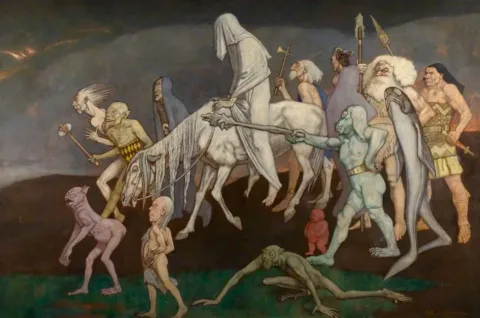
There is no single physical description that applies to every Fomorian.
Some medieval traditions give them distinctly monstrous features. In versions of Lebor Gabála Érenn, the Fomorians who fight Partholón under Cichol are described with a single arm and a single leg, while another tradition also gives them a single eye.
Other Fomorians are portrayed very differently. Elatha, one of their kings, appears in Cath Maige Tuired as a handsome man with golden-yellow hair, rich clothing, silver weapons, and gold ornaments. His son Bres is also associated with exceptional beauty. Balor, by contrast, is defined by the destructive eye that makes him one of the most feared figures in the tradition.
The common modern description of the Fomorians as a race of giants is also too broad. Medieval sources do not consistently give them enormous size or a single monstrous form.
They are better understood as a supernatural people whose appearance changes from one figure and text to another, ranging from human and beautiful to visibly monstrous.
Where Did the Fomorians Come From?
Irish tradition does not give the Fomorians a single, clearly defined homeland.
They are repeatedly associated with the sea and with places beyond Ireland. In several stories they arrive by ship, attack from overseas, or operate from islands around the Irish Sea, making the maritime connection one of their most persistent features.
Lebor Gabála Érenn also tries to place them within a Christian history of the world. Different versions trace their ancestry to figures such as Ham or Cain, reflecting the efforts of medieval writers to fit older Irish traditions into biblical genealogy rather than preserving one clear pre-Christian origin story.
Cath Maige Tuired is less concerned with ancestry. There, the Fomorians already exist as a powerful supernatural people with kings, fleets, territories, and political influence. Elatha comes from across the sea, and the Fomorian army later reaches Ireland by ship.
Their exact homeland therefore changes with the source. What remains consistent is their strong association with the sea and with powers coming from beyond Ireland.
The Fomorians Before the Tuatha Dé Danann
The Fomorians appear in Ireland’s legendary history long before the arrival of the Tuatha Dé Danann.
In Lebor Gabála Érenn, Partholón and his followers fight a Fomorian force led by Cichol Gricenchos. The encounter is presented as the first battle fought in Ireland, ending in a victory for Partholón’s people.
Their role becomes more substantial in the story of Nemed. His people fight several battles against the Fomorians, but after Nemed’s death they fall under the power of two Fomorian leaders, Conand and Morc.
In the Book of Leinster tradition, the tribute imposed on the Nemedians is severe: two-thirds of their children, grain, and milk must be surrendered at Samhain. The Nemedians eventually rebel and attack Conand’s stronghold, commonly known as Conand’s Tower.
Conand is killed and the tower is taken, but the rebellion ends badly. Morc arrives with another Fomorian force, and only a small number of the Nemedians survive.
These episodes show that the Fomorians were already established as raiders, rulers, and tribute-takers in Irish legendary history before their later conflict with the Tuatha Dé Danann.
The Fomorians and the Tuatha Dé Danann Were Also Kin
The Fomorians and the Tuatha Dé Danann were enemies, but they were also connected by marriage and blood.
In Cath Maige Tuired, Balor gives his daughter Ethniu to Cian, son of Dian Cécht, as part of an alliance between the two peoples. Their son was Lugh, making one of the greatest champions of the Tuatha Dé the grandson of the Fomorian leader he would later face in battle.
Bres had the same mixed connection. His mother, Ériu, belonged to the Tuatha Dé Danann, while his father was Elatha, a Fomorian king. Bres later fathered Ruadán with Brigid, daughter of the Dagda, linking another generation to both sides.
These family ties show why the conflict cannot be reduced to a war between two entirely separate peoples. The same tradition presents the Fomorians and the Tuatha Dé as relatives, allies, rulers, and enemies at different moments.
Bres and the Rise of Fomorian Power
After Nuada lost his hand and could no longer remain king, Bres was chosen to replace him. His mixed Fomorian and Tuatha Dé ancestry made him a politically useful choice, but his reign soon strengthened Fomorian influence over Ireland.
In Cath Maige Tuired, the Fomorian kings Indech, Elatha, and Tethra impose tribute, while prominent members of the Tuatha Dé are forced into service. Ogma carries firewood, and the Dagda is made to build fortifications for Bres.
Bres is also portrayed as failing the basic obligations of kingship, particularly generosity and hospitality. When the poet Coirpre receives poor treatment at his court, he pronounces a satire against Bres, and the Tuatha Dé eventually demand that the kingship be returned.
Bres responds by turning to his Fomorian relatives for military support. What began as a dispute over kingship now leads directly toward the Second Battle of Mag Tuired.
The Second Battle of Mag Tuired
The Second Battle of Mag Tuired was the decisive confrontation between the Fomorians and the Tuatha Dé Danann.
After Bres lost the kingship, he sought help from his Fomorian relatives. Balor and Indech gathered a large force and sailed to Ireland, joined by other leading figures including Bres, Elatha, and Tethra.
Balor became the central figure on the Fomorian side. His destructive eye was said to weaken those who faced it, but Lugh struck it with a sling stone, driving it back through Balor’s head so that its power turned against his own army. With Balor dead, the Fomorian position collapsed.
Bres survived the battle and was captured. He first tried to save himself by promising extraordinary abundance, but the offer was rejected. He was ultimately spared after giving practical advice about ploughing, sowing, and harvesting.
Who Were the Major Fomorians?
Several Fomorian rulers and warriors play important roles across Irish tradition.
Balor
Balor is the best-known Fomorian leader, remembered for his destructive eye and his role at the Second Battle of Mag Tuired. Through his daughter Ethniu, he was also the grandfather of Lugh.
Elatha
Elatha was a Fomorian king and the father of Bres. Cath Maige Tuired describes him as handsome and richly dressed, sharply contrasting with later images of the Fomorians as uniformly monstrous.
Bres
Bres was the son of Elatha and Ériu, giving him both Fomorian and Tuatha Dé ancestry. His reign brought growing Fomorian influence over Ireland and helped set the stage for the conflict at Mag Tuired.
Indech
Indech mac Dé Domnann is named as a king of the Fomorians. He was associated with the tribute imposed on Ireland and later became one of the leading commanders in the Fomorian army.
Tethra
Tethra was another Fomorian king. Later traditions also connect him with the sea and an otherworldly realm beyond it.
Cethlenn
Cethlenn was a Fomorian woman associated with the battle traditions. She wounded the Dagda, and later accounts linked that wound to his eventual death.
Ethniu
Ethniu was Balor’s daughter and the mother of Lugh by Cian of the Tuatha Dé Danann. Her place in the genealogy is one of the clearest examples of how closely the two peoples were connected.
Read Also
Were the Fomorians Evil?
The Fomorians often serve as enemies in Irish mythology, but the medieval sources do not present them as a race of absolute evil.
In Cath Maige Tuired, they impose tribute, exploit the Tuatha Dé Danann, and return to war in an attempt to restore their power. Balor and Indech are dangerous opponents, and the Fomorian defeat ends their domination of Ireland.
Yet the boundary between the two peoples is never entirely moral. The Fomorians and the Tuatha Dé intermarry, share descendants, and sometimes form political alliances. Lugh himself is Balor’s grandson, while Bres belongs to both groups by birth.
The Fomorians are therefore better understood as hostile rivals and, at times, oppressive rulers rather than as embodiments of pure evil.
What Did the Fomorians Represent?
There is no single accepted interpretation of what the Fomorians represented.
Older scholarship often viewed them as forces of darkness and chaos opposed to the Tuatha Dé Danann as powers of light and order. This reading was shaped largely by Cath Maige Tuired and Lebor Gabála Érenn, where the two groups stand on opposing sides of major conflicts.
More recent scholarship is more cautious. John Carey notes that elsewhere in Irish tradition the distinction between Fomorians and Tuatha Dé repeatedly breaks down. They intermarry, share ancestry, and can resemble one another closely, making a simple “dark gods versus light gods” model difficult to sustain.
Another interpretation sees the Fomorians as threatening outsiders. Their fleets, overseas attacks, tribute, and attempts at political domination fit that role, and Elizabeth A. Gray argues that their portrayal in Cath Maige Tuired was shaped in part by medieval Ireland’s experience of Viking incursions.
Even that interpretation does not explain every detail. After the battle, Bres offers abundance and later provides agricultural knowledge, linking him with harvests and prosperity as well as conflict.
The Fomorians therefore resist a single symbolic meaning. Different texts can present them as supernatural rivals, oppressive rulers, outsiders, or figures connected with the prosperity of the land.
What Happened to the Fomorians After Mag Tuired?
The Second Battle of Mag Tuired ended Fomorian domination of Ireland, but not the Fomorians themselves.
After Balor fell and the battle turned against them, Cath Maige Tuired says that the Fomorians were driven back to the sea. Their hold over Ireland collapsed, and the cattle they had taken as tribute were later recovered.
Some important figures survived. Bres was captured and eventually released, while Elatha appears again when Lugh, the Dagda, and Ogma pursue the Fomorians to recover the Dagda’s stolen harper.
Mag Tuired therefore ends Fomorian rule in Ireland, not their existence within Irish tradition.
Academic Sources
- Gray, Elizabeth A., ed. and trans.
Cath Maige Tuired: The Second Battle of Mag Tuired.
Irish Texts Society, 1982. Electronic edition hosted by CELT,
University College Cork.
Macalister, R. A. Stewart, ed. and trans.
Lebor Gabála Érenn: The Book of the Taking of Ireland.
Irish Texts Society, 5 vols., 1938–1956.
Online index and supporting material hosted by CELT,
University College Cork. - Carey, John.
“The Nature of the Fomoiri: The Dark Other in the Medieval Irish Imagination.”
In Myth and History in Celtic and Scandinavian Traditions,
edited by Emily Lyle, pp. 25–48.
Amsterdam University Press, 2021. - Gray, Elizabeth A.
“Tuatha Dé and Fomoiri in Cath Maige Tuired.”
In Myth and History in Celtic and Scandinavian Traditions,
edited by Emily Lyle, pp. 49–70.
Amsterdam University Press, 2021. - Ó Cathasaigh, Tomás.
“Cath Maige Tuired as Exemplary Myth.”
In Coire Sois, The Cauldron of Knowledge: A Companion to Early Irish Saga,
edited by Matthieu Boyd, pp. 135–154.
University of Notre Dame Press, 2014.
Originally published in 1983.
Carey, John.
A New Introduction to Lebor Gabála Érenn: The Book of the Taking of Ireland.
Irish Texts Society, Subsidiary Series 1, 1993.
These sources combine medieval Irish primary texts with modern academic studies of the Fomorians, their relationship with the Tuatha Dé Danann, and the interpretation of their role in Irish mythological tradition.
© 2026 History & Myths. All rights reserved.
This article is original content and may not be copied, republished, or redistributed without prior written permission.