The Dream of Macsen Wledig: Legend and Roman History
The Dream of Macsen Wledig tells of a Roman emperor who follows a vision of an unknown woman to Britain. In the Welsh tale, his marriage to Elen leads to the founding of strongholds, a struggle for control of Rome, and a legendary account of how Britons settled in Brittany.
Macsen is associated with Magnus Maximus, the Roman commander proclaimed emperor in Britain in AD 383. The story draws on his historical identity but reshapes his life through medieval Welsh tradition.
A Roman fort identified near Frenni Fawr in Pembrokeshire in 2024 has renewed interest in the legend. Archaeological finds reported in October 2026 suggest late Roman activity at the site, but none establishes that Maximus himself visited or occupied the fort.
Who Was Macsen Wledig?
The title Wledig, commonly translated as “ruler” or “lord,” was associated with figures of political and military authority in Welsh tradition. Macsen was among those remembered under this title, alongside other leaders linked to Roman and post-Roman Britain.
His story survives as Breuddwyd Macsen Wledig (The Dream of Macsen Wledig) in the fourteenth-century White Book of Rhydderch and Red Book of Hergest. Although included in the collection later known as The Mabinogion, it is separate from the Four Branches of the Mabinogi.
Macsen also appears in medieval genealogies as an ancestor of Welsh ruling families and figures associated with early Christianity. These traditions extended his importance beyond the dream narrative, although the genealogical claims cannot be treated as verified fourth-century family records.
The Dream of Macsen Wledig: The Full Story
The Emperor’s Dream
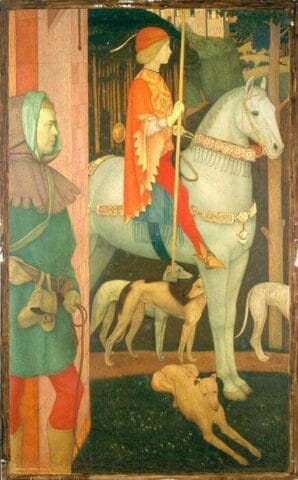
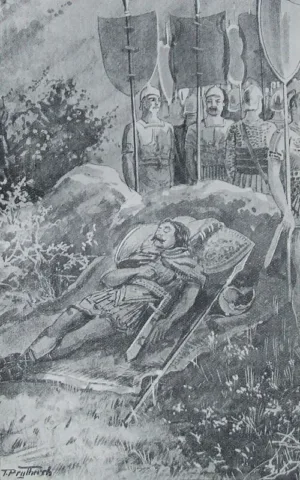
During a hunting expedition, Macsen Wledig falls asleep beneath shields raised by his attendants to protect him from the midday sun. In his dream, he crosses a towering mountain, follows great rivers to the sea, and boards a magnificent ship bound for a distant island.
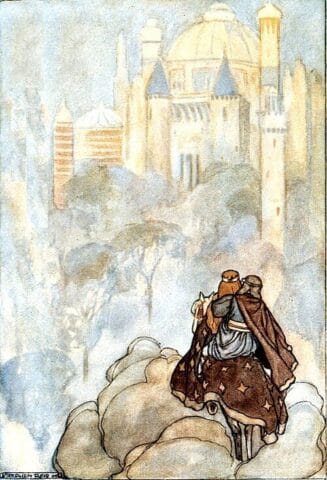
He travels across the island until he reaches a castle beside a river. Inside its richly decorated hall, two young men are playing a board game while an older nobleman carves game pieces. Nearby sits a beautiful woman on a golden chair. Macsen embraces her, but the noise of the hunting party wakes him.
Back in Rome, he cannot forget the woman. He withdraws from court life and loses interest in his imperial duties. His advisers send messengers to search for her, but a year passes without success.
Eventually, one of his attendants suggests retracing the journey from his dream. Thirteen messengers follow the route across the sea to Britain, reaching Arfon in north Wales. There, they find the castle, the hall, and the people Macsen described.
The woman is Elen, daughter of the British nobleman Eudaf Hen. When the messengers invite her to Rome to become empress, she refuses. If Macsen wishes to marry her, he must come to Britain himself.
Macsen’s Marriage to Elen
Macsen sails to Britain with his army. After conquering the island from Beli son of Manogan and his sons, he travels to Arfon, where he finds Elen and her family. They marry that night.
The following morning, Elen asks for her bridal gift. She requests sovereignty over Britain for her father, under her authority as empress, and three great strongholds built wherever she chooses.
Macsen agrees. The principal stronghold is established in Arfon, with two others at Caerleon and Carmarthen.
During a later hunting expedition near Carmarthen, Macsen pitches his tent on a height called y Freni Fawr in one manuscript reading. The encampment becomes known as Cadeir Macsen, or Macsen’s Chair.
Elen then orders roads to be built between the strongholds across Britain. The tale attributes these roads to her, giving them the name associated with Elen Luyddog, or Elen of the Hosts.
The Return to Rome
Macsen remains in Britain for seven years. During his absence, the Romans appoint another emperor, who sends him a threatening message warning him against returning.
Macsen marches toward Rome, conquering territories along the way. But the city resists his army, and after a year of siege he has made no progress.
Elen’s brothers, Cynan and Adeon, arrive from Britain with a smaller force. After studying the defenses, they measure the city walls and prepare ladders. They attack while the opposing armies are taking their customary midday meal.
The Britons scale the walls, kill the rival emperor, and capture Rome. They hold the city under their own control until Macsen asks them to surrender it to him.
With his throne restored, Macsen rewards the brothers by giving them an army and permission to conquer whatever lands they choose.
Cynan and the Origins of Brittany
Cynan and Adeon lead their warriors into further campaigns, capturing lands, castles, and cities. Their conquests continue for so long that the young men who originally joined them grow old.
Eventually, the brothers must decide whether to remain abroad or return home. Adeon chooses Britain, taking part of the army with him. Cynan stays with the remaining warriors.
The tale gives a brutal account of their conquest. The Britons kill the local men and spare the women, only to cut out their tongues to prevent the native language from influencing their own.
This episode provides the story’s legendary explanation for the British language and identity of Armorica, the region later known as Brittany in northwestern France.
Read Also
The Mabinogion Explained: The Great Stories of Welsh Mythology
Explore the collection of medieval Welsh tales that preserves the story of Macsen Wledig.
The Children of Lir: The Tragic Swan Legend of Irish Mythology
Discover another major Celtic legend preserved through medieval storytelling.
Who Was Elen Luyddog?
Elen Luyddog, or “Elen of the Hosts,” is the legendary British woman who becomes Macsen Wledig’s empress. Her title refers to the great hosts assembled at her request in the Welsh tale. Although later traditions give her a prominent place in British history, her identity as a historical empress remains unverified.
Her name survives in Sarn Helen or Sarn Elen, names associated with sections of Roman roads in Wales. These roads were not necessarily built at her command. Their association with Elen belongs to medieval Welsh tradition rather than documented Roman construction history.
Elen also appears in Welsh genealogical and religious traditions, where she is sometimes remembered as a saint. Her identity became entangled with that of Saint Helena, the mother of Constantine the Great, although they are distinct figures in the traditions and cannot simply be treated as the same historical woman.
Magnus Maximus: The Roman Emperor Behind the Legend
Magnus Maximus was a Roman commander of Spanish origin serving in Britain when his troops proclaimed him emperor in AD 383. He crossed into Gaul to challenge Emperor Gratian, whose army abandoned him. Gratian was killed while fleeing, allowing Maximus to establish his imperial court at Trier.
Maximus controlled Britain, Gaul, and Spain. The eastern emperor Theodosius I temporarily recognized his authority, while Valentinian II retained Italy. During his rule, Priscillian, a Christian ascetic accused of heresy and sorcery, was executed at Trier along with several followers. The decision drew opposition from prominent churchmen, including Martin of Tours.
In 387, Maximus invaded Italy, forcing Valentinian II to flee east. Theodosius responded with a military campaign in 388, defeating Maximus’s forces near Siscia and Poetovio. Maximus retreated to Aquileia, where he was captured and executed in August 388.
His rebellion also affected Roman Britain. Troops accompanied him to the continent, although their numbers and the long-term consequences of their withdrawal remain uncertain. Roman administration and military activity continued in Britain after his death.
Why Did Medieval Wales Remember Macsen?
For medieval Welsh dynasties, Macsen Wledig provided a prestigious connection to Rome’s imperial past. His name appeared in claims of royal ancestry centuries after the death of Magnus Maximus.
One of the earliest surviving examples is the ninth-century Pillar of Eliseg, erected by Cyngen, ruler of Powys, in memory of his great-grandfather. Its Latin inscription linked the dynasty with Magnus Maximus and the post-Roman ruler Vortigern. The lettering is now largely illegible, but the antiquarian Edward Lhuyd recorded it in 1696. Archaeologist Nancy Edwards interprets the monument as a public statement of political legitimacy at a time when Powys faced external threats.
The Dream of Macsen Wledig gave this Roman connection a narrative form, portraying British nobles as participants in imperial affairs rather than merely subjects of Rome.
These traditions do not establish genuine descent from Maximus. Historian Ben Guy’s research suggests that medieval Welsh writers often developed such accounts from earlier written sources rather than preserving an unchanged oral tradition.
The Roman Fort Near Frenni Fawr: What Was Discovered?
Archaeologist Mark Merrony identified a Roman fort near Frenni Fawr in Pembrokeshire in 2024, after noticing its outline in satellite imagery and finding Roman roofing material at the site. It lies approximately 3.5 kilometres southwest of the hill’s summit in the Preseli Hills.
The fort measures roughly 180 by 150 metres, with rounded corners and a road layout typical of Roman auxiliary forts. Geophysical surveys revealed two rectangular buildings that Merrony interprets as a possible headquarters and commander’s residence. His estimate of around 500 soldiers is based on the fort’s size, not a documented garrison.
Excavations reported in October 2026 uncovered Roman pottery, building tiles, an iron writing stylus, compacted clay floors, wagon ruts, and two coins dating to the late fourth century. Earlier assessments had suggested that the fort dated to between the first and third centuries. The coins raise the possibility of later activity but do not establish when the fort was built or how long it remained occupied.
As of October 2026, a detailed academic excavation report had not yet been published. The site’s chronology and the identification of its internal buildings therefore remain provisional.
Does the Archaeology Confirm the Legend?
The Roman fort near Frenni Fawr does not prove that Magnus Maximus camped there. The archaeological evidence establishes a Roman military site in the area, but its connection to the emperor remains unverified.
In The Dream of Macsen Wledig, Macsen travels from Carmarthen to a hill called y Freni Fawr, where he pitches his tent. The newly investigated fort lies approximately 3.5 kilometres southwest of the modern hill’s summit, rather than at the location described as his campsite.
The place name itself is disputed. In their 1929 translation of The Mabinogion, T. P. Ellis and John Lloyd note that the White Book of Rhydderch texts read y Freni Fawr, while the Red Book of Hergest has Vrevi vawr. Lady Charlotte Guest associated the latter with Llanddewi Brefi in Ceredigion, whereas Ellis and Lloyd suggested a possible reference to y Frenin Fawr, a hill in the Carmarthen area.
The two late-fourth-century coins found at the fort offer another possible connection, but coins can remain in circulation long after they are minted. Without securely dated occupation evidence, they cannot establish that the fort was occupied during Maximus’s reign from AD 383 to 388.
No reported inscription or other securely identified discovery has yet connected the fort directly to Maximus. Whether the medieval tale preserves a memory of Roman military activity at this particular location remains unresolved.
What Does the Dream of Macsen Wledig Mean?
The dream reverses the usual relationship between Rome and Britain. Instead of summoning a bride to his imperial court, Macsen must travel to her homeland, where Elen sets the terms of their marriage. Her demands turn a romantic encounter into a political bargain, securing authority for her family and strongholds for Britain.
That exchange continues when Elen’s brothers help Macsen recover Rome and receive the right to conquer territories of their own. The tale presents the Britons not simply as subjects of imperial power, but as people capable of negotiating with it and pursuing their own ambitions.
Yet the violent ending in Armorica complicates this portrayal. The killing and mutilation of the conquered population make the legendary foundation of Brittany a story of domination as well as settlement. The dream begins with an emperor’s desire, but its consequences extend far beyond his personal wishes.
Academic Sources & Historical References
This article draws on medieval Welsh manuscripts, scholarly translations, peer-reviewed historical research, and contemporary archaeological reporting. Literary traditions are distinguished from documented Roman history and archaeological evidence.
Primary Texts & Scholarly Translations
- National Library of Wales.
White Book of Rhydderch (Peniarth MS 4).
Fourteenth-century manuscript preserving The Dream of Macsen Wledig.
Manuscript record
- Ellis, T. P., and John Lloyd.
The Mabinogion: A New Translation, Volume I.
Oxford: Clarendon Press, 1929.
An annotated translation used to examine the Macsen narrative and variant readings of the Frenni Fawr place name.
Read the historical edition
- Davies, Sioned, trans.
The Mabinogion.
Oxford World’s Classics. Oxford University Press, 2007.
A modern scholarly translation of the medieval Welsh narratives.
Publication details
Academic Studies & Roman History
- Guy, Ben.
“Constantine, Helena, Maximus: On the Appropriation of Roman History in Medieval Wales, c. 800 to 1250.”
Journal of Medieval History 44, no. 4 (2018): 381–405.
Examines how medieval Welsh writers adapted Roman imperial figures in genealogical, religious, and literary traditions.
DOI: 10.1080/03044181.2018.1488150
- Harbus, Antonina.
“Magnus Maximus and the Welsh Helena.”
In Helena of Britain in Medieval Legend, pp. 52–63.
Boydell & Brewer, 2002.
Investigates the development of Elen’s legendary identity and its relationship to Roman and Christian traditions.
Cambridge Core
- Edwards, Nancy.
“Rethinking the Pillar of Eliseg.”
The Antiquaries Journal 89 (2009): 143–177.
Analyzes the monument, its inscription, and the political use of ancestry in ninth-century Powys.
DOI: 10.1017/S0003581509000018
- Matthews, John F.
“Magnus Maximus, Roman Emperor, 383–388 CE.”
Oxford Classical Dictionary.
Oxford University Press, 2016.
Historical reference for Maximus’s rise to power, imperial government, and defeat.
Oxford Academic
Contemporary Archaeological Reporting
The Guardian.
“Roman Fort Found in Wales Could Prove Myth of Emperor’s Camp Is Real.”
12 October 2026.
Reports the excavations directed by Mark Merrony near Frenni Fawr, including late Roman coins, structural remains, and preliminary interpretations.
Read the excavation report
The October 2026 archaeological findings are based on preliminary reporting, not a published peer-reviewed excavation study. The discovery of a Roman fort near Frenni Fawr does not independently establish that Magnus Maximus occupied the site or that the medieval narrative records a historical event.
Copyright & Content Rights
© 2026 History & Myths. All rights reserved for the original written content of this article.
This article presents an original historical and literary analysis based on medieval Welsh narratives, academic research, and archaeological reporting. Historical facts, traditional stories, and independently published source materials remain subject to their respective rights and applicable public-domain provisions.
Unauthorized reproduction of the article’s original text is prohibited, except where permitted by applicable copyright law. Brief quotations with appropriate attribution and a link to the original article are welcome.