Branwen, Daughter of Llŷr: The Tragic Mabinogi Tale
Branwen, daughter of Llŷr, is the central figure of the Second Branch of the Mabinogi, a medieval Welsh tale about a royal marriage that ends in a devastating war between Britain and Ireland.
After her half-brother Efnisien insults Matholwch, king of Ireland, Branwen is punished for an offence she did not commit. She sends a message to her brother Bendigeidfran through a trained starling, prompting him to lead an army across the sea. The conflict claims the life of her young son Gwern, and Branwen eventually dies of grief after returning to Wales.
Yet Branwen also tries to prevent further bloodshed. Her advice to accept a peaceful settlement offers a striking contrast to the decisions that ultimately destroy both kingdoms.
Who Was Branwen in Welsh Mythology?
Branwen belongs to the royal family of Britain in medieval Welsh legend. She is the daughter of Llŷr and Penarddun, and the sister of Bendigeidfran (Brân the Blessed), the giant king of Britain, and Manawydan.
She also has two maternal half-brothers, Nisien and Efnisien, whose father is Euroswydd. The tale describes Nisien as a peacemaker who reconciles quarrelling relatives, while Efnisien provokes conflict even among those on good terms.
The meaning of Branwen’s name is debated. It is often interpreted as “white raven,” from the Welsh brân (raven) and gwen (white or blessed). Another scholarly interpretation connects it to Bronwen, meaning “white breast,” suggesting that the spelling Branwen may have been influenced by her brother Brân’s name.
The story opens at Bendigeidfran’s court in Harlech, overlooking the sea. Branwen is described as one of the three foremost women of Britain and praised for her exceptional beauty.
Her tale, Branwen ferch Llŷr, survives in medieval Welsh manuscripts. The earliest known fragment appears in Peniarth MS 6, dating to the second half of the thirteenth century. Complete versions are preserved in the fourteenth-century White Book of Rhydderch and Red Book of Hergest. The identity of the author and the original date of composition remain unknown.
Branwen’s Marriage to Matholwch
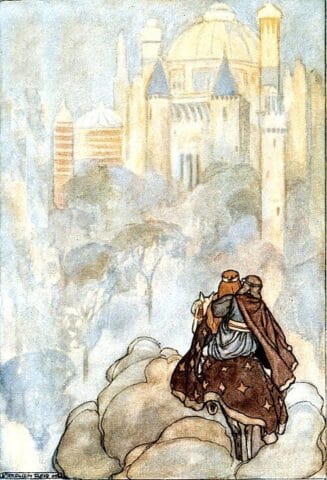
Matholwch, king of Ireland, arrived at Harlech with thirteen ships to ask for Branwen’s hand in marriage. The union would strengthen ties between Britain and Ireland, and Bendigeidfran accepted the proposal after consulting his council. The wedding celebrations took place at Aberffraw.
The trouble began when Efnisien learned that his sister’s marriage had been arranged without consulting him. Enraged, he mutilated Matholwch’s horses, cutting their ears, lips, tails, and eyelids until the animals were no longer usable.
Matholwch regarded the attack as an insult to his royal honour and prepared to leave Britain. Bendigeidfran, who had not sanctioned Efnisien’s actions, sent messengers after Matholwch with an offer of compensation: a healthy horse for each one mutilated, a silver rod as tall as Matholwch, and a gold plate as broad as his face.
Matholwch returned but remained visibly unhappy. Bendigeidfran then offered him the Pair Dadeni, or Cauldron of Rebirth. A warrior killed in battle and placed inside it would return to life the following day, although he would never speak again. The tale also reveals that the cauldron had originally come from Ireland.
Pleased with the gift, Matholwch eventually sailed home with Branwen.
Branwen’s Suffering in Ireland
Branwen was initially welcomed in Ireland. She gained friends at court and gave rings, clasps, and jewels to visiting nobles. She later gave birth to a son, Gwern, who was placed in foster care among the leading men of Ireland.
In the second year, the insult to Matholwch resurfaced. His foster-brothers and close companions openly mocked him for accepting compensation for the horses Efnisien had mutilated. Under their pressure, the court took revenge on Branwen.
She was removed from the chamber she shared with Matholwch and forced to bake for the royal household. Every day, after cutting up the meat, the court butcher struck her on the ear.
To prevent her family from learning of her treatment, Matholwch’s men urged him to cut off communication with Wales. Ships and smaller boats were forbidden to sail there, while visitors arriving from Wales were imprisoned to prevent their return.
Branwen endured this punishment and isolation for at least three years.
The Starling That Carried Branwen’s Message
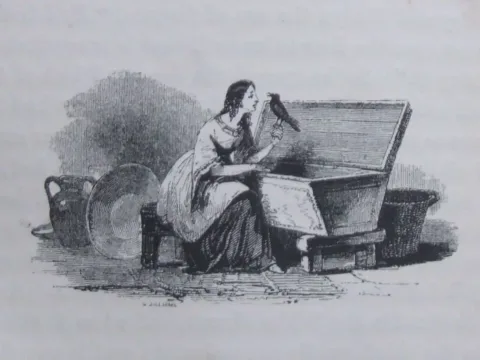
While working in the royal kitchen, Branwen raised a starling beside her kneading trough. She taught it to speak and described her brother Bendigeidfran so the bird could recognise him.
She wrote a letter describing her mistreatment, tied it beneath the starling’s wing, and sent it across the sea to Wales.
The bird found Bendigeidfran at Caer Seint in Arfon, where he was attending an assembly. It landed on his shoulder and ruffled its feathers until the letter was noticed. When Bendigeidfran read his sister’s account, he summoned the nobles and fighting men of Britain.
After hearing what had happened to Branwen, the assembled leaders agreed to attack Ireland. Seven men remained behind to govern Britain, led by Bendigeidfran’s son Caradog.
Bendigeidfran’s Invasion and the Failed Peace
Bendigeidfran led his army across the Irish Sea. Too large for any ship, he waded through the water while his warriors sailed alongside him. From the Irish coast, Matholwch’s swineherds saw what appeared to be a moving forest and a mountain rising from the sea. Branwen recognised the approaching army and explained that the forest was the ships’ masts, while the mountain was her brother.
Matholwch withdrew behind the River Llinon and destroyed its bridge to block the invasion. Bendigeidfran overcame the obstacle by lying across the river, allowing his warriors to cross over his body.
Matholwch offered to make Gwern king of Ireland as compensation for Branwen’s mistreatment. Bendigeidfran, however, wanted sovereignty for himself. The Irish proposed submitting to his authority and building a hall large enough to accommodate the giant king and both armies.
Branwen urged her brother to accept the settlement to spare Ireland further destruction. He agreed, and the hall was built.
The Irish had secretly prepared an ambush. Two hundred armed warriors were concealed in leather bags hanging from hooks beside the hall’s hundred pillars. Efnisien entered ahead of the British army and noticed the bags. When told they contained flour, he felt inside, found the hidden warriors, and crushed their skulls one by one.
With the ambush defeated, both sides entered the hall. Peace was formally concluded, and Gwern was granted the kingship of Ireland.
Gwern’s Death and the Cauldron of Rebirth
During the peace gathering, the young Gwern was presented to his British relatives. Bendigeidfran welcomed him, followed by Manawydan and Nisien. Efnisien then complained that his nephew had not approached him.
When Gwern came forward, Efnisien seized him by the feet and threw him headfirst into the fire. Branwen tried to leap after her son, but Bendigeidfran restrained her. Fighting immediately broke out between the British and Irish.
The Irish relied on the Cauldron of Rebirth, which Bendigeidfran had previously given Matholwch. Their dead warriors were placed inside it and returned to battle the following morning, able to fight as before but unable to speak.
Seeing the losses among his own people, Efnisien realised the destruction he had caused. He hid among the Irish dead and was thrown into the cauldron with the bodies. Once inside, he stretched himself until the vessel broke into four pieces, killing himself in the process.
The destruction of the cauldron turned the battle in favour of the British, but their victory came at a terrible cost. Only seven warriors escaped, alongside Branwen and the mortally wounded Bendigeidfran, who had been struck in the foot by a poisoned spear.
According to the tale, the only survivors left in Ireland were five pregnant women sheltering in a cave. Their sons later divided the island into five territories, providing a legendary explanation for Ireland’s traditional five divisions.
How Did Branwen Die?
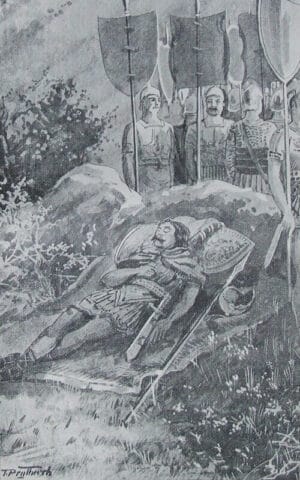
After the battle, Bendigeidfran ordered the seven surviving warriors to sever his head and carry it to the White Hill in London. According to the tale, his severed head would continue speaking throughout much of the journey.
Branwen accompanied the seven men across the Irish Sea. When they landed at Aber Alaw on Anglesey, she looked towards Ireland and Britain and lamented that both islands had been devastated because of her. She gave a great sigh, and her heart broke. The survivors buried her in a four-sided grave beside the River Alaw.
A prehistoric burial cairn near Llanddeusant, known as Bedd Branwen (Branwen’s Grave), is traditionally associated with her burial. Archaeologists date the monument to the Bronze Age, probably around 1400 BC, but there is no evidence connecting it to the legendary Branwen.
The seven survivors continued to Harlech, where Rhiannon’s birds sang to them for seven years. They later spent eighty years at Gwales before finally burying Bendigeidfran’s head in London.
What Does Branwen’s Tragedy Mean?
Branwen’s tragedy reveals the tensions within a system built on royal marriage, family loyalty, and honour. The alliance intended to unite Britain and Ireland instead exposes divisions within Branwen’s own family. Neither compensation nor the bonds created by marriage can prevent personal grievances from escalating into war. Even the Cauldron of Rebirth, originally offered as a peace gift, becomes a means of prolonging the bloodshed.
Branwen is caught between families that claim obligations to her while making decisions beyond her control. Yet she shows initiative and judgment, seeking help when isolated and supporting peace when it becomes possible. Her final belief that she has brought ruin upon both kingdoms stands in painful contrast to the decisions that actually caused the disaster.
Was Branwen a Celtic Goddess?
Branwen is sometimes described as a Celtic goddess of love, beauty, or fertility. However, no surviving evidence establishes that she was worshipped as a deity. In the Second Branch of the Mabinogi, she appears as a royal princess, wife, and mother, with no divine title or religious cult attributed to her.
Early scholars proposed possible pre-Christian origins for her character. In The Religion of the Ancient Celts (1911), J. A. MacCulloch suggested that Branwen might once have been a sea goddess or fertility goddess, partly through her family’s mythological associations and the Cauldron of Rebirth. He also acknowledged that the tale does not clearly connect Branwen herself to the cauldron.
These theories remain unproven. Branwen may preserve elements of older Celtic mythology, but the surviving Welsh narrative provides no firm basis for assigning her a specific divine role.
Read Also
The Mabinogion Explained: The Great Stories of Welsh Mythology
Explore the Welsh tales and the Four Branches to which Branwen belongs.
Rhiannon: The Story of a Mysterious Woman in Welsh Mythology
Discover Rhiannon’s story and the magical birds heard by the survivors of Branwen’s war.
The Dream of Macsen Wledig: Legend and Roman History
Read another medieval Welsh tale about a royal marriage linking Britain with a foreign ruler.
Academic Sources & Primary Texts
This article draws on surviving medieval Welsh manuscripts, scholarly translations of the Second Branch of the Mabinogi, and academic research into its literary themes. Interpretations of Branwen’s possible pre-Christian origins are distinguished from what the surviving text establishes.
Medieval Manuscripts & Textual Sources
- Peniarth MS 6, Fragments of Branwen and Manawydan
National Library of Wales. Thirteenth-century manuscript preserving the earliest surviving fragments of Branwen ferch Llŷr.
- The White Book of Rhydderch, Peniarth MS 4
National Library of Wales. Mid-fourteenth-century manuscript containing the Four Branches of the Mabinogi.
- Branwen ferch Llŷr: The Second Branch of the Mabinogi
Translated and annotated by Will Parker. An accessible English translation used to verify the narrative sequence, character relationships, and events.
Scholarly Translations & Literary Studies
- Davies, Sioned. The Mabinogion.
Oxford University Press, 2007. A modern scholarly translation with an introduction and explanatory notes on medieval Welsh storytelling.
- Ford, Patrick K. The Mabinogi and Other Medieval Welsh Tales.
University of California Press, 1977; second edition, 2019. An influential translation and introduction to the medieval Welsh narrative tradition.
- Mac Cana, Proinsias. Branwen, Daughter of Llyr.
University of Wales Press, 1958. A Study of the Irish Affinities and of the Composition of the Second Branch of the Mabinogi. A specialist monograph examining the tale’s structure and Irish literary connections.
- Jacobs, Lesley. Trouble in the Island of the Mighty: Kinship and Violence in Branwen ferch Lŷr.
Viator, 40(2), 2009, pp. 113–133. An academic study of family relationships, dynastic alliances, and violence in the tale.
- Sumner, Natasha. Efnisien’s Trickster Wiles: Meanings, Motives, and Mental Illness in the Second Branch of the Mabinogi.
Studia Celtica Posnaniensia, 1, 2016, pp. 73–89. Examines Efnisien’s characterization and narrative role in the catastrophe.
Historical Interpretations
- MacCulloch, J. A. The Religion of the Ancient Celts.
T. & T. Clark, 1911, Chapter VI. An early scholarly interpretation proposing possible divine origins for Branwen. These suggestions are historical hypotheses, not evidence of an established cult.
Research note:
Medieval narrative evidence and later scholarly interpretations are treated separately. References to ancient religious origins do not establish that Branwen was historically worshipped as a goddess.
Copyright & Editorial Notice
© 2026 History & Myths. All rights reserved for the original written content and editorial presentation of this article.
This article is an original educational examination of Branwen’s story, based on medieval Welsh literature and published scholarly research. Historical and literary interpretations are distinguished from the surviving narrative evidence.
The underlying myths, historical traditions, and public-domain source materials are not claimed as proprietary content. All referenced scholarly works remain subject to their respective authors’ and publishers’ rights.