The Children of Lir: The Tragic Swan Legend of Irish Mythology
The Children of Lir is one of Ireland’s best-known legends, but the surviving story is far richer than the familiar image of four children turned into swans.
It follows Fionnghuala, Aodh, Fiachra, and Conn, the children of Lir, who are cursed by their stepmother Aoife and forced to live as swans for 900 years. Their exile carries them from Lough Derravaragh to the Sea of Moyle and then to the western coast of Ireland, where they endure storms, separation, and the slow disappearance of the world they once knew.
The tale also reaches beyond the curse itself. It begins with rivalry among the Tuatha Dé Danann, follows the children through centuries of exile, and ends in a Christian Ireland very different from the world into which they were born.
This article follows the full surviving Irish narrative, explaining who the Children of Lir were, why they were cursed, what happened during each stage of their exile, and how their story finally ended.
Who Were the Children of Lir?
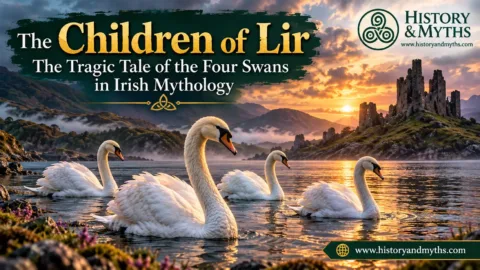
The Children of Lir were Fionnghuala, Aodh, Fiachra, and Conn, the four children of Lir and Aobh in the legendary world of the Tuatha Dé Danann.
Fionnghuala was the only daughter and the eldest of the group. As the story unfolds, she becomes the strongest presence among the siblings, protecting, guiding, and comforting her brothers throughout their long exile.
Aodh, Fiachra, and Conn remain closely bound to her, and the four are repeatedly presented as a single family unit. Their story depends not only on the curse placed upon them, but on their determination to remain together through centuries of hardship.
Their fate begins within the family and political world of the Tuatha Dé Danann, before Aoife’s jealousy changes their lives completely.
Why Did Lir and Bodb Dearg Become Rivals?
Before the Children of Lir were born, their father was already involved in a dispute over leadership among the Tuatha Dé Danann.
The chiefs gathered to choose a single king, with Lir and Bodb Dearg, son of the Dagda, among the leading candidates. The assembly chose Bodb Dearg, partly because of his lineage and seniority. Lir believed the kingship should have gone to him and left the gathering in anger without accepting the decision.
Some of the Tuatha Dé Danann wanted to punish Lir, but Bodb Dearg refused. He argued that Lir was powerful enough to defend his territory and saw no reason to force him into submission.
Their hostility ended after the death of Lir’s first wife. Bodb Dearg then offered him a marriage alliance, allowing him to choose among three women under his protection. Lir chose the eldest, Aobh, turning a political rivalry into a family connection.
Aobh and the Birth of the Four Children
Lir married Aobh, the eldest daughter of Ailill of Aran and a foster daughter of Bodb Dearg. Their marriage also helped end the earlier hostility between Lir and Bodb.
Aobh first gave birth to twins, Fionnghuala and Aodh. Later she gave birth to another pair, Fiachra and Conn, but died during the birth of the younger children.
Her death deeply affected Lir. The tale repeatedly emphasizes his grief for Aobh and the strong attachment he developed to the four children after losing her.
That attachment became an important part of the family dynamic that followed, especially after Lir later married Aobh’s sister, Aoife.
Why Did Aoife Become Jealous?
After Aobh’s death, Lir married her sister Aoife. At first, Aoife did not hate the children. The surviving tale says she felt affection for them, and their beauty made them widely loved.
That affection gradually changed. Bodb Dearg visited often because of the children and sometimes took them to stay with him. The Tuatha Dé Danann also delighted in them, while Lir’s attachment was especially strong. The story even describes him rising early to lie among them.
Over time, Aoife became jealous of the attention surrounding the four siblings. Her feelings hardened into hatred toward the children of her own sister.
She did not act immediately. Aoife feigned illness for much of a year before deciding to remove them.
How Did Aoife Turn the Children Into Swans?
Aoife took the four children away from Lir under the pretense of visiting Bodb Dearg. During the journey, she considered having them killed, but the men traveling with her refused to take part.
She then brought the children to Loch Dairbhreach, where they entered the water to bathe. Once they were in the lake, Aoife struck them with a magical wand and transformed them into four white swans.
Fionnghuala immediately confronted her, asking why she had destroyed the children of her own sister. Aoife then pronounced the curse that would keep them in swan form for centuries.
Despite the transformation, the children retained human reason, memory, speech, and song. They knew who they were even though they could no longer return to human life.
What Were the Exact Terms of the Curse?
Aoife divided the children’s exile into three periods of 300 years, making the curse last 900 years in total:
- 300 years on Loch Dairbhreach, where they were transformed.
- 300 years on Sruth na Maoilé, the Sea of Moyle between Ireland and Scotland.
- 300 years around Iorrus Domnann and Inis Gluairé on the western coast of Ireland.
She also declared that the curse would not end until Lairgnen of the north and Deoch of the south were united, a condition that would only be fulfilled centuries later.
The children would remain swans throughout that time, but they were allowed to keep human reason, speech, memory, and their remarkable singing voices.
The First 300 Years on Lough Derravaragh
The first stage of the curse was spent on Loch Dairbhreach, later known as Lough Derravaragh. Unlike the harsher years that followed, the children were not completely cut off from the people they loved.
Lir soon found them there and discovered that they could still speak and sing. Their music was said to be so beautiful that those who heard it fell into peaceful sleep.
Bodb Dearg and members of the Tuatha Dé Danann also came to the lake, and others gathered there to hear the swans. For much of these 300 years, the children remained connected to the world they had known before the curse.
That made their departure especially painful. When the appointed time ended, they had to leave Lough Derravaragh for the Sea of Moyle, where the next stage of their exile would be far colder, lonelier, and more dangerous.
The Second 300 Years on the Sea of Moyle
The second stage of the curse took the children to Sruth na Maoilé, the Sea of Moyle between Ireland and Scotland. Compared with Lough Derravaragh, it was a far harsher place.
The cold sea, violent winds, and exposed coastline made survival difficult. On Lough Derravaragh they had remained close to people who knew them, but on the Moyle they were largely alone.
During one severe storm, the four swans were scattered across the sea. Before the weather broke, they had agreed to meet at Carraig na Ron if they became separated. Fionnghuala reached the meeting place first and waited through the night for her brothers.
Conn and Fiachra eventually returned, exhausted by the cold, and Aodh followed later. The reunion did not end their suffering. For the rest of their 300 years on the Moyle, storms, freezing water, and exposure remained part of daily life.
Fionnghuala and the Survival of Her Brothers
Among the four children, Fionnghuala gradually becomes the figure who keeps the siblings together.
As the eldest, she takes responsibility for her brothers during the hardest parts of their exile. She shelters them from the cold, encourages them when their strength fails, and repeatedly acts as the steady presence within the group.
The surviving tale gives her a role that goes beyond simple companionship. While all four children endure the curse, Fionnghuala is often the one who responds to danger, speaks for the group, and tries to protect the others.
Her importance lies in that constancy. Across centuries of exile, she becomes the emotional center of the family and the person most responsible for keeping the four siblings united.
The Final 300 Years at Erris and Inis Gluairé
After completing their 300 years on the Sea of Moyle, the children flew west to Iorrus Domnann, in the region of Erris. This began the final stage of Aoife’s curse.
The conditions remained harsh. On one winter night, frost and snow were so severe that the water between Iorrus and Achill froze, trapping the swans on the ice. During the ordeal, Fionnghuala urged her brothers to place their faith in God.
When their appointed time at Iorrus ended, the children decided to return once more to their father’s home, hoping to find Lir and the world they had left centuries earlier.
Who Was Aibhric?
During their time at Iorrus Domnann, the Children of Lir met a young man named Aibhric.
The surviving tale describes him as a man of good family who became deeply attached to the four swans after hearing their singing. The children also grew fond of him, making him one of the few people to form a lasting connection with them during their exile.
Aibhric is especially important because the text credits him with arranging and narrating the adventures of the Children of Lir. Within the story’s own tradition, he becomes the figure associated with preserving the memory of their long ordeal.
The Return to Their Father’s Abandoned Home
When their time at Iorrus Domnann ended, the children returned to Sioth Fionnachaidh, expecting to find Lir, his household, and the home they had left centuries earlier.
Instead, they found the place deserted. The settlement had fallen into roofless green mounds and overgrown ground, with no house, fire, or sign of the people they once knew.
The four swans gathered together and cried out in grief. Lir was gone, their household had vanished, and nothing remained of the world of their childhood.
Fionnghuala’s lament gives the scene its full weight. The place that had once been filled with music, gatherings, and family life was now silent, confirming that their old life could never be recovered.
Mochaomhóg and the Coming of Christianity
The final phase of the story begins when the Children of Lir meet Mochaomhóg, a Christian holy man living on Inis Gluairé.
The swans are drawn to the sound of his bell, something completely unfamiliar to them. Mochaomhóg welcomes them, and they remain with him, listening to the offices of the Church and taking part in Christian worship.
He also places silver chains around them in pairs, keeping the four siblings together as they wait for the final condition of Aoife’s curse to be fulfilled.
Lairgnen and Deoch: How the Curse Finally Ended
Aoife had declared centuries earlier that the spell would last until Lairgnen of the north and Deoch of the south were united. By the time the Children of Lir were living with Mochaomhóg, that condition had finally been fulfilled: Lairgnen was king of Connacht, and Deoch, daughter of the king of Munster, was his wife.
Deoch heard about the four swans and wanted them for herself. She asked Lairgnen to obtain them, but Mochaomhóg refused to give them up. Lairgnen then went to the cleric in person.
He seized the birds from the altar, taking two in each hand. At that moment, their feathers fell away and the curse ended.
The children returned to human form, but not to the bodies they had lost centuries earlier. Fionnghuala appeared as an aged woman, while her brothers became extremely old men.
How Did the Children of Lir Die?
Once the swan forms fell away, the four siblings were left as extremely old humans. Their 900 years had not been undone, and Fionnghuala understood that death was near.
She asked Mochaomhóg to baptize them and gave precise instructions for their burial. Conn was to lie on one side of her, Fiachra on the other, and Aodh before her, keeping the four siblings together even in death.
Mochaomhóg baptized them, and the Children of Lir died soon afterward. They were buried as Fionnghuala had requested, with a stone raised over the grave and their names inscribed in Ogham.
What Happened to Aoife?
Aoife’s punishment came soon after the truth about the children was discovered.
When Lir told Bodb Dearg what she had done, Bodb condemned her betrayal and told her that the children would eventually be released from their suffering.
He then asked Aoife what form she would consider the worst possible shape to endure. She answered that it would be a demon of the air.
Bodb struck her with a magical wand and transformed her into that form. The tale says she flew away immediately and would remain a demon of the air forever.
Is the Children of Lir an Ancient Irish Myth?
The Children of Lir is often described as an ancient Celtic or pagan myth, but the surviving tale is more complicated than that.
Its setting belongs to the mythological world of the Tuatha Dé Danann, and it uses familiar Irish motifs such as transformation, magical curses, supernatural beings, and enchanted landscapes. However, the literary version that survives was recorded much later.
Christian elements are also built into the ending. Mochaomhóg, church worship, baptism, and the children’s final release all form an essential part of the story rather than a brief addition at the end.
It is therefore more accurate to describe the Children of Lir as a traditional Irish legendary tale preserved in a later Christian literary form, rather than as a direct record of pre-Christian Celtic religion.
Why Is the Story So Tragic?
The tragedy of the Children of Lir comes from more than their transformation into swans. The curse forces them to remain conscious through 900 years of loss.
They keep their memories, voices, and human understanding, so they never forget who they are or the family they once had. Over the centuries, Lir dies, their home disappears, and the world of the Tuatha Dé Danann passes away around them.
Even the end of the curse offers no real restoration. When the children regain human form, they return as extremely old people rather than the young figures they once were.
What makes the story especially painful is that time itself becomes part of the punishment. The children survive physically, but everything that once made their old life possible is gone.
What the Surviving Sources Actually Tell Us
The Children of Lir does not survive in a single ancient manuscript. The tale reached us through a later manuscript and print tradition.
The UCC CELT edition is based on the nineteenth-century edition prepared by Richard J. O’Duffy, which drew on earlier work by Eugene O’Curry. UCC also lists several manuscript witnesses, including a seventeenth-century copy now held by the National Library of Scotland.
The title of the tale appears earlier still, in a 1526 catalogue from the Earl of Kildare’s library. This shows that the story was known before the earliest surviving manuscript currently listed by UCC.
How closely those later texts reflect earlier versions cannot be established with certainty. What survives is a substantial literary tradition that allows the story to be followed in far greater detail than the short modern retellings usually provide.
Conclusion
The Children of Lir is far more than a tale about four children transformed into swans. Its power comes from the long journey of Fionnghuala, Aodh, Fiachra, and Conn through loss, exile, and centuries of change.
Across 900 years, the story moves from the mythic world of the Tuatha Dé Danann into a very different Ireland, while the four siblings remain bound together by memory and family.
That combination of endurance, loss, and change is what has made the Children of Lir one of the most enduring legends in Irish tradition.
Academic & Primary Sources
- The Fate of the Children of Lir, CELT: Corpus of Electronic Texts, University College Cork.
English digital edition based on the nineteenth-century edition of Richard J. O’Duffy, itself drawing on Eugene O’Curry’s earlier work. Primary source used for the narrative, characters, curse, exile, and ending. - Oidhe Chloinne Lir, Early Modern Irish text, CELT, University College Cork.
Early Modern Irish version of the tale, with manuscript and bibliographic information supplied by the CELT project. - Breatnach, Caoimhín. “The Religious Significance of Oidheadh Chloinne Lir.”
Ériu 50 (1999), pp. 1–40. Major academic study of the Christian structure and religious meaning of the surviving tale. - Byrne, Aisling. “The Earls of Kildare and their Books at the End of the Middle Ages.”
The Library 14.2 (2013), pp. 129–153. Academic study of the Kildare library inventories, relevant to the 1526 record of the tale’s title and its late-medieval circulation. - University College Cork, Irish Sagas: Oidhe Chloinne Lir Sources.
Scholarly source guide listing manuscript witnesses, early editions, translations, and bibliographic references for the tale.