Dian Cécht: Healer of the Tuatha Dé Danann in Irish Mythology
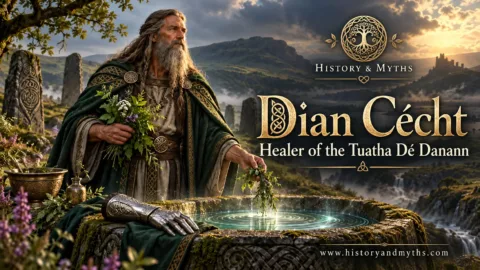
Dian Cécht was the physician of the Tuatha Dé Danann, the supernatural people at the center of early Irish mythology. In Cath Maige Tuired, he is already recognized as their healer when Lugh arrives at Tara, and his medical skill later becomes part of their strength in the Second Battle of Mag Tuired.
He is best known for giving King Nuada a silver hand after the king lost his own in battle. Yet Dian Cécht is not remembered only for healing. His son Miach later achieves a cure that goes beyond his father’s work, and Dian Cécht kills him. His daughter Airmed is also drawn into the family’s medical tradition through the story of the 365 healing herbs that grow from Miach’s grave.
These stories make Dian Cécht more complicated than the simple modern label “god of healing” suggests. The early Irish texts present him first as a powerful physician, but also as a figure whose skill, authority, and conflict with his own children shape some of the darkest episodes in the mythology of the Tuatha Dé Danann.
Who Was Dian Cécht?
In Cath Maige Tuired, Dian Cécht is already the recognized physician of the Tuatha Dé Danann when Lugh arrives at Tara. When Lugh offers his own skill as a healer, the gatekeeper replies that the Tuatha Dé already have Dian Cécht. The exchange shows that medicine was not a minor talent attached to his character, but the role by which he was known.
His importance becomes clearer before the Second Battle of Mag Tuired. When Lugh asks the leading members of the Tuatha Dé what each can contribute to the coming war, Dian Cécht promises to restore wounded fighters by the following day unless they have suffered certain fatal injuries to the head or spinal cord.
That places him among the specialists whose skills make the Tuatha Dé effective as a group. Dian Cécht is not presented as a warrior or ruler, but as the physician whose ability to return injured men to health gives his people a practical advantage in war.
The surviving stories therefore define him less by a formal divine title than by a specific function: he is the healer the Tuatha Dé already rely on when crisis comes.
What Does the Name Dian Cécht Mean?
The exact meaning of the name Dian Cécht is uncertain. The Old Irish adjective dían means “swift” or “rapid,” while the medieval text Cóir Anmann explains cécht as “power.” This has led to the common interpretation “swift power.”
Cóir Anmann also preserves its own medieval explanation of the name, describing Dian Cécht as a figure associated with power. That explanation is valuable evidence for how later Irish scholars understood the name, but it does not necessarily preserve its original etymology.
Other interpretations have been proposed, including attempts to connect the name more directly with healing or remedies. None is secure enough to treat as definitive. For that reason, “swift power” is best presented as a plausible reading rather than a settled translation.
Dian Cécht and Nuada’s Silver Hand
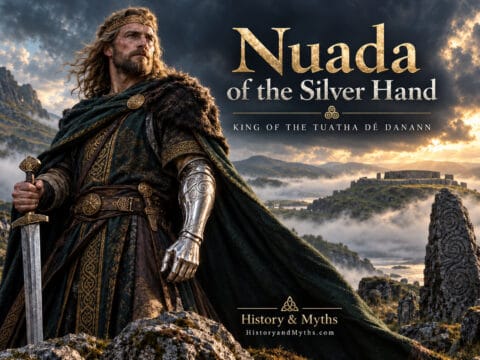
Dian Cécht’s best-known achievement is the silver hand he made for Nuada, king of the Tuatha Dé Danann.
Nuada lost his hand in the First Battle of Mag Tuired, when Sreng of the Fir Bolg struck it off. The injury had political consequences as well as physical ones. Because a king with such a bodily defect could no longer rule, Nuada was forced to give up the kingship.
Dian Cécht did not work alone. Cath Maige Tuired says that Crédne the brazier helped him fit Nuada with a silver hand that moved like a natural one. The episode combines two kinds of expertise: Dian Cécht’s healing skill and Crédne’s craftsmanship.
The silver hand restored Nuada’s ability to function, but it did not fully restore the physical wholeness required for kingship. That came later, when Dian Cécht’s son Miach achieved a more complete cure by restoring Nuada’s natural hand.
The episode therefore connects healing directly with sovereignty. Dian Cécht preserves Nuada after a devastating injury, but Miach’s later treatment changes both the king’s fate and the relationship between father and son.
Why Did Dian Cécht Kill Miach?
The darkest episode in Dian Cécht’s story begins when his son Miach surpasses his treatment of Nuada.
Dian Cécht had given the king a functioning silver hand. Miach goes further. In Cath Maige Tuired, he restores Nuada’s natural hand by placing it against the king’s body and healing the flesh, skin, and sinew over nine days and nights.
Dian Cécht reacts violently. The text says he disliked Miach’s cure and struck him on the head with a sword. Miach heals the first wound himself. A second blow cuts deeper, and he recovers again. A third reaches the membrane around the brain, but Miach still survives. The fourth destroys the brain itself and kills him.
The text never states exactly why Dian Cécht responds this way. Jealousy is the usual modern explanation because Miach has just achieved a cure beyond his father’s earlier work, but Cath Maige Tuired does not name jealousy as his motive. What it does show is a clear conflict between two generations of healers, ending with Dian Cécht deliberately killing the son who had surpassed him.
Airmed and the 365 Healing Herbs
Miach’s death leads to one of the most distinctive healing episodes in Irish mythology. After Dian Cécht buries him, 365 herbs grow from the grave, matching the number of Miach’s joints and sinews in the text.
Airmed, Miach’s sister and a healer in her own right, gathers the plants and arranges them on her cloak according to their properties. Dian Cécht then mixes them together, destroying the order she had created. Cath Maige Tuired says that their healing qualities could no longer be properly known unless divine instruction revealed them again.
The episode presents Airmed as someone who understands how remedies differ and how they should be classified. Dian Cécht, by contrast, becomes the figure who disrupts that knowledge after already killing Miach.
The number 365 is linked in the text to Miach’s body, specifically his joints and sinews. Later interpretations sometimes connect it with the days of the year, but Cath Maige Tuired itself does not make that connection.
The Healing Well of Sláine
Before the Second Battle of Mag Tuired, Lugh asks the leading specialists of the Tuatha Dé Danann what each can contribute to the coming fight. Dian Cécht answers as a physician, saying he can restore wounded warriors by the following day unless they have suffered certain fatal injuries to the head or spinal cord.
During the battle, that promise is put into practice at a healing well called Sláine. Dian Cécht works there with Miach, Octriuil, and Airmed, chanting over the water as wounded members of the Tuatha Dé are brought to them. The injured are placed in the well and emerge restored.
Cath Maige Tuired also calls the well Loch Luibe, “Lake of Herbs,” because Dian Cécht had placed in it every herb that grew in Ireland. When Goibniu is wounded during the battle, he enters the well and comes out healed.
The Fomorians eventually recognize the advantage the well gives their enemies and fill it with stones to stop its use.
Sláine shows Dian Cécht’s role in the war clearly. He does not win fame through a duel or weapon, but by keeping wounded fighters alive and returning them to the conflict through herbs, incantation, and the combined skill of his healing family.
Read Also
- Nuada of the Silver Hand: King of the Tuatha Dé Danann
- The Second Battle of Mag Tuired: Tuatha Dé Danann vs Fomorians
- The Tuatha Dé Danann: The Supernatural Race of Irish Mythology
Dian Cécht’s Family
Dian Cécht belongs to a wider family of healers, but the surviving Irish sources do not preserve one completely consistent genealogy.
In Cath Maige Tuired, his children include Miach, Octriuil, and Airmed, all of whom appear with him at the Well of Sláine as physicians. The same text also names Cian as his son. Since Cian is the father of Lugh, this makes Dian Cécht Lugh’s paternal grandfather in that tradition.
Other medieval texts expand the family further. Lebor Gabála Érenn, for example, gives Dian Cécht additional sons and preserves different versions of how his children are counted. That kind of variation is common in Irish mythological genealogy, where different texts do not always preserve the same family structure.
The most secure relationships for this article are therefore the ones directly supported by Cath Maige Tuired: Miach, Airmed, and Octriuil belong to the healing circle around Dian Cécht, while Cian connects him directly to Lugh.
Was Dian Cécht Really a “God of Healing”?
Calling Dian Cécht the Irish god of healing is useful shorthand, but it is not how the surviving medieval texts usually describe him.
In Cath Maige Tuired, he appears first and foremost as the physician of the Tuatha Dé Danann. His identity comes from his craft: treating wounds, helping create Nuada’s silver hand, and healing wounded warriors during the Second Battle of Mag Tuired.
That fits the way many figures among the Tuatha Dé are presented. Their roles are often defined through skills, relationships, and actions rather than through fixed divine domains in the later classical sense. Dian Cécht can therefore be called a healing deity, but “physician of the Tuatha Dé Danann” is closer to the language and structure of the surviving tradition.
His association with medicine also continued beyond mythological narrative. The legal tract known as Bretha Déin Chécht, “The Judgements of Dian Cécht,” bears his name, while later Irish medical manuscripts preserve remedies attributed to him. His authority as a healer therefore survived in Irish learned tradition long after the mythological stories themselves.
What Makes Dian Cécht Different From Miach and Airmed?
Dian Cécht, Miach, and Airmed all belong to the healing tradition of the Tuatha Dé Danann, but the stories give them distinct roles.
Dian Cécht is the established physician of the Tuatha Dé Danann. Miach is the younger healer whose restoration of Nuada’s natural hand surpasses his father’s earlier treatment. Airmed is most closely associated with medicinal knowledge, especially through the story of the 365 herbs she sorts after Miach’s death.
The distinction is simple but important: Dian Cécht represents established healing authority, Miach represents exceptional restorative skill, and Airmed is most strongly linked with the knowledge and classification of remedies.
Conclusion
Dian Cécht is best understood not simply as a “god of healing,” but as the physician of the Tuatha Dé Danann, a figure whose authority comes from skill, status, and a long association with medicine.
His stories also resist a simple heroic image. The same healer who restores a king and saves wounded warriors is remembered as the father who kills Miach and disrupts Airmed’s knowledge of the healing herbs.
That tension is what makes Dian Cécht distinctive. In the early Irish tradition, he is a master physician whose healing power exists alongside violence, rivalry, and conflict within his own family.
Academic & Primary Sources
- Elizabeth A. Gray (ed. and trans.), Cath Maige Tuired: The Second Battle of Mag Tuired.
Irish Texts Society, 1982. The principal primary source used for Dian Cécht’s role as physician of the Tuatha Dé Danann, Nuada’s silver hand, Miach, Airmed, the 365 herbs, and the Healing Well of Sláine.
CELT, University College Cork
- Whitley Stokes (ed.), Cóir Anmann (“Fitness of Names”).
Published in Irische Texte, 1897. A medieval Irish name-lore text containing an explanation of Dian Cécht’s name and the interpretation of cécht as “power.”
CELT, University College Cork
- D. A. Binchy (ed. and trans.), “Bretha Déin Chécht.”
Ériu, Vol. 20, 1966, pp. 1–66. Edition of the early Irish medico-legal tract known as “The Judgements of Dian Cécht,” important for understanding the later association of Dian Cécht with medical authority in Irish learned tradition.
LEIGHEAS, Maynooth University
- Deborah Hayden, “Three Versified Medical Recipes Attributed to Dían Cécht.”
In Fír Fesso: A Festschrift for Neil McLeod, Sydney Series in Celtic Studies 17, 2018, pp. 107–123. Examines later Irish medical recipes attributed to Dian Cécht and the survival of his authority beyond mythological narrative.
Maynooth University Research Archive
- Deborah Hayden, “Attribution and Authority in a Medieval Irish Medical Compendium.”
Studia Hibernica, 2019. A peer-reviewed study of how Dian Cécht and other figures of the Tuatha Dé Danann were invoked as medical authorities in medieval Irish learned texts.
Maynooth University Research Archive