Ragnarök Explained: How the Norse World Ends and What Comes After
Ragnarök is the great catastrophe of Norse mythology, the moment when the old order collapses. A terrible winter grips the world, social bonds break down, Fenrir and Jörmungandr are unleashed, Loki joins the enemies of the gods, and the Æsir march toward a final battle they cannot fully escape.
Odin is killed by Fenrir, Thor defeats Jörmungandr but dies from its venom, Freyr falls before Surtr, and fire sweeps across the world. Yet Ragnarök is not simply the end. Some gods survive, Baldr returns, two human survivors preserve mankind, and the earth rises again green from the sea.
The familiar story, however, was not preserved in one complete ancient account. Much of what we know comes from Völuspá and other Eddic poems, while Snorri Sturluson later arranged many of these traditions into the more orderly sequence found in the Prose Edda. Understanding Ragnarök therefore means following the destruction and rebirth of the Norse world while also asking what the surviving sources actually say.
What Does Ragnarök Actually Mean?
The name Ragnarök is often translated as “Twilight of the Gods,” but that is not the most accurate meaning of the Old Norse term.
The first element, ragna, refers to the gods or divine powers. The second, rök or rǫk, is associated with fate, judgement, or final destiny. Ragnarök is therefore better understood as the “fate of the gods” or the final destiny of the divine powers.
The familiar phrase “Twilight of the Gods” comes from the related form ragnarøkkr, in which røkkr means twilight or darkness. That wording became especially influential in later European culture, most famously through Richard Wagner’s Götterdämmerung, but it is not the literal meaning of the older term Ragnarök.
The name points to the fate that overtakes the gods and the order they inhabit, rather than simply to their gradual disappearance.
Where Does the Ragnarök Story Come From?
There is no single Old Norse text that tells Ragnarök from beginning to end exactly as it is usually retold today.
The most important poetic source is Völuspá, a prophecy in the Poetic Edda that describes the breakdown of the world, the final conflict, the deaths of major gods, and the emergence of a renewed earth. Other Eddic poems preserve important parts of the tradition. Vafþrúðnismál, for example, adds details about survivors such as Víðarr, Váli, Magni and Móði, while Lokasenna and Grímnismál contain further references to the fate of the gods.
The fullest continuous account appears in Snorri Sturluson’s Prose Edda, written in the thirteenth century. In Gylfaginning, Snorri gathers older poetic material and arranges it into a more orderly sequence, from the signs of the end to the final battle, destruction and renewal.
Some details belong clearly to older Eddic poetry, while others survive most fully, or only in their familiar form, through Snorri. The Ragnarök story known today is therefore assembled from several medieval sources rather than preserved in one original narrative.
What Happens Before Ragnarök?
Ragnarök does not begin with one single event. The surviving sources describe a world already moving toward crisis, with Baldr’s death, Loki’s punishment, social collapse and the coming of Fimbulwinter all forming part of the background.
Baldr’s death is one of the great disasters among the gods. In Völuspá, his fate appears before the final sequence of Ragnarök, while Snorri gives the fuller story in which Loki engineers his death through Höðr and later prevents Baldr’s return from Hel. Loki is then captured and bound as punishment.
Baldr’s death is often treated in modern retellings as the event that starts Ragnarök, but the sources do not present such a simple chain of cause and effect. It is better understood as part of the wider breakdown of the divine order.
The clearest immediate sign is Fimbulwinter, the terrible winter that precedes the final battle. In Snorri’s account, three winters come without a summer between them, following years of warfare and social collapse. Brothers kill one another, family bonds fail, and violence spreads through the human world before the monsters themselves are unleashed.
By the time the final battle approaches, human society has already begun to collapse and the natural world is failing with it.
The Bonds Break: Fenrir, Jörmungandr and Loki
After the long winter and the collapse of human order, the crisis becomes cosmic. The earth shakes, mountains fall, and the bonds that once held the gods’ enemies in check can no longer contain them.
Fenrir breaks free from his fetters. Jörmungandr, the Midgard Serpent, rises violently from the sea, driving the waters onto the land and spreading venom through the air and ocean. Loki, bound after Baldr’s death, is also free by the time the enemies of the gods gather for the final confrontation.
Snorri’s Gylfaginning makes the scene especially vivid. Fenrir advances with his jaws stretched from earth toward heaven, Jörmungandr moves beside him, and the sea floods the land. At the same time, hostile forces begin moving toward Vígríðr, the field where the final battle will take place.
Fenrir and Jörmungandr are not new threats appearing at the end of the story. The gods had restrained them earlier because of what they were expected to do. Ragnarök is the moment when those precautions finally fail, and the gods must prepare for battle.
Heimdall Sounds Gjallarhorn
As the enemies of the gods advance, Heimdall sounds Gjallarhorn, the great horn whose blast warns the gods that the final battle has begun.
The moment appears in both Völuspá and Snorri’s Gylfaginning. In the poem, Gjallarhorn sounds as Yggdrasil trembles and the forces of chaos move forward. Snorri expands the scene: Heimdall awakens the gods, Odin rides to Mímir’s well for counsel, and the Æsir prepare for war.
Odin then leads the gods toward Vígríðr, armed with Gungnir. The bindings and precautions that once held their enemies back have failed, and the gods now move to meet the fate they know is coming.
The Final Battle at Vígríðr
The familiar image of Ragnarök as a series of one-on-one duels comes most clearly from Snorri’s Gylfaginning. The older poems preserve several of the same deaths and confrontations, but not always as one neatly ordered battle.
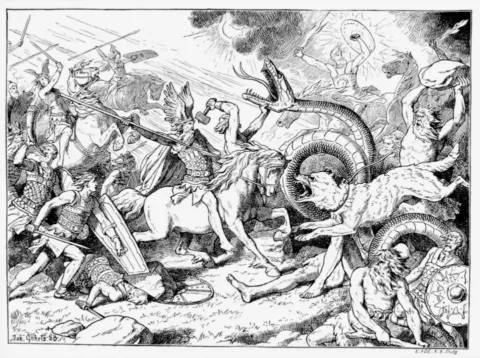
Odin rides against Fenrir and is swallowed by the wolf. His son Víðarr avenges him. Vafþrúðnismál already preserves this outcome, while Snorri gives the more elaborate version in which Víðarr forces Fenrir’s jaws apart and kills him.
Thor fights Jörmungandr and kills the Midgard Serpent, but survives for only a few moments. He walks nine steps before falling dead from its venom. Völuspá also preserves the confrontation, although parts of the surviving stanza are textually difficult.
Elsewhere on the field, Freyr faces Surtr and falls. Snorri connects his defeat with the sword Freyr had earlier given away. Týr and the hound Garmr kill one another, while Heimdall and Loki meet and both die. These paired combats are presented most systematically in the Prose Edda, which is one reason modern retellings often make Ragnarök appear more orderly than the poetic material itself.
There is no victorious side left to claim the field. Odin, Thor, Freyr, Týr, Heimdall and Loki are dead, while Surtr remains to carry the destruction beyond Vígríðr and into the world itself.
Does Loki Really Sail Naglfar?
Modern retellings often say that Loki captains Naglfar, the ship that breaks free at Ragnarök. The surviving sources are less straightforward.
In Völuspá, Naglfar is mentioned as breaking loose during the chaos. The poem then describes a ship coming from the east with Loki at its helm. Because the passages appear close together, the two vessels are often treated as the same ship, but the poem never states that explicitly.
Snorri gives a different arrangement in Gylfaginning. He identifies Hrym, a giant, as the one who steers Naglfar, while Loki arrives with other enemies of the gods. Snorri also describes Naglfar as being made from the untrimmed nails of the dead.
Loki does command a ship in the poetic account, but identifying that vessel with Naglfar is uncertain. In Snorri’s version, Naglfar is explicitly steered by Hrym.
How Does the World End?
The deaths of the gods do not end Ragnarök. The destruction spreads beyond the battlefield and reaches the world itself.
In Völuspá, the sun turns black, the stars disappear from the sky, the earth sinks into the sea, and fire rises toward heaven. The poem presents a collapse of the natural order, not simply the aftermath of the battle.
Snorri gives Surtr the clearest role in the destruction. After the fighting, he casts fire over the earth and burns the world. Earlier in Gylfaginning, Surtr leads the sons of Muspell into battle with a blazing sword, while Bifröst breaks as the hostile forces advance toward Vígríðr.
Modern retellings often describe Ragnarök as the destruction of all the Nine Worlds, but the surviving sources do not give a separate fate for each realm. What they describe is a cosmic disaster in which the world is overwhelmed by fire, darkness and the sea.
Who Survives Ragnarök?
Ragnarök destroys much of the old divine order, but some gods and humans survive.
Among the gods, Víðarr and Váli live through the catastrophe. Thor’s sons, Magni and Móði, also survive and inherit Mjölnir after their father’s death. Vafþrúðnismál preserves these traditions, while Snorri later incorporates them into his fuller account of the aftermath.
Humanity continues through Líf and Lífþrasir. According to Vafþrúðnismál, they hide in Hoddmímir’s wood during the great winter and survive on morning dew. From them, a new human population descends after Ragnarök.
The surviving gods represent a younger generation, while Líf and Lífþrasir preserve the human line beyond the destruction of the old world.
Read More
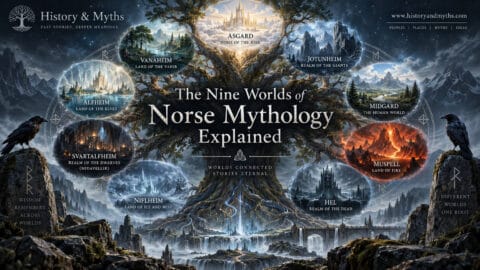
The Nine Worlds of Norse Mythology Explained: Asgard to Hel
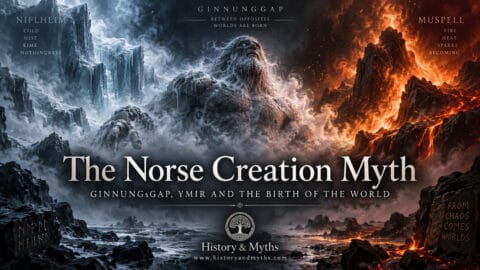
Norse Creation Myth: Ginnungagap, Ymir and the Birth of the World
What Happens After Ragnarök?
After the destruction, the earth rises again from the sea, green and fertile, and a new age begins.
In Völuspá, fields grow without being sown, waterfalls return, and the surviving gods gather at Iðavöllr, where the Æsir had once met before Ragnarök. There they remember the old world and recover the golden game pieces associated with the earlier age.
Baldr and Höðr, both dead before Ragnarök, return and join the renewed divine order. Their appearance is especially striking because they are not survivors of the catastrophe, but figures restored after it.
A new sun also takes the place of the one lost during Ragnarök. Vafþrúðnismál says that the sun gives birth to a daughter before being swallowed, and that daughter follows the same path across the sky afterward.
The sources give only brief glimpses of this renewed world, not a complete second mythology. What remains clear is that Ragnarök ends the old order without ending life itself.
Was Ragnarök a Pagan Myth or Shaped by Christianity?
Ragnarök was preserved in manuscripts written after the Christianization of Scandinavia, so Christian influence has to be considered. That does not mean Christian writers invented the myth.
Its central features, including the release of monsters, the final battle, the destruction of the world and its renewal, are generally understood as rooted in older Scandinavian tradition. At the same time, the surviving poems and prose were transmitted in a medieval Christian environment where ideas about judgement, cosmic fire and a renewed world were already familiar.
Scholars therefore disagree over how much Christian influence can be detected in individual passages, especially in Völuspá. Some older interpretations gave that influence a larger role, while more recent scholarship is more cautious. Anders Hultgård, for example, argues that Christian influence on Völuspá is relatively slight, while still recognizing the Christian setting in which the poem was transmitted.
Ragnarök is best understood as a pre-Christian Scandinavian myth preserved through medieval Christian transmission. The setting in which the texts survived may have shaped some details, but it did not create the myth itself.
Was Ragnarök the End or a New Beginning?
Ragnarök is both an ending and a beginning, but the surviving sources do not describe an endless cycle in which the same events repeat forever.
The old divine order is broken and cannot simply be restored. Major gods are gone, the world has been transformed, and what follows belongs to a different age.
Modern retellings often describe Ragnarök as a “cycle of destruction and rebirth.” The phrase is useful only in a limited sense. The texts describe one catastrophic ending followed by renewal, not a clearly defined eternal recurrence.
Ragnarök therefore closes one age of the Norse cosmos without closing the future. The world the gods knew is lost, but another world takes its place.
Academic Sources
This article draws on the main Old Norse sources for Ragnarök together with modern academic studies of the myth, its transmission, and the relationship between Eddic poetry and Snorri Sturluson’s account.
- Hultgård, Anders.
The End of the World in Scandinavian Mythology: A Comparative Perspective on Ragnarök.
Oxford University Press, 2022.
Oxford Academic
- Larrington, Carolyne, trans.
The Poetic Edda.
2nd revised edition, Oxford University Press, 2014.
Google Books
- Sturluson, Snorri.
Edda: Prologue and Gylfaginning.
Edited by Anthony Faulkes, 2nd edition.
Viking Society for Northern Research, 2005.
Viking Society for Northern Research
- Males, Mikael.
“Gylfaginning: Poetic Sources and the Structure of the Archetype.”
Saga-Book, Vol. XLV, Viking Society for Northern Research, 2021.
Saga-Book, Viking Society for Northern Research
- Lindow, John.
Norse Mythology: A Guide to the Gods, Heroes, Rituals, and Beliefs.
Oxford University Press, 2002.
Oxford Academic
- Nordal, Sigurður.
“Three Essays on Völuspá.”
Translated by B. S. Benedikz and J. S. McKinnell.
Saga-Book, Vol. XVIII.
Viking Society for Northern Research.
Viking Society for Northern Research
Copyright Notice
This article is an original work published by
History & Myths. All rights reserved.
The text may not be copied, republished, translated, or redistributed
in whole or in substantial part without prior written permission.