Vidar: The Silent Norse God Who Avenges Odin
Vidar (Old Norse Víðarr) is the son of Odin and the giantess Gríðr in Norse mythology. Known as the Silent God, he is described by Snorri Sturluson as second only to Thor in strength. The reason for his silence remains unknown.
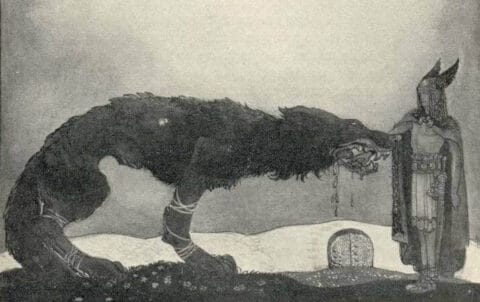
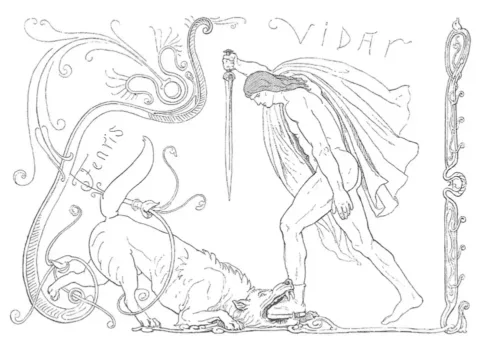
Vidar is best known for avenging Odin at Ragnarök. After Fenrir swallows his father, Vidar kills the wolf. The surviving accounts differ on how he does it: one describes a sword driven into Fenrir’s heart, while another tells of Vidar tearing the wolf’s jaws apart. Snorri adds the detail of a specially made shoe that helps him overpower Fenrir.
Vidar also survives Ragnarök, joining the gods who inhabit the renewed world.
Who Was Vidar in Norse Mythology?
Vidar belongs to the Æsir, the group of Norse gods that includes Odin, Thor, and Baldr. In Gylfaginning, chapter 29, Snorri Sturluson says the gods place great trust in him during times of difficulty. Yet despite this reputation, Vidar has no major adventure of his own in the surviving myths before Ragnarök.
His mother, Gríðr, is a jötunn, commonly translated as a giantess. In Skáldskaparmál, she helps Thor during his journey to confront the giant Geirröðr, warning him of the danger and lending him a belt of strength, iron gloves, and a staff called Gríðarvölr. Her assistance shows that relations between the Æsir and the jötnar were not always hostile. The account identifies her as Vidar’s mother but says nothing about his upbringing.
Vidar’s half-brother Váli is another son of Odin, born to Rindr. Both gods are associated with vengeance, but their roles are distinct. Váli kills Höðr to avenge Baldr, while Vidar avenges Odin at Ragnarök.
Why Was Vidar Called the Silent God?
Snorri Sturluson calls Vidar inn þögli áss, meaning “the silent god,” in Gylfaginning, chapter 29. The title also appears among Vidar’s poetic names in Skáldskaparmál. Neither text explains its origin or describes a vow of silence.
In Lokasenna, Vidar appears at a feast in Ægir’s hall. When Bragi refuses Loki a seat, Loki reminds Odin of their old pledge to share drinks. Odin then instructs Vidar to make room for “the wolf’s father,” referring to Loki. Vidar rises and serves him a drink without speaking. The scene is striking because Loki’s son Fenrir is destined to kill Odin, whose death Vidar will avenge.
John Lindow discusses a possible connection between Vidar’s silence and ritual abstinence associated with vengeance. In Baldrs draumar, Váli refrains from washing his hands or combing his hair until he avenges Baldr. A similar vow might explain Vidar’s title, but none is recorded for him in the surviving myths.
Where Did Vidar Live?
In Grímnismál, Odin describes the dwellings of several Norse gods, including their magnificent halls. Vidar’s home stands apart. Stanza 17 depicts his land as overgrown with brushwood and tall grass, without mentioning a hall or any other building.
His dwelling is commonly called Viði, a name meaning “woodland.” However, the Old Norse wording allows another reading: the poem may simply describe woods growing across Vidar’s land rather than identify a place by name. Scholar Eldar Heide favors Viði as a proper name, noting that the preceding stanzas name the residences of other gods and that this interpretation better fits the verse’s grammar.
The wooded landscape has led to interpretations of Vidar as a forest deity. Yet Grímnismál describes his surroundings without explicitly assigning him authority over forests. His connection to woodland is clear, but a wider religious role remains a matter of interpretation.
Vidar’s Shoe: What Made It Special?
Vidar’s thick shoe first appears in Gylfaginning, chapter 29, but Snorri Sturluson explains its unusual construction in chapter 51. According to his account, the shoe has been assembled over the ages from scraps of leather left over when shoemakers cut the toe and heel sections of shoes.
Snorri adds that anyone wishing to help the Æsir should throw away these scraps. The discarded leather becomes part of the shoe Vidar will need at Ragnarök, when he uses it to brace his foot against Fenrir’s lower jaw.
The shoe is described differently in Skáldskaparmál, where Vidar is called the “owner of the iron shoe.” Snorri does not explain how this title relates to the leather construction described in Gylfaginning. Neither Völuspá nor Vafþrúðnismál mentions the shoe when recounting Vidar’s vengeance, leaving its extraordinary construction a detail preserved in Snorri’s prose account.
How Did Vidar Avenge Odin at Ragnarök?
At Ragnarök, Fenrir swallows Odin during the final battle of the gods. According to Gylfaginning, chapter 51, Thor cannot help his father because he is fighting the world serpent Jörmungandr. Vidar then confronts the wolf to avenge Odin’s death.
In Völuspá, stanza 54 (numbered 55 in some editions), Vidar attacks Fenrir with a sword, driving the blade into the wolf’s heart. The poem places this act immediately after Odin’s death, which brings Frigg another great sorrow.
Vafþrúðnismál, stanza 53, describes a different fate for Fenrir. During a contest of wisdom, Odin asks the giant Vafþrúðnir how he will die. The giant predicts that a wolf will devour Odin and that Vidar will avenge him by tearing apart the beast’s jaws.
Snorri Sturluson gives a fuller account of this second method in Gylfaginning. Vidar plants his thick-shod foot against Fenrir’s lower jaw, grasps the upper jaw with one hand, and tears the wolf’s mouth apart.
The accounts agree that Vidar kills Fenrir to avenge Odin, but none presents the sword thrust and the tearing of the jaws as successive actions in a single encounter.
Did Vidar Survive Ragnarök?
Yes. In Vafþrúðnismál, stanzas 50–51, Odin asks the giant Vafþrúðnir who will possess the gods’ realm after Surtr’s flames have died out. The giant replies that Vidar and Váli will inhabit the gods’ sacred places, while Thor’s sons, Móði and Magni, will inherit his hammer, Mjölnir.
Snorri Sturluson expands on their fate in Gylfaginning, chapter 53. After Ragnarök, the earth rises from the sea, green and fertile once again. Vidar and Váli survive both the flood and Surtr’s fire, settling at Iðavöllr, where Asgard once stood. Móði and Magni join them, along with Baldr and Höðr, who return from Hel.
The gods gather to recall the events of the old world and discover the golden playing pieces once owned by the Æsir lying in the grass. Although Vidar survives and returns to the former home of the gods, neither source identifies him as Odin’s successor or describes him as the ruler of the renewed world.
Was Vidar Worshipped by the Vikings?
There is no secure evidence of a cult dedicated specifically to Vidar. Unlike Odin, Thor, and Freyr, whose worship is supported by place names and other historical evidence, Vidar has no firmly identified sanctuary. The surviving Norse texts also record no festivals, sacrifices, or rituals performed in his honour.
One disputed clue is Vidarshov, near Vang in Hedmark, Norway. Located among several place names associated with pre-Christian religion, it was traditionally interpreted as Víðarshof, meaning “Vidar’s sanctuary.” However, Stefan Brink argues that its earliest recorded forms, including Wirishaugh around 1550, point instead to haugr, meaning “burial mound.” The first element may derive from a personal name, although Brink does not entirely rule out a connection with Vidar. The place name therefore cannot establish that a temple dedicated to him existed there.
The tenth-century Gosforth Cross in Cumbria, England, offers another possible reference. A carving of a figure confronting a beast is commonly interpreted as Vidar tearing apart Fenrir’s jaws. The cross also depicts Christ’s crucifixion, and scholars have examined how its Norse imagery expresses Christian religious ideas.
Even if the figure represents Vidar, the carving would show that his story was known in Viking Age England. It would not, by itself, establish that he received independent worship.
Read Also
What Did Vidar Represent in Norse Mythology?
Vidar’s role is closely tied to vengeance and the survival of the gods after Ragnarök. In Skáldskaparmál, Snorri Sturluson calls him the “avenger of the gods” and the “dweller in the fathers’ homesteads.” The latter title is also applied to Váli, suggesting a shared connection with the ancestral dwelling places of the Æsir rather than a distinct religious function.
In his 1965 study Le dieu Scandinave Vidarr, Georges Dumézil proposed a broader interpretation of Vidar’s role. Snorri describes Fenrir opening his jaws so widely that the lower jaw touches the earth and the upper reaches the sky. Dumézil saw Vidar’s intervention as an act that prevents the wolf from swallowing the universe. He interpreted the god’s powerful step and his tearing apart of the jaws as movements that preserve cosmic space.
Dumézil compared this action with the enormous strides of Vishnu in Indian mythology, suggesting a possible shared Indo-European tradition. The comparison helps explain why Vidar’s shoe and physical strength receive such unusual attention, although the Norse sources themselves never explicitly describe him as a god of cosmic space.
Academic & Primary Sources
Primary Texts & Critical Editions
- The Poetic Edda. Translated by Carolyne Larrington. Revised edition, Oxford University Press, 2014.Includes Völuspá, Vafþrúðnismál, Grímnismál, and Lokasenna, the principal poetic accounts of Vidar’s dwelling, silence, vengeance, and survival.
- Snorri Sturluson, Edda: Prologue and Gylfaginning. Edited by Anthony Faulkes. Second edition, Viking Society for Northern Research, 2005.Chapters 29, 51, and 53: Vidar’s identity, extraordinary shoe, confrontation with Fenrir, and survival after Ragnarök.
- Snorri Sturluson, Edda: Skáldskaparmál. Edited by Anthony Faulkes. Viking Society for Northern Research, 1998.Preserves Vidar’s poetic titles and the account of Gríðr assisting Thor.
Scholarly Studies & Historical Evidence
- Lindow, John. Norse Mythology: A Guide to the Gods, Heroes, Rituals, and Beliefs. Oxford University Press, 2002.Scholarly reference for Vidar, Norse religious traditions, and interpretations of mythological figures.
- Dumézil, Georges. “Le dieu Scandinave Vidarr.” Revue de l’histoire des religions 168, no. 1 (1965): 1–13.Comparative study of Vidar’s role at Ragnarök and possible Indo-European parallels.
- Brink, Stefan. “How Uniform Was the Old Norse Religion?”Examines variation in pre-Christian Scandinavian religion and the disputed interpretation of the place name Vidarshov.
- Historic England. Gosforth Cross, archaeological monument record.Historical documentation of the cross and its combination of Scandinavian and Christian imagery, including the possible depiction of Vidar and Fenrir.
Copyright Notice
© 2026 History & Myths. All rights reserved. The original writing, analysis, and editorial presentation of this article are protected by copyright. Ancient mythological texts and third-party images remain subject to their respective rights and licenses. Image credits are provided separately where applicable.