The Norns in Norse Mythology: Fate Beneath Yggdrasil
The Norns are among the most mysterious figures in Norse mythology, supernatural women associated with fate, lifespan, and the course of events.
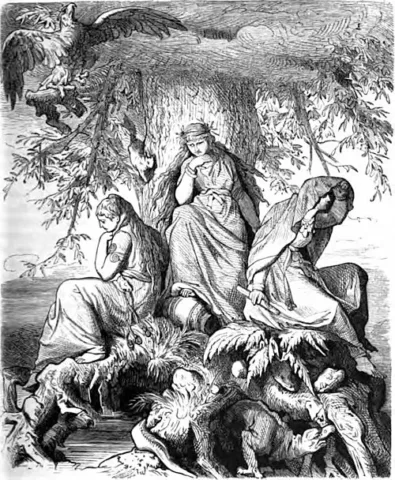
The best known are Urðr, Verðandi, and Skuld, who appear beside Urðarbrunnr, the Well of Urðr, beneath Yggdrasil. They are often described today as representing the past, present, and future, but the medieval sources are less tidy than that modern summary suggests.
The Norns were not limited to three figures. Other texts connect them with birth and individual destiny, while some poems describe them shaping or extending the course of a life.
Their role is therefore broader than the familiar image of three women spinning fate. In the Old Norse sources, the Norns belong to a wider idea of destiny and the limits placed on both humans and gods.
Who Were the Norns?
In Völuspá, Urðr, Verðandi, and Skuld appear beneath Yggdrasil and are linked with establishing laws and assigning destinies.
They are not presented simply as another group of goddesses like the Æsir or Vanir.
Who Were Urðr, Verðandi and Skuld?
Urðr, Verðandi, and Skuld are the three Norns most clearly named in the surviving Old Norse sources.
In Völuspá, they appear beside the Well of Urðr beneath Yggdrasil, where they are associated with law and the shaping of fate.
Their names carry meanings connected with becoming and obligation: Urðr with what has happened or become, Verðandi with what is becoming, and Skuld with what should or must happen.
Their clearest shared role is shaping or assigning destiny.
The surviving sources do not clearly describe Urðr, Verðandi, and Skuld as sisters, even though modern retellings often present them that way.
Did the Three Norns Represent Past, Present and Future?
The idea that Urðr, Verðandi, and Skuld represent the past, present, and future is widespread, but the Old Norse sources do not state this directly.
Their names make that interpretation understandable, especially because each can be read in ways that suggest different relationships to time.
But the medieval texts do not define them as three fixed personifications of past, present, and future.
It is therefore better to treat that scheme as a later interpretation of their names, while the sources themselves connect the trio more directly with fate, law, and destiny.
Were There Only Three Norns?
No. Urðr, Verðandi, and Skuld are the best-known Norns, but the surviving sources describe others as well.
In Gylfaginning, Snorri says that Norns come to children at birth and shape the course of their lives.
The three figures beneath Yggdrasil are therefore not the only Norns in Norse mythology. They are the most prominent trio within a broader tradition that also connects Norns with individual human destinies.
Were Some Norns Good and Others Harmful?
Snorri does not describe every Norn in the same way.
In Gylfaginning, he explains differences in human fortune by saying that good and well-born Norns shape good lives, while harmful Norns are associated with misfortune.
This belongs to Snorri’s account of the wider class of Norns, not specifically to Urðr, Verðandi, and Skuld. It suggests that individual Norns could be associated with different kinds of fortune.
Where Did the Norns Live and What Did They Do Beneath Yggdrasil?
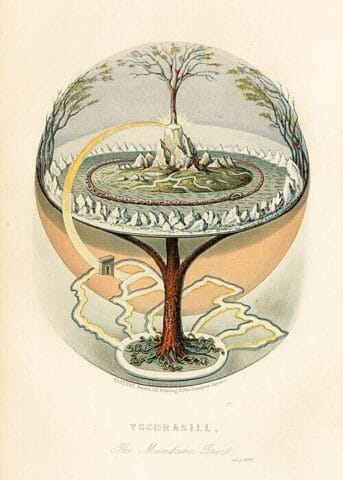
The three best-known Norns are associated with Urðarbrunnr, the Well of Urðr, beneath Yggdrasil.
In Völuspá, Urðr, Verðandi, and Skuld appear beside the world tree. Snorri places their dwelling near the well and gives them another role there.
In Gylfaginning, they take water from Urðarbrunnr and mix it with the earth around the well, then apply it to Yggdrasil so that the tree does not dry out or decay.
Their place beneath Yggdrasil therefore connects them with both fate and the preservation of the world tree.
Did the Norns Weave the Threads of Fate?
The familiar image of the Norns spinning or weaving destiny is only partly supported by the Old Norse sources.
In Völuspá, Urðr, Verðandi, and Skuld are described as carving, setting laws, and assigning destinies, not sitting at a loom.
Thread imagery does appear elsewhere. In Helgakviða Hundingsbana I, Norns arrive at the birth of Helgi and stretch out the threads of his fate.
So the connection between Norns and fate-threads is genuinely old, but weaving was not the only way Norse texts imagined their work.
Did the Norns Decide a Person’s Fate at Birth?
Old Norse sources sometimes place the Norns at the very beginning of a person’s life.
Snorri says that Norns come to newborn children and shape the lives they will lead, linking them with lifespan, fortune, and the course of individual destiny.
This does not mean the texts describe every choice or event as mechanically predetermined. What they do show is that the Norns were closely associated with the broad course and limits of a person’s life from birth onward.
Could Anyone Escape the Fate Set by the Norns?
Old Norse literature often treats fate as something that cannot simply be avoided once it has been set.
Heroes and gods may learn what is coming, resist it, or choose how to face it, but knowledge does not usually allow them to erase the outcome.
The texts do not present a formal theory of free will. Instead, they repeatedly show characters acting within limits they cannot fully control.
The Norns fit that pattern: they are linked with destinies that shape a life without reducing every action to a fixed script.
Were the Norns More Powerful Than the Gods?
The sources do not place the Norns above the gods in a clear hierarchy.
What they do show is that even the gods are not free from fate. Odin can seek knowledge of what is coming, and the gods can prepare for events such as Ragnarök, but they cannot simply overturn what has been foretold.
So describing the Norns as “more powerful than Odin” goes too far. The sources support a simpler idea: divine power has limits, and fate is one of them.
Were the Norns Goddesses?
Calling the Norns goddesses is convenient, but not entirely precise.
Urðr, Verðandi, and Skuld are powerful female supernatural figures, yet the sources do not place them neatly among the Æsir or Vanir like Frigg or Freyja.
Snorri describes Norns of different origins, including some from the gods, some from the elves, and others among the daughters of Dvalinn.
It is therefore more accurate to describe the Norns as supernatural beings connected with fate than simply as a group of goddesses.
Read More
Yggdrasil: The World Tree at the Center of Norse Mythology
Odin: The All-Father, God of Wisdom, War and Magic
Ragnarök Explained: How the Norse World Ends and What Comes After
Was Skuld Both a Norn and a Valkyrie?
Yes. Skuld appears as one of the three best-known Norns, but she is also named among the Valkyries.
In Völuspá, she appears with Valkyries who ride to choose those who will fall in battle, while Snorri also connects her with deciding the outcome of combat.
The two groups otherwise have different roles. Norns are linked with fate more broadly, including birth, lifespan, and destiny, while Valkyries are closely associated with warfare and the choosing of the slain.
Skuld’s appearance in both roles shows that Old Norse mythic categories could overlap without making Norns and Valkyries the same kind of beings.
Were the Norns Worshipped?
The surviving evidence does not clearly show an organized cult devoted specifically to the Norns.
They are prominent in Old Norse literature and closely connected with fate, birth, and destiny, but literary importance does not by itself prove widespread worship.
It is therefore safer to say that the Norns were significant mythological figures while the extent of any historical cult devoted to them remains uncertain.
Why the Norns Matter in Norse Mythology
The Norns matter because they connect fate, birth, lifespan, and cosmic order within a single mythic tradition.
Their presence beneath Yggdrasil places them close to the structure of the Norse world itself, while other sources bring them into the lives of individuals from the moment of birth.
They also express one of the mythology’s most persistent ideas: knowledge and power do not guarantee control over destiny.
That makes the Norns more than mysterious figures beside a well. They are part of the way Old Norse tradition explains why both humans and gods must live within limits they cannot fully command.
Academic Sources
This article draws on the main Old Norse sources for the Norns together with modern scholarship on fate, Urðr, Verðandi and Skuld, Yggdrasil, birth, destiny, and the later interpretation of the Norns as figures of past, present, and future.
Primary Texts and Scholarly Editions
- Snorri Sturluson.
Edda: Prologue and Gylfaginning.
Edited by Anthony Faulkes. 2nd ed. Viking Society for Northern Research, University College London, 2005.
Key prose source for Urðarbrunnr, the Norns beneath Yggdrasil, Norns at birth, differences among Norns, and their role in preserving the world tree.
- Larrington, Carolyne, trans.
The Poetic Edda.
2nd ed. Oxford World’s Classics. Oxford University Press, 2014.
Includes Völuspá, where Urðr, Verðandi and Skuld are named, and Helgakviða Hundingsbana I, which preserves the important image of Norns stretching the threads of Helgi’s fate.
Modern Scholarship
- Bek-Pedersen, Karen.
The Norns in Old Norse Mythology.
Edinburgh: Dunedin Academic Press, 2011.
The most important modern study devoted specifically to the Norns, including their identity, the women at the well, fate, textile imagery, and the limits of the common past-present-future interpretation.
- Simek, Rudolf.
A Dictionary of Northern Mythology.
Translated by Angela Hall. D.S. Brewer, 1996.
A standard scholarly reference for Norse mythological figures, terms, cultic evidence, supernatural beings, and the wider religious context in which the Norns appear.
- Clunies Ross, Margaret.
Prolonged Echoes: Old Norse Myths in Medieval Northern Society. Vol. 1: The Myths.
Odense University Press, 1994.
Useful for understanding fate, divine limits, social order, and the broader structure of Old Norse myth in its medieval literary context.
Old Norse sources do not always describe the Norns in the same way. This article distinguishes between what the Eddic poems state directly, what Snorri adds in Gylfaginning, and later interpretations that became common in modern retellings.
Copyright Notice
© 2026 History & Myths. All rights reserved.
This article is original editorial content created for HistoryAndMyths.com.
Unauthorized reproduction, republication, or substantial copying of the text,
structure, or original analysis is prohibited without prior written permission.
Brief quotations are permitted for commentary, research, or educational use
when accompanied by clear attribution and a link to the original article.