Bifröst: The Rainbow Bridge Between Midgard and Asgard
In Norse mythology, Bifröst (also spelled Bifrost) is the bridge connecting Midgard, the human world, with Asgard, the realm of the gods. Heimdall guards its entrance to heaven, and the bridge is destined to break during Ragnarök.
Snorri Sturluson’s Prose Edda identifies Bifröst with the rainbow and describes it as a three-colored bridge whose red section burns with fire. Older Norse poems use the name Bilröst and offer fewer details about its appearance, although they also refer to the bridge’s flames and eventual collapse. Much of the familiar description of Bifröst therefore comes from Snorri’s account.
What Is Bifröst in Norse Mythology?
In Snorri Sturluson’s Gylfaginning, Bifröst provides the Æsir with a route to Urðarbrunnr, the Well of Urd, where the gods hold their assembly beneath a root of Yggdrasil. They travel there to conduct their judgments, making the bridge part of the gods’ regular affairs.
Snorri also calls it Ásbrú, meaning “Bridge of the Æsir.” Although commonly described as connecting Midgard and Asgard, its destination in this account is specifically the gods’ meeting place near the sacred well.
Bifröst was not a road connecting all the worlds of Norse mythology. It provided access to the heavenly realm, but crossing it was not open to everyone.
What Does the Name Bifröst Mean?
The Old Norse name appears in two forms: Bilröst in the Eddic poems Grímnismál and Fáfnismál, and Bifröst in Snorri Sturluson’s Prose Edda. Both refer to the same bridge.
Bifröst is commonly linked to the Old Norse verb bifa, meaning “to shake” or “tremble,” and röst, meaning a distance or stretch of road. This has produced interpretations such as “swaying road” and “shimmering path.”
Rudolf Simek considers Bilröst a likely older form. Its first element, bil, can mean “a moment,” suggesting something briefly visible, like a rainbow. The exact origin of the name remains disputed.
Neither form literally means “Rainbow Bridge.” That is a description of the bridge in Norse mythology, while Bifrost is the common English spelling without the accent.
What Did Bifröst Look Like?
In Gylfaginning, Snorri Sturluson describes Bifröst as a remarkably strong bridge built by the gods with exceptional skill. It has three colors, although he provides no measurements or detailed description of its structure.
The red color is burning fire, intended to prevent frost giants and mountain giants from reaching heaven. Snorri does not name the other two colors.
The older poem Grímnismál, stanza 29, also describes the gods’ bridge as blazing with flames but offers no further details about its appearance.
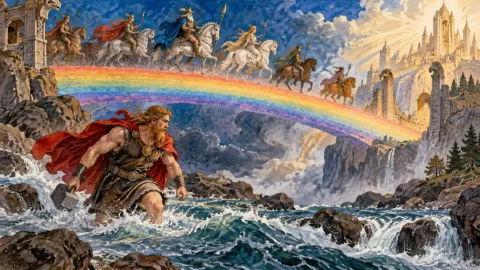
Modern illustrations often depict Bifröst as a wide, seven-colored pathway or a monumental stone bridge. Neither image is described in the surviving Norse texts.
Who Could Cross Bifröst?
The Æsir generally rode across Bifröst to their assembly. Snorri lists the horses used by the gods, including Odin’s eight-legged Sleipnir, but singles out Thor as an exception.
In Grímnismál, stanza 29, Thor wades through Körmt, Örmt, and the two Kerlaugar rivers instead. The poem describes the gods’ bridge as burning with flames and the sacred waters as seething. It does not say, as some modern retellings suggest, that Thor was too heavy to cross Bifröst.
The bridge was not open to everyone. In Snorri’s account, its fiery barrier prevented giants from freely reaching heaven. Nor do the surviving myths establish Bifröst as the ordinary route taken by human souls to Valhalla.
Bifröst should not be confused with Gjallarbrú, the bridge over the river Gjöll on the road to Hel. In Gylfaginning, chapter 49, Hermóðr crosses Gjallarbrú while searching for Baldr. The two bridges lead to different destinations.
Why Does Heimdall Guard Bifröst?
Heimdall lives at Himinbjörg, where Bifröst reaches heaven. In Gylfaginning, Snorri Sturluson identifies him as the gods’ watchman, stationed there to prevent mountain giants from crossing into their realm.
Heimdall possesses extraordinary senses. He needs less sleep than a bird, can see vast distances by day or night, and hears grass growing and wool growing on sheep. These abilities make him well suited to guarding the entrance to heaven.
He also carries Gjallarhorn, a horn whose sound can be heard throughout the worlds. At Ragnarök, he will blow it to alert the gods to the approaching danger.
The older poem Grímnismál, stanza 13, identifies Himinbjörg as Heimdall’s dwelling but does not describe his watch over Bifröst in the same detail. The more complete account comes from Snorri’s Prose Edda.
Bifröst in the Poetic Edda and Prose Edda
The surviving Norse sources do not tell a single, continuous story about Bifröst. Instead, brief references in older poetry provide the foundation for the fuller account found in Snorri Sturluson’s thirteenth-century Prose Edda.
In Grímnismál, stanza 29 mentions the burning bridge of the gods without naming it, while stanza 44 calls Bilröst the finest of bridges. Fáfnismál, stanza 15, foretells its collapse during the final battle but leaves the identity of those crossing it unclear.
Another reference appears in the tenth-century poem Húsdrápa by Úlfr Uggason, preserved in Snorri’s Skáldskaparmál. It describes Heimdall as the defender of the “powers’ way,” generally interpreted as Bifröst, although the bridge is not named directly.
Snorri’s Gylfaginning brings these traditions into a more detailed account. Since he also quotes earlier verses, similarities between the two Eddas do not always represent independent evidence for every detail.
What Happens to Bifröst During Ragnarök?
In Gylfaginning, chapter 51, Snorri Sturluson describes the sky splitting open as the sons of Muspell ride forth, led by Surtr with a sword brighter than the sun. When they ride onto Bifröst, the bridge breaks beneath them.
Its collapse does not stop their advance. As Snorri explains in chapter 13, their horses swim across great rivers, allowing the invading forces to continue toward Vígríðr, the battlefield of Ragnarök.
Earlier in Gylfaginning, Gangleri questions how a bridge built by the gods could fail. He is told that the gods’ craftsmanship is not at fault: nothing can remain secure when the sons of Muspell attack.
The older poem Fáfnismál, stanza 15, also foretells Bilröst breaking as riders cross it, with their horses forced to swim. Unlike Snorri’s account, the verse does not explicitly identify those riders as the sons of Muspell.
Bifröst’s destruction leaves the gods’ heavenly passage broken as the final battle approaches.
Is Bifröst the Same as Marvel’s Bifrost?
Marvel’s Bifrost is inspired by Norse mythology but works differently from the bridge described in the medieval sources.
In the Thor films, it allows rapid travel between the Nine Realms through an energy-based transport system operated by Heimdall from Asgard.
The Norse myths instead describe a bridge that the gods travel across. They contain no equivalent of Marvel’s instantaneous transportation system.
Marvel preserves the rainbow imagery, Asgard, and Heimdall’s role as guardian, but its portrayal of Bifrost is a modern reinterpretation rather than a faithful reconstruction of the original mythology.
Conclusion
Bifröst was a remarkable creation of the gods, yet its strength had limits. Heimdall guarded the passage, and its fiery defenses kept unwanted visitors from reaching heaven. At Ragnarök, even those protections would fail.
The bridge’s collapse reflects a central theme of Norse mythology: the gods possess extraordinary powers, but neither they nor the world they have built can escape their destined destruction.