Poetic Edda vs. Prose Edda: How Norse Myths Survived
The Poetic Edda and the Prose Edda are two of the principal surviving sources of Norse mythology, but they are different kinds of works. The Poetic Edda is a collection of anonymous Old Norse poems about the gods and legendary heroes, preserved chiefly in an Icelandic manuscript copied around 1270. The poems were composed at different times, although their precise dates remain disputed. The Prose Edda, associated with Snorri Sturluson and composed in the early thirteenth century, uses traditional myths and poetry to explain the language and techniques of Old Norse verse.
Neither work offers an unaltered account of pre-Christian Scandinavian religion. Both survive through manuscripts produced in Christian Iceland, and Snorri’s explanations do not always agree with the surviving poems. Together, they preserve much of what we know about Norse mythology, while leaving important questions about the origins of these traditions and their place in pre-Christian belief.
Poetic Edda vs. Prose Edda: What Is the Difference?
The Poetic Edda consists of separate mythological and heroic compositions rather than a continuous account of Norse mythology. Its poems take different forms, including prophecy, dialogue, contests of wisdom, and heroic narrative. The Prose Edda, by contrast, organizes mythological stories alongside explanations of traditional poetic language and verse forms.
The distinction is not simply between poetry and prose. The Poetic Edda includes short prose passages, particularly those connecting episodes in the heroic poems. The Prose Edda contains numerous quotations from older poetry, which Snorri uses to support mythological accounts and explain expressions found in skaldic verse. His work is therefore not merely a prose retelling of the poetic collection.
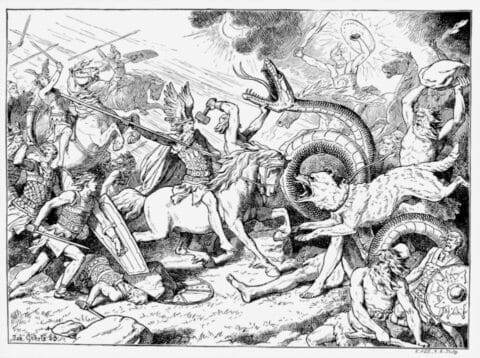
Their different approaches are evident in accounts of Ragnarök. In Völuspá, a seeress describes the world’s destruction and renewal through prophetic visions. In Gylfaginning, related events are presented through answers given to King Gylfi, within a broader explanation of the gods and the history of the world.
Read Also
Why Are They Both Called the Edda?
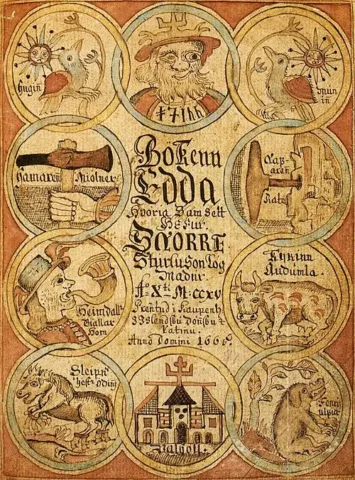
The name Edda was first securely recorded as the title of the medieval work associated with Snorri Sturluson. The early fourteenth-century Codex Upsaliensis begins with the statement Bók þessi heitir Edda, meaning “This book is called Edda.” The same passage credits Snorri with compiling the work, although whether he personally chose its title remains unknown.
The original meaning of Edda is disputed. In Old Norse, edda could mean “great-grandmother,” while other proposed explanations connect the title with Oddi, the Icelandic estate where Snorri was educated, or with words associated with poetry. These interpretations have faced linguistic and historical objections. Fourteenth-century expressions such as eddu list and eddu reglur, referring to the art and rules of poetry, show that the term had acquired a connection with poetic instruction, but they do not establish its original meaning.
The poetic collection received the same name much later. In 1643, Bishop Brynjólfur Sveinsson acquired a medieval manuscript containing poems about Norse gods and legendary heroes. Believing it to preserve an older source behind Snorri’s work, he attributed the collection to Sæmundr Sigfússon, known as Sæmundr the Learned (d. 1133). No reliable evidence supports this attribution, but the collection became known as Sæmundar Edda, or Sæmundr’s Edda.
The distinction eventually gave rise to the names Elder Edda and Younger Edda, now more commonly called the Poetic Edda and Prose Edda. These names reflect the history of the works’ identification and study, rather than a straightforward chronology of their composition or surviving manuscripts.
The Poetic Edda: Mythological and Heroic Poetry
The poems of the Poetic Edda are traditionally divided into mythological and heroic compositions. This distinction is reflected in the principal manuscript, where poems concerning gods and supernatural beings precede those about legendary heroes. The boundary is not always clear. Völundarkviða, placed among the mythological poems, follows the extraordinary smith Völundr through a story of captivity and revenge that combines heroic and supernatural elements.
Völuspá traces the history of the world from its creation to its destruction and renewal. Hávamál, meaning “Sayings of the High One,” brings together advice on conduct, hospitality, friendship, and wisdom. Other passages recount Odin’s acquisition of runic knowledge and his encounter with the mead of poetry.
Several poems convey mythological knowledge through dialogue and confrontation. In Vafþrúðnismál, Odin competes with the giant Vafþrúðnir in a contest of questions about the cosmos and its inhabitants. Grímnismál describes divine dwellings, supernatural beings, and the organization of the mythological world. Lokasenna presents Loki’s accusations against the assembled gods, exposing conflicts and personal relationships among them. In Þrymskviða, Thor disguises himself as a bride to recover his stolen hammer, introducing comedy and deception into a story about divine power.
The heroic poems concentrate on warfare, loyalty, betrayal, revenge, and the consequences of family conflict. Several concern Helgi, whose adventures involve rival rulers and valkyries. Others follow the interconnected stories of Sigurðr, Brynhildr, Guðrún, and their families. These include Sigurðr’s killing of the dragon Fáfnir, his subsequent death, and the tragedies surrounding Guðrún’s marriages and her brothers’ conflict with Atli, the legendary counterpart of Attila the Hun.
Individual heroic poems recount particular episodes rather than presenting complete biographies. Related legends also appear in other Germanic literature, notably the Middle High German Nibelungenlied, although its treatment of the shared characters and their relationships differs substantially from the Norse poems.
Eddic verse relies chiefly on alliteration, linking stressed words through their initial sounds rather than regular end rhyme. Three important metres are fornyrðislag, frequently used for narrative; ljóðaháttr, especially suited to dialogue, wisdom sayings, and verbal contests; and málaháttr, which generally allows fuller lines and is also employed in narrative poetry. These patterns influence how stories and conversations unfold, although no single metre belongs exclusively to one genre.
Eddic poetry is traditionally distinguished from skaldic poetry, particularly the elaborate verse associated with named poets and Scandinavian royal courts. Skaldic compositions often employ intricate syntax, internal rhyme, and figurative expressions called kennings, especially in the demanding metre known as dróttkvætt. Eddic poetry generally uses less elaborate metrical structures, but it can also employ kennings and other forms of figurative language. The distinction concerns poetic conventions and transmission rather than an absolute separation of subject matter or technique.
Read Also
Who Composed the Poetic Edda, and How Old Are Its Poems?
The authors of the eddic poems remain unidentified. Unlike many skaldic compositions attributed to named poets, these works generally preserve no reliable information about their creators. Some may have originated as individual compositions, while others incorporated older verses or underwent changes before reaching their surviving forms. The identity of the person who assembled the principal poetic collection is also unknown.
Dating the poems is complicated by the difference between the age of a story and the age of the verse that preserves it. The heroic poems about Atli, for example, draw on traditions associated with Attila the Hun, who died in 453 CE. This historical connection does not establish when the Norse poems were composed. A myth involving Odin or Thor could likewise have circulated for generations before appearing in its surviving poetic form.
Scholars use linguistic and metrical evidence to investigate these questions. Changes in Old Norse grammar, word order, vocabulary, and verse structure can provide clues to a poem’s date. In Dating the Old Norse Poetic Edda (2022), Christopher D. Sapp compares linguistic features of eddic poetry with more securely dated skaldic verse. His analysis combines evidence from the particle of, forms of negation, and relative clause constructions to propose dates for individual poems. Such methods can narrow the possibilities, although inherited expressions and changes during transmission complicate the results.
Individual poems present different problems. Völuspá has often been associated with the religious transformations of the late Viking Age, when traditional Scandinavian beliefs encountered Christianity. Its date, place of composition, and possible Christian influences remain debated, partly because scholars disagree over which elements reflect older traditions and which might belong to the poem’s literary setting.
Hávamál is particularly difficult because its surviving text combines wisdom sayings, mythological episodes, and teachings attributed to Odin. Scholars have proposed that these sections originated separately, but disagree about when they were brought together. In a 2024 study, Mikael Males argued that the poem’s content supports composition before approximately 1000 CE and that, if several compositions were combined, this probably occurred around 900–950. His argument challenges theories of a substantially later compilation without settling every question about the poem’s development.
The geographical origins of the poems are also uncertain. Their preservation in Icelandic manuscripts does not establish that they were all composed in Iceland. Some may have developed in Norway or other Norse-speaking communities before entering the Icelandic literary tradition. Linguistic features, geographical references, and comparisons with other Germanic traditions sometimes provide clues, but rarely identify a poem’s original setting with certainty.
Snorri Sturluson and the Making of the Prose Edda
Snorri Sturluson (1179–1241) was an Icelandic poet, historian, and powerful chieftain whose literary career developed alongside his political ambitions. As a child, he was fostered by Jón Loftsson at Oddi in southern Iceland, an established center of learning where Christian scholarship and traditional Icelandic literature were cultivated.
Snorri became one of Iceland’s wealthiest chieftains and twice served as lawspeaker of the Alþingi, the island’s national assembly. During a journey to Norway between 1218 and 1220, he established connections with King Hákon Hákonarson and Earl Skúli Bárðarson. After returning to Iceland, he composed Háttatal, a praise poem honoring both rulers while demonstrating his mastery of skaldic verse.
The Prose Edda probably took shape between 1221 and 1225, although its stages of composition remain uncertain. Its literary purpose was closely connected with the demands of skaldic poetry, whose elaborate language frequently relied on mythological references. In Skáldskaparmál, for example, Snorri explains why gold could be called “Sif’s hair.” The expression refers to the story of Loki cutting off Sif’s hair and the dwarfs replacing it with hair made of gold. Without knowing the myth, a reader might recognize the individual words but miss the meaning of the poetic expression.
The precise extent of Snorri’s authorship remains uncertain. The early fourteenth-century Codex Upsaliensis identifies him as the compiler of the Edda, but no manuscript survives from his lifetime. Scholars have questioned whether its principal sections were conceived as a single project or developed at different stages. The surviving text incorporates earlier traditions, making it difficult to distinguish every inherited element from Snorri’s own literary arrangement.
Inside the Prose Edda: How Snorri Organized Norse Mythology
The Prose Edda consists of a Prologue followed by three principal works: Gylfaginning, Skáldskaparmál, and Háttatal. Together, they cover the supposed origins of the Norse gods, mythological narratives, the specialized language of skaldic poetry, and the rules governing verse composition.
The Prologue places Norse mythology within a framework influenced by Christian and classical learning. It begins with an account of humanity’s loss of knowledge of its creator, then traces the Æsir to Troy. Odin and his companions are presented as extraordinary human ancestors who migrated north and eventually came to be regarded as gods. This interpretation, known as euhemerism, explains divine figures as historical people whose achievements led later generations to worship them. The account reflects medieval attempts to reconcile pagan traditions with Christian understandings of history, rather than preserving an independent tradition about the actual origins of the gods.
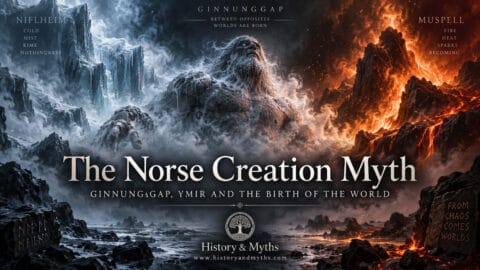
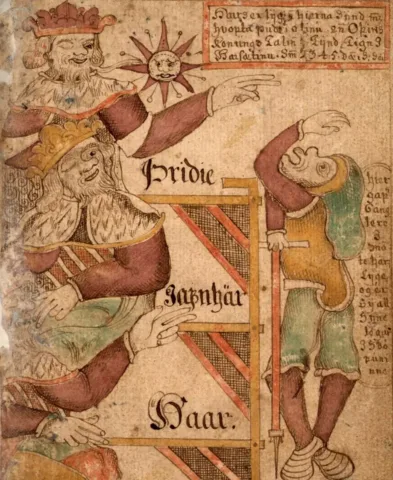
Gylfaginning, meaning “The Deception of Gylfi,” contains one of the fullest surviving medieval accounts of Norse mythology. Its framing narrative follows Gylfi, a legendary Swedish king who travels in disguise under the name Gangleri to investigate the powers of the Æsir. He encounters three mysterious figures called High, Just-as-High, and Third, who answer his questions about the gods and the universe. Their explanations cover the primordial giant Ymir, the creation of the world, Yggdrasil and its surrounding realms, the principal deities, Ragnarök, and the world’s renewal.
The dialogue is supported by quotations from older poetry, but it ends with a deception. After Gylfi has received his answers, the hall and its occupants suddenly disappear. The closing episode reveals that his encounter took place within an illusion, complicating the relationship between the mythological knowledge he has heard and the figures who presented it.
Skáldskaparmál, or “The Language of Poetry,” examines the vocabulary and figurative expressions used by skaldic poets. Its opening narrative describes Ægir’s visit to the gods, where Bragi recounts traditional stories and explains poetic language. The work then develops into a detailed treatment of kennings, descriptive expressions that identify something indirectly, and heiti, alternative poetic names or synonyms.
Many kennings depend on knowledge of mythology. Poetry, for example, can be called Kvasir’s blood or Odin’s mead, expressions connected with the story of the mead of poetry. Snorri explains such references while quoting earlier skaldic compositions to demonstrate their use. Some of these verses survive only through his quotations, making Skáldskaparmál an important witness to otherwise lost poetry. The manuscript tradition also preserves lists of poetic names known as þulur, although their precise relationship to Snorri’s original work remains uncertain.
Háttatal, or “List of Verse Forms,” demonstrates the technical construction of skaldic poetry. It consists of 102 stanzas composed by Snorri in praise of King Hákon Hákonarson and Earl Skúli Bárðarson. The stanzas illustrate variations in metre, alliteration, internal rhyme, syntax, and poetic style. Accompanying prose commentary explains the techniques employed, making the work both a courtly praise poem and a systematic examination of verse composition.
The order of these works does not necessarily reflect their composition. Scholars have suggested that Háttatal was written first, possibly soon after Snorri’s return from Norway, and that Skáldskaparmál and Gylfaginning developed subsequently. The precise sequence remains uncertain, particularly because the surviving manuscripts preserve differences in the arrangement and content of the work.
From Oral Tradition to Written Literature in Christian Iceland
Before the Eddas were recorded in manuscripts, Norse myths circulated through oral storytelling and poetry. Poets could recount an entire episode or refer to a familiar story through a few names and images, relying on their listeners to recognize the allusions. Eddic poems frequently employ dialogue and direct speech, features that have led scholars such as Terry Gunnell to examine their relationship with oral performance and its audiences.
Alliteration, metre, and recurring poetic expressions helped preserve verses in memory, but oral transmission did not necessarily produce identical versions across generations. Poems could be adapted, rearranged, or combined with other traditional material. The precise circumstances of their performance remain uncertain, since the surviving manuscripts record the texts rather than the occasions on which they were recited.
The development of written literature in Iceland followed its official adoption of Christianity around 1000 CE. The Church introduced Latin-based manuscript practices and institutions of learning, gradually creating opportunities to record material that had previously circulated orally. Scandinavians had already used runes for inscriptions, but the emerging manuscript culture supported the production and preservation of extended literary works. During the twelfth century, Icelandic writing expanded to include law, history, genealogy, and vernacular scholarship. By the thirteenth century, traditional poetry and mythology were also being collected and studied in written form.
Writing did not immediately replace recitation. Some poems may have reached scribes through remembered performances, while others could have been copied from earlier written texts that no longer survive. Scribes and compilers also made choices about which material to preserve and how to arrange it, so the relationship between a surviving poem and its earlier forms cannot always be reconstructed.
Christian Icelanders continued to value traditional poetry, heroic legends, and accounts of the Scandinavian past. Preserving the mythological stories embedded in this literature allowed poets and scholars to understand an inherited tradition without necessarily sharing the religious beliefs associated with it.
The Poetic Edda Manuscripts: Codex Regius and the Surviving Poems
The principal manuscript of the Poetic Edda is Codex Regius (GKS 2365 4to), an Icelandic parchment book copied around 1270 by a single scribe. Its 45 surviving leaves contain approximately 29 poems, arranged in two main groups. The collection begins with mythological poetry, headed by Völuspá, before turning to Germanic heroic legends, particularly those concerning Sigurðr, Brynhildr, Guðrún, and their families.
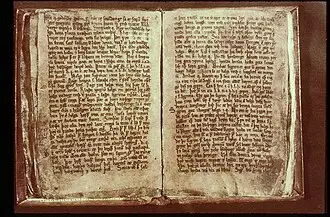
The manuscript also contains prose passages that introduce characters or connect episodes, especially within the heroic material. Some poems bear medieval titles, while others received their familiar names from later editors. The poem usually called Skírnismál, for example, is titled Fǫr Skírnis (“Skírnir’s Journey”) in Codex Regius. Such differences matter when comparing modern editions with the medieval texts they represent.
The manuscript entered the possession of Bishop Brynjólfur Sveinsson in 1643. He sent it to King Frederick III of Denmark in 1662, after which it was preserved in the Royal Library in Copenhagen. Its association with the royal collection gave it the name Codex Regius, meaning “Royal Book.” It returned to Iceland on 21 April 1971 and is now held by the Árni Magnússon Institute for Icelandic Studies in Reykjavík.
Eight leaves, forming an entire gathering, were already missing when Brynjólfur acquired the manuscript. This gap, known as the Great Lacuna, interrupts the heroic material between Sigrdrífumál and the surviving fragment called Brot af Sigurðarkviðu. In standard editions, the text of Sigrdrífumál breaks off after the first line of stanza 29. The lost leaves also contained material whose original wording can no longer be recovered.
The remaining verses of Sigrdrífumál survive in later paper manuscripts. Þórdís Edda Jóhannesdóttir has examined these witnesses, particularly Lbs 1199 4to, and identified evidence that the poem was copied before the missing gathering disappeared. Völsunga saga also recounts events associated with the lost material, providing clues to its narrative content without preserving the original poetic text.
Other medieval manuscripts help establish the wider transmission of eddic poetry. The fragmentary AM 748 I a 4to, copied in the early fourteenth century, preserves portions of poems also found in Codex Regius, including Vafþrúðnismál, Grímnismál, and Hymiskviða. It also contains Baldrs draumar, absent from the principal collection. The two manuscripts appear to descend from a common textual source, providing evidence of an earlier stage in the transmission of these poems.
Individual compositions also survive in manuscripts assembled for different purposes. Hauksbók preserves another version of Völuspá, Flateyjarbók contains Hyndluljóð, and Codex Wormianus, associated primarily with Snorri’s Edda, preserves Rígsþula. These witnesses explain why modern editions of the Poetic Edda extend beyond the contents of Codex Regius. Edward Pettit’s 2023 edition, for example, includes 36 texts drawn from the broader surviving tradition.
Modern textual scholarship distinguishes the physical manuscript from the edited versions prepared for readers. A scholarly edition of Codex Regius appeared in 2019, followed by an electronic edition in 2024 containing images of every manuscript page, diplomatic transcriptions, and linguistic analysis. These resources allow researchers to examine the surviving wording directly and assess how modern editors have interpreted or reconstructed individual passages.
The Prose Edda Manuscripts: Different Versions of Snorri’s Work
Four principal manuscripts preserve different versions of the Prose Edda: Codex Regius, Codex Upsaliensis, Codex Wormianus, and Codex Trajectinus. Three date from the fourteenth century, while the fourth is a later copy of a lost medieval manuscript. Their differences extend beyond individual words to the arrangement, length, and contents of the work.
Codex Regius (GKS 2367 4to), copied in the first half of the fourteenth century, preserves a relatively extensive version of the Edda. It is distinct from the Codex Regius containing the Poetic Edda. Its text of Gylfaginning is particularly coherent and shows comparatively few signs of scribal alteration, making it the principal witness used by Anthony Faulkes in his critical edition. The manuscript’s first leaf is missing, removing the beginning of the Prologue. Seventeenth-century copies apparently descended from the manuscript before this loss preserve material that helps reconstruct the missing passage.
Codex Upsaliensis (DG 11 4to), held at Uppsala University Library, probably dates from the first quarter of the fourteenth century and may be the oldest surviving witness. Its version is substantially shorter than that of Codex Regius, with passages omitted, rearranged, or abbreviated. Háttatal is also incomplete.
The Uppsala manuscript contains additional texts associated with Icelandic scholarship and Snorri’s family, including Skáldatal, a catalogue of court poets, a genealogy of the Sturlungs, a list of Icelandic lawspeakers, and the Second Grammatical Treatise. These materials have encouraged speculation that its version of the Edda derives from an early draft associated with Snorri. Faulkes considers this possible but unprovable. The shorter text may reflect an earlier stage of composition, but it also contains abbreviations that sometimes obscure the meaning.
Codex Wormianus (AM 242 fol.), copied around 1350 and preserved at the University of Copenhagen, offers another distinctive version. Its Prologue contains passages drawing extensively on biblical and classical traditions that are absent from the other principal manuscripts and are generally considered later interpolations. The second half of Skáldskaparmál underwent substantial revision, although missing pages have left much of this material incomplete.
The manuscript also preserves the four Icelandic grammatical treatises alongside the Edda. Their inclusion places traditional mythology and poetry within a broader medieval study of language, style, and rhetoric.
Codex Trajectinus (Utrecht University Library, MS 1374) was copied in Iceland around 1595, but is believed to descend from a medieval manuscript that no longer survives. Its text closely resembles that of Codex Regius, including shared errors that indicate a common textual ancestor. The surviving copy lacks the beginning of the Prologue and the final three leaves of Háttatal. Its late copying date therefore does not prevent it from providing evidence about an older manuscript tradition.
Additional fragments preserve parts of Skáldskaparmál and collections of poetic names. AM 748 II 4to, copied around 1400, contains a text closely resembling that of Codex Regius. By contrast, AM 757 a 4to, also copied around 1400, preserves a substantially revised version of portions of Skáldskaparmál, alongside collections of poetic names known as þulur. These differences show that sections of the Edda could be copied and adapted separately from the complete work.
How the Poetic Edda and Prose Edda Preserve the Same Traditions
Snorri’s use of older poetry can be traced through the verses he quotes in Gylfaginning and the mythological information he incorporates into his prose. His sources included several poems that survive in the Poetic Edda, although their wording did not always match the versions preserved in later manuscripts. Whether he consulted written collections, relied on remembered poetry, or used both methods remains uncertain.
Völuspá provided an important framework for Gylfaginning, particularly its account of creation, the history of the gods, Ragnarök, and the world’s renewal. Snorri quotes the poem at several points, but supplements its material with information from other traditions. In Vafþrúðnismál, Odin questions the giant Vafþrúðnir about the origins of the cosmos, the primordial beings, and the world’s fate after Ragnarök. Grímnismál supplies descriptions of divine dwellings, supernatural beings, and the organization of the mythological world. Snorri draws these accounts together, sometimes constructing explanations that no single surviving poem presents in full.
Other quotations preserve poetry absent from the surviving eddic collection. In Gylfaginning, Njörðr complains about the wolves he hears in the mountains, while Skaði describes the seabirds that disturb her sleep beside the sea. Their Old Norse verses survive only in Snorri’s account. Anthony Faulkes suggests that they may have belonged to a lost poem about the couple, noting that Saxo Grammaticus preserves a related tradition in his story of Haddingus and Regnilda. The parallel points to a tradition known beyond Snorri’s surviving narrative, although the form of his poetic source remains uncertain.
The account of Thor’s journey to Útgarða-Loki presents a different problem. Snorri describes a series of deceptive contests in which Thor and his companions confront opponents whose true nature is concealed. No surviving poem tells the complete story, but individual elements appear elsewhere. Hárbarðsljóð and Lokasenna refer to Thor seeking shelter in a giant’s glove, while Lokasenna also mentions his inability to open a food bag. These references establish that parts of the tradition circulated independently of Snorri’s surviving narrative. Whether he assembled them from lost poetry, oral stories, or other material cannot be determined.
Snorri also drew on named skaldic poets. In Skáldskaparmál, he quotes passages from Haustlöng, attributed to Þjóðólfr of Hvin, including verses about Thor’s conflict with the giant Hrungnir. Another important source is Þórsdrápa, attributed to Eilífr Goðrúnarson, which recounts Thor’s dangerous journey to the giant Geirröðr. These compositions preserve mythological material through a different poetic tradition and provide evidence against which Snorri’s prose accounts can be compared.
Read Also
Why Do the Eddas Preserve Different Versions of Norse Myths?
The surviving versions of Norse myths differ for several reasons. Poets and compilers could adapt inherited material to suit particular audiences or literary purposes, while scribes sometimes omitted, rearranged, or altered passages during transmission. These changes are especially visible in Völuspá, whose two principal manuscript versions, preserved in Codex Regius and Hauksbók, differ in wording, length, and stanza order.
The Hauksbók version omits several passages found in Codex Regius, including the account of Baldr’s death, while preserving material absent from the other manuscript. Some differences may reflect deliberate adaptation, but others disrupt the connections between mythological events. Scholars have therefore considered defective transmission alongside conscious revision rather than attributing every variation to an editor’s intentions.
A revealing difference concerns the setting of the seeress’s prophecy. In Codex Regius, a passage describes her sitting alone outdoors, a practice known as útiseta, when Odin approaches to obtain her knowledge. This establishes a setting in which she has already experienced certain visions. The corresponding passage is absent from Hauksbók, where some descriptions appear in the present tense rather than the past.
The distinction is visible in a line describing a hall. Codex Regius reads Sal sá hon standa, while Hauksbók has Sal sér hon standa. In the first, the seeress saw the hall; in the second, she sees it. Bernt Ø. Thorvaldsen argues that the present tense in Hauksbók is consistent with the removal of the earlier scene that provided a context for recalling past visions.
A further change appears in Gylfaginning, where the corresponding line becomes Sal veit ek standa. The third-person reference to the seeress has been replaced by a first-person statement, and the verb now expresses knowledge rather than sight. Thorvaldsen interprets this as an adaptation to Snorri’s narrative framework, in which the mythological information is delivered through the figures answering Gylfi’s questions. Preserving the seeress’s original perspective could have confused the identity of the speaker within that dialogue.
The selection of quotations reinforces this interpretation. Gylfaginning does not reproduce the opening appeal to the seeress’s audience or the poem’s closing reference to her disappearance. These passages establish the dramatic circumstances of her prophecy but contribute less directly to Snorri’s account of mythological events. He does, however, quote part of the útiseta passage when discussing Odin’s eye and Mímir’s well. His treatment therefore reduces the prominence of the seeress’s narrative setting without eliminating every trace of it.
The differences cannot be explained simply by the dates of the surviving texts. Thorvaldsen argues that Hauksbók preserves traces of oral performance but shows greater literary adaptation than Codex Regius. The quotations in Gylfaginning are adapted more extensively to fit Snorri’s prose narrative. Yet Snorri composed his work before either surviving poetic manuscript was copied. The degree of adaptation therefore reflects different literary purposes, not a straightforward chronological progression from an original poem to increasingly altered versions.
Read Also
How Reliable Are the Eddas as Evidence of Pre-Christian Norse Religion?
The reliability of the Eddas depends on the historical question being asked. A poem about Odin’s pursuit of wisdom provides evidence of a mythological tradition, but it does not establish how widely that story was known or whether it influenced religious ceremonies. Reconstructing pre-Christian Scandinavian religion requires distinguishing the stories people transmitted from the beliefs and practices they followed.
The age and independence of a source are important considerations. Skaldic poetry attributed to Viking Age poets may preserve references closer to the period of pagan worship, although its dating and later manuscript transmission require scrutiny. Agreement between genuinely independent accounts can strengthen the evidence for an older tradition, while similarities between related texts offer less independent confirmation. Even a securely dated mythological reference does not necessarily reveal how its audience understood the story.
The Christian setting of the surviving Eddas adds another difficulty. The Prose Edda incorporates interpretations influenced by medieval Christian and classical learning, particularly in its treatment of the gods’ origins. Snorri’s organization of mythological material may also give separate traditions a coherence they did not possess in pre-Christian Scandinavia. Yet Christian transmission does not make the inherited stories entirely Christian creations. Scholars must assess individual passages rather than accepting or rejecting the texts as a whole.
Material evidence offers a different perspective. The Altuna runestone in Uppland, Sweden, depicts a scene generally identified as Thor fishing for the world-serpent, an episode also preserved in Hymiskviða and Gylfaginning. The carving demonstrates that this mythological scene was recognizable outside the surviving literary accounts. It cannot establish that every detail recorded in those texts was known to the stone’s carver or audience.
Runic inscriptions sometimes provide more direct evidence of religious practice. The Glavendrup stone on the Danish island of Funen, erected in the first half of the tenth century, contains an invocation asking Thor to consecrate its runes. Unlike a depiction of a mythological episode, this inscription invokes the god in connection with a memorial monument. It therefore provides evidence of Thor’s religious significance in a particular historical setting, although it tells us little about the wider ceremonies associated with his worship.
Thor’s hammer pendants demonstrate the use of his symbol in Viking Age material culture, while place names such as Torsåker and Odensala preserve associations with particular deities in Scandinavian landscapes. These sources can indicate religious significance without revealing the full beliefs of the people who used the objects or named the places. Burial customs, deposits of offerings, and archaeological remains interpreted as ritual sites provide further evidence of practices that receive little attention in the Eddas.
Such evidence also reveals differences across time and place. As archaeologist Anders Andrén has emphasized, pre-Christian Scandinavian religion varied between regions and social environments rather than forming an unchanging system shared by every community. A deity prominent in Icelandic literature need not have held the same position in Sweden, Denmark, Norway, or Norse settlements overseas. Nor does the absence of a practice from the Eddas establish that it never existed.
Academic Sources & Primary Texts
Primary Texts & Critical Editions
- Pettit, Edward, ed. and trans. The Poetic Edda: A Dual-Language Edition. Cambridge, UK: Open Book Publishers, 2023.
- Snorri Sturluson. Edda: Prologue and Gylfaginning. Edited by Anthony Faulkes. 2nd ed. Viking Society for Northern Research, 2005.
- Snorri Sturluson. Edda: Skáldskaparmál. Edited by Anthony Faulkes. 2 vols. Viking Society for Northern Research, 1998.
- Snorri Sturluson. Edda: Háttatal. Edited by Anthony Faulkes. 2nd ed. Viking Society for Northern Research, 2007.
- Pálsson, Heimir, ed. The Uppsala Edda: DG 11 4to. Translated by Anthony Faulkes. Viking Society for Northern Research, 2012.
Academic Studies
- Clunies Ross, Margaret. A History of Old Norse Poetry and Poetics. Boydell & Brewer, 2005.
- Sapp, Christopher D. Dating the Old Norse Poetic Edda: A Multifactorial Analysis of Linguistic Features. John Benjamins, 2022.
- Males, Mikael. “The Dating of Hávamál.” Maal og Minne 116, no. 1 (2024): 81–117.
- Thorvaldsen, Bernt Ø. “The Literary Adaptation of Vǫluspá in Hauksbók and Snorra Edda.” Maal og Minne 1 (2019): 93–113.
- Gunnell, Terry. “Eddic Performance and Eddic Audiences.” In A Handbook to Eddic Poetry, edited by Carolyne Larrington, Judy Quinn, and Brittany Schorn. Cambridge University Press, 2016.
- Fulk, R. D. “Eddic Metres.” In A Handbook to Eddic Poetry, edited by Carolyne Larrington, Judy Quinn, and Brittany Schorn, 252–270. Cambridge University Press, 2016.
- Schjødt, Jens Peter. “Eddic Poetry and the Religion of Pre-Christian Scandinavia.” In A Handbook to Eddic Poetry, edited by Carolyne Larrington, Judy Quinn, and Brittany Schorn, 132–146. Cambridge University Press, 2016.
- Andrén, Anders. “Old Norse and Germanic Religion.” In The Oxford Handbook of the Archaeology of Ritual and Religion, edited by Timothy Insoll, 846–862. Oxford University Press, 2012.
- Þórdís Edda Jóhannesdóttir. “Sigurdrífumál og eyðan í Konungsbók Eddukvæða: Um varðveislu Sigurdrífumála í yngri handritum og útgáfu síðustu vísnanna.” Gripla 23 (2011): 287–317.
Manuscript Resources
- Árni Magnússon Institute for Icelandic Studies. “New Electronic Edition of the Codex Regius of the Poetic Edda.” November 13, 2024.
Copyright & Usage
© 2026 History & Myths. All rights reserved.
Original article written by H. Moses for History & Myths. Unauthorized reproduction or republication of the original text is prohibited. Brief quotations with appropriate attribution and a link to the original article are welcome. Historical sources, ancient texts, and third-party images remain subject to their respective copyright terms and licenses.