Valhalla in Norse Mythology: Who Goes There and What Happens?
Valhalla is often described as the Viking version of heaven, where every warrior who died bravely in battle was rewarded with an eternal feast. The Norse sources give a more specific picture.
Valhalla, or Valhöll, is Odin’s hall for selected battle-slain warriors. Even death in combat did not automatically guarantee a place there: Grímnismál says that Freyja chooses half of the slain, while Odin receives the other half.
Those who enter Valhalla become the Einherjar. Their afterlife is not one of peaceful rest. They fight one another each day, rise again for the evening feast, and are eventually expected to fight beside Odin at Ragnarök.
So who actually qualified for Valhalla, how were the dead chosen, what happened inside Odin’s hall, and where did everyone else go after death in Norse belief?
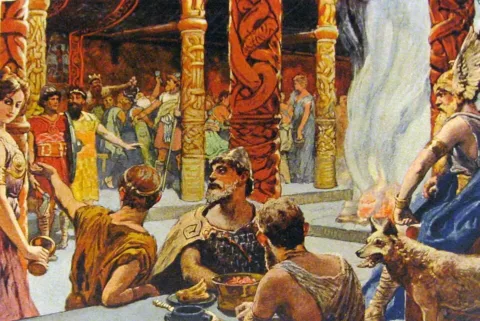
What Was Valhalla?
Valhalla, Old Norse Valhöll, is Odin’s hall for selected warriors killed in battle. Those admitted there become part of his company of dead fighters, the Einherjar.
In Grímnismál, Valhalla stands in Glaðsheimr, one of the divine dwellings associated with Odin. The poem presents it as a vast martial hall belonging to a god closely connected with war, death and the battle-slain.
Valhalla was therefore a specific destination within the Norse afterlife, not the destination of all the dead or even all warriors who died in combat.
What Does Valhalla Mean?
The Old Norse name Valhöll is usually understood as “hall of the slain.”
The first element, valr, refers to those killed in battle, while höll means “hall.” The name points directly to Valhalla’s connection with the battle-slain gathered there.
The same valr element appears in Valkyrie, reflecting their role in choosing the slain from the battlefield.
The English form Valhalla developed from Valhöll, but the Old Norse name preserves the original meaning more clearly.
Who Went to Valhalla?
Valhalla was associated with warriors killed in battle and chosen for Odin.
In Grímnismál, Odin is described as selecting the weapon-slain for Valhalla. Other poems reinforce this idea of selection. In Hákonarmál, Odin sends the Valkyries Göndul and Skögul to choose who will join him, while Eiríksmál imagines a fallen king being welcomed into the hall.
The surviving texts connect Valhalla most strongly with warriors claimed by Odin, while poems such as Hákonarmál and Eiríksmál give particular attention to fallen rulers. They do not provide a fixed list of qualifications or a formal rule explaining exactly why one battle-slain warrior was chosen over another.
Did Every Viking Warrior Go to Valhalla?
No. Dying in battle did not automatically guarantee a place in Valhalla.
Grímnismál says that Freyja chooses half of the battle-slain, while Odin receives the other half. That alone rules out the popular idea that every fallen warrior entered Odin’s hall.
Valhalla was therefore a destination for warriors specifically claimed by Odin, not a universal reward for anyone who died fighting.
The Norse afterlife also included other possible destinations, so Valhalla should not be treated as the automatic fate of every Viking warrior.
Freyja and Fólkvangr: Where Did the Other Half of the Slain Go?
Valhalla was not the only destination associated with warriors killed in battle. In Grímnismál, Freyja is said to choose half of the slain, while Odin receives the other half.
The poem connects Freyja with Fólkvangr, where she determines who will have seats in her hall. Snorri later names that hall Sessrúmnir.
The sources tell us far less about Fólkvangr than about Valhalla. They do not describe a comparable cycle of daily combat and feasting, or explain in detail what Freyja’s chosen dead did there.
Fólkvangr therefore confirms that the battle-slain were not automatically Odin’s dead, while leaving much of Freyja’s afterlife realm unexplained.
How Did the Valkyries Choose the Dead?
The Valkyries were closely connected with Odin’s selection of the battle-slain, but the Norse sources do not give a fixed set of qualities that guaranteed their choice.
In Gylfaginning, Odin sends them to battles, where they choose who will die and influence who wins. Some are also described as riding out to take the slain after the fighting.
The skaldic poem Hákonarmál gives a more personal example. Odin sends Göndul and Skögul to choose a king for his hall, and the dying Hákon learns that he is being summoned to join Odin.
The Valkyries were therefore more than escorts for the dead. They were tied to the outcome of battle itself, deciding death, victory and who would be claimed for Odin.
The sources never spell out a simple rule for why one warrior was chosen and another was not.
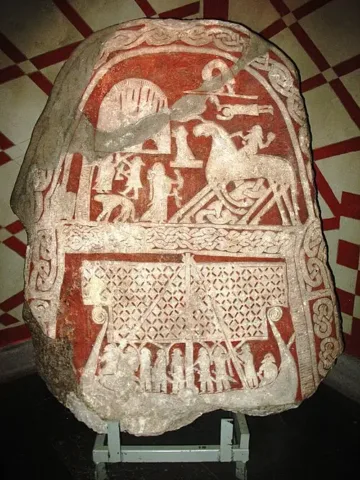
**The Tjängvide Picture Stone**, from Gotland, Sweden. The upper scene is commonly interpreted as a fallen warrior arriving at Valhalla, where a woman, often identified as a Valkyrie, offers him a drinking horn. The rider appears on an eight-legged horse, which has encouraged comparisons with Odin’s horse Sleipnir. The interpretation is widely accepted but not certain.
Who Were the Einherjar?
The Einherjar are the dead warriors gathered in Valhalla under Odin.
The term does not refer to every warrior killed in battle. It applies specifically to those who have entered Odin’s hall and become part of his chosen company.
Norse sources present them as an organized warrior host rather than as passive spirits of the dead. They continue to exist as fighters within Valhalla, taking part in the hall’s daily cycle of combat and feasting.
That is what separates the Einherjar from the wider category of the battle-slain: not every fallen warrior becomes one, only those admitted into Odin’s company.
What Happened in Valhalla After Death?
Entering Valhalla meant joining the Einherjar, Odin’s company of chosen dead warriors.
Their afterlife remained active rather than peaceful. They continued to live as fighters inside Odin’s hall, sharing in its daily routines and supernatural abundance.
Valhalla was therefore not a place where warriors simply rested after death. Their identity as fighters continued, and the details of that existence shaped everything that happened inside the hall.
Why Did the Einherjar Fight Every Day?
The Einherjar fight one another every day in Valhalla, but the surviving sources do not describe these battles as formal military training.
In Vafþrúðnismál, they go out to fight each day, kill one another, then return healed and sit together afterward. Gylfaginning gives the same pattern and calls the fighting their sport.
The wider mythology gives the routine a military context. The Einherjar are Odin’s warrior host, and Grímnismál says they will eventually march out from Valhalla when the Wolf is fought at Ragnarök.
The daily combat is therefore part of their continued existence as warriors. Calling it specific “training” for Ragnarök is a reasonable interpretation, but the poems themselves do not say that directly.
What Did the Einherjar Eat and Drink?
The Einherjar feast on the flesh of the boar Sæhrímnir, which is cooked every day and becomes whole again by evening.
In Gylfaginning, the cook is named Andhrímnir, and the cauldron used to prepare the boar is called Eldhrímnir. Sæhrímnir provides enough meat for everyone in Valhalla, however large the company becomes.
Their drink is mead supplied by the goat Heiðrún, which feeds from the branches of Læraðr above Valhalla. She produces enough mead for all the Einherjar to drink their fill.
Odin is described differently. He gives the food from his table to his wolves, Geri and Freki, and is said to live on wine alone.
The feast reflects the supernatural abundance of Valhalla: neither food nor drink is exhausted, regardless of how many warriors gather there.
What Did Valhalla Look Like?
The Norse sources describe Valhalla as a vast warrior hall rather than a palace of comfort.
In Grímnismál, its roof is made from shields and its rafters from spear shafts. Armor lies across the benches, while a wolf hangs near the western door with an eagle above it.
The imagery is deliberately martial. Weapons and armor are built into the description of the hall itself, making Valhalla look less like a peaceful afterlife and more like a place shaped entirely by warrior culture.
How Many Warriors Could Valhalla Hold?
The Norse sources never give a fixed capacity for Valhalla.
Grímnismál says that the hall has 540 doors, and that 800 Einherjar will go out through each doorway when they march to fight the Wolf at Ragnarök. Snorri repeats the same description in Gylfaginning.
Multiplying those numbers gives 432,000 warriors, a figure often quoted as Valhalla’s population. But the poem does not say that 432,000 is the hall’s maximum capacity. It describes the force able to leave through its doors for the final battle.
The number is better understood as an image of extraordinary scale than as a precise architectural limit.
Why Was Odin Gathering Warriors?
Odin gathers the Einherjar because they will eventually fight beside the gods at Ragnarök.
Grímnismál describes the warriors marching out from Valhalla to fight the Wolf, while Gylfaginning places the Einherjar alongside the Æsir when the final conflict begins.
Valhalla therefore serves a military purpose as well as an afterlife destination. Odin is building a supernatural host for the battle he knows is coming.
Valhalla and Ragnarök
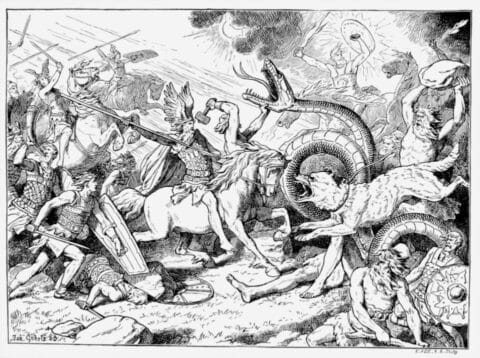
In Gylfaginning, Heimdall sounds Gjallarhorn, the gods arm themselves, and Odin leads the Einherjar toward the battlefield of Vígríðr.
The warriors of Valhalla fight alongside the Æsir against Fenrir, Surtr and the other enemies of the gods. Odin himself rides against Fenrir and is killed by the wolf.
The Einherjar take part in the same final conflict, but the sources do not describe them returning to Valhalla afterward as they do after their daily battles.
Ragnarök therefore marks the end of Valhalla’s repeating cycle of combat and feasting. The hall has gathered its warriors for this confrontation, and once it begins, that cycle no longer continues in the same way.
Read More
Odin: All-Father, Chief of the Norse Gods and God of Wisdom
Freyja: Norse Goddess of Love, War, Magic and the Slain
Ragnarök Explained: How the Norse World Ends and What Comes After
Did the Einherjar Die Again at Ragnarök?
The sources give no sign that the Einherjar return after Ragnarök as they do after their daily battles in Valhalla.
In Gylfaginning, after the final conflict and the burning of the world, Gangleri asks what remains when the gods and the Einherjar are dead. The account then names several gods and humans who survive or return after Ragnarök, but the Einherjar are not among them.
The older poetic sources do not describe the individual fate of every Einherji, so there is no basis for claiming that they rise again after the final battle.
Their repeated recovery belongs to life inside Valhalla before Ragnarök. Once the final conflict begins, the sources do not extend that cycle beyond it.
What Happened to People Who Did Not Go to Valhalla?
Norse tradition does not describe one universal destination for everyone who failed to enter Valhalla.
Snorri Sturluson says that Hel receives those who die from sickness or old age. This does not make Hel equivalent to the Christian hell; it is presented as a realm of the dead ruled by the figure who shares its name.
Other traditions point to different outcomes. Freyja receives part of the battle-slain in Fólkvangr, drowned people could be associated with Rán, and saga literature sometimes keeps the dead connected with burial mounds rather than sending them to a distant hall.
The Norse afterlife was therefore varied rather than organized around one destination. Valhalla was important, but it was only one possible fate among several.
Was Valhalla the Norse Heaven?
Calling Valhalla the “Norse heaven” is convenient, but it is misleading.
Valhalla was not a universal paradise for good people, and entry was not presented as a reward for moral virtue. It was Odin’s hall for selected battle-slain warriors.
Norse tradition also does not describe one single system of judgment in which every person is assigned an afterlife according to how well or badly they lived.
Valhalla is better understood as Odin’s warrior afterlife: a specific destination within a much broader and less uniform set of beliefs about the dead.
What Valhalla Meant in Norse Mythology
Valhalla expresses a distinctly Odinic idea of the afterlife. Death does not remove the chosen warrior from conflict; it draws him more deeply into Odin’s world of battle, violent death and fate.
Its mythology joins honor with something darker. The warriors receive an extraordinary existence after death, but even that existence is temporary. They remain part of a cosmic struggle whose ending is already known.
Valhalla is therefore less a promise of eternal peace than a place of continued purpose. Even the honored dead still have a role to play before the old world comes to an end.
Academic Sources
This article draws on Old Norse primary texts together with modern academic scholarship on Valhalla, the Einherjar, Valkyries and beliefs about death in the Norse world.
- Snorri Sturluson.
Edda: Prologue and Gylfaginning.
Edited by Anthony Faulkes. 2nd ed., Viking Society for Northern Research, University College London, 2005.
Primary source for Valhalla, the Einherjar, Valkyries, Sæhrímnir, Heiðrún, the daily fighting in Odin’s hall and the role of the Einherjar at Ragnarök.
- The Poetic Edda.
Translated with an introduction and notes by Carolyne Larrington. Revised ed., Oxford World’s Classics, Oxford University Press, 2014.
Includes Grímnismál and Vafþrúðnismál, central sources for Valhalla, Fólkvangr, the Einherjar, the hall’s 540 doors and the daily combat of Odin’s warriors.
- R. D. Fulk, ed.
“Eyvindr skáldaspillir Finnsson, Hákonarmál.”
In Poetry from the Kings’ Sagas 1: From Mythical Times to c. 1035,
edited by Diana Whaley. Skaldic Poetry of the Scandinavian Middle Ages 1, Brepols, 2012.
Important skaldic evidence for Valkyries choosing the slain and a fallen king being summoned to Odin and Valhalla.
- John Lindow.
Norse Mythology: A Guide to the Gods, Heroes, Rituals, and Beliefs.
Oxford University Press, 2002.
Major scholarly reference for Odin, Valhalla, Valkyries, the Einherjar, Ragnarök and the wider structure of Norse mythological belief.
- Rudolf Simek.
A Dictionary of Northern Mythology.
Translated by Angela Hall. D. S. Brewer, 1996.
Academic reference work covering Valhöll, the Einherjar, Valkyries, Fólkvangr, Hel and wider Germanic beliefs about death and the afterlife.
- Hilda Roderick Ellis Davidson.
The Road to Hel: A Study of the Conception of the Dead in Old Norse Literature.
Cambridge University Press, 1943.
Classic scholarly study of Old Norse ideas about death, burial, Hel, Valhalla and the range of possible fates imagined for the dead.