Fenrir in Norse Mythology: Why the Gods Feared Odin’s Killer
Fenrir is one of the most feared figures in Norse mythology, a monstrous wolf whose fate is tied directly to Odin and Ragnarök.
The son of Loki and the giantess Angrboða, Fenrir grows so powerful that the gods decide he cannot be left free. They try to restrain him more than once before finally binding him with Gleipnir, a magical cord strong enough to hold even the wolf they fear most.
Their efforts do not change the future foretold about him. At Ragnarök, Fenrir breaks free and kills Odin, fulfilling the prophecy that had shaped the gods’ actions from the beginning.
His story is therefore not only about a giant wolf, but about fear, prophecy, trust, and the limits of trying to escape a fate already known.
Who Was Fenrir in Norse Mythology?
Fenrir is the great wolf of Norse mythology, best known for being bound by the gods and for his role at Ragnarök.
He is the son of Loki and the giantess Angrboða, and one of the most dangerous figures connected with the final destruction of the gods.
In Gylfaginning, Fenrir grows rapidly in both size and strength while living among the Æsir. His increasing power, combined with the prophecies surrounding him, eventually convinces the gods that they cannot allow him to remain free.
Fenrir is therefore remembered not simply as a monstrous wolf, but as a figure whose entire story is shaped by the future the gods believe he is destined to fulfill.
Who Were Fenrir’s Parents and Siblings?
Fenrir was the son of Loki and the giantess Angrboða, who lived in Jötunheim. According to Gylfaginning, they had three children together: Fenrir, Jörmungandr, and Hel.
The three siblings were dealt with differently by the gods. Jörmungandr was cast into the sea, where he grew into the serpent that encircles the world, while Hel was sent to rule over the realm of the dead. Fenrir remained among the gods as his size and strength continued to increase.
Snorri connects all three with prophecies of future disaster, which is why Odin had them taken from Jötunheim and separated.
What Does the Name Fenrir Mean?
The name Fenrir is commonly interpreted as “fen-dweller” or “dweller in the marsh,” linking it with the Old Norse word fen, meaning a fen or marsh.
That interpretation is widely used, but the etymology is not completely certain. The ending of the name is difficult to explain from fen alone, and other linguistic explanations have been proposed.
Fenrir was probably understood as a name connected with a fen or marsh, although its exact original formation remains uncertain
Why Were the Norse Gods Afraid of Fenrir?
The gods feared Fenrir because of both his growing strength and the prophecies surrounding his future.
According to Gylfaginning, the Æsir had learned that great destruction would come from the children of Loki and Angrboða. Fenrir became especially alarming because he remained among the gods while rapidly increasing in size and power.
The story does not begin with Fenrir attacking the Æsir or committing an earlier crime against them. Their fear is based largely on what they believe he will eventually become.
That fear leads them to restrain him before Ragnarök, hoping to contain the danger foretold in prophecy.
Why Did Týr Feed Fenrir?
While Fenrir was being raised among the gods, Týr was the only one willing to approach him closely enough to feed him.
Gylfaginning says that the other Æsir were afraid of the growing wolf, while Týr alone had the courage to bring him food. This creates a direct connection between the two before the episode with Gleipnir.
The source does not describe their relationship in greater detail. It does not say that Týr raised Fenrir, trained him, or became his friend, as some modern retellings suggest.
That earlier contact gives Týr a distinctive place in the later story of Fenrir’s binding.
Læðing and Drómi: The Chains Fenrir Broke
Before using Gleipnir, the gods tried to bind Fenrir with two stronger-looking restraints.
The first was called Læðing. The gods presented it as a test of strength, and Fenrir allowed them to place it around him. He broke free without difficulty.
They then brought a much stronger chain called Drómi. Fenrir was more cautious this time, but eventually agreed to the test. After struggling against it, he burst the chain apart.
With both restraints broken, the gods realized that ordinary chains would never be enough. They turned instead to the dwarfs, who created Gleipnir, a binding unlike anything Fenrir had faced before.
What Was Gleipnir Made Of?
After Fenrir broke the earlier chains, Odin sent Skírnir to the dwarfs to obtain a restraint strong enough to hold him. The result was Gleipnir.
According to Gylfaginning, Gleipnir was made from six impossible things:
- the sound of a cat’s footsteps
- a woman’s beard
- the roots of a mountain
- a bear’s sinews
- a fish’s breath
- a bird’s spittle
The list explains why these things can no longer be found in the world: they had been used to create the magical binding.
Despite its strength, Gleipnir looked harmless. It was smooth and soft like a silken ribbon, completely unlike the heavy chains Fenrir had already broken.
Why Did Fenrir Demand Týr’s Hand as a Pledge?
Fenrir immediately distrusted Gleipnir. It looked like a thin ribbon, yet the gods insisted that he test it after he had already broken far heavier chains.
He argued that there would be little glory in breaking something so slight, but if the ribbon proved stronger than it appeared, he had no reason to believe the gods would release him afterward.
Fenrir therefore agreed to be bound only on one condition: one of the gods had to place a hand in his mouth as a pledge of good faith.
The gods hesitated because they knew Fenrir’s suspicion was justified. Týr was the only one willing to accept the risk.
How Did Týr Lose His Hand?
Once the gods had bound Fenrir with Gleipnir, the wolf struggled to break free as he had with the earlier chains.
This time, the binding held.
When Fenrir realized that the gods had no intention of releasing him, he closed his jaws on Týr’s hand and bit it off at the wrist.
Týr had placed his hand in Fenrir’s mouth as the pledge demanded before the test, so the injury was the direct consequence of the gods’ deception.
The episode is the source of Týr’s famous one-handed appearance in later Norse tradition.
What Happened to Fenrir After He Was Bound?
Once Fenrir was trapped by Gleipnir, the gods secured the binding so he could not escape.
They fastened the cord through a great stone called Gjöll, drove it deep into the ground, and used another stone, Þviti, as an anchoring peg.
Fenrir continued to struggle and tried to bite at the gods. To stop him, they forced a sword into his mouth, with the hilt against his lower jaw and the point against the upper.
Unable to close his jaws, Fenrir howled and drooled. The liquid flowing from his mouth was said to form the river Ván.
Fenrir remained there, bound until Ragnarök.
Why Didn’t the Gods Kill Fenrir?
The gods clearly believed Fenrir was dangerous, so an obvious question remains: why did they bind him instead of killing him?
Gylfaginning gives a direct answer. The gods did not want to shed Fenrir’s blood in their sacred places and regarded such an act as a serious pollution.
Rather than kill him, they chose to keep him permanently restrained.
Fenrir at Ragnarök
Fenrir remains bound until Ragnarök, when the restraints holding him finally break.
In Gylfaginning, the wolf escapes as the world collapses around the gods. Snorri describes him advancing with his jaws stretched enormously wide, his lower jaw near the earth and the upper reaching toward the sky, with fire blazing from his eyes and nostrils.
Fenrir then joins the forces moving against the gods on the battlefield of Vígríðr.
Older Norse poetry also preserves the image of Fenrisúlfr unfettered, showing that the idea of the bound wolf breaking free at Ragnarök was not limited to Snorri’s prose account.
How Does Fenrir Kill Odin?
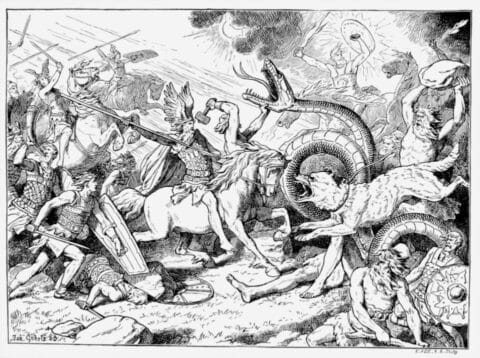
At Ragnarök, Fenrir kills Odin by swallowing him.
In Gylfaginning, Odin rides into battle against Fenrir while Thor faces Jörmungandr nearby. The wolf overcomes the All-Father and devours him, fulfilling the fate the gods had feared long before Fenrir was bound.
The same outcome appears in older Norse poetry. Vafþrúðnismál says that the wolf will swallow Odin at the end of the gods and that Víðarr will later avenge his father.
This shows that Fenrir’s killing of Odin was already part of the older poetic tradition and was not introduced only in Snorri’s prose account.
How Does Víðarr Kill Fenrir?
After Fenrir kills Odin, Víðarr, one of Odin’s sons, avenges his father.
In Gylfaginning, Víðarr steps on Fenrir’s lower jaw with a specially prepared shoe, grips the upper jaw with one hand, and tears the wolf’s mouth apart.
Snorri explains that Víðarr’s shoe is made from scraps cut from the toes and heels of shoes, material gathered over time for his use at Ragnarök.
Völuspá preserves a different version of the killing. There, Víðarr avenges Odin by striking the wolf in the heart rather than tearing its jaws apart.
Both traditions agree on the central event: Víðarr kills Fenrir in revenge for Odin’s death.
Are Fenrir, Fenrisúlfr, Hróðvitnir and Vánagandr the Same Wolf?
The same mythological wolf appears under several names in Old Norse sources.
Fenrir is the familiar name, while Fenrisúlfr, literally “Fenrir’s wolf,” refers to the same creature. Snorri also identifies Vánagandr directly with Fenrisúlfr.
Hróðvitnir is less straightforward. The name appears in Old Norse poetry for a mythical wolf and is generally associated with Fenrir, but the identification is not expressed as directly as it is with Vánagandr.
So Fenrir, Fenrisúlfr, and Vánagandr clearly refer to the same wolf, while Hróðvitnir is best treated as a poetic name closely associated with Fenrir rather than as an exact synonym in every context.
Is Fenrir the Father of Sköll and Hati?
Fenrir is often described as the father of Sköll and Hati, the wolves associated with the sun and moon, but the surviving sources are clearer about Hati than Sköll.
In Grímnismál, Hati is called Hróðvitnir’s son. Since Hróðvitnir is generally associated with Fenrir, Hati’s connection to him is relatively strong.
Sköll is less certain. The poem names him alongside Hati but does not explicitly call him Fenrir’s son. Snorri later places both wolves within the same wolfish brood associated with the giantess of Járnviðr, but still does not give a simple statement that Fenrir fathered both.
So Hati is strongly linked to Fenrir as his son, while Sköll’s parentage remains less explicit in the surviving sources.
Did the Gods Create Their Own Enemy?
Fenrir’s story is sometimes read as a self-fulfilling prophecy: the gods fear what he will become, deceive him, imprison him, and eventually face him as an enemy at Ragnarök.
The surviving sources do not say that the binding caused Fenrir to kill Odin. In Gylfaginning, the gods act because they already know the prophecies surrounding Loki’s children and are alarmed by Fenrir’s growing strength.
Fenrir is restrained before he has carried out the destruction foretold about him, and the gods knowingly deceive him during the test with Gleipnir.
By Ragnarök, he becomes exactly the threat they feared. Whether their actions helped create that hostility remains an interpretation rather than something the sources state directly.
What the Norse Sources Actually Tell Us About Fenrir
Fenrir’s story does not survive in one continuous early poem. What we know about him comes from several Old Norse sources that preserve different parts of the tradition.
The Poetic Edda already presents Fenrir as a bound wolf connected with Ragnarök. Lokasenna refers to Týr losing his hand to the wolf, while Vafþrúðnismál says that Fenrir will swallow Odin and that Víðarr will avenge his father. Völuspá also places the wolf within the destruction of the final battle.
The Prose Edda, written by Snorri Sturluson in the thirteenth century, preserves the fullest surviving version of Fenrir’s story, including the detailed account of his binding and the events leading to Ragnarök.
Snorri was writing in Christian Iceland long after Scandinavia’s conversion, so his account should not be treated as a complete record of Viking Age belief. Even so, several central elements of his narrative are also found in older poetry.
Taken together, the sources show that Fenrir was already known as the bound wolf who would kill Odin, while Snorri preserves the most detailed surviving account of how that fate unfolded.
Conclusion
Fenrir’s story brings together prophecy, fear, and the limits of the gods’ attempts to control the future.
The gods bind him with Gleipnir and keep him imprisoned until Ragnarök, but the fate they fear still comes to pass. Fenrir breaks free, kills Odin, and is then slain by Víðarr.
That arc, from feared prophecy to fulfilled fate, is what gives Fenrir such a powerful place in Norse mythology.
Academic & Primary Sources
- Snorri Sturluson, Edda: Prologue and Gylfaginning, ed. Anthony Faulkes.
Viking Society for Northern Research, 2005. The principal primary source for Fenrir’s parentage, growth, failed bindings, Gleipnir, Týr’s lost hand, imprisonment, and role at Ragnarök. - The Poetic Edda, trans. Carolyne Larrington.
Oxford University Press, 2nd ed., 2014. Includes Lokasenna, Vafþrúðnismál, Grímnismál, and Völuspá, which preserve older poetic traditions about Fenrir, Týr, Odin, Víðarr, Hati, and Ragnarök. - Lindow, John. Norse Mythology: A Guide to the Gods, Heroes, Rituals, and Beliefs.
Oxford University Press, 2002. Major scholarly reference work for Fenrir, Loki’s family, Ragnarök, and the interpretation of Old Norse mythological figures. - Lindow, John. Old Norse Mythology.
Oxford University Press, 2021. Modern academic study of the Old Norse mythological tradition, its written sources, and the relationship between medieval texts and earlier belief. - Simek, Rudolf. A Dictionary of Northern Mythology.
Translated by Angela Hall. D. S. Brewer, 1996. Standard scholarly reference for Fenrir, Fenrisúlfr, Hróðvitnir, Vánagandr, Sköll, Hati, Gleipnir, and other Old Norse mythological names and traditions.