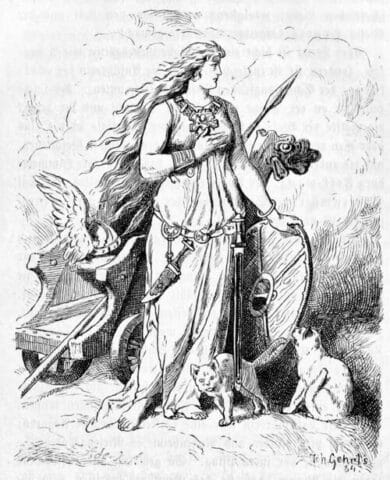
Frigg: Norse Goddess, Queen of Æsir, Wife of Odin, Mother of Baldr
Frigg is one of the most important goddesses in Norse mythology and the wife of Odin. She is closely associated with marriage, motherhood and fate, but the surviving sources present a more complicated figure than the familiar image of a quiet queen beside the All-Father.
She tries to protect her son Baldr from death, knows more about fate than she reveals, and in Grímnismál turns a wager with Odin to her advantage. Later tradition also connected her with fertility, weaving and prophecy, although those claims are not all equally well supported by the medieval texts.
Frigg is also frequently compared with Freyja, raising a long-running question about whether the two may share an earlier Germanic background.
So who was Frigg according to the Norse sources, and which parts of her modern image actually come from them?
Who Was Frigg in Norse Mythology?
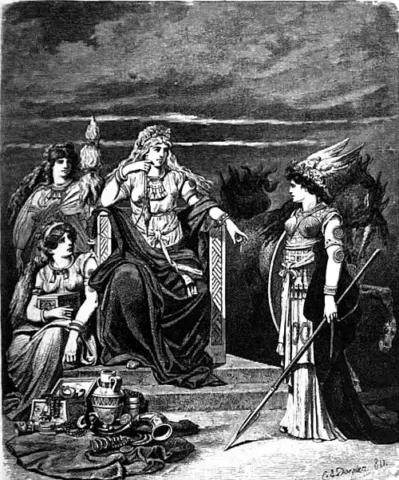
Frigg is a leading goddess of the Æsir and the wife of Odin. In the Prose Edda, Snorri Sturluson places her first among the Ásynjur and names Fensalir as her dwelling.
The surviving stories do not give her one narrowly defined domain. Instead, Frigg appears through her position and actions: as Odin’s partner, Baldr’s mother, a figure with knowledge of fate and a goddess whose decisions can influence both gods and humans.
That makes simple labels such as “goddess of marriage” or “queen of Asgard” useful only up to a point. The medieval sources clearly give Frigg exceptional status, but they do not reduce her to a single function.
Many qualities now strongly associated with her, especially formal queenship, fertility and weaving, belong partly to later interpretation and need to be tested against the older sources rather than assumed.
What Does the Name Frigg Mean?
The name Frigg belongs to an old Germanic word family associated with love, affection and the idea of someone who is “beloved.”
The Old Norse form Frigg is usually connected with reconstructed Proto-Germanic Frijjō, while related forms appear elsewhere in the Germanic world, including Old English Frīg and Old High German Frīja. This suggests that Frigg was not originally a purely Scandinavian figure, but belonged to a wider Germanic religious tradition.
The name is also related to words associated with love, friendship and courtship, which fits the broader associations later attached to the goddess.
The familiar form Frigga is later. In the medieval Old Norse sources, the goddess is simply Frigg.
Was Frigg Really Queen of Asgard?
Frigg is often called the “Queen of Asgard,” but that exact title does not appear in the surviving Norse sources.
Her status is nevertheless exceptionally high. In Gylfaginning, Snorri Sturluson places Frigg foremost among the Ásynjur and identifies her as Odin’s wife. In Skáldskaparmál, she is described as the “Lady of the Æsir and Ásynjur,” language that clearly marks her as the leading goddess of the divine household.
“Queen of Asgard” is therefore a reasonable modern shorthand for her rank, but it should not be mistaken for an original Old Norse title. The medieval sources present Frigg as a pre-eminent goddess, not as a monarch ruling Asgard in the formal sense of a historical queen.
Her own hall, Fensalir, and her prominent role in stories involving Odin and Baldr further reinforce that elevated position.
Frigg and Odin
Frigg is consistently presented as Odin’s wife, but the surviving myths do not portray her as a passive figure beside him.
Their relationship is marked by status, independence and occasional rivalry. In Grímnismál, for example, Frigg openly challenges Odin and successfully turns events against him, showing that she has her own loyalties and is willing to act independently even when he is directly involved.
The sources do not give a detailed picture of their marriage in the modern sense. Instead, they preserve brief episodes in which the two appear as powerful figures with different priorities, capable of disagreement as well as partnership.
Frigg’s position beside Odin is central to her status, but the myths also make clear that she has an identity and authority of her own.
Frigg as a Goddess of Marriage and Motherhood
Frigg is strongly associated with marriage and motherhood, although the surviving Norse sources do not simply label her “goddess of marriage.”
Her position as Odin’s wife is central to her identity, and Skáldskaparmál also names her as the mother of Baldr. Those relationships place family at the center of several of the stories in which she appears.
Marriage also falls within her sphere of authority. In Gylfaginning, the goddess Lofn is said to obtain permission from Odin or Frigg for marriages that might otherwise be forbidden, suggesting that Frigg held recognized authority in matters of marriage.
Her role as a mother becomes most visible through Baldr, whose fate drives one of the most important myths connected with her.
It is therefore accurate to associate Frigg with marriage, family and motherhood. What the sources do not support is reducing her to a single fixed role defined only by those themes.
Was Frigg a Fertility Goddess?
Frigg is often described as a fertility goddess, but the surviving Norse sources do not define her that clearly.
One of the clearest pieces of evidence comes from childbirth rather than from a broad fertility cult. In Oddrúnargrátr, Frigg and Freyja are invoked together to help a woman in labor, showing that Frigg could be associated with childbirth.
That connection is significant, but it does not prove that fertility was her primary divine function. Modern labels such as “fertility goddess” can become too broad when they are applied to any goddess connected with motherhood or birth.
Frigg is therefore better described as a goddess associated with marriage, motherhood and childbirth, with possible fertility connections, rather than as a clearly defined fertility deity.
Did Frigg Know the Future?
The Norse sources give Frigg an unusual kind of knowledge: she knows fate, but does not openly reveal it.
In Gylfaginning, Snorri states that Frigg knows the fates of people even though she does not speak prophecy. The same idea appears in Lokasenna, where Freyja says that Frigg knows fate but keeps that knowledge to herself.
This is different from acting as a professional seer. Frigg is not shown giving regular predictions or publicly interpreting the future. Her defining trait is foreknowledge rather than open prophecy.
The story of Baldr adds an important limit to that knowledge. Frigg can foresee danger and act against it, but knowing what may happen does not give her complete control over the outcome.
Frigg is therefore best understood as a goddess with knowledge of destiny, not simply as a fortune-teller.
Was Frigg a Völva?
Frigg is sometimes described as a völva, or Norse seeress, because she is said to know fate. The surviving sources, however, never explicitly give her that title.
A völva was a female ritual specialist associated with prophecy and practices such as seiðr. Frigg is not shown performing this kind of ritual divination, while other Norse figures, including Freyja and Odin, are more directly connected with seiðr.
Knowing the future is therefore not enough to classify Frigg as a völva. The safest description is that she possesses foreknowledge, while the claim that she was a seeress goes beyond what the medieval sources clearly support.
Frigg and the Death of Baldr
Frigg’s most famous story centers on the death of her son Baldr, one of the most beloved gods in Norse mythology.
After Baldr begins having ominous dreams about his death, the gods become alarmed. Frigg responds by taking oaths from nearly everything in the world, including fire, water, metals, stones, trees, animals, sickness and poison, that none of them will harm him. Once Baldr appears invulnerable, the gods turn the situation into a game, throwing weapons and objects at him without effect.
One thing is left out: mistletoe. Frigg considers it too young to require an oath. Loki discovers this weakness after approaching her in disguise, then gives the mistletoe to Baldr’s blind brother Höðr and guides his throw. The mistletoe strikes Baldr and kills him.
The story shows both the reach and the limits of Frigg’s protection. She can secure promises from almost everything in existence, but one overlooked exception is enough to undo the entire effort.
For Frigg, Baldr’s death becomes the clearest example of a tragedy she tries to prevent but cannot ultimately stop.
Frigg in Grímnismál: When She Outsmarts Odin
One of Frigg’s most revealing appearances comes in Grímnismál, where she turns a wager with Odin to her advantage.
The poem’s prose introduction tells how Odin and Frigg had each fostered one of two brothers. Frigg favored Agnar, while Odin favored Geirröðr, who later became king. Years later, the two gods sit in Hliðskjálf and argue over which foster-son has prospered better. Odin praises Geirröðr, while Frigg accuses him of treating guests badly.
Odin refuses to believe her, and the disagreement becomes a wager. Frigg sends Fulla to warn Geirröðr that a dangerous magician has entered his land, giving him a description that points directly to Odin, who is travelling in disguise as Grimnir.
Geirröðr has the stranger seized and tortured between two fires for eight nights. Odin eventually reveals his identity, but by then Frigg has already turned the king against him.
The episode gives Frigg an unusually active role. She anticipates Odin’s arrival, uses Fulla as her agent and shapes the situation before he can respond.
Read More
Odin: All-Father, Chief of the Norse Gods and God of Wisdom
Loki in Norse Mythology: Trickster, Shapeshifter, Enemy of the Gods
Ragnarök Explained: How the Norse World Ends and What Comes After
Frigg in Lokasenna
Frigg appears briefly but significantly in Lokasenna, a poem built around Loki’s insults against the gods and goddesses gathered in Ægir’s hall.
When Odin and Loki begin attacking each other over past behavior, Frigg intervenes and says that old deeds should not be discussed publicly. Loki immediately turns on her, accusing her of having slept with Odin’s brothers, Vili and Vé.
That accusation needs caution. Lokasenna is a flyting poem, a formal exchange of insults in which Loki attacks nearly everyone present with sexual, moral or social accusations. His words may preserve a tradition known to the audience, but the poem does not require us to treat every charge as established fact.
Later in the exchange, Loki boasts about his role in Baldr’s death, while Freyja defends Frigg and refers to her knowledge of fate.
The value of Lokasenna lies less in proving the accusations than in showing which stories, rumors and tensions were recognizable enough to be used as weapons in the poem.
Fensalir: Frigg’s Hall
Frigg’s hall is called Fensalir, one of the few places in Norse mythology consistently associated with her.
In Gylfaginning, Snorri Sturluson says that Frigg dwells there and describes it as a splendid residence. Skáldskaparmál also identifies her as the mistress of Fensalir.
The name is usually translated as “Fen Halls” or “Marsh Halls,” but its mythological meaning is uncertain. Later scholars proposed links with water, fertility or solar symbolism, yet the surviving sources do not explain the name in those terms.
Fensalir also appears in Völuspá, where Frigg grieves there after Baldr’s death. This is one of the few moments in which the hall is tied directly to an event in her story.
Beyond that, the sources tell us little about Fensalir’s appearance, location or symbolic meaning.
Fulla, Gná and the Goddesses Around Frigg
Several goddesses in the Prose Edda are closely connected with Frigg and carry out tasks on her behalf.
Fulla is the closest to her. Snorri describes her as a maiden with loose hair and a golden band around her head. She carries Frigg’s chest, looks after her footwear and knows her secret counsel. Elsewhere, she also acts as Frigg’s messenger.
Gná serves a more mobile role. Frigg sends her on errands through different worlds, and she travels on the horse Hófvarpnir, which can move through the air and over the sea.
Hlín is associated with protection. Snorri says that Frigg appoints her to guard people she wishes to save from danger.
Together, these figures show that Frigg is not simply one goddess among many. The sources place her at the center of a small network of attendants and messengers who act in her name.
Was Frigg a Goddess of Weaving?
Frigg is often described today as a goddess of spinning and weaving, but the surviving Old Norse sources give little direct support for that role.
Textile production was strongly associated with women in Norse society, and weaving could carry symbolic links with fate and female power. The clearest mythological example, however, comes from the Valkyries in Darraðarljóð, where they weave the outcome of battle rather than from Frigg herself.
The medieval texts focus instead on Frigg’s status, her knowledge of fate, her relationship with Odin and Baldr, and her hall at Fensalir. They do not clearly describe her spinning, weaving or acting as a patron of textile work.
Her later association with weaving became much stronger in post-medieval retellings, especially during the nineteenth century, when writers such as Jacob Grimm helped shape a more domestic image of Frigg.
Weaving is therefore part of Frigg’s later reception, but calling her an original Norse “goddess of weaving” goes beyond what the medieval sources clearly support.
Frigg and Freyja: Were They Originally the Same Goddess?
Frigg and Freyja are sometimes treated as two forms of an earlier Germanic goddess, but the surviving Norse sources present them as separate figures.
In Skáldskaparmál, they are listed individually among the Ásynjur and given different families, halls and attributes. Frigg is Odin’s wife and the mother of Baldr, while Freyja is the daughter of Njörðr, sister of Freyr and wife of Óðr. By the time the medieval Norse sources were written, the distinction between them was clear.
The debate concerns an earlier period that is much less well documented. Similarities in their associations with love, female power and certain aspects of magic have led some scholars to suggest that Frigg and Freyja may have developed from a shared Germanic background.
The problem is evidence. Sources from before the Viking Age are too limited to reconstruct that development with confidence, and overlapping functions do not prove that the two goddesses were once identical.
Frigg and Freyja should therefore be treated as distinct goddesses in the surviving Norse tradition. A possible shared origin remains a scholarly hypothesis, not a settled conclusion.
Friday and the Name of Frigg
The English word Friday is traditionally linked with Frigg.
Old English used the form Frīġedæġ, commonly understood as “Frigg’s day.” The name belongs to a wider Germanic pattern in which Roman weekday names were adapted using Germanic deities. In this case, Latin dies Veneris, the “day of Venus,” was matched with Frigg.
The connection is important because it places Frigg within a wider Germanic tradition, not only the later Scandinavian sources in which most of her myths survive.
Friday is sometimes linked instead with Freyja, largely because of her associations with love and sexuality. But the Old English form points more directly to Frigg, and the two goddesses should not be merged on that basis.
The weekday name remains one of the clearest traces of Frigg outside the Old Norse literary tradition.
What Frigg Represents in Norse Mythology
Frigg’s importance in Norse mythology comes less from one fixed divine function than from the position she holds among the gods.
She combines high status with unusual knowledge, yet neither gives her complete control over events. Her stories repeatedly place her in situations where she can advise, influence, protect or intervene, but not always determine the final outcome.
Family is also central to her character. Her relationships with Odin and Baldr are not simply genealogical details, but shape some of the most important stories in which she appears.
Frigg ultimately represents authority without absolute power, knowledge without certainty of control, and the tension between action and fate that runs through much of Norse mythology.
Academic Sources
This article draws primarily on medieval Old Norse texts, supported by modern academic scholarship on Norse mythology and religion.
- Snorri Sturluson.
Edda: Prologue and Gylfaginning.
Edited by Anthony Faulkes. Viking Society for Northern Research, University College London, 2005.
Primary source for Frigg’s status among the Ásynjur, Fensalir, her knowledge of fate, Lofn, Fulla, Gná, Hlín and the death of Baldr.
- Snorri Sturluson.
Edda: Skáldskaparmál.
Edited by Anthony Faulkes. Viking Society for Northern Research, University College London, 1998.
Important for Frigg’s family relationships, status and descriptions connected with Odin, Baldr and Fensalir.
- The Poetic Edda.
Translated by Carolyne Larrington. Revised edition, Oxford World’s Classics, Oxford University Press.
Includes Grímnismál, Lokasenna, Völuspá and Oddrúnargrátr, all central to Frigg’s surviving literary portrayal.
- John Lindow.
Norse Mythology: A Guide to the Gods, Heroes, Rituals, and Beliefs.
Oxford University Press, 2002.
Major scholarly reference for Frigg, Freyja, Baldr, Fensalir, Germanic divine traditions and the interpretation of Old Norse mythological sources.
- Rudolf Simek.
A Dictionary of Northern Mythology.
Translated by Angela Hall. D. S. Brewer, 1996.
Academic reference work covering Germanic and Norse deities, mythological names, cult traditions and the wider historical background of Frigg.
- Carolyne Larrington, Judy Quinn and Brittany Schorn, eds.
A Handbook to Eddic Poetry.
Cambridge University Press, 2016.
Scholarly context for the transmission, interpretation and mythological content of Eddic poetry, including poems used as primary evidence in this article.