Heimdall: The Norse God Who Guards Bifröst and Warns of Ragnarök
Heimdall is the watchman of the Norse gods, stationed near Bifröst to detect approaching enemies and warn the gods when danger comes.
The Old Norse sources give him extraordinary senses. He can see across immense distances, hear sounds as faint as grass growing, and needs very little sleep. From his hall at Himinbjörg, he keeps Gjallarhorn ready for the warning that will announce Ragnarök.
But Heimdall is stranger than the familiar image of a god guarding a rainbow bridge. He is born from nine mothers, called the “White God” and “Golden-Toothed,” linked with Loki through an old rivalry, and possibly connected with Rígr, the mysterious figure associated with the origins of human social classes.
These traditions preserve several different sides of Heimdall, not all of which fit neatly into the simple role of divine gatekeeper.

Who Was Heimdall?
Heimdall was one of the Æsir gods and held the recognized role of watchman among them.
Snorri Sturluson describes him as “great and holy” and gives him several distinctive names and titles, including Hallinskíði, Gullintanni, and the “White God.” He is also said to have been born from nine mothers, one of the most unusual birth traditions attached to any Norse god.
His identity is built less around conquest or brute force than around vigilance and guardianship. That role places him at the edge of the gods’ world, watching for threats that other gods might not detect in time.
Other traditions connect him with Ragnarök, Loki, Rígr, and Brísingamen, but his central identity remains consistent: Heimdall is the divine watchman of the Æsir.
Why Was Heimdall the Watchman of the Gods?
Heimdall’s role was to guard the approach to the gods’ realm. In Gylfaginning, Snorri places him at Himinbjörg beside Bifröst, watching for giants who might attempt to cross into the divine world.
His position was active rather than ceremonial. Heimdall was expected to remain alert, detect approaching danger, and give the gods enough warning to respond.
Lokasenna reinforces how closely this duty was tied to his identity. Loki mocks Heimdall for being condemned to stand watch over heaven, suggesting that even within hostile dialogue he was recognized above all as the gods’ permanent sentinel.
What Powers Did Heimdall Have?
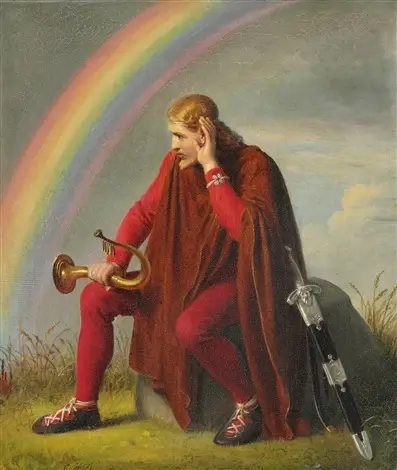
Heimdall’s most remarkable abilities were his sight, hearing, and resistance to sleep.
In Gylfaginning, Snorri says he needs less sleep than a bird, can see for a hundred leagues by night as clearly as by day, and can hear sounds as faint as grass growing on the earth or wool growing on sheep.
These abilities explain why Heimdall was suited to constant watch. He could detect threats long before they reached Bifröst and remain alert when an ordinary guard could not.
His powers are therefore unusual for a Norse god: they depend less on overwhelming strength than on perception, endurance, and vigilance.
Himinbjörg: Where Did Heimdall Live?
Heimdall’s home was Himinbjörg, a hall located near Bifröst, at the edge of the gods’ realm.
Snorri places Heimdall there because the location suited his role as watchman, giving him a position from which he could observe anyone approaching the bridge.
The name is usually translated as “Heaven’s Cliffs” or “Heaven-Mountain.” Grímnismál also names Himinbjörg as Heimdall’s dwelling and describes him drinking good mead there in his hall.
Himinbjörg is therefore not just a divine residence. It is the watch-post from which Heimdall guards the boundary of the gods’ world.
What Was Gjallarhorn?
Gjallarhorn was Heimdall’s warning horn, kept for the moment when the gods would need to be summoned.
In Gylfaginning, Snorri says its sound could be heard throughout all worlds. At Ragnarök, Heimdall blows it to wake the gods and call them to council before the final battle.
The horn also appears in Völuspá, showing that it belonged to an older poetic tradition and was not simply a detail added by Snorri.
Its role is straightforward but important: Gjallarhorn is the alarm that signals the beginning of the gods’ final crisis.
Why Did Heimdall Have Nine Mothers?
Heimdall’s birth is one of the strangest traditions attached to him. In Gylfaginning, Snorri says he was born from nine sisters, while Hyndluljóð names nine giant women as his mothers.
The poem gives their names as Gjálp, Greip, Eistla, Eyrgjafa, Úlfrún, Angeyja, Imðr, Atla, and Járnsaxa. It also describes Heimdall as being strengthened by the earth, the cold sea, and sacrificial blood.
The sources never explain why he has nine mothers. Scholars have often connected them with waves or the sea, partly because several names have been interpreted in ways that suggest water or natural forces, but that remains uncertain.
Whatever its original meaning, the story gives Heimdall an origin unlike that of almost any other Norse god.
Was Odin Really Heimdall’s Father?
Snorri does call Heimdall a son of Odin in Skáldskaparmál, where he lists traditional poetic descriptions of the god.
Other sources place far greater emphasis on Heimdall’s nine mothers. In the surviving fragment of Heimdalargaldr, Heimdall identifies himself as the son of nine sisters without naming a father.
Odin’s paternity is therefore part of Snorri’s tradition, but it is not equally explicit across the older poetic material.
For Heimdall, the ninefold maternal ancestry is the more distinctive and consistently emphasized part of his birth story.
Why Was Heimdall Called the White God and Golden-Toothed?
Snorri gives Heimdall two striking descriptions: “the White God” and Gullintanni, “Golden-Toothed.” He also says that Heimdall’s teeth were made of gold.
The meaning of “White God” is uncertain. It may suggest brightness, purity, or a shining appearance, but the sources do not define it as a specific divine function. Calling Heimdall simply a god of light therefore goes beyond what the surviving texts actually say.
Gold appears elsewhere in his imagery as well. His horse is called Gulltoppr, “Gold-Top,” reinforcing the association without explaining what it was meant to symbolize.
Was Heimdall Really Rígr?
A medieval prose introduction to Rígsþula identifies Rígr as Heimdall, which is why the two figures are often treated as the same god.
The poem itself, however, never names Heimdall. It follows a wandering figure called Rígr as he visits three households and fathers the ancestors of different social groups.
That leaves the identification open to debate. Some scholars have suggested that Rígr may originally have been Odin, since the poem’s themes of wandering, runes, wisdom, and kingship also fit him.
There is still an important reason for connecting Rígr with Heimdall: Völuspá addresses humanity as the “sons of Heimdall,” which fits a tradition in which he stands near the mythical ancestry of humankind.
The connection between Heimdall and Rígr is therefore significant, but not certain enough to treat every detail of Rígsþula as unquestionably part of Heimdall’s mythology.
Read More
Ragnarök Explained: How the Norse World Ends and What Comes After
Loki in Norse Mythology: Trickster, Shapeshifter, Enemy of the Gods
The Nine Worlds of Norse Mythology Explained: Asgard to Hel
The Valkyries in Norse Mythology: Who Chose Who Fell in Battle?
Heimdall and the Origins of Human Social Classes
In Rígsþula, Rígr visits three households representing different levels of society. From these visits come Þræll, Karl, and Jarl, who become the ancestors of thralls, free farmers, and aristocrats.
The poem distinguishes these groups through their work, food, clothing, property, and way of life, creating one of the clearest mythic pictures of social hierarchy in Old Norse literature.
Jarl receives special treatment. Rígr teaches him runes, and his descendants move toward kingship, linking aristocratic status with warfare, knowledge, and inherited authority.
If the prose identification of Rígr with Heimdall is accepted, the god becomes connected not only with guarding the divine world, but also with the mythic ordering of human society.
Heimdall and Loki: Why Were They Enemies?
Heimdall and Loki are presented as enemies well before their final clash at Ragnarök.
In Skáldskaparmál, Heimdall is called the foe of Loki and the “seeker of Freyja’s necklace,” showing that their rivalry was already established in older poetic tradition.
Another tradition connects them with a struggle over Brísingamen, but much of that story survives only in fragments.
What remains clear is that Heimdall and Loki were not paired only at the end of the world. Their hostility belonged to the mythology long before Ragnarök, giving their final confrontation a history behind it.
Did Heimdall Recover Brísingamen?
The surviving tradition does connect Heimdall with the recovery of Brísingamen, Freyja’s famous necklace, although most of the story has been lost.
In Skáldskaparmál, Snorri says that Heimdall and Loki fought over the necklace at Singasteinn, while an older poem, Húsdrápa, described them taking the forms of seals.
A surviving stanza from Húsdrápa indicates that Heimdall gained possession of the jewel during the contest. What led to the fight, how Loki obtained the necklace, and how it was returned to Freyja are no longer preserved.
The surviving evidence therefore supports Heimdall’s role in recovering Brísingamen, but not the complete theft-and-recovery story found in many later retellings.
Heimdall at Ragnarök
Heimdall’s role as watchman reaches its final point at Ragnarök.
When the crisis begins, he blows Gjallarhorn, summoning the gods and announcing that the danger he has watched for has finally arrived.
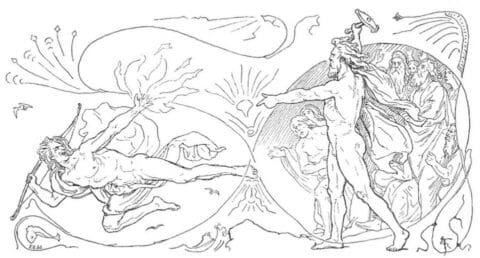
He then joins the battle itself. In Gylfaginning, Heimdall fights Loki, and the two kill each other.
His end completes the role he has held throughout the mythology: the watchman who gives the final warning and then enters the battle himself.
Was Heimdall Worshipped?
Heimdall is prominent in the surviving mythology, but evidence for a cult devoted specifically to him is limited.
Unlike gods such as Thor, Odin, or Freyr, he has not left a clear pattern of place-names, shrines, or archaeological finds that can be confidently connected with his worship.
That does not prove that Heimdall was never honored. Pre-Christian Norse religion varied by region, and much of its ritual practice is poorly documented. It simply means that Heimdall is far better attested in mythological texts than in surviving evidence for cult activity.
Why Heimdall Matters in Norse Mythology
Heimdall stands out because his mythology is built around boundaries and vigilance.
He watches the approach to the gods’ world, waits for the threat that will bring that world to an end, and may also appear in a tradition concerned with the ordering of human society.
That gives him a role much broader than “guardian of the rainbow bridge.” Heimdall is a figure of watchfulness, transition, and the fragile boundary between order and the forces waiting beyond it.
Academic Sources
This article draws on the principal Old Norse texts that preserve Heimdall’s mythology, together with modern academic studies of Norse religion, myth, and poetic tradition.
Snorri Sturluson, Edda: Prologue and Gylfaginning, ed. Anthony Faulkes.
Viking Society for Northern Research, University College London, 2nd ed., 2005. A primary source for Heimdall’s role as watchman, Himinbjörg, Bifröst, his extraordinary senses, nine mothers, Gjallarhorn, and his death with Loki at Ragnarök.
Viking Society for Northern Research
Snorri Sturluson, Edda: Skáldskaparmál, ed. Anthony Faulkes.
Viking Society for Northern Research, 1998. Important for Heimdall’s poetic names and kennings, his identification as a son of Odin, his rivalry with Loki, and the tradition surrounding Brísingamen.
Viking Society for Northern Research
Carolyne Larrington (trans.), The Poetic Edda.
Oxford World’s Classics, revised edition, 2014. Provides modern scholarly translations of poems including Völuspá, Grímnismál, Lokasenna, Hyndluljóð, and Rígsþula, all central to Heimdall’s surviving poetic tradition.
Oxford University Press
John Lindow, Norse Mythology: A Guide to the Gods, Heroes, Rituals, and Beliefs.
Oxford University Press, 2002. A major academic reference for Heimdall, the Æsir, Ragnarök, mythic geography, and the problems involved in reconstructing Norse religious traditions from medieval sources.
Oxford Academic
Rudolf Simek, A Dictionary of Northern Mythology.
D. S. Brewer, 1996. A standard scholarly reference covering Heimdall, Bifröst, Gjallarhorn, Rígr, Brísingamen, divine names, cult evidence, and the wider Germanic mythological tradition.
Boydell & Brewer
Margaret Clunies Ross, Prolonged Echoes: Old Norse Myths in Medieval Northern Society, Vol. 1: The Myths.
Odense University Press, 1994. A major scholarly study of the structure, social meaning, and transmission of Old Norse myth, useful for interpreting Heimdall’s place within the divine order and the relationship between mythic roles and medieval society.
Google Books
Copyright Notice
© 2026 History & Myths. All rights reserved.
This article is original editorial content created for HistoryAndMyths.com.
Unauthorized reproduction, republication, or substantial copying of the text,
structure, or original analysis is prohibited without prior written permission.
Brief quotations are permitted for commentary, research, or educational use
when accompanied by clear attribution and a link to the original article.