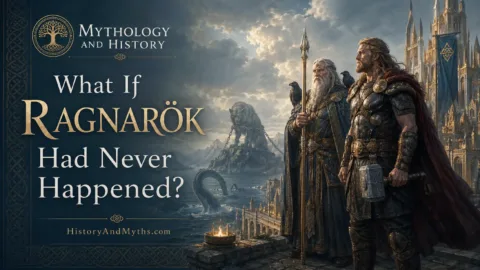
What If Ragnarök Never Happened? Norse Mythology Reimagined
If Ragnarök had never happened, the Norse gods might have escaped the deaths foretold for them—but the survival of the old world would come at a surprising cost. Odin would not fall to Fenrir, Thor would never fight his final battle with Jörmungandr, and the destruction of the Nine Worlds would never unfold as prophecy describes.
At first, that sounds like the best possible outcome. Yet Ragnarök is not only the catastrophe of Norse mythology. It is also the event that clears the way for renewal. After the old order collapses, the world is supposed to rise again, surviving gods inherit a changed cosmos, humanity begins anew, and Baldr returns from Hel.
Without Ragnarök, none of that future is guaranteed. Loki and Fenrir could remain imprisoned indefinitely, the warriors of Valhalla might continue preparing for a battle that never comes, and Baldr could remain among the dead instead of returning to the renewed world. Odin and Thor might survive, but the next generation of gods would never inherit the roles prophecy prepared for them.
The result would therefore be more complicated than an eternal golden age. Preventing Ragnarök could save the gods and spare humanity from cosmic destruction, while trapping the Norse cosmos in an old order that was never meant to last. The real question is not simply whether the gods would survive—but whether a world without its promised ending could ever truly move forward.
The Mythic Turning Point
Ragnarök is the point at which the existing order of Norse mythology finally collapses. In the surviving sources, the crisis is preceded by the terrible Fimbulwinter and a breakdown of the natural and social world. Fenrir breaks free, Jörmungandr rises from the sea, Loki joins the enemies of the gods, and Surtr advances with fire.
The battle ends many of the rivalries that have shaped the myths. Odin is killed by Fenrir, who is then slain by Víðarr. Thor kills Jörmungandr but dies soon afterward from the serpent’s venom. Freyr falls to Surtr, while Heimdall and Loki kill one another. Surtr’s fire consumes the world, and the earth sinks beneath the sea.
But Ragnarök does not end with permanent emptiness. The surviving tradition also describes a renewed earth rising again. Víðarr and Váli survive, Móði and Magni inherit Mjölnir, and Baldr and Höðr return from the realm of the dead. Two human survivors, Líf and Lífþrasir, become the beginning of a new human population.
That second half matters as much as the destruction. Ragnarök removes the old divine order, but it also creates the conditions for what comes after it. Our alternate scenario changes that exact turning point: the catastrophe never arrives, so neither does the renewal that depends on it.
The Scenario Used in This Article
This is a hypothetical scenario, not part of the surviving Norse sources. It assumes that the events leading toward Ragnarök have already unfolded: Baldr is dead, Loki has been punished and bound, Fenrir is restrained by Gleipnir, and Odin continues preparing for the final conflict.
The change is simple: Ragnarök never begins. The final Fimbulwinter does not trigger the collapse of the world, the imprisoned enemies of the gods do not break free for the last battle, and Surtr never destroys the existing cosmos.
Everything that was supposed to follow Ragnarök is therefore also placed in doubt. Odin and Thor avoid their foretold deaths, but Baldr has no promised return, Móði and Magni do not inherit Mjölnir through Thor’s death, and the renewed world described after the catastrophe never appears.
The scenario is not about making the gods immortal or creating permanent peace. It asks what happens when the old Norse order continues beyond the ending that was supposed to replace it.
Would Odin and Thor Escape Their Prophesied Deaths?
If Ragnarök never happened, Odin and Thor would avoid the deaths specifically tied to the final battle. Odin would not be swallowed by Fenrir, and Thor would never fight Jörmungandr and die from the serpent’s venom.
That does not make either god immortal. It only removes the circumstances in which the surviving sources say they are destined to die.
For Odin, the change would be especially significant. Much of his preparation for Ragnarök is driven by the knowledge that the final conflict is coming. He gathers fallen warriors in Valhalla and seeks knowledge partly because he knows his own end cannot simply be ignored.
Thor would also remain one of the strongest defenders of the gods, with Mjölnir still in his possession rather than passing into the renewed world through his sons.
Their survival would preserve the leadership and military power of the old divine order—but it would also prevent the succession that Ragnarök was supposed to create.
What Happens to Loki, Fenrir, and Jörmungandr?
If Ragnarök never begins, Loki and Fenrir lose the moment in which they are supposed to break free and join the final assault on the gods.
Fenrir would remain bound by Gleipnir unless some other event released him. Loki, already punished for his role in Baldr’s death, would also remain confined rather than marching against the gods at Ragnarök.
Jörmungandr is different. The world-serpent is not imprisoned in the same way, but its final role depends on the last battle. Without Ragnarök, it remains a continuing threat in the sea rather than becoming Thor’s final opponent.
This would make the surviving cosmos more stable, but not necessarily peaceful. The gods would still live with powerful enemies who had not been defeated—only contained or postponed.
In that sense, preventing Ragnarök would not solve the conflict between the gods and their enemies. It would leave the conflict permanently unfinished.
Would Baldr Ever Return from Hel?
Baldr’s fate becomes one of the strangest consequences of preventing Ragnarök. His death has already happened before the final destruction, and the surviving tradition places his return in the world that comes afterward.
If Ragnarök never occurs, that path back disappears.
Baldr could therefore remain in Hel indefinitely, even while Odin and Thor continue to live. The gods would avoid their foretold deaths, but they would also lose the future in which Baldr returns and takes his place in the renewed divine order.
This creates a sharp reversal of what initially looks like a happy outcome. Saving the old gods may mean preserving the very world in which Baldr remains absent.
Unless some completely different release from Hel occurred, his return would no longer be part of the expected future.
What Would Happen to Valhalla and the Einherjar?
Valhalla would lose much of its purpose if Ragnarök never came.
Odin gathers chosen fallen warriors there because they are meant to fight beside the gods in the final battle. The Einherjar feast, train, and prepare for a conflict they expect to face one day.
Without Ragnarök, that preparation never reaches its goal. Valhalla could continue receiving warriors, but its army would be built for a war that no longer has an ending point.
That would turn Odin’s greatest military preparation into a permanent state of readiness. The Einherjar would still have status and purpose within Valhalla, yet the event that gives their training its larger meaning would remain forever absent.
Rather than becoming the force that helps defend the gods at the end of the world, they would become an army waiting for a battle that never arrives.
Would the Old Order of the Gods Become Permanent?
Without Ragnarök, the older generation of gods would remain in control far longer than the surviving myths expect.
Odin would still rule, Thor would keep Mjölnir, and the divine order centered on the Æsir would continue without the violent break that creates a new generation after the final battle.
That would also change the roles of the gods who are supposed to inherit what remains. Víðarr would never avenge Odin’s death at Ragnarök, while Móði and Magni would have no reason to inherit Mjölnir from Thor.
The result would be continuity rather than succession. The old order might remain powerful, but the younger gods would lose the future that prophecy gives them.
Ragnarök is therefore not only a destruction of the gods. It is also a transfer of the world from one divine generation to another—and without it, that transition never takes place.
What Happens to Fate If Ragnarök Never Comes?
Ragnarök is not presented as a surprise attack. Odin knows it is coming, and much of his behavior makes sense only because he believes the final crisis cannot be avoided.
If Ragnarök never happens, that certainty breaks.
The problem is larger than one failed prophecy. Odin’s search for knowledge, his preparation of the Einherjar, and the expected deaths of several gods all depend on a future that was supposed to be fixed.
A world in which Ragnarök simply fails to arrive would therefore raise an uncomfortable question: was fate changed, misunderstood, or never as absolute as the gods believed?
The surviving sources do not give a clear answer to that hypothetical problem. But within this scenario, the consequences would be profound. If the greatest foretold event in Norse mythology could fail, then every other prophecy tied to it would become less certain as well.
That would not free the gods from danger. It would leave them in a world where the future had become harder to read—and where even Odin could no longer be sure which destinies were truly unavoidable.
Would Humans and the Nine Worlds Actually Be Better Off?
For ordinary humans, avoiding Ragnarök would remove the most obvious danger: the collapse of the world itself.
The final Fimbulwinter would not devastate human society, Surtr would not burn the world, and the destruction associated with the last battle would never take place. From that perspective, countless lives would be spared.
But the surviving cosmos would not become safe or peaceful. Humans would still face war, disease, harsh winters, monsters, and the ordinary limits of mortal life. The gods’ older conflicts would also remain unresolved rather than disappearing.
Líf and Lífþrasir would no longer need to survive Ragnarök and repopulate the world, because humanity itself would never be reduced to the point where such a renewal was necessary.
So humans would gain survival, but not a perfect world. They would continue living in the same imperfect cosmos instead of inheriting the renewed one that was supposed to follow its destruction.
The Hidden Cost: No Ragnarök Means No Renewed World
The greatest cost of preventing Ragnarök would be easy to miss: the old world survives, but the new one never arrives.
After the destruction, Norse tradition describes the earth rising again, fertile and renewed. Surviving gods gather in a changed world, Baldr returns, and a new human beginning follows through Líf and Lífþrasir.
If Ragnarök never happens, that entire transition is lost. The existing cosmos continues with the same unresolved rivalries, the same divine generation, and the same wounds left by earlier myths.
This makes Ragnarök more than an apocalypse. It also serves as the break between an exhausted order and the world that follows it.
Preventing the end could therefore protect the present while blocking the future. Odin and Thor may survive, but the Norse cosmos would remain tied to an age that was never given the chance to end.
Read More
- What If Loki Had Never Turned Against the Gods? Norse Myth Scenarios
- Odin: All-Father, Chief of the Norse Gods and God of Wisdom
- Norse Creation Myth: Ginnungagap, Ymir and the Birth of the World
- Thor: Norse God of Thunder, Mjölnir and Viking-Age Worship
- Yggdrasil: The World Tree of Norse Mythology Explained
- Ragnarök Explained: How the Norse World Ends and What Comes After
What Would Probably Not Change
Even without Ragnarök, several basic features of the Norse cosmos would remain unchanged.
Humans would still be mortal, and the gods would not become all-powerful simply because they escaped their foretold deaths. Odin could still face political and supernatural threats, Thor could still be wounded or defeated, and conflicts between the gods and their enemies would continue.
Baldr would remain dead under the rules of this scenario, while Loki and Fenrir would remain dangerous even if they never reached the battlefield of Ragnarök.
The Nine Worlds would therefore continue much as before: unstable, contested, and shaped by forces the gods could influence but never fully control.
Removing Ragnarök would change the future of the cosmos, but it would not erase the problems already built into it.
Most Likely
The most likely outcome is that the old Norse order simply continues.
Odin and Thor avoid the deaths assigned to them at Ragnarök, while Loki and Fenrir remain contained and Jörmungandr never reaches its final confrontation with Thor. The gods preserve their power, but they also remain trapped in the same unresolved system of rivalries and threats.
Baldr would have no clear path back from Hel, and the younger generation would not inherit the roles prepared for them after the destruction. Valhalla would continue gathering warriors for a battle that never comes.
In the short term, this would be safer for gods and humans alike. In the long term, it would create a cosmos with no natural transition into the renewed world described after Ragnarök.
The result would not be a perfect age. It would be an old world surviving beyond the ending it was meant to have.
Plausible but Uncertain
A less certain possibility is that the gods would eventually try to replace Ragnarök with another solution.
They might seek a new way to deal with Loki, Fenrir, and Jörmungandr, or attempt to restore Baldr without waiting for the destruction of the world. Odin, in particular, would have strong reasons to keep searching for knowledge if the future no longer followed the pattern he expected.
The younger gods could also gain greater roles without inheriting the world through catastrophe. Víðarr, Váli, Móði, and Magni might gradually rise in importance while Odin and Thor were still alive.
Another possibility is that the tension simply builds until a different conflict takes Ragnarök’s place. The sources give no basis for predicting what that event would look like, so it should remain speculation rather than a replacement prophecy.
What can be said with more confidence is that an eternal stalemate would be difficult to maintain. The forces that made Ragnarök possible would still exist even if the foretold battle itself never came.
Highly Unlikely
The least plausible outcome is that preventing Ragnarök creates permanent peace.
Too many tensions already exist before the final battle. Loki’s punishment, Fenrir’s confinement, Jörmungandr’s hostility, and the wider conflict between the gods and their enemies would not disappear simply because prophecy failed to reach its expected ending.
It is also unlikely that Odin and Thor would become untouchable. Escaping the deaths assigned to them at Ragnarök would remove one specific fate, not every possible danger.
A flawless eternal age under the old gods would therefore contradict the world the myths already describe. Without Ragnarök, the cosmos might survive longer—but survival alone would not resolve the forces that made the final conflict possible in the first place.
Final Verdict: Saving the Gods Might Prevent the World’s Rebirth
If Ragnarök never happened, the immediate result would look like a victory. Odin and Thor would survive, humanity would avoid catastrophic destruction, and the Nine Worlds would be spared the final collapse.
But Norse mythology does not treat Ragnarök as destruction alone. It also clears the way for a renewed world, the return of Baldr, the rise of a younger generation of gods, and a new beginning for humanity.
Removing Ragnarök would preserve the old order instead of repairing it. The gods would keep their enemies contained, Valhalla would continue preparing for a battle without an end, and the future promised after the catastrophe would remain unreachable.
The paradox is simple: saving the old world might also prevent the better world that was meant to follow it.
Ragnarök is terrifying because it ends an age. Yet without that ending, the Norse cosmos may survive only by remaining unfinished.
Frequently Asked Questions
What would happen if Ragnarök never happened?
The old Norse order would continue. Odin and Thor would avoid their foretold deaths, while the destruction and renewal associated with Ragnarök would never take place.
Would Odin and Thor live forever without Ragnarök?
Not necessarily. Avoiding Ragnarök would remove the specific deaths foretold for them, but Norse mythology does not imply that they would become permanently immortal or immune to every other danger.
Would Baldr return if Ragnarök never happened?
Probably not under the conditions of this scenario. The surviving tradition places Baldr’s return after Ragnarök, so removing the final catastrophe also removes the expected moment of his return.
What would happen to Loki and Fenrir?
If Ragnarök never began, Loki and Fenrir would have no final battle in which to break free. They could remain bound unless some separate event eventually released them.
What would happen to Valhalla without Ragnarök?
Valhalla could continue receiving chosen fallen warriors, but the Einherjar would be preparing for a final battle that never arrived, leaving Odin’s great army without its intended purpose.
Would a world without Ragnarök be better?
It would avoid enormous destruction and save many gods and humans, but it would also lose the renewed world, Baldr’s return, and the transition to the next generation described after Ragnarök.
Sources and Further Reading
Primary Norse Sources
1. The Poetic Edda — Völuspá (The Seeress’s Prophecy).
One of the principal surviving accounts of Ragnarök, including the destruction of the old world and the emergence of the renewed world afterward.
Internet Sacred Text Archive — Völuspá
2. The Poetic Edda — Vafþrúðnismál.
Important for the fate of humanity after the final catastrophe, including Líf and Lífþrasir, the future sun, and traditions concerning the gods after the world’s destruction.
Internet Sacred Text Archive — Vafþrúðnismál
3. The Poetic Edda — Baldrs draumar (Baldr’s Dreams).
A major poetic source for Baldr’s death and the chain of events associated with the approaching end of the divine order.
Internet Sacred Text Archive — Baldrs draumar
4. Snorri Sturluson — Edda: Prologue and Gylfaginning.
Edited by Anthony Faulkes. Gylfaginning provides the most extensive surviving prose narrative of Ragnarök, including Fimbulwinter, the final battles, the deaths of the gods, and the renewed world.
Viking Society for Northern Research
5. Carolyne Larrington — The Poetic Edda.
Oxford World’s Classics. A modern scholarly translation of the Eddic poems, including Völuspá and the traditions surrounding Ragnarök and the rebirth of the world.
Oxford University Press
Modern Academic Scholarship
6. Anders Hultgård — The End of the World in Scandinavian Mythology: A Comparative Perspective on Ragnarök.
A detailed academic study of Ragnarök, its surviving sources, the signs of the end, the final battle, destruction, and cosmic renewal.
Oxford University Press
7. Anders Hultgård — “The Signs of the End and the Final Battle.”
A focused examination of Fimbulwinter, the release of the bound monsters, the final conflict, and the structure of Snorri’s Ragnarök narrative.
Oxford Academic
8. Jonas Wellendorf — “Ragnarøk: From Dawn to Dusk.”
In The Lives and Deaths of the Norse Gods. Examines Ragnarök as both the destruction of the established divine order and the beginning of a renewed world.
Cambridge Core
9. Jonas Wellendorf — “Baldr and the Grand Narrative Arc of Mythological History.”
Examines Baldr’s death within the larger sequence that leads from the old order of the gods toward its destruction and eventual renewal.
Cambridge Core
10. John Lindow — Norse Mythology: A Guide to Gods, Heroes, Rituals, and Beliefs.
A major academic reference covering Odin, Thor, Loki, Fenrir, Baldr, Valhalla, Ragnarök, and the wider structure of Old Norse mythology.
Oxford Academic
11. John Lindow — Old Norse Mythology.
A later scholarly study examining the surviving literary evidence, mythic time, divine conflict, cosmology, and Old Norse ideas about the end of the world.
Oxford Academic
12. Jonas Wellendor — “Ymir, Baldr, and the Grand Narrative Arc of Mythological History.”
A scholarly examination of Baldr’s death, fate, and the larger mythological sequence that moves the order of Odin from creation toward destruction.
Cambridge Core
© Copyright Notice
Copyright Notice: This article is an original alternate-mythology analysis published by Mythology and History. It draws on surviving Norse mythological traditions, Old Norse literary sources, and modern academic scholarship to explore a hypothetical scenario.
The alternate outcomes presented in this article are interpretive and should not be treated as part of the original Norse myths, the Poetic Edda, the Prose Edda, or as a historical record.
Copying, republishing, translating, adapting, or substantially reproducing this content, in whole or in part, without prior written permission is prohibited.
Written by H. Moses
All rights reserved © Mythology and History
“`