The Celtic Otherworld: Tír na nÓg, Sídhe and Annwn Explained
The Celtic Otherworld was not a single hidden kingdom with one name or one entrance. Medieval Irish and Welsh literature describes a variety of supernatural realms, some reached across the sea, others associated with ancient mounds or places that seemed to exist alongside the mortal world.
Tír na nÓg is the most famous today, remembered as a land of youth where time passes differently. But it was only one part of a much wider tradition that also included Mag Mell, Tír Tairngire, Emain Ablach, the Irish síd, and the Welsh realm of Annwn.
These places were not simply Celtic versions of heaven. Living people could enter them, meet their inhabitants and sometimes return, although the journey might separate them from ordinary human time. Understanding the Otherworld therefore means looking at several related traditions rather than searching for one fixed mythological realm.
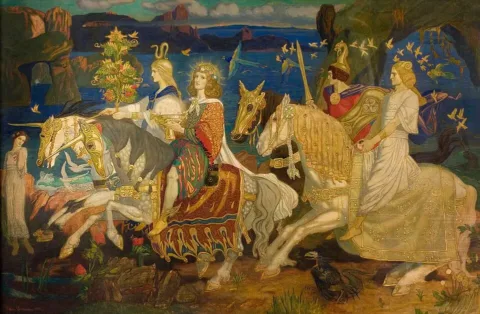
The Riders of the Sidhe (1911), John Duncan. Public domain, via Wikimedia Commons.
What Was the Celtic Otherworld?
“Celtic Otherworld” is a modern umbrella term for the supernatural realms found in medieval Celtic-language literature. The surviving texts do not describe a single place with one ruler, geography or set of rules.
Irish tradition preserves several kinds of Otherworld landscape, from distant islands and lands beyond the sea to dwellings beneath ancient mounds. Welsh literature developed its own traditions, particularly Annwn, which shares some features with Irish accounts without being another name for the same realm.
Despite their differences, these places often share recognizable qualities. They may be marked by extraordinary beauty, abundance, music, feasting, youth or unusual longevity. Their inhabitants possess knowledge, wealth or powers beyond normal human experience, while familiar rules of distance and time may no longer apply.
The similarities are real, but they do not form a single map. Medieval texts preserve different traditions from different periods, which is why “Otherworld” is most useful as a collective term rather than the historical name of one universal Celtic kingdom.
Was the Otherworld an Afterlife?
Not necessarily. Many people who enter Otherworld realms in Irish literature are still alive. Connla is invited away by a supernatural woman, while Bran sails with his companions toward a marvellous land beyond the sea. Neither story begins with death.
The confusion is understandable because some descriptions resemble paradise. Certain realms are free from sickness or sorrow and offer lasting youth, abundance and pleasure. But these texts were also preserved by medieval Christian writers, so older supernatural traditions sometimes appear beside, or become entangled with, Christian ideas about paradise and the fate of the soul.
Some traditions are more directly connected with death. Tech Duinn, the House of Donn, was associated with the dead in medieval Irish literature, although it differs from places entered by living adventurers such as Bran.
The evidence therefore does not support a single Celtic afterlife shared by everyone. Otherworld traditions could concern supernatural peoples, extraordinary lands reached by the living, or, in particular cases, destinations associated with the dead.
Tír na nÓg: The Land of Youth
Tír na nÓg, literally the “Land of Youth,” is the best-known Irish Otherworld realm today. It is remembered as a place where youth endures, ordinary ageing loses its power, and life is marked by abundance, music and pleasure.
Its fame comes largely from the story of Oisín and Niamh. In the best-known version, Niamh invites Oisín to leave Ireland and travel with her to Tír na nÓg. He remains young there while generations pass in the mortal world. When he eventually returns, he is warned not to touch the ground. After falling from his horse, the lost years catch up with him at once and he becomes an old man.
That familiar version, however, is not one of the earliest surviving Irish Otherworld tales. Laoi Oisín ar Thír na nÓg is a much later Ossianic poem, probably composed around the mid-eighteenth century and traditionally attributed to Micheál Coimín. Earlier Irish literature already contained journeys to supernatural lands where age and time behaved differently, so the motif is old even though the famous Oisín version is comparatively late.
Beyond Tír na nÓg: Mag Mell, Tír Tairngire and Emain Ablach
Medieval Irish literature preserves several other named supernatural lands, each with its own associations.
Mag Mell, usually translated as the “Plain of Delight” or “Pleasant Plain,” is described as a place of beauty, wealth and abundance. In one tradition, Cú Chulainn’s charioteer Lóeg describes the home of Labraid there as filled with magnificent halls, horses, precious objects and feasting.
Tír Tairngire, the “Land of Promise,” appears in medieval narratives including Echtra Cormaic, the Adventure of Cormac. It too is associated with marvels and abundance, although the surviving text reflects the Christian literary culture in which it was preserved.
Emain Ablach, often understood as “Emain of the Apples,” is closely linked with Manannán mac Lir and the western sea. In Immram Brain, a mysterious woman carries a silver branch from an apple tree of Emain and describes a land without sorrow, sickness or death. Her appearance sets Bran on his voyage beyond Ireland.
These realms share familiar Otherworld motifs, but the texts do not arrange them into one consistent geography. They are better read as distinct traditions that sometimes overlap than as interchangeable names for Tír na nÓg.
What Does Síd Mean? The Mounds and the Aos Sí
The word síd, later sí, can refer to a supernatural dwelling associated with a hill or ancient mound, and over time it also became closely connected with the beings believed to inhabit such places.
The term Aos Sí, or earlier áes síde, means the “people of the sí.” Translating them simply as “fairies” can be misleading, because the beings of Irish tradition are often more powerful, unpredictable and dangerous than the modern image of a fairy suggests.
The síd were not imagined merely as burial mounds occupied by ghosts. In medieval Irish literature, they could mark places where the human landscape opened onto another realm. Hills, ancient monuments and other striking features of the landscape could therefore carry supernatural significance without being separate worlds in the same sense as Tír na nÓg or Mag Mell.
The distinction is simple but important: Tír na nÓg is a named Otherworld land, the síd are supernatural dwellings or thresholds, and the Aos Sí are the beings associated with them.
The Tuatha Dé Danann and the Síd
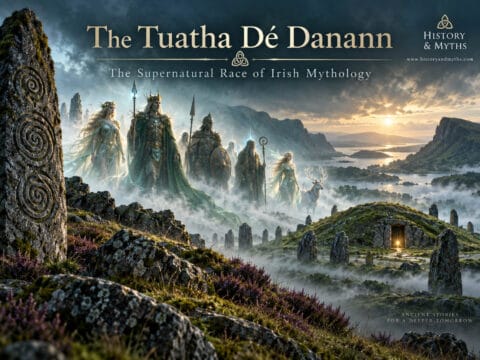
The Tuatha Dé Danann became closely associated with the síd in medieval Irish tradition. In Ireland’s legendary history, they ruled before the arrival of the sons of Míl, the ancestors of the Gaels. After the newcomers gained possession of Ireland, later stories increasingly placed members of the Tuatha Dé Danann within the supernatural landscape of the mounds.
Individual figures became linked with particular síd dwellings. One well-known tradition tells how the Dagda distributed these places among the Tuatha Dé Danann, while his son Óengus gained Brú na Bóinne through a clever bargain. The prehistoric monument was thus incorporated into the medieval mythological landscape as Óengus’s supernatural residence.
The relationship between the Tuatha Dé Danann and the Aos Sí was not explained through one simple transformation story. Across medieval tradition, the Tuatha Dé Danann increasingly appear as inhabitants or rulers of the síd, helping shape the later idea of powerful supernatural peoples living alongside, but usually hidden from, the human world.
How Mortals Entered the Otherworld: Bran, Connla and the Journey Tradition
Irish stories offer no single entrance to the Otherworld. A journey might begin at an ancient mound, cave, lake, well, river or shoreline, while mist could mark the moment when familiar surroundings gave way to something supernatural. In other tales, no physical gateway was needed at all. Someone from the Otherworld came to the mortal first.
Bran and Connla show these two patterns clearly. In Immram Brain, a mysterious woman describes a marvellous land beyond the sea, prompting Bran to sail west with his companions. His route into the Otherworld is a voyage through physical space, although the world he encounters no longer follows ordinary rules of distance or time.
Connla does not go searching. A supernatural woman appears at his father’s court and speaks to him of a land free from ordinary human troubles. At first only Connla can see her, though others hear her voice. She gives him an apple, later returns, and eventually persuades him to leave Ireland with her.
The contrast is important. Otherworld journeys could begin by crossing a geographical boundary, but they could also begin when the supernatural world reached into human life first. Hills, water and distant shores acted as thresholds, while invitations, gifts and mysterious visitors could serve the same purpose.
Echtrae and Immram: Two Kinds of Otherworld Journey?
Medieval Irish literature used several forms of narrative for journeys beyond the human world. Two important terms are echtrae and immram, although the boundary between them is not rigid.
An echtrae, or “adventure,” usually centres on a hero’s encounter with the supernatural and entry into an extraordinary realm. The adventures of Connla and Cormac are examples of this pattern.
An immram, or “voyage,” places greater emphasis on travel by sea. Immram Brain is the best-known example, while later voyage tales could combine older Otherworld motifs with Christian images of wondrous islands, punishment and paradise.
The distinction is therefore useful rather than absolute. Echtrae tends to emphasize the supernatural adventure; immram emphasizes the voyage. Some stories share features of both, which is why scholars have long treated the categories with caution.
Read More
The Fomorians in Irish Mythology: Giants, Monsters, and Rivals
The Second Battle of Mag Tuired: Tuatha Dé Danann vs Fomorians
Why Does Time Move Differently in the Otherworld?
Otherworld time often breaks the rules of mortal life. A traveller may experience only a short stay, then return to discover that years or generations have passed.
In Immram Brain, Bran eventually returns toward Ireland only to find that his name survives as something from the distant past. One of his companions steps onto land and immediately turns to dust. The later Oisín tradition uses the same motif in a different form: he remains young in Tír na nÓg while centuries pass at home, and age overtakes him only after his return.
The stories do not suggest a fixed ratio between mortal and Otherworld time. Instead, altered time marks the traveller’s separation from ordinary human existence. Youth and pleasure may endure beyond the boundary, but returning means confronting everything that continued without them.
The Otherworld offers escape from ageing, but not an easy return to the life left behind.
Manannán mac Lir and the World Beyond the Sea
Manannán mac Lir is one of the figures most closely associated with the maritime Otherworld. Medieval Irish texts connect him with the sea, supernatural travel and lands that lie beyond ordinary human perception.
His appearance in Immram Brain captures that role particularly well. Bran sees only the sea beneath his ship, while Manannán describes the same space as a flowering plain filled with animals and untouched by decay. The scene suggests that the Otherworld need not always lie at the end of a long journey. It may occupy the same landscape while remaining invisible to human eyes.
Manannán also guides Bran toward the Land of Women, and other traditions connect him with supernatural islands and Emain Ablach. Rather than ruling one universal Otherworld kingdom, he appears as a figure who moves easily across the boundary between worlds.
His importance lies in that ability to cross perspectives. In stories connected with Manannán, the sea is not merely a road to the Otherworld. Under the right conditions, it is already part of it.
Tech Duinn and the Dead
Tech Duinn, the “House of Donn,” stands apart from many Irish Otherworld traditions because of its direct association with the dead.
In the Dindshenchas, Donn is one of the sons of Míl who dies before the Milesians fully take possession of Ireland. His body is taken to a rocky island off the southwest coast, which becomes known as Tech Duinn. The same tradition says that the souls of the dead came there before continuing on their journey.
This makes Tech Duinn different from realms such as Tír na nÓg or Mag Mell, which are more often reached by living travellers and associated with youth, abundance or supernatural adventure.
The surviving account was preserved by Christian writers and includes ideas about sinners, repentance and hell, so it cannot be read as a direct record of pre-Christian belief. What it does preserve is a clear medieval association between Donn, Tech Duinn and the passage of the dead.
Annwn: The Welsh Otherworld
Welsh literature preserves its own Otherworld tradition in Annwn, also written Annwfn.
In the First Branch of the Mabinogi, Pwyll encounters Arawn, ruler of Annwn, and agrees to exchange places with him for a year and a day. Annwn appears as an organized realm with its own ruler, court and conflicts, not simply as an undefined land of spirits.
Another important source is Preiddeu Annwn, “The Spoils of Annwn,” an early Welsh Arthurian poem preserved in the Book of Taliesin. Arthur and his companions journey toward mysterious Otherworld fortresses connected with a prisoner and a magical cauldron, and only seven return.
Annwn shares features with Irish Otherworld traditions, including supernatural rulers, dangerous journeys and contact between mortal and otherworldly realms. But it belongs to a distinct Welsh literary tradition rather than serving as another name for Tír na nÓg or the Irish síd.
Was There One Celtic Otherworld?
No single Otherworld shared by every Celtic-speaking society appears in the surviving medieval texts. Irish and Welsh literature instead preserves several supernatural traditions with different names, landscapes and inhabitants.
What connects them is a recurring sense that another order of existence lies close to the human world but follows different rules. Mortals may cross into it, supernatural beings may cross out of it, and ordinary limits of time, distance and ageing can break down.
“Celtic Otherworld” is therefore most useful as a modern umbrella term for these related traditions, not as the name of one universal mythological kingdom.
Academic Sources
This article draws on medieval Irish and Welsh texts together with modern academic scholarship on the Celtic Otherworld, supernatural landscapes, voyage literature and Otherworld traditions.
- Sims-Williams, Patrick.
“Kaer Sidi and Other Celtic Otherworld Terms.”
In Irish Influence on Medieval Welsh Literature.
Oxford University Press, 2010.
Oxford Academic
- Key, Heather C.
Otherworld Women in Early Irish Literature.
Amsterdam University Press, 2023.
Cambridge Core
- Byrne, Aisling.
Otherworlds: Fantasy and History in Medieval Literature.
Oxford University Press, 2015.
Oxford Academic
- Adderley, Mark.
“Singing to the Silent Sentinel: ‘Preiddeu Annwn’ and the Oral Tradition.”
The Review of English Studies, Vol. 60, No. 244, 2009, pp. 175–193.
Oxford Academic
- Immram Brain.
Edited by Séamus Mac Mathúna.
Corpus of Electronic Texts (CELT), University College Cork.
CELT, University College Cork
- Echtra Cormaic i Tír Tairngiri.
Edition based on Whitley Stokes.
Corpus of Electronic Texts (CELT), University College Cork.
CELT, University College Cork
- The Metrical Dindshenchas: Tech Duinn.
Corpus of Electronic Texts (CELT), University College Cork.
CELT, University College Cork
Copyright Notice: This article is an original work published by
History & Myths
.
All rights reserved. The text may not be copied, republished, translated, or redistributed in whole or in substantial part without prior written permission.