Tyr: The One-Handed Norse God of War and Courage
Tyr was one of the major gods of Norse mythology, best known for his courage, his connection with warfare, and the hand he lost while helping bind the wolf Fenrir.
The surviving Norse sources associate him clearly with battle and victory. Modern accounts also often call him a god of law and justice, although that connection is less direct in the Eddic texts and depends partly on wider Germanic evidence.
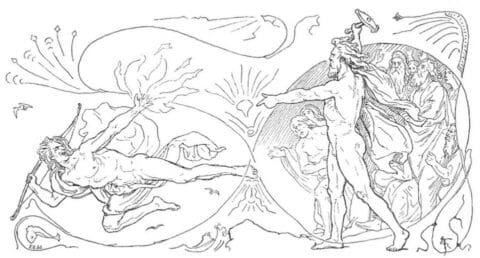
Tyr’s most famous story explains his missing hand. When the gods needed to restrain Fenrir, he was willing to place his hand in the wolf’s mouth as a guarantee of good faith. Fenrir bit it off when he realized he had been trapped.
That sacrifice became the defining image of Tyr: a god remembered not only for warfare, but for courage, duty and the willingness to accept personal loss. His name also survives beyond the myths in the Tiwaz rune and in the English word Tuesday.
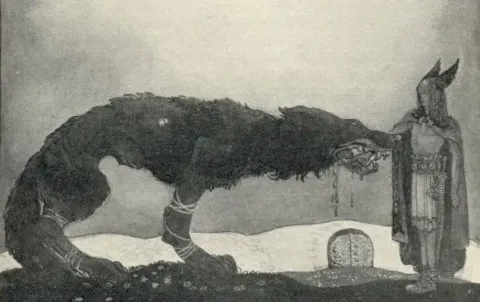
Image: John Bauer, Tyr and Fenrir (1911). Public Domain. Via Wikimedia Commons.
Who Was Tyr in Norse Mythology?
Tyr, or Týr in Old Norse, was one of the Æsir, the principal group of gods in Norse mythology.
The Prose Edda describes him as exceptionally bold and also associates him with wisdom. Although he appears less often in the surviving myths than gods such as Odin or Thor, the episodes that remain give him a distinctive identity.
Tyr is recognizable as the one-handed god, but his mythology extends beyond that famous injury. He appears in Eddic poetry, is invoked in connection with victory, travels with Thor in Hymiskviða, exchanges insults with Loki in Lokasenna, and fights at Ragnarök.
His surviving stories are relatively few, yet together they present a god closely associated with courage, duty and martial authority.
What Was Tyr the God Of?
Tyr was most clearly associated with war, victory and courage.
The surviving Norse sources connect him with success in battle and portray him as exceptionally brave. His mythology also gives unusual weight to duty and personal risk, especially in the story of Fenrir.
Modern accounts often add law, justice and order to his domains. That description has some basis in wider Germanic evidence, but it is less explicit in the Eddic texts than his connection with warfare and victory.
Tyr is therefore best described as a Norse god of war and victory strongly associated with courage and duty, with a possible broader connection to law and public order.
Was Tyr Really a God of Law and Justice?
Tyr is often called a god of law and justice, but the surviving Norse texts do not assign him that role as explicitly as they connect him with warfare and courage.
Much of the argument comes from wider Germanic evidence. Roman-period inscriptions referring to Mars Thingsus have been linked with the Thing, the assembly where communities handled legal, political and public affairs. Some scholars have connected this figure with Tyr.
The identification is not certain. Both the meaning of the title and its direct connection with Tyr have been debated, so Mars Thingsus cannot by itself prove that Tyr held a formal role as a god of law.
The Norse myths offer a looser thematic connection. Tyr is associated with duty, obligation and accepting the consequences of a pledge, most famously when he places his hand in Fenrir’s mouth.
That makes a connection with order and obligation plausible, but it is more accurate to treat Tyr’s legal role as a scholarly reconstruction than as a title clearly stated in the Eddas.
Why Did Tyr Lose His Hand? The Binding of Fenrir
Tyr lost his hand during the gods’ attempt to bind Fenrir, the giant wolf they feared would eventually become impossible to control.
Fenrir had already broken earlier chains, so the gods turned to Gleipnir, a magical restraint made by the dwarfs. It looked thin and harmless, which immediately made the wolf suspicious.
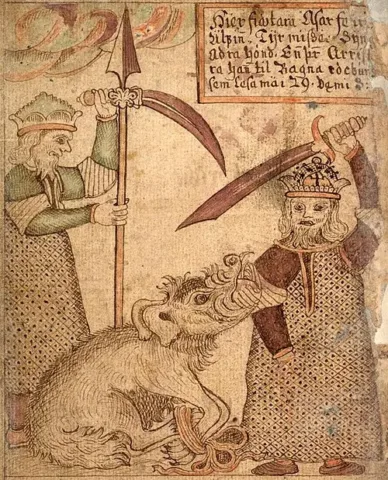
Fenrir agreed to be bound only if one of the gods placed a hand in his mouth as a guarantee that he would be released if he could not break free.
Only Tyr accepted the risk.
Once Gleipnir held and Fenrir realized the gods had deceived him, he bit off Tyr’s hand.
The gods succeeded in restraining Fenrir, but Tyr alone paid the physical price for the plan. He did not lose his hand in ordinary combat; he knowingly placed it in danger because the binding could not succeed without someone Fenrir was willing to trust.
What Tyr’s Sacrifice Actually Meant
Tyr’s sacrifice is more complicated than a simple act of bravery.
He knows the gods are deceiving Fenrir, yet he also knows that the plan will fail unless someone makes their promise believable. By placing his hand in the wolf’s mouth, Tyr becomes the guarantee on which the deception depends.
That gives the episode an uncomfortable moral edge. Tyr accepts the consequences of a promise the gods themselves do not intend to honor.
He does not defeat Fenrir or gain anything from the encounter. His role is to bear the cost of a decision the gods believe is necessary.
The missing hand therefore becomes a lasting symbol of courage, duty and personal responsibility.
Tyr as a God of War and Victory
Tyr’s connection with warfare is one of the clearest parts of his surviving mythology.
In the Prose Edda, he is described as a courageous god associated with victory in battle. The Poetic Edda reinforces that connection in Sigrdrífumál, where a warrior is instructed to carve victory-runes on a sword and invoke Tyr.
That does not make Tyr identical to Odin, who is also strongly connected with war. Odin’s martial role extends to kingship, the chosen dead and the fate of warriors, while Tyr is more directly associated with combat, courage and victory.
The surviving evidence therefore supports calling Tyr a god of war and victory, but not treating him as the only or universal Norse god of battle.
Tyr and the Tiwaz Rune
Tyr’s name is closely connected with the Tiwaz rune (ᛏ), the rune representing the sound t in the Elder Futhark.
The association becomes especially important in Sigrdrífumál, where a warrior seeking victory is instructed to carve victory-runes on a sword and invoke Tyr twice. The passage links his name directly with weapons, battle and victory.
That does not mean every appearance of the Tiwaz rune was a prayer to Tyr. Runes also functioned as ordinary writing signs, and their use varied across periods and contexts.
What the passage does show is that Tyr’s connection with victory extended beyond stories about the god himself and into a ritual setting involving runes and weapons.
Why Tuesday Is Named After Tyr
The English word Tuesday preserves Tyr’s name.
It comes from Old English Tīwesdæg, meaning “Tiw’s day.” Tiw was the Old English form of the Germanic divine name represented in Old Norse as Týr.
The weekday was named as a Germanic equivalent of the Latin dies Martis, “day of Mars.” Because Mars was associated with war, Germanic speakers substituted a corresponding deity from their own tradition.
Related weekday names also appeared elsewhere in the Germanic world, including Old Norse forms based on Tyr’s name.
Tuesday therefore preserves an old Germanic form of Tyr’s name in everyday language, long after the religious tradition in which the god was worshipped had disappeared.
Tyr and Thor in Hymiskviða
Tyr appears in Hymiskviða alongside Thor during the search for a huge cauldron needed by the gods.
When the gods need a vessel large enough for Ægir to brew ale, Tyr tells Thor that Hymir owns one of extraordinary size. The two travel together to Hymir’s hall, where Tyr is treated as part of the household.
Most of the action belongs to Thor, who later proves strong enough to carry the enormous cauldron away. Tyr tries to move it twice and fails, while Thor lifts it himself.
The episode is useful because it shows Tyr outside his famous Fenrir story. Here he appears as Thor’s companion and as the figure who knows where the gods can find the vessel they need.
Read More
Who Were Tyr’s Parents?
Tyr’s parentage is not consistent across the surviving Norse sources.
In Hymiskviða, Hymir is presented as Tyr’s father, placing the god within a giant household.
Snorri Sturluson preserves a different tradition. In Skáldskaparmál, Tyr is described as a son of Odin.
The contradiction cannot be resolved with certainty. It may preserve different traditions that existed side by side or reflect later reshaping of older material.
The most accurate answer is therefore that Tyr has two competing parentage traditions in the surviving sources: Hymir in Hymiskviða and Odin in Snorri’s Prose Edda.
Tyr and Loki in Lokasenna
Tyr also appears in Lokasenna, the Eddic poem in which Loki insults the gods one after another during a feast.
When Tyr speaks against him, Loki immediately targets his missing hand. He mocks Tyr for losing it to Fenrir, turning the wound into a source of humiliation rather than heroism.
Tyr answers by reminding Loki that Fenrir remains bound and will stay restrained until Ragnarök.
The exchange is brief, but it shows how closely Tyr’s identity had become tied to the loss of his hand. In Lokasenna, the wound is not treated as a noble symbol but as something Loki can use against him.
How Does Tyr Die at Ragnarök?
Tyr dies during Ragnarök, the final battle of the gods.
In the Prose Edda, he faces Garmr, the great hound bound before Gnipahellir. When the final battle begins, Garmr is released and meets Tyr in combat.
Their fight ends with both of them dead. Snorri states that Tyr and Garmr become each other’s slayers.
The scene is brief compared with the deaths of Odin or Thor, but it gives Tyr a clear place in the final battle: he meets one of the unleashed monsters directly and dies fighting it.
Was Tyr Once a More Important Germanic God?
Tyr appears only occasionally in the surviving Norse myths, yet his name points to a much older Germanic background.
Old Norse Týr is related to the Proto-Germanic name usually reconstructed as Tīwaz and ultimately belongs to an Indo-European family of words connected with divinity. Related forms, including Old English Tiw, show that the name was known far beyond medieval Scandinavia.
This wider distribution has led some scholars to suggest that Tyr may once have held a more prominent position in Germanic religion, possibly before Odin became dominant in later Norse tradition.
That remains a hypothesis. The age and spread of Tyr’s name do not prove that he was once the supreme god, nor do the surviving myths preserve a clear transfer of authority from Tyr to Odin.
What they do suggest is that the relatively small role Tyr plays in the Eddas may represent only the later surviving form of a much older deity.
What Tyr Represents in Norse Mythology
Tyr’s surviving myths give him a remarkably consistent character despite their small number.
He is associated with war and victory, but his importance lies just as much in the qualities attached to action: courage, duty, discipline and the willingness to accept consequences.
Unlike gods defined mainly by overwhelming strength, magic or rulership, Tyr is remembered through choices that carry a personal cost.
That makes him difficult to reduce to a simple label such as “god of war.” His mythology presents a figure defined by resolve and responsibility as much as by combat.
Tyr therefore occupies a distinctive place in the Norse pantheon: a god of war, courage and duty, remembered above all for acting when the cost of action falls on himself.
Academic Sources
This article draws on primary Old Norse texts and modern academic scholarship
on Tyr, Germanic religion, runes, warfare and the Norse pantheon.
- Snorri Sturluson. Faulkes, Anthony, ed. (2005).
Edda: Prologue and Gylfaginning. Second edition.
Viking Society for Northern Research.
Primary source for Tyr’s character, the binding of Fenrir, his lost hand,
and his death fighting Garmr at Ragnarök.
- Snorri Sturluson. Faulkes, Anthony, ed. (1998).
Edda: Skáldskaparmál.
Viking Society for Northern Research.
Critical edition useful for Tyr’s place among the gods and the alternative
tradition that identifies him as a son of Odin.
- Larrington, Carolyne, trans. (2014).
The Poetic Edda. Revised edition.
Oxford World’s Classics, Oxford University Press.
Modern scholarly translation containing Hymiskviða,
Lokasenna and Sigrdrífumál, important for Tyr’s
parentage, his exchange with Loki, and his association with victory-runes.
- Lindow, John (2002).
Norse Mythology: A Guide to the Gods, Heroes, Rituals, and Beliefs.
Oxford University Press.
Major academic reference for Tyr’s mythology, his role among the Æsir,
Fenrir, Ragnarök and the wider interpretation of Norse divine figures.
- Simek, Rudolf (1993).
Dictionary of Northern Mythology.
Translated by Angela Hall. D. S. Brewer.
Scholarly reference for Tyr/Tiwaz, Germanic religious traditions,
linguistic evidence and comparisons beyond the medieval Icelandic sources.