Jörmungandr: The World Serpent and Thor’s Fated Enemy
Jörmungandr, also known as the Midgard Serpent or World Serpent, is a giant sea serpent in Norse mythology and one of Thor’s deadliest enemies. According to Snorri Sturluson’s Gylfaginning, he is the son of Loki and the giantess Angrboða, and the brother of Fenrir and Hel. Fearing the destruction foretold through Loki’s children, Odin cast Jörmungandr into the ocean, where he grew large enough to encircle Midgard and bite his own tail.
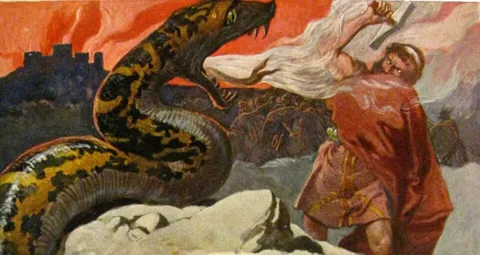
Thor encounters the serpent during a fishing expedition with the giant Hymir. Using an ox head as bait, he hooks Jörmungandr and pulls him toward the surface. The surviving accounts differ over how this confrontation ends.
At Ragnarök, their final battle has a fatal outcome for both. Thor kills Jörmungandr, but walks only nine steps before collapsing from the serpent’s venom.
Who Was Jörmungandr in Norse Mythology?
Jörmungandr is not counted among the Æsir or Vanir gods. Unlike many figures in Norse mythology, he has no surviving stories told from his own perspective. The sources reveal little about his motives or personality, portraying him mainly through his enormous size, deadly venom, and confrontations with Thor.
What Does the Name Jörmungandr Mean?
The Old Norse name Jörmungandr (Jǫrmungandr) is commonly interpreted as “Great Monster.” Its first element, jǫrmun-, means “great” or “immense,” while the second, gandr, has a less certain meaning. It can refer to a staff, a magical object, or a supernatural being, making “Great Monster” a conventional interpretation rather than an exact translation.
The serpent is also known as Miðgarðsormr, meaning “Midgard Serpent.” The name combines Miðgarðr, the world inhabited by humans, with ormr, meaning “serpent” or “snake.” Unlike Jörmungandr, this name directly describes the creature through its connection to Midgard.
Who Were Jörmungandr’s Parents and Siblings?
According to Gylfaginning, Loki and the giantess Angrboða had three children together in Jötunheimr: Jörmungandr, the wolf Fenrir, and Hel, who later became ruler of a realm of the dead.
The gods feared the three children because prophecies warned of the destruction they could bring. Their stories, however, took different paths. Fenrir was eventually bound by the Æsir, while Hel received authority over the dead who entered her realm. Jörmungandr was sent into the surrounding ocean, where he would grow beyond the gods’ expectations.
Why Did Odin Throw Jörmungandr into the Sea?
In Gylfaginning, Odin orders Loki and Angrboða’s three children brought from Jötunheimr after the gods learn of prophecies warning that they will bring great harm. Their parentage also troubles the gods, but the warnings about their future are the main reason Odin decides to act.
He casts Jörmungandr into the deep sea surrounding the inhabited lands. Snorri does not explain why Odin chooses this fate rather than killing the serpent. The attempt to remove the threat proves ineffective, as Jörmungandr continues to grow beneath the waves.
How Could Jörmungandr Encircle the World?
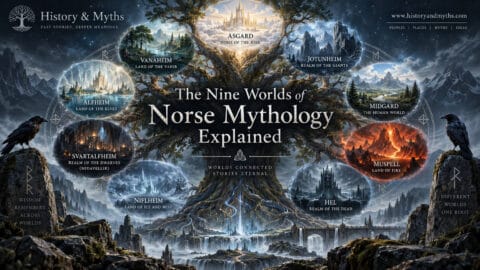
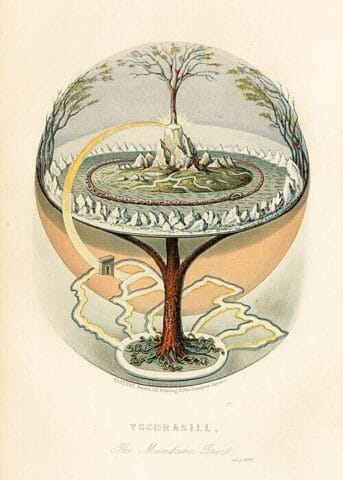
In Gylfaginning, the inhabited world is surrounded by a vast ocean. Jörmungandr grows within these waters until his body stretches around the land and he can grasp his own tail in his mouth.
The description belongs to Norse mythical geography, not a modern astronomical picture of a serpent wrapped around a planet. The text offers no physical explanation for his extraordinary growth, nor does it describe him as holding the world together. His immense size is simply part of how the myth portrays him.
Why Were Thor and Jörmungandr Enemies?
The surviving Norse myths do not describe a personal feud between Thor and Jörmungandr or identify a particular event that began their hostility.
Thor is frequently portrayed fighting giants and other dangerous beings, while Jörmungandr is one of Loki’s children whose future actions threaten the gods. Their conflict reflects these opposing roles rather than a dispute over revenge or personal betrayal.
Thor and Jörmungandr: The Cat at Útgarða-Loki
During Thor’s visit to the giant Útgarða-Loki, he was challenged to lift a large gray cat from the floor. His host claimed that even young boys could manage the feat.
Thor placed his hand beneath the cat’s belly and tried to raise it. The animal arched its back as he lifted, forcing him to stretch higher. Despite his efforts, Thor managed to lift only one of its paws off the ground.
The following morning, Útgarða-Loki revealed that the contest had been an illusion. The cat was actually Jörmungandr, the serpent encircling Midgard. Thor had lifted part of its enormous body, a feat that terrified the giants watching him.
Thor’s Fishing Trip with Hymir
In Hymiskviða, Thor joins the giant Hymir on a fishing expedition. While Hymir catches two whales, Thor uses an ox head as bait and insists on rowing farther out to sea, despite the giant’s fear of the Midgard Serpent.
When Jörmungandr takes the bait, Thor pulls the enormous serpent toward the boat and strikes its head with Mjölnir. The earth shakes, and the creature sinks beneath the waves.
Snorri Sturluson tells the encounter differently in Gylfaginning. As Thor struggles with the serpent, he braces himself so powerfully that his feet break through the boat’s hull. Jörmungandr rises toward him, glaring and spewing venom. Just as Thor raises his hammer, the terrified Hymir cuts the fishing line, allowing the serpent to sink back into the sea. Thor hurls Mjölnir after it, then punches Hymir overboard and wades ashore.
Did Thor Kill Jörmungandr Before Ragnarök?
Hymiskviða describes Thor striking the serpent with his hammer, but does not explicitly state whether the blow killed it.
In Gylfaginning, Snorri acknowledges a tradition claiming that Thor severed the serpent’s head beneath the waves. He rejects that account, insisting that Jörmungandr remained alive in the surrounding ocean.
The fishing encounter also appears in older skaldic poetry attributed to Bragi Boddason and Úlfr Uggason. These verses show that the story circulated before Snorri, although they do not establish a single undisputed ending.
In the surviving accounts of Ragnarök, Jörmungandr’s death comes during his final confrontation with Thor.
Jörmungandr at Ragnarök
At Ragnarök, Jörmungandr rises from the ocean, sending seawater onto the land. In Gylfaginning, Snorri Sturluson describes the serpent spreading venom through the air and water before joining the enemies of the gods on the battlefield of Vígríðr.
Thor faces Jörmungandr while Odin fights Fenrir. Unable to help his father, Thor kills the serpent but takes only nine steps before collapsing from its venom.
Völuspá also describes Thor’s final confrontation with the serpent and his death after nine steps, although the poem does not explicitly identify venom as the cause.
Was Jörmungandr Depicted in Viking-Age Art?
Yes. Several Viking-Age stone carvings depict Thor’s fishing encounter with Jörmungandr, showing that the story was known centuries before Snorri recorded his account.
The eleventh-century Altuna Runestone (U 1161) in Sweden shows Thor holding his hammer and fishing line, with one foot breaking through the boat’s hull as he struggles with the serpent.
In Denmark, the Hørdum Picture Stone depicts Thor and another figure, generally identified as Hymir, holding a tool often interpreted as an axe intended to cut the fishing line. The Gosforth Fishing Stone in northern England also shows the fishing expedition, including the ox-head bait.
These carvings preserve recognizable details of the myth independently of Snorri’s written account.
Jörmungandr in the Poetic Edda and Prose Edda
Jörmungandr’s story survives in separate Old Norse poems and prose accounts rather than a single continuous narrative. In the Poetic Edda, Hymiskviða recounts Thor’s fishing expedition, while Völuspá describes their final encounter at Ragnarök.
Snorri Sturluson’s thirteenth-century Gylfaginning provides additional details about the serpent’s origins and the episode at Útgarða-Loki. Earlier skaldic verses attributed to Bragi Boddason and Úlfr Uggason, preserved in Skáldskaparmál, also describe Thor’s fishing encounter.
What Did Jörmungandr Represent?
Jörmungandr’s position in the ocean surrounding Midgard places him at the edge of the inhabited world. His emergence at Ragnarök accompanies its destruction, but the surviving Norse texts do not assign him a clearly defined religious function or explicitly identify him as a god of chaos.
His image resembles the ouroboros, a serpent biting its own tail. However, the Norse sources do not associate Jörmungandr explicitly with infinity, eternal renewal, or the cycle of life and death. Those interpretations cannot be established from the Eddas.
Conclusion
Jörmungandr’s encounters with Thor survive in medieval Norse texts and earlier Viking-Age carvings. Although the sources differ over the outcome of their fishing encounter, the Ragnarök tradition ends with Thor killing the World Serpent before dying from its venom.
Academic Sources & Primary Texts
This article draws on medieval Old Norse texts, modern academic scholarship, and archaeological evidence. The sources below distinguish the surviving mythological narratives from later interpretations.
Primary Old Norse Sources
- The Poetic Edda. Translated by Carolyne Larrington. Revised edition, Oxford University Press, 2014.
Hymiskviða preserves Thor’s fishing expedition, while Völuspá describes his final encounter with the World Serpent at Ragnarök.
Oxford University Press - Snorri Sturluson. Edda: Prologue and Gylfaginning. Edited by Anthony Faulkes. Second edition, Viking Society for Northern Research, University College London, 2005.
Primary source for Jörmungandr’s origins, the episode at Útgarða-Loki, Thor’s fishing expedition, and Ragnarök.
Viking Society for Northern Research - Snorri Sturluson. Edda: Skáldskaparmál. Edited by Anthony Faulkes. Viking Society for Northern Research, 1998.
Preserves earlier skaldic poetry, including verses attributed to Bragi Boddason and Úlfr Uggason concerning Thor’s encounter with the serpent.
Scholarly Edition
Academic Studies & Archaeological Evidence
- John Lindow. “Old Norse Mythology as Sacred Narrative: Þórr’s Fishing Expedition.” In Old Norse Mythology, pp. 65–102. Oxford University Press, 2021.
A detailed scholarly comparison of the Eddic and skaldic versions of Thor’s encounter with Jörmungandr, including Viking-Age visual evidence.
Oxford Academic - John Lindow. Norse Mythology: A Guide to the Gods, Heroes, Rituals, and Beliefs. Oxford University Press, 2002.
A scholarly reference for Norse mythological figures, traditions, cosmology, and terminology.
Oxford University Press - Rudolf Simek. Dictionary of Northern Mythology. Translated by Angela Hall. D. S. Brewer, 1993.
A specialist reference for names, mythological traditions, and concepts in pre-Christian Germanic religion.
Boydell & Brewer - Lilla Kopár. The Iconography of Viking-Age Stone Sculptures: Visual Evidence of Religious Accommodation in the Anglo-Scandinavian Communities of Northern England. Doctoral dissertation, University of Szeged, 2003.
Examines Viking-Age mythological imagery, including representations of Thor’s fishing expedition.
University Repository (PDF) - Lesley Abrams. “Locations of Religious Encounter: The Scandinavian Diaspora in the Viking Age.” Studies in Church History, vol. 61, 2025, pp. 142–167.
Discusses Scandinavian religious imagery in northern England, including the Gosforth carving of Thor fishing for the World Serpent.
Cambridge University Press
Source Note: The surviving Norse texts preserve different versions of some events, particularly the outcome of Thor’s fishing expedition. Where accounts disagree, this article distinguishes the original evidence from later scholarly interpretation.