Idunn: The Norse Goddess Who Kept the Gods Young
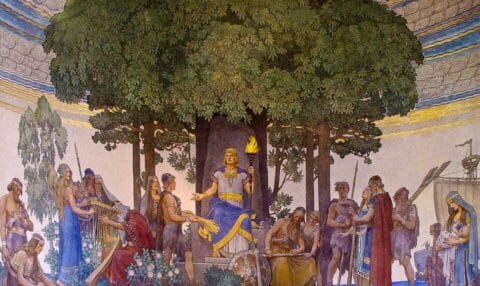
Idunn (Old Norse Iðunn) is the Norse goddess who guards the apples that preserve the gods’ youth. According to the Prose Edda, the Æsir eat her apples when they begin to age, restoring their youth. The fruit cannot, however, protect them from death.
Her best-known myth begins when Loki tricks her into leaving Asgard, allowing the giant Þjazi to abduct her. Without Idunn, the gods begin to grow old. They discover Loki’s involvement and force him to rescue her, revealing how much their continued youth depends on the goddess and her apples.
Who Was Idunn in Norse Mythology?
Idunn, also spelled Idun or Iduna, belongs to the Ásynjur, the goddesses of the Æsir. Her name is often interpreted as “the rejuvenating one” or “ever young,” although its precise etymology remains uncertain.
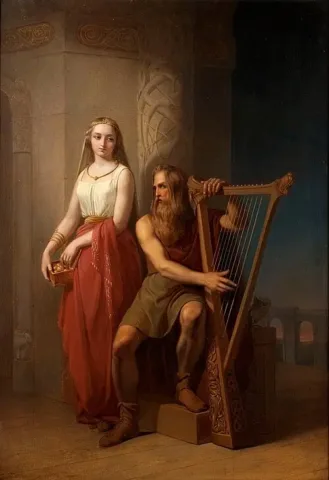
She is married to Bragi, the god associated with poetry and eloquence. Their relationship is mentioned in the Prose Edda and Lokasenna, where Idunn attempts to calm her husband during an argument with Loki.
Unlike several prominent Norse deities, Idunn has no well-established genealogy in the surviving sources. Her parents and birthplace are unknown, and the texts preserve few stories about her beyond the famous abduction.
What Were Idunn’s Apples of Youth?
In Gylfaginning, chapter 26 of the Prose Edda, Snorri Sturluson describes Idunn keeping her apples in a chest made of ash wood. When the gods grow old, eating the fruit restores their youth.
Snorri gives no fixed schedule for eating the apples, nor does he describe them as golden, despite that familiar detail in modern retellings. Their power lasts until Ragnarök, but it cannot prevent the deaths foretold during that final conflict.
The apples protect the gods against aging, not against fate.
How Did Loki Betray Idunn?
In Skáldskaparmál, Odin, Hœnir, and Loki are travelling together when they slaughter an ox and attempt to cook it. The meat refuses to roast. An eagle perched in a nearby tree claims responsibility and agrees to let it cook in exchange for a share.
When the eagle takes an excessive portion, Loki strikes it with a wooden pole. The pole sticks to the bird, and Loki cannot release his grip. As the eagle flies away, it drags him over rocks and trees until he begs to be freed.
The eagle is Þjazi, a jötunn who demands that Loki bring Idunn and her apples outside Asgard. Loki agrees to the bargain.
Later, Loki tells Idunn that he has found unusual apples in a nearby forest. He persuades her to bring her own so they can compare them. Once she follows him outside Asgard, Þjazi arrives in eagle form, seizes her, and carries her to his home in Þrymheimr.
What Happened When Idunn Disappeared?
Without Idunn and her apples, the Æsir began to grow old and grey. Alarmed by her disappearance, they assembled at a thing, a formal council, to determine what had happened. They learned that she had last been seen leaving Asgard with Loki.
The gods seized Loki and threatened him with death or torture unless he brought her back. He agreed to recover Idunn from Jötunheimr, provided Freyja lent him her falcon plumage.
How Did Loki Rescue Idunn?
Using Freyja’s falcon plumage, Loki flew to Þrymheimr, where Þjazi lived. The giant had gone rowing at sea, leaving Idunn alone. Loki transformed her into a nut, took her in his claws, and flew toward Asgard.
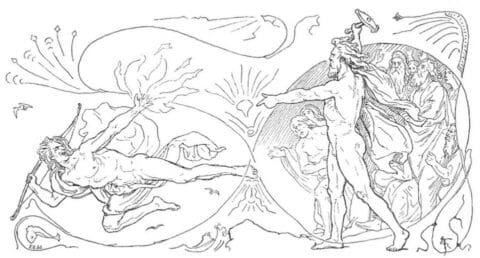
When Þjazi returned and discovered she was gone, he changed into an eagle and pursued them. His enormous wings made a thunderous noise as he flew after Loki.
The Æsir saw the falcon approaching with the eagle close behind. They piled wood shavings beside Asgard’s walls and waited.
Loki flew inside the stronghold. As Þjazi followed, the gods set the shavings alight. The eagle could not stop in time, and the flames caught his feathers, bringing him down. The Æsir killed him inside Asgard’s gates.
What Happened After Þjazi’s Death?
After Þjazi was killed, his daughter Skaði arrived in Asgard wearing armour and carrying weapons, determined to avenge him. The Æsir offered compensation instead of fighting her.
Skaði agreed to choose a husband from among the gods, but she could see only their feet. She selected a pair she believed belonged to Baldr, only to discover that she had chosen Njörðr.
She also demanded that the gods make her laugh. Loki accomplished this through a painful tug-of-war with a goat, tying a rope between its beard and his own genitals. He eventually fell into Skaði’s lap, making her laugh.
Odin added a final gesture of compensation by placing Þjazi’s eyes in the sky as two stars, completing the reconciliation.
Idunn in the Poetic Edda: Lokasenna
Idunn appears in stanzas 16–18 of Lokasenna, a poem in which Loki exchanges insults with the gods during a feast hosted by Ægir.
When the argument between Loki and Bragi grows heated, Idunn urges her husband to stop insulting Loki. Loki turns on her, accusing her of embracing the man who killed her brother.
The accusation refers to events unknown from any other surviving Norse source. Neither Idunn’s brother nor his alleged killer can be identified, and the poem offers no explanation.
Idunn does not answer the accusation. She tells Loki that she is trying to calm Bragi, who has become heated with drink, because she does not want the quarrel to turn into a fight.
Read More: Norse Gods & Mythology
Loki in Norse Mythology: Trickster, Shapeshifter, Enemy of the Gods
Explore Loki’s complicated role among the Æsir, from his dangerous bargains and transformations to his eventual conflict with the gods.
Njord: Norse God of the Sea, Wealth and Seafaring
Discover the sea god who married Skaði after the death of her father, Þjazi, and why their marriage could not last.
Ragnarök Explained: How the Norse World Ends and What Comes After
Learn why even the gods whose youth Idunn preserves cannot escape the fate awaiting them at Ragnarök.
Was Idunn a Goddess of Spring and Fertility?
Idunn is often described as a goddess of spring and fertility because of her association with youth and renewal. The surviving Old Norse sources, however, do not assign her responsibility for the seasons, agricultural growth, or childbirth.
Apples also appear in Skírnismál, where Skírnir offers Gerðr eleven golden apples while seeking her acceptance of Freyr’s marriage proposal. The poem does not connect these fruits with Idunn or explain them as fertility symbols.
Her established mythological role concerns the rejuvenation of the gods. Any broader association with spring or fertility remains a later interpretation.
What Do the Old Norse Sources Tell Us About Idunn?
Three Old Norse works provide most of the surviving evidence about Idunn, although they differ in age, literary form, and detail.
Haustlöng, attributed to Þjóðólfr of Hvinir and generally dated to the late ninth or early tenth century, preserves the earliest surviving poetic account of her abduction. It describes Idunn as possessing the gods’ remedy against old age. Its verses survive because Snorri Sturluson quoted them centuries later in Skáldskaparmál.
Snorri’s thirteenth-century Prose Edda provides a fuller prose narrative. Gylfaginning describes the apples kept in Idunn’s chest, while Skáldskaparmál recounts her abduction and rescue. Some details in Snorri’s account are not independently preserved in the earlier poetry.
Lokasenna, preserved in the Poetic Edda, presents Idunn speaking during a quarrel involving Loki and Bragi. It makes no reference to her apples or kidnapping.
These texts preserve different aspects of Idunn’s mythology, but none offers a detailed account of her worship.
Why Was Idunn Important to the Norse Gods?
Idunn’s importance becomes most apparent through her absence. Even Odin, Thor, and the other Æsir cannot replace the apples she guards. Their strength offers no solution to aging, and recovering the goddess becomes essential to restoring their youth.
Unlike the warrior gods who dominate many Norse myths, Idunn holds no weapon or command over armies. Yet her role is indispensable to Asgard, showing that divine power does not always depend on strength or authority.
Academic Sources & Historical References
This article draws on original Old Norse texts, critical scholarly editions, and academic research into Iðunn, her rejuvenating apples, and the surviving accounts of her abduction.
Primary Sources & Critical Editions
Snorri Sturluson, edited by Anthony Faulkes (2005)
Edda: Prologue and Gylfaginning
Viking Society for Northern Research, second edition. Chapter 26 describes Iðunn’s chest of apples and their role in restoring the gods’ youth.
Snorri Sturluson, edited by Anthony Faulkes (1998)
Edda: Skáldskaparmál
Viking Society for Northern Research. The principal prose account of Loki’s bargain with Þjazi, Iðunn’s abduction and rescue, and Skaði’s subsequent demand for compensation.
Þjóðólfr of Hvinir, edited and translated by Richard North (1997)
The Haustlǫng of Þjóðólfr of Hvinir
Hisarlik Press. A scholarly edition and translation of the early skaldic poem preserving the abduction of Iðunn and references to the gods’ remedy against old age.
Carolyne Larrington (2014)
The Poetic Edda
Oxford University Press, revised edition. Contains translations of Lokasenna, including Iðunn’s exchange with Loki and Bragi, and Skírnismál, which mentions eleven golden apples offered to Gerðr.
Skaldic Poetry of the Scandinavian Middle Ages
Þjóðólfr of Hvinir: Poems and Haustlǫng
Academic database of Old Norse skaldic poetry, providing edited poetic texts, attribution, dating information, and scholarly commentary on the surviving verses.
Academic Studies & Reference Works
Maria Cristina Lombardi (2022)
Ageing and Myths of Rejuvenation: Iðunn’s Apples and Springs of Youth in Old Norse Literature
Annali, Sezione Germanica, 32, pp. 139–158. A peer-reviewed study examining rejuvenation, the symbolism of Iðunn’s apples, and the wider literary treatment of aging and renewed youth.
John Lindow (2002)
Norse Mythology: A Guide to the Gods, Heroes, Rituals, and Beliefs
Oxford University Press. An authoritative reference work on Norse deities, mythological narratives, religious concepts, and the evidence preserved in medieval Scandinavian literature.
Rudolf Simek (1993)
Dictionary of Northern Mythology
Translated by Angela Hall. D. S. Brewer. A reference work covering Old Norse mythological names, deities, literary attestations, and historical interpretations.
John Lindow (2021)
Old Norse Mythology
Oxford University Press. A modern scholarly overview of the Old Norse mythological tradition, its surviving sources, divine figures, and the interpretation of mythology preserved in medieval Icelandic texts.
Research Note
The surviving sources differ in age and detail. Haustlǫng preserves an early poetic account of Iðunn’s abduction, while Snorri’s Prose Edda provides the fuller narrative and explicitly describes her rejuvenating apples. Lokasenna records a separate exchange involving Iðunn and Bragi. Claims about golden apples, spring festivals, fertility, or immortality are treated with caution where the Old Norse texts do not establish them.
Copyright Notice
© 2026 History & Myths. All rights reserved. The original written content of this article is protected by copyright. Unauthorized reproduction or republication of substantial portions is not permitted, except as allowed by applicable law.
Ancient Norse texts, scholarly references, and third-party images remain subject to their respective rights and licenses. Sources are acknowledged for research and educational purposes.