Baldr: The Shining God Whose Death Changed the Norse World
Baldr is one of the most tragic figures in Norse mythology, a son of Odin and Frigg whose death becomes one of the great turning points in the story of the gods.
He is remembered as a radiant and beloved figure whose ominous dreams foreshadow a fate the gods cannot prevent. Frigg tries to protect him from harm, but a single exception, mistletoe, becomes the weapon that kills him.
Baldr is often called the Norse god of light, yet the surviving sources are less precise. They describe him as bright and shining, while his greater importance lies in his death, the failed attempt to recover him from Hel, and his eventual return after Ragnarök.
Who Was Baldr?
Baldr is one of the Æsir. In Snorri Sturluson’s Gylfaginning, he is described as exceptionally fair, radiant, wise, and gracious.
His home is Breiðablik, a hall where nothing unclean can exist. He is also the husband of Nanna and the father of Forseti.
Unlike gods remembered mainly for battles or great feats, Baldr is defined above all by the fate that overtakes him and by what his loss means for the other gods.
Was Baldr Really the Norse God of Light?
Baldr is often called the Norse god of light, but the surviving sources do not give him that title as a formal divine role.
In Gylfaginning, Snorri describes him as exceptionally beautiful and radiant, saying that light shines from him. His hall, Breiðablik, also fits this image.
That supports describing Baldr as shining or radiant, but it does not prove that light was a defined religious domain attached to him.
So “god of light” is useful modern shorthand, while “shining god” is closer to what the medieval texts actually describe.
Baldr’s Dreams Foretell His Death
Before Baldr dies, the gods are already warned that something is wrong.
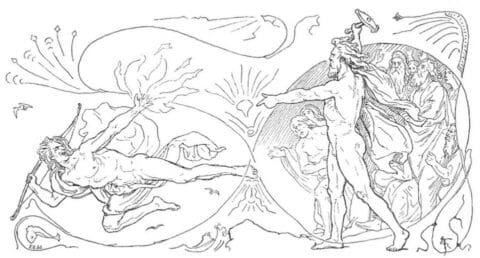
In Baldrs draumar (“Baldr’s Dreams”), Baldr begins having ominous dreams that trouble the Æsir. Odin saddles Sleipnir and rides to Niflhel to discover what they mean.
There he raises a dead seeress and questions her about what is being prepared in Hel. Her answer is clear: mead has already been brewed for Baldr, revealing that his death is approaching.
The poem therefore presents Baldr’s fate as something foreseen before the mistletoe episode. Odin can seek knowledge of what is coming, but he cannot prevent it.
Why Could Nothing Harm Baldr?
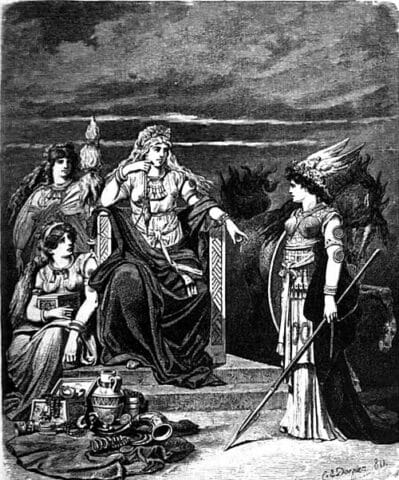
After Baldr’s troubling dreams, Frigg tries to protect him from the fate they seem to predict.
In Gylfaginning, she takes oaths from fire, water, metals, stones, earth, trees, sickness, animals, birds, venom, and serpents, requiring them not to harm her son.
When the gods discover that nothing can injure Baldr, they begin throwing weapons and other objects at him for amusement.
One thing has been overlooked: mistletoe. Frigg considers it too young and harmless to demand an oath from it.
Baldr is therefore not naturally invulnerable. His protection depends on the promises Frigg has secured, and mistletoe remains outside them.
How Did Baldr Die?
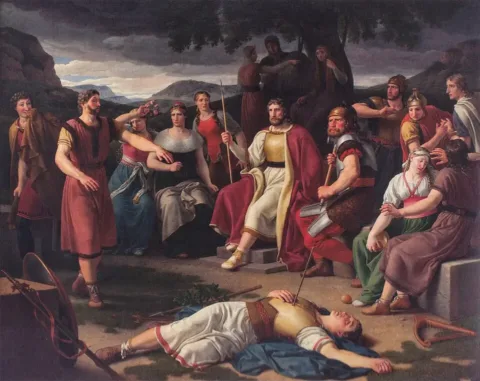
In Snorri’s Gylfaginning, Loki learns that mistletoe is the one thing that has not sworn to spare Baldr. He obtains a piece of it and brings it to the gathering where the gods are testing Baldr’s protection.
Baldr’s blind brother Höðr stands apart because he cannot see where Baldr is and has no weapon. Loki gives him the mistletoe and guides his aim.
Höðr throws it, and Baldr falls dead.
The older Völuspá also connects Baldr’s death with mistletoe and Höðr, showing that both elements belonged to the tradition before Snorri’s fuller prose account.
In Snorri’s version, the responsibility is divided clearly: Höðr delivers the fatal blow, while Loki plans the killing and makes it possible.
The Funeral of Baldr
Baldr’s funeral is one of the most elaborate scenes in Gylfaginning.
The gods place his body on Hringhorni, described as the greatest of all ships. When they cannot move it, they summon the giantess Hyrrokkin, who launches the vessel with enormous force.
Baldr’s wife, Nanna, dies from grief and is placed beside him on the funeral pyre. Odin adds his ring Draupnir, and Baldr’s horse is burned with him.
Before the ship is set alight, Thor consecrates the pyre with Mjölnir.
The scale of the funeral reflects Baldr’s status among the Æsir. His death is treated as a loss shared by the whole divine community.
Baldr’s death also demands vengeance. In Baldrs draumar, Rindr bears Váli, a son of Odin, who avenges Baldr by killing Höðr. The poem presents Váli as fulfilling this role almost immediately, adding another layer to the cycle of death and retaliation surrounding Baldr.
Why Could Baldr Not Return from Hel?
After the funeral, Hermóðr rides Sleipnir to Hel in an attempt to bring Baldr back.
Hel agrees to release him on one condition: everything in the world, living and dead, must weep for him. Nearly everything does.
The attempt fails because one figure refuses. A giantess named Þökk says she will weep only dry tears and tells Hel to keep Baldr.
Snorri adds that Þökk was believed to be Loki in disguise, although the text does not present her openly revealing herself as Loki.
Because the condition is not fulfilled, Baldr remains in Hel until after Ragnarök.
Did Baldr’s Death Cause Ragnarök?
Baldr’s death is one of the clearest signs that the divine order is beginning to fail, but the surviving sources do not present it as the single event that directly causes Ragnarök.
In Völuspá, his death comes before the later disasters that lead toward Ragnarök, including vengeance for Höðr’s role and the wider breakdown of the world.
Snorri likewise treats Baldr’s death as a devastating loss, but Ragnarök develops through a much larger chain of events involving Loki, Fenrir, broken bonds, cosmic disorder, and the final battle.
Baldr’s death therefore marks a major break in the old divine order rather than directly triggering Ragnarök by itself.
Read More
Frigg: Norse Goddess, Queen of Æsir, Wife of Odin, Mother of Baldr
Loki in Norse Mythology: Trickster, Shapeshifter, Enemy of the Gods
Ragnarök Explained: How the Norse World Ends and What Comes After
Was Loki Always Responsible? The Sources Disagree
The surviving sources do not tell Baldr’s death in exactly the same way.
In Snorri’s Gylfaginning, Loki arranges the killing while Höðr delivers the fatal blow. Völuspá names Höðr and the mistletoe weapon, but does not describe Loki’s manipulation in the same detail.
Lokasenna gives Loki a more direct connection. During his exchange with Frigg, Loki claims responsibility for Baldr no longer returning home, showing that his association with the death was not limited to Snorri’s later prose account.
A very different tradition survives in Saxo Grammaticus. His Balderus and Hotherus are rivals for Nanna, and their conflict unfolds through warfare rather than the familiar story of a blind Höðr, mistletoe, and Loki’s deception.
So the sources preserve more than one version. Loki is central to the best-known Icelandic tradition, while Saxo records a different story in which Baldr’s death grows out of a rivalry between Balderus and Hotherus.
Was Baldr Worshipped in the Viking Age?
Baldr is clearly important in Norse mythology, but literary importance does not prove that he had a large or widespread cult in the Viking Age.
Compared with Thor and Odin, there is far less clear evidence for Baldr in place-names, inscriptions, amulets, or archaeological finds. Most of what survives about him comes from medieval literary sources, especially the Poetic Edda, Snorri’s Edda, and Saxo Grammaticus.
Some Scandinavian Iron Age bracteates have been interpreted as scenes from Baldr’s death, but those identifications remain debated.
The evidence therefore supports Baldr’s importance as a mythological figure, while the scale and form of any historical worship devoted to him remain uncertain.
What Was Baldr Associated With?
The medieval sources do not give Baldr a fixed list of sacred symbols.
His strongest associations are brightness and Breiðablik, prophetic dreams, mistletoe as the weapon of his death, mourning, and his eventual return after Ragnarök.
These are better understood as recurring elements of Baldr’s mythology rather than proof of an ancient system of sacred symbols attached to his worship.
Does Baldr Return After Ragnarök?
Yes. In Völuspá, Baldr returns after Ragnarök, when the world rises again and a new order begins.
The poem places him alongside Höðr, the brother who killed him. The two dwell together in the renewed world, creating a striking contrast with the violence that defined Baldr’s death.
The poem does not explain in detail how Baldr leaves Hel or what role he plays afterward. What it makes clear is that his story continues beyond Ragnarök.
Why Baldr Matters in Norse Mythology
Baldr matters because his fate reveals the limits of the gods themselves.
Frigg cannot protect him completely, Odin cannot prevent the prophecy from being fulfilled, and the Æsir cannot bring him back once he reaches Hel.
That makes Baldr different from gods remembered mainly for strength, warfare, or magic. His story centers on loss, prophecy, and the failure of divine power to stop what has been foretold.
His eventual return gives that story a final contrast: Baldr belongs both to the collapse of the old world and to the renewed world that follows it.
Academic Sources
This article draws on medieval Norse texts together with modern academic scholarship on Baldr, his death, the differences between surviving traditions, and the archaeological evidence associated with his cult.
- Snorri Sturluson.
Edda: Prologue and Gylfaginning.
Edited by Anthony Faulkes. Viking Society for Northern Research, 2005.
Primary source for Baldr’s character, Breiðablik, Frigg’s oaths, the mistletoe episode, Höðr and Loki, the funeral, Hermóðr’s journey, and Þökk.
- Larrington, Carolyne, trans.
The Poetic Edda.
2nd ed. Oxford University Press, 2014.
Contains key poetic material including Völuspá, Lokasenna, and Baldrs draumar, essential for Baldr’s dreams, death, Loki’s responsibility, Váli’s vengeance, and Baldr’s return after Ragnarök.
- Saxo Grammaticus.
Gesta Danorum: The History of the Danes.
Edited by Karsten Friis-Jensen, translated by Peter Fisher. Oxford Medieval Texts, Clarendon Press, 2015.
Important for the alternative Balderus and Hotherus tradition, which differs sharply from Snorri’s account.
- Lindow, John.
Murder and Vengeance among the Gods: Baldr in Scandinavian Mythology.
FF Communications 262. Helsinki: Academia Scientiarum Fennica, 1997.
A major scholarly study devoted specifically to Baldr, examining his death, funeral, vengeance cycle, and the differences between the surviving sources.
- Wellendorf, Jonas.
“Baldr and the Grand Narrative Arc of Mythological History.”
In The Lives and Deaths of the Norse Gods, pp. 43–65.
Boydell & Brewer, 2026.
Recent academic analysis of Baldr’s death and its place within the larger movement of Norse mythology toward Ragnarök.
- Bek-Pedersen, Karen.
“Baldr’s Achilles’ Heel?: About the Scandinavian Three-God B-Bracteates.”
In Myth and History in Celtic and Scandinavian Traditions, pp. 173–196.
Amsterdam University Press, 2021.
Useful for evaluating disputed attempts to identify Iron Age bracteates as visual representations of Baldr’s death.
Medieval sources do not always preserve the same version of Baldr’s story. Where accounts differ, the article distinguishes between Snorri’s prose narrative, Eddic poetry, and Saxo Grammaticus rather than treating them as a single uniform tradition.
Copyright Notice
© 2026 History & Myths. All rights reserved.
This article is original editorial content created for HistoryAndMyths.com.
Unauthorized reproduction, republication, or substantial copying of the text, structure, or original analysis is prohibited without prior written permission.
Brief quotations are permitted for commentary, research, or educational use when accompanied by clear attribution and a link to the original article.