The Valkyries in Norse Mythology: Who Chose Who Fell in Battle?
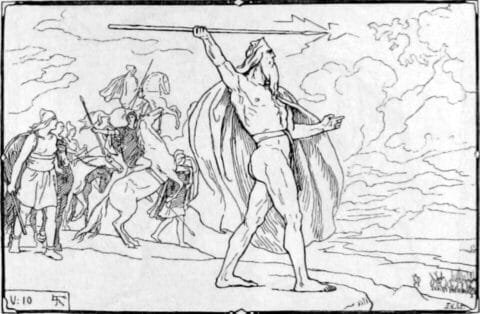
The Valkyries were supernatural women in Norse mythology associated with battle, death, and Odin. Their Old Norse name, valkyrja, means “chooser of the slain,” but that role was more complex than simply carrying dead warriors to Valhalla.
In the surviving sources, they could be involved in deciding who fell in battle, who received victory, and which warriors were claimed for Odin. Some appear as frightening powers of war, while others, such as Sigrdrífa and Brynhildr, are given individual stories and choices of their own.
The picture becomes more complicated because not every battle-slain warrior belonged to Odin. Grímnismál says that Freyja receives half of the slain in Fólkvangr, while Odin receives the other half, without explaining how that division worked.
So what did it actually mean for a Valkyrie to “choose the slain”? The Old Norse texts preserve several answers, and they do not all fit the later image of a winged warrior woman carrying heroes to Valhalla.
Who Were the Valkyries?
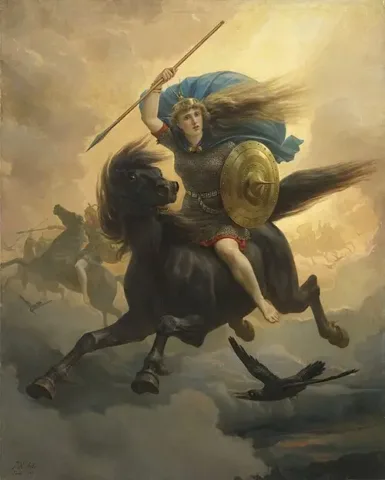
The Valkyries were supernatural female figures closely tied to Odin and warfare.
In Gylfaginning, Snorri Sturluson says that Odin sends them to battles, where they help determine who will die and who will receive victory. Some are also described in Valhalla, serving drink to the Einherjar.
Their role was therefore broader than escorting the dead. Valkyries could be involved in the battle itself, in the fate of warriors, and in Odin’s claim on some of those who fell.
The sources also give them different forms. Some appear as a collective group serving Odin, while others are named individually and develop stories, personalities, and motives of their own.
What Does “Valkyrie” Mean?
The word Valkyrie comes from Old Norse valkyrja, usually translated as “chooser of the slain.” The first element, valr, refers to those killed in battle, while the second is related to kjósa, “to choose.”
The name describes a role rather than simply a type of supernatural woman. Valkyries were defined by their connection with battlefield death and the selection of the slain.
But the phrase can be misleading if taken too literally. In the surviving Norse sources, choosing the slain could involve more than selecting warriors after death.
Did Valkyries Choose the Dead or Choose Who Would Die?
In some sources, Valkyries were involved before the battle was over.
In Gylfaginning, Snorri says that Odin sends them to battles, where they determine who is fated to die and who receives victory. Their role is therefore connected with deciding battlefield fate, not merely collecting warriors afterward.
Hákonarmál provides a clearer example. Göndul and Skögul are sent to the battle involving King Hákon, and the poem presents his fate as already tied to Odin while the fighting is still taking place.
In this context, “chooser of the slain” can mean choosing who will become one of the slain, not simply choosing among those already dead.
Did Valkyries Decide Who Won a Battle?
In some Norse sources, Valkyries are connected not only with death, but also with victory.
Snorri says that Odin sends them to battles to choose the slain and “award victory.” Hákonarmál presents the same idea more dramatically, with Skögul speaking as if the result of the battle lay within the Valkyries’ power.
The sources do not describe every battle as being controlled by Valkyries, and there is no single system explaining how this power worked. But when they appear in this role, they are part of the decision over which side wins, not merely witnesses to the aftermath.
How Did Valkyries Choose Warriors?
The surviving sources never give a fixed set of rules explaining why one warrior was chosen and another was not.
There is no preserved test based on bravery, honor, rank, or moral character. Kings and famous warriors appear among those chosen, but the texts do not say that status or courage alone determined the decision.
This makes the common idea that Valkyries simply selected “the bravest warriors” too neat. Their choices are closely tied to battle and often to Odin, but the exact criteria behind them remain unknown.
Did All the Slain Go to Odin?
No. The Norse sources do not say that every warrior killed in battle automatically belonged to Odin.
In Grímnismál, Freyja receives half of the battle-slain in Fólkvangr, while Odin receives the other half. Snorri preserves the same division in Gylfaginning.
Neither source explains how the dead were divided between them. There is no surviving rule based on courage, rank, allegiance, or any other clear criterion.
This complicates the familiar idea that Valkyries simply gathered all worthy fallen warriors for Odin. Some of the battle-dead belonged to Freyja instead, while the process behind that division remains unclear.
What Did Valkyries Do in Valhalla?
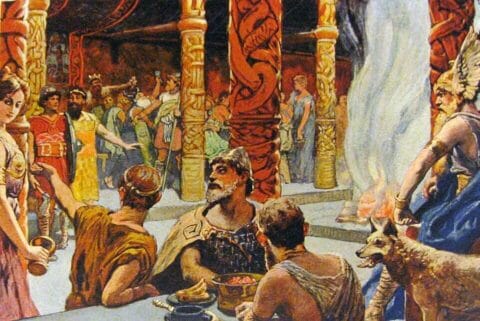
In Valhalla, Valkyries appear in a different role from the one they perform on the battlefield.
Snorri describes some of them serving drink, tending the tables, and carrying ale to the Einherjar. Grímnismál names Hrist, Mist, Skögul, Hildr, Hlökk, and Reginleif among the Valkyries associated with Odin’s hall.
This domestic role is only one part of their portrayal. The same tradition also connects Valkyries with battle, death, and the warriors claimed for Odin.
Their presence in Valhalla therefore belongs to their wider relationship with Odin and the slain, rather than defining what a Valkyrie was.
Were All Valkyries the Same?
No. The surviving Norse sources do not present every Valkyrie in the same way.
Some appear as collective figures associated with battle and Odin, while others are given names, voices, and individual stories. In heroic poetry, figures such as Sigrdrífa, Sigrún, and Brynhildr can make choices, form relationships, and act with a degree of independence.
The differences between these portrayals matter. “Valkyrie” describes a shared connection with battle and the slain, but the surviving texts preserve several distinct versions of that role.
The Darker Valkyries of Darraðarljóð
One of the darkest surviving images of the Valkyries appears in Darraðarljóð, a poem preserved in Njáls saga.
The poem shows twelve women weaving the fate of battle on a gruesome loom. Human entrails form the threads, severed heads serve as weights, and weapons including spears, arrows, and swords become the tools of the weaving.
Six of the women are named, including Hildr, Göndul, and Svipul, linking the scene directly to the Valkyrie tradition. Their work is bound to battle, bloodshed, and the shaping of its outcome.
This is very different from the later romantic image of the Valkyrie. Here, they appear as terrifying powers of war, actively shaping destruction rather than merely escorting the dead after the fighting ends.
Read More
Valkyries in Hákonarmál
Hákonarmál, a tenth-century praise poem for King Hákon the Good, gives one of the clearest early portrayals of Valkyries acting on Odin’s behalf.
At the beginning of the poem, Odin sends Göndul and Skögul to the battlefield to choose which king will come to him and dwell in Valhalla. Hákon’s death is therefore presented as part of a decision already made within the supernatural world of the poem.
The Valkyries are also connected with victory. Hákon questions why the battle ended as it did, and Skögul answers in a way that places the outcome within their power.
Here, they appear as Odin’s agents in battle, involved both in Hákon’s death and in his journey toward Valhalla.
Sigrdrífa and the Valkyrie Who Defied Odin
Sigrdrífumál presents a Valkyrie who acts against Odin’s will.
Sigrdrífa tells Sigurðr that Odin had promised victory to Hjálm-Gunnarr, but she killed him instead and allowed the opposing king, Agnar, to prevail. Odin punished her with a sleep-thorn and declared that she would no longer win victories in battle.
The episode gives Sigrdrífa a degree of independence unusual for the more collective Valkyries found elsewhere. She makes her own choice even when it contradicts the outcome Odin intended.
After Sigurðr wakes her, her role expands further. She teaches him runes, practical wisdom, and forms of magical knowledge, moving well beyond the battlefield role usually associated with Valkyries.
Was Brynhildr Really a Valkyrie?
Brynhildr is closely connected with the Valkyrie tradition, but the surviving sources do not present her identity in exactly the same way.
In the prose linking Fáfnismál and Sigrdrífumál, Sigurðr finds a sleeping battle-maiden on Hindarfjall who has been punished by Odin. The prose of Sigrdrífumál identifies her as Sigrdrífa and explicitly calls her a Valkyrie. In Völsunga saga, however, the sleeping Valkyrie encountered by Sigurðr is Brynhildr.
The two traditions clearly overlap, but the surviving material does not make the relationship between Sigrdrífa and Brynhildr completely simple. Brynhildr can therefore be described as a Valkyrie within the wider Sigurðr legend without assuming that every medieval reference to the two names represents exactly the same version of the character.
Were Valkyries the Same as the Norns?
No. Both Valkyries and Norns are connected with fate, but their roles are different.
The Norns are associated with destiny on a much broader scale, including birth, lifespan, and the course of a person’s life. Valkyries are tied more specifically to warfare, especially the fate of warriors in battle.
Their roles overlap when a Valkyrie helps determine who will fall in combat, but that does not make her a Norn. The distinction is mainly one of scope: Norns are linked with fate broadly, while Valkyries are linked with battle and the slain.
Were Valkyries the Same as Shield-Maidens?
No. Valkyries and shield-maidens belong to different traditions, even though modern retellings often blend them together.
Valkyries are supernatural figures associated with Odin, battle, death, and the choosing of the slain. Shield-maidens are human or legendary warrior women found in saga and heroic tradition.
The overlap comes from their shared connection with warfare. Some figures, especially Brynhildr, also blur the boundary by combining traits associated with both traditions.
But an armed woman is not automatically a Valkyrie. The presence of female warriors in saga, legend, or archaeology should not be treated as evidence that Valkyries themselves were historical warriors.
Did Valkyries Have Wings?
Not in the form familiar from modern fantasy art.
Old Norse sources do not normally describe Valkyries as women with permanent wings. They are more often associated with horses, weapons, armor, and movement across the battlefield or through the air.
Some traditions connect Valkyrie-like women with swan garments or feathered forms, but that is not the same as portraying Valkyries as winged warrior women.
The large feathered wings common in later art and fantasy are therefore a later visual convention rather than a standard feature of the medieval Norse sources.
What Did Valkyries Look Like in Norse Art and Archaeology?
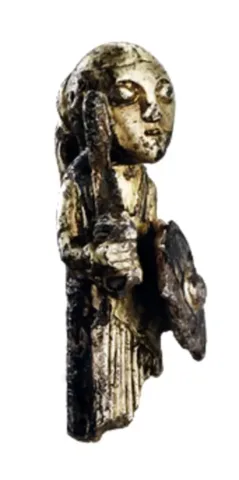
Viking Age art includes several female figures that scholars have interpreted as possible Valkyries, although many identifications remain uncertain.
Some small metal figures show women carrying shields, swords, or spears. Others hold drinking horns, an image that can be compared with literary descriptions of Valkyries serving warriors in Valhalla.
Recent scholarship has become more cautious about labeling every armed female figure a Valkyrie. Viking Age figurative metalwork varies considerably, and similar images may have represented different supernatural, legendary, or human figures.
Archaeology can therefore show that armed and horn-bearing female imagery existed in Viking Age visual culture, but it cannot identify every such figure with certainty. The interpretation depends on details such as clothing, weapons, gestures, archaeological context, and comparison with the surviving texts.
Famous Valkyries in Norse Sources
Old Norse texts preserve many Valkyrie names, although only some are developed as individual characters.
Göndul and Skögul appear in Hákonarmál as Valkyries acting on Odin’s behalf. Hildr occurs in battle-related poetic traditions, while Hrist, Mist, Hlökk, and Reginleif appear mainly in lists and passages associated with Valhalla.
Sigrdrífa has a much larger individual role in Sigrdrífumál, where she defies Odin and later teaches Sigurðr. Brynhildr belongs to the wider Sigurðr tradition and is closely connected with the Valkyrie material, although her relationship with Sigrdrífa is not identical in every surviving source.
The names reflect the variety of the tradition: some Valkyries remain brief poetic figures, while others developed into characters with stories and choices of their own.
Why Valkyries Matter in Norse Mythology
The Valkyries gave Norse poets a way to imagine battlefield death as something shaped by forces beyond the warrior himself.
Through them, victory and defeat could become part of a supernatural decision. A warrior might fall because he had been chosen, while his death could also connect the battlefield with Odin, Valhalla, and the wider fate of the slain.
Their importance lies in that position between war and the supernatural. Valkyries turn death in battle from a simple military outcome into part of a larger mythological order, where victory, fate, and the destination of the dead are closely connected.
Academic Sources
This article draws on primary Old Norse texts together with modern academic editions and peer-reviewed scholarship on Norse mythology, Valkyries, and Viking Age imagery.
Primary Texts and Academic Editions
- Edward Pettit, ed. and trans. (2023).
The Poetic Edda: A Dual-Language Edition.
Open Book Publishers.
Includes Grímnismál, Fáfnismál, Sigrdrífumál, and the heroic poems associated with Brynhildr and Sigurðr.
View academic edition - Snorri Sturluson.
Edda: Prologue and Gylfaginning.
Edited by Anthony Faulkes, 2nd ed., Viking Society for Northern Research, 2005.
A major medieval source for Odin’s Valkyries, their role in battle, victory, and Valhalla.
Viking Society edition - R. D. Fulk, ed. (2012).
“Eyvindr skáldaspillir Finnsson, Hákonarmál.”
In Poetry from the Kings’ Sagas 1, Skaldic Poetry of the Scandinavian Middle Ages.
Provides the critical edition of the poem describing Göndul and Skögul at the death of King Hákon.
Skaldic Poetry Project
Modern Scholarship
- John Lindow (2021).
Old Norse Mythology.
Oxford University Press.
A modern scholarly overview of Old Norse myth, its surviving sources, and the variation between different medieval traditions.
Oxford Academic - Leszek Gardeła, Peter Pentz, and Neil Price (2022).
“Revisiting the ‘Valkyries’: Armed Females in Viking Age Figurative Metalwork.”
Current Swedish Archaeology, 30, 95–151.
A peer-reviewed reassessment of Viking Age female figurines commonly identified as Valkyries.
Read the study - Neil Price et al. (2019).
“Viking Warrior Women? Reassessing Birka Chamber Grave Bj.581.”
Antiquity, 93(367), 181–198.
Useful for distinguishing archaeological evidence for armed women from literary and mythological Valkyrie traditions.
Cambridge Core
Medieval Norse sources do not always preserve a single consistent version of a myth. Where accounts differ, this article distinguishes between the surviving textual traditions rather than combining them into one fixed narrative.
Copyright Notice
© 2026 History & Myths. All rights reserved.
This article is original editorial content created for HistoryAndMyths.com.
Unauthorized reproduction, republication, or substantial copying of the text,
structure, or original analysis is prohibited without prior written permission.
Brief quotations are permitted for commentary, research, or educational use
when accompanied by clear attribution and a link to the original article.