The Nine Worlds of Norse Mythology Explained: Asgard to Hel
The Nine Worlds of Norse mythology are usually described as the different realms that make up the Norse cosmos, including Asgard, Midgard, Jotunheim, Vanaheim, Alfheim, Niflheim, Muspell, Hel, and one realm often identified as Svartalfheim or Nidavellir.
The surviving Norse sources, however, do not preserve one official list of nine named worlds. Poems such as Völuspá refer to nine worlds, while other texts describe individual realms, their inhabitants, and their relationship to Yggdrasil.
Modern lists therefore do not always agree. Some realms are clearly attested, while others depend on how overlapping names and places are interpreted.
This article explains the Nine Worlds one by one while separating what the medieval sources actually say from later reconstruction.
What Are the Nine Worlds of Norse Mythology?
The Nine Worlds are the different regions that make up the mythological cosmos described in Old Norse literature. They include the homes of gods, humans, jötnar, elves, the dead, and other supernatural beings.
The Old Norse phrase níu heimar means “nine worlds” or “nine homes.” Völuspá refers to them near the beginning of the poem, and Vafþrúðnismál also mentions nine worlds.
The term does not describe nine planets or neatly separated dimensions. It refers to different parts of a connected mythological cosmos.
Did the Norse Sources Actually List All Nine Worlds?
No surviving Norse text gives a complete list of nine named worlds in one place.
The Poetic Edda refers explicitly to nine worlds, but individual realms appear only when they matter to a particular poem or story. Snorri Sturluson’s Prose Edda describes places such as Asgard, Midgard, Jotunheim, Niflheim, and Hel in greater detail, but it still does not define a fixed set of nine.
The familiar modern list is therefore assembled from references scattered across different texts. Some realms are easy to identify, while others overlap or remain difficult to classify.
The Common Modern List of the Nine Worlds
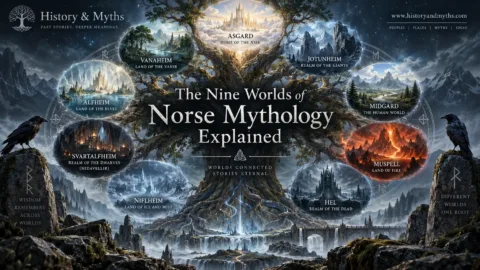
A commonly used modern list includes:
- Asgard: home of the Æsir gods.
- Midgard: the world inhabited by humans.
- Jotunheim: the land associated with the jötnar.
- Vanaheim: home of the Vanir gods.
- Alfheim: the realm associated with the elves.
- Svartalfheim or Nidavellir: commonly linked with dwarfs, though whether the two names refer to the same place is disputed.
- Niflheim: a cold, misty region connected with the earliest stages of the cosmos.
- Muspell: the fiery region associated with Surtr and Ragnarök.
- Hel: the realm of the dead ruled by the being also called Hel.
The uncertainty lies mainly in how Svartalfheim, Nidavellir, Niflheim, and Hel should be separated or combined.
Asgard: Realm of the Æsir
Asgard is the realm most closely associated with the Æsir, the group of gods that includes Odin, Thor, Frigg, and others.
In the Prose Edda, Asgard is presented as the gods’ stronghold, separate from the human world of Midgard but connected to it by Bifröst, the burning rainbow bridge guarded by Heimdall.
Asgard is not a single palace. It contains different halls and sacred places linked to individual gods. Valhalla, for example, is Odin’s hall within Asgard, not a separate world of its own.
Asgard functions as the main divine center of the Æsir and the setting for many of the myths involving the gods.
Midgard: The Human World
Midgard is the world inhabited by humans and occupies a central place in the Norse cosmos.
Its name means roughly “middle enclosure,” reflecting the idea of a protected human realm surrounded by more dangerous regions beyond its boundaries. In Snorri’s Prose Edda, the gods create Midgard from the body of the primordial being Ymir and use his eyebrows to form a defensive barrier around it.
Midgard is closely connected with Asgard through Bifröst, but it is also exposed to threats from the jötnar and other forces outside the human world.
It is not simply “Earth” in the modern planetary sense, but the inhabited human region within a much larger mythological cosmos.
Jotunheim: Land of the Jötnar
Jotunheim is the region associated with the jötnar, beings often translated as giants but better understood as a broad group of powerful supernatural figures who may oppose, marry, or interact with the gods.
The realm lies beyond the protected human world of Midgard and appears repeatedly in stories involving Thor, Loki, and other members of the Æsir. It is often dangerous, but the jötnar are not presented as a single race of evil monsters.
Figures such as Gerðr, Skaði, Þjazi, and Útgarða-Loki show how varied these beings can be. Some are enemies of the gods, while others form family ties with them.
Jotunheim is therefore a major source of both conflict and kinship in Norse mythology.
Vanaheim: Home of the Vanir
Vanaheim is the realm associated with the Vanir, the divine group linked with figures such as Njörðr, Freyr, and Freyja.
The surviving sources say much less about Vanaheim than they do about Asgard or Midgard. In Vafþrúðnismál, Njörðr is said to have come from Vanaheim before being sent to the Æsir as part of the settlement that followed the war between the two divine groups.
The texts do not give Vanaheim a detailed landscape, list of halls, or clear boundaries. What they preserve most clearly is its role as the homeland of the Vanir.
Alfheim: Realm of the Elves
Alfheim is a realm associated with the elves.
One of the clearest references comes from Grímnismál, where Alfheim is given to Freyr as a tooth-gift. Beyond that, the surviving poems provide little detail about its landscape or inhabitants.
Snorri later distinguishes between light elves and dark elves, but the relationship between those categories and the older poetic tradition is not completely clear.
Alfheim is securely attested as a named realm, but the sources tell us far less about it than many modern maps suggest.
Svartalfheim and Nidavellir: Are They the Same World?
Svartalfheim and Nidavellir are often treated as two names for the same realm, but the medieval sources never clearly identify them as one place.
Snorri uses Svartálfaheimr for a place associated with dwarfs, while Völuspá mentions Nidavellir in connection with a hall belonging to the kin of Sindri.
Because both names are linked with dwarfs, modern reconstructions often combine them. Other lists use one name or the other, while some treat them as separate places.
That uncertainty is one of the main reasons modern lists of the Nine Worlds do not always agree.
Niflheim: The World of Mist and Cold
Niflheim is a cold, mist-filled region that plays an important role in Snorri Sturluson’s account of the beginning of the cosmos.
In the Prose Edda, Niflheim exists before the creation of the world and contains Hvergelmir, a great spring from which several rivers flow. Its freezing waters meet the heat of Muspell, helping create the conditions from which the earliest beings emerge.
Niflheim is also connected with the dead in later descriptions, which is why it is often confused with Hel. The two are closely related in Snorri’s cosmology, but they are not always treated as the same place.
Muspell: The Realm of Fire
Muspell is the fiery region of the Norse cosmos, associated with extreme heat and with Surtr, who leads its forces at Ragnarök.
In Snorri’s Prose Edda, Muspell exists before the creation of the world. Its heat meets the cold flowing from Niflheim in Ginnungagap, helping create the conditions from which the earliest beings emerge.
The sources describe Muspell less fully than Asgard or Midgard, but its connection with fire and destruction is clear. At Ragnarök, Surtr advances against the gods and the world is consumed by flame.
Modern writers often use Muspelheim for the realm, while the older sources also use Muspell. The two names should not be treated as separate worlds.
Hel: Realm of the Dead
Hel is both the name of a realm of the dead and the name of the being who rules it.
In Snorri’s Prose Edda, Odin sends Hel to Niflheim and gives her authority over those who die from sickness or old age. Her realm is therefore different from Valhalla, where some of those killed in battle are received by Odin.
Hel is not the same as the Christian idea of Hell. In Old Norse mythology, it is a destination for many of the dead, not simply a place of eternal punishment for the wicked.
Hel vs Niflheim: Are They the Same Place?
Hel and Niflheim are closely connected, but the sources do not consistently treat them as the same place.
In Snorri’s Prose Edda, Hel is sent to Niflheim, where she rules over many of the dead. That suggests that Hel may be understood as a realm within, or closely associated with, the wider region of Niflheim.
Elsewhere, Hel appears more broadly as a destination of the dead, while Niflheim is described as a cold, misty region that also plays a role in the creation of the cosmos.
Modern lists often separate them into two of the Nine Worlds, but the medieval sources leave their exact relationship uncertain.
Read More
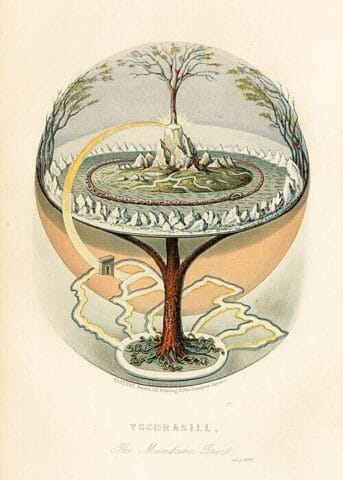
Where Were the Nine Worlds Located on Yggdrasil?
The surviving sources do not give us a map placing all nine worlds on specific branches or levels of Yggdrasil.
In Grímnismál, three roots extend toward Hel, the frost giants, and the world of humans. Snorri gives a different arrangement, placing the roots among the Æsir, the frost giants, and Niflheim.
Modern diagrams often place Asgard at the top, Midgard in the middle, and other realms around the branches and roots, but the medieval texts do not provide such a complete layout.
Yggdrasil connects different parts of the Norse cosmos, but it should not be treated as a surviving map of the Nine Worlds.
Why Do Modern Maps of the Nine Worlds Differ?
Modern maps differ because the Norse sources never provide a complete diagram of the cosmos.
The names of realms are scattered across different poems and prose texts, and their relationships are not always described in the same way. Ambiguous pairs such as Hel and Niflheim or Svartalfheim and Nidavellir also force modern writers to make interpretive choices.
A map can therefore be useful for orientation, but it is a modern reconstruction rather than an original Norse blueprint.
Were the Nine Worlds Separate Planets or Dimensions?
The Norse sources do not describe the Nine Worlds as separate planets or dimensions in the modern sense.
They are better understood as different regions of a shared mythological cosmos. Gods, humans, jötnar, and other beings can travel between them by bridge, road, sea, or supernatural means.
Terms such as parallel dimensions or separate universes are modern comparisons, not categories used by the medieval sources.
Were There Only Nine Places in Norse Mythology?
No. Norse mythology mentions many more than nine named places.
Some are halls or regions within larger realms rather than separate worlds. Valhalla, for example, is Odin’s hall in Asgard, while Fólkvangr is associated with Freyja. Other names, including Þrúðheimr, Gimlé, and Náströnd, refer to places with their own roles in the mythology.
The number nine should therefore not be treated as a complete catalogue of every location in the Norse cosmos. The sources describe many other halls, regions, and supernatural destinations alongside the Nine Worlds.
What Happens to the Nine Worlds at Ragnarök?
At Ragnarök, destruction spreads across the Norse cosmos rather than affecting only one realm.
The gods fight their enemies, Bifröst breaks, Surtr advances with fire, and major figures including Odin, Thor, Loki, and Heimdall are killed. Snorri also describes the world being consumed by flame before a renewed earth emerges.
The sources do not give a separate fate for each of the Nine Worlds, so claims about exactly which realms survive or disappear usually go beyond what the texts actually say.
So What Were the Nine Worlds Really?
The Nine Worlds belong to a connected Norse cosmos inhabited by gods, humans, jötnar, elves, the dead, and other supernatural beings.
The number nine is clearly part of the Old Norse tradition, but the surviving sources never preserve one definitive list or map of nine named realms. Modern lists are therefore useful reconstructions, not copies of a single ancient Norse blueprint.
Academic Sources
Primary Norse Sources
- Pettit, Edward, ed. and trans.
The Poetic Edda: A Dual-Language Edition.
Open Book Publishers, 2023.
Used especially for Völuspá, Vafþrúðnismál,
and Grímnismál, including references to the nine worlds,
Vanaheim, Alfheim, Yggdrasil, and the structure of the Norse cosmos. - Snorri Sturluson.
Edda: Prologue and Gylfaginning.
Edited by Anthony Faulkes, 2nd ed.,
Viking Society for Northern Research, University College London, 2005.
A principal source for Asgard, Midgard, Niflheim, Muspell,
Hel, Bifröst, Yggdrasil, creation, and Ragnarök.
Modern Academic Scholarship
- Lindow, John.
Old Norse Mythology.
Oxford University Press, 2021.
A modern scholarly study of Norse mythological tradition,
its surviving medieval sources, cosmology, gods, supernatural beings,
and the limits of reconstructing pre-Christian belief from later texts. - Clunies Ross, Margaret.
Prolonged Echoes: Old Norse Myths in Medieval Northern Society.
Volume 1: The Myths.
Odense University Press, 1994.
Important for the structure of the Norse mythic world,
relationships between gods and jötnar, and the social and cosmological
ideas preserved in medieval Norse mythology. - Acker, Paul, and Carolyne Larrington, eds.
The Poetic Edda: Essays on Old Norse Mythology.
Routledge, 2002.
A collection of scholarly studies on Eddic mythology and cosmography,
useful for interpreting the poetic sources behind modern reconstructions
of the Norse cosmos.
This article distinguishes between realms explicitly named in medieval
Old Norse sources and the modern reconstruction commonly known as the
Nine Worlds. Where the surviving texts disagree or leave relationships
uncertain, those limits are stated rather than presented as a fixed
ancient cosmological map.
© 2026 History & Myths. All rights reserved.
This article is original content and may not be copied, republished, adapted, or redistributed without prior written permission.