Tarhunna: The Storm God of the Hittites
Tarhunna (Tarḫunna) was the Hittite storm god, associated with thunder, lightning, and the rain that sustained agriculture in ancient Anatolia. Alongside the Sun Goddess of Arinna, the Storm God of Hatti occupied a central place in state religion and the religious foundations of Hittite kingship.
His importance extended beyond the weather. Storm gods appeared in royal ceremonies, religious festivals, and myths, including the struggle against the serpent Illuyanka. Over time, Hurrian influence brought Tarhunna into close association with Teshub, the Hurrian storm god, although local Anatolian storm deities retained distinct identities.
Who Was Tarhunna in Hittite Religion?
His name is generally linked to the Hittite verb tarḫ-, meaning “to prevail” or “to conquer,” although the precise formation of the divine name remains debated.
Hittite scribes often wrote the names of storm gods using Sumerian signs such as dU or dIŠKUR rather than spelling them out phonetically. Identifying the deity therefore depends on context. The Storm God of Heaven and the Storm God of Hatti, for example, appear separately in some religious records and should not always be treated as interchangeable titles.
The Hittites also worshipped local storm gods with their own cults. Nerik and Zippalanda were important religious centers, each associated with a distinct storm-god tradition. Although these deities shared characteristics with the principal Storm God, Hittite texts could recognize them separately within the wider pantheon.
Tarhunna’s Powers and Role in Hittite Kingship
Rainfall sustained agriculture and grazing across central Anatolia, making the Storm God’s favor essential to the prosperity of the Hittite kingdom. His influence, however, extended beyond the natural world to the authority of its rulers.
The connection also appears in royal diplomacy. In his treaty with Duppi-Teshub of Amurru, Mursili II bears the title “Beloved of the Storm God.” Hittite treaties invoked storm gods alongside other deities as witnesses to agreements, calling upon them to protect those who honored their oaths and punish those who broke them.
Tarhunna and the Sun Goddess of Arinna
The Sun Goddess of Arinna was Tarhunna’s consort and one of the highest-ranking deities in the Hittite pantheon. Her cult had Hattian roots, with names such as Eštan and Wurunšemu associated with her. Despite her title, she was distinct from the male Sun God of Heaven, who also appears in Hittite religious texts.
The divine couple headed a family of gods. In Puduhepa’s prayer (CTH 384), their daughter Mezulla, granddaughter Zintuhi, and the Storm God of Zippalanda are invoked as intermediaries seeking protection for Hattusili III. The prayer also identifies the Storm God of Nerik as a son of the Sun Goddess of Arinna.
The same prayer identifies the Sun Goddess of Arinna with Hepat, the Hurrian goddess whose consort was Teshub. This identification reflects the growing influence of Hurrian religion at the Hittite royal court, not an original identity shared by all these deities.
How Was Tarhunna Worshipped?
Worship of the Hittite Storm God involved temples, regular offerings, and religious festivals. At Hattusa, the Great Temple (Temple 1) is generally identified as the sanctuary of the Storm God of Hatti and the Sun Goddess of Arinna. Its storerooms and administrative tablets show how temple activities depended on organized supplies and personnel.
Offerings included bread, beer, wine, and sacrificed animals. Priests performed routine ceremonies, while major festivals brought the king and queen into religious celebrations involving music, ritual meals, and offerings to multiple deities.
Two important festivals followed the agricultural calendar. The spring AN.TAḪ.ŠUM festival included rites for the Storm God of Hatti, while the autumn nuntarriyašḫa festival took the royal household through several religious centers.
Thunder also had ritual significance. Hittite texts describe ceremonies intended to protect the king from the danger associated with the Storm God’s anger. Some belonged to the regular festival calendar rather than being performed only when a storm occurred.
Local worship varied across Anatolia. At Ḫakmiš, a spring ritual for the Storm God of Rain included offerings of sheep, bread, and beer, accompanied by a request for abundant rainfall. Nerik maintained its own traditions, including the purulli festival associated with the Illuyanka myth. These local cults formed part of Hittite religion without necessarily representing identical forms of Tarhunna.
The Bull and Other Symbols of Tarhunna
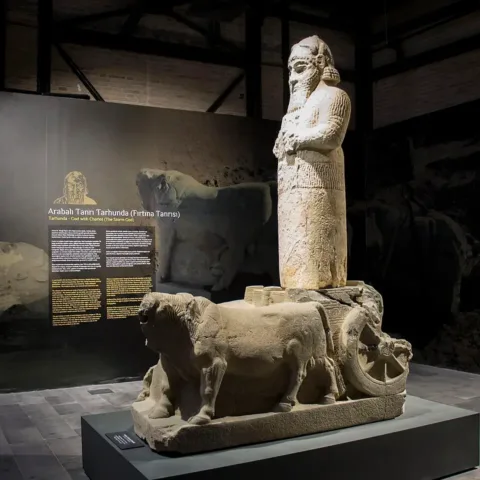
The bull was the principal animal symbol of Hittite storm gods, associated with their strength and power over the weather. Hittite cult inventories record bull-shaped divine images made from metals such as iron and silver, along with animal-shaped vessels used in religious ceremonies. A silver bull vessel from the Hittite Empire, now in the Metropolitan Museum of Art, may have belonged to the cult of the storm god Teshub.
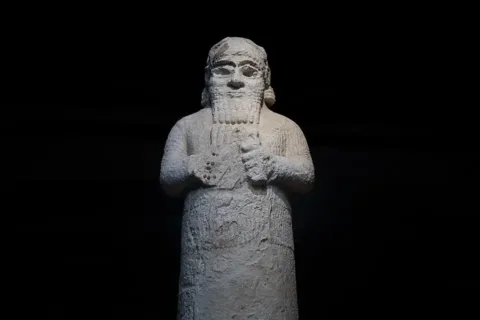
When depicted in human form, Hittite storm gods commonly appear bearded, wearing a tall horned headdress, a short kilt, and shoes with upturned toes. They often carry a mace on one shoulder or raise it as a weapon. Axes and forked lightning symbols also appear in storm-god imagery, particularly in the Luwian reliefs of the first millennium BCE.
At Yazılıkaya, the rock sanctuary near Hattusa, a prominent storm god stands upon two mountain deities. In this Hurrian-influenced religious setting, the figure is identified as Teshub, who was closely associated with the Hittite Storm God.
These symbols were shared by several Anatolian storm gods. Unless an inscription or the surrounding context identifies the deity, a relief showing a bull, mace, or lightning weapon cannot automatically be attributed to Tarhunna.
Read Also
- Who Were the Hittites? History, Origins and Empire
, Explore the civilization, royal authority, and religious traditions of the Hittite kingdom.
- Samuha: The Hittite Royal City and Cuneiform Archive Found in 2026
, Discover an important Hittite religious center and the ancient texts that reveal its cult traditions.
- Baal: God of Storms and Fertility in Canaanite Mythology
, Compare Tarhunna with a storm deity from a different ancient Near Eastern religious tradition.
Tarhunna and the Serpent Illuyanka
One of the best-known Anatolian myths tells of the Storm God’s battle against Illuyanka, a serpent that defeats him before eventually being killed. Two versions of the story survive in Hittite texts catalogued as CTH 321.
In the first version, the goddess Inara prepares a feast and invites Illuyanka and its offspring to eat and drink. After consuming the food and drink, they cannot return to their lair. A mortal named Hupasiya then binds the serpent with a rope, allowing the Storm God to kill it.
The second version tells a different story. Illuyanka defeats the Storm God and takes his heart and eyes. To recover them, the god marries a mortal woman and fathers a son, who later marries the serpent’s daughter. At his father’s request, the son obtains the stolen organs from his wife’s family. Once restored, the Storm God confronts Illuyanka again. His son, now bound to the serpent’s household by marriage, asks his father not to spare him. The Storm God kills them both.
The text connects the myth to the purulli festival and identifies its narrator as a priest of the Storm God of Nerik. The text introduces Kella, a priest of the Storm God of Nerik, and contains a fragmentary reference to the Storm God of Heaven. The narrative itself does not explicitly identify its central deity by the name Tarhunna.
Tarhunna, Taru, Tarhunz and Teshub: What Is the Difference?
The names Taru, Tarhunna, Tarhunz, and Teshub reflect different languages and religious traditions, although their identities sometimes overlapped.
Taru was the storm god of the Hattians, whose religious traditions influenced Hittite worship. His cult became closely integrated with that of the Hittite Storm God, making the two difficult to separate in later sources.
Tarhunna (Tarḫunna) was the Hittite name, while Tarhunz (Tarḫunz) was the related Luwian form. Luwian texts also preserve forms such as Tarḫunt and Tarḫunza. Worship of the Luwian Storm God continued in the Iron Age kingdoms of southeastern Anatolia and northern Syria after the Hittite Empire’s collapse.
Teshub (Teššub) belonged to the Hurrian religious tradition. His mythology included the Kumarbi cycle, which describes struggles over divine kingship. These narratives were transmitted in Hittite texts but originated in a different religious tradition from the Anatolian Illuyanka myth.
As Hurrian influence increased at the Hittite royal court, Teshub became closely identified with the Hittite Storm God. This religious integration did not eliminate the separate histories and local cults associated with these deities.
Academic Sources & Primary Texts
This article draws on Hittite religious texts, royal prayers, cult inventories, and academic research into the Storm God’s worship, political significance, and connections with other Anatolian deities.
Primary Hittite Texts
- CTH 321: The Illuyanka Myth
TITUS, Goethe University Frankfurt. Scholarly German translation of the two surviving versions of the Storm God’s conflict with Illuyanka, including their connection to the purulli festival. - CTH 384.1: Puduhepa’s Prayer to the Sun Goddess of Arinna
Hethitologie-Portal Mainz. Critical scholarly translation documenting the divine family, the Storm God of Nerik, and the identification of the Sun Goddess of Arinna with Hepat. - CTH 821: Kingship and Divine Authority (IBoT 1.30)
Ancient Hittite ritual text declaring the Storm God the owner of the land and Labarna its appointed ruler. Discussed and translated in Hajime Yamamoto’s study of Hittite royal ideology. - Hittite Cult Inventories (CTH 501-530)
Digital research project edited by Michele Cammarosano. Critical editions documenting local deities, cult images, temple offerings, and religious festivals.
Academic Studies
- Taracha, Piotr. Religions of Second Millennium Anatolia (2009).
Harrassowitz Verlag, Dresdner Beiträge zur Hethitologie 27. Comprehensive study of Hittite religious traditions, local cults, and Hurrian influence on the imperial pantheon. - Schwemer, Daniel. The Storm-Gods of the Ancient Near East, Part II (2008).
Journal of Ancient Near Eastern Religions, 8(1), 1-44. Comparative research distinguishing Hattian, Hittite, Luwian, and Hurrian storm-god traditions. - Singer, Itamar. Hittite Prayers (2002).
Society of Biblical Literature, Writings from the Ancient World 11. Scholarly translations of royal prayers, including Puduhepa’s appeals to the Sun Goddess of Arinna. - Cammarosano, Michele. Hittite Local Cults (2018).
SBL Press. Translation and analysis of provincial cult inventories, religious offerings, divine images, and local festivals. - Yamamoto, Hajime. The Concept of Territories and Borders in Hittites’ Royal Ideology (2020).
Orient, 55, 29-41. Examination of divine ownership of the kingdom and the Hittite monarch’s authority to govern. - Barsacchi, Francesco. When the Storm-god Thunders: Some Considerations on Hittite Thunder Festivals (2019).
Acts of the IX International Congress of Hittitology, pp. 101-124. Study of thunder rituals and their place within the Hittite festival calendar.
Research note: Hittite religious texts refer to several storm gods with distinct local traditions. Identifications between Tarhunna, Taru, Tarhunz, and Teshub must be understood within their historical and linguistic contexts.
Copyright & Content Rights
© 2026 History & Myths.
All rights reserved.
The original writing, analysis, and editorial presentation of this article are protected by copyright. Reproduction or republication without prior permission is not authorized.
Historical and mythological accounts discussed in this article are based on ancient Hittite texts, archaeological evidence, and scholarly research. No ownership is claimed over the original ancient sources or the ideas and findings of cited scholars.
