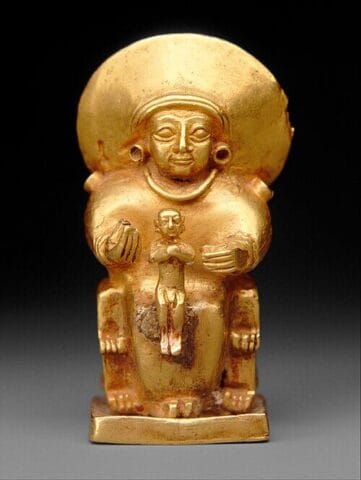
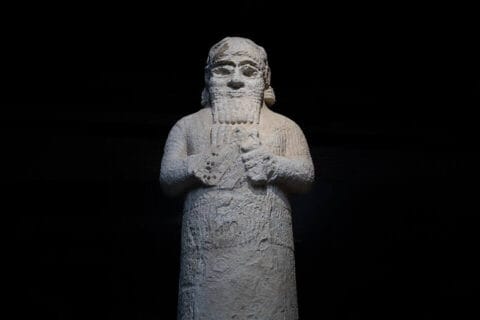
Inara: Hittite Goddess of Wild Animals and Protection
Inara was a Hittite goddess of Hattian origin, associated with wild animals and the protection of Hattusa, the Hittite capital. Identified in Hittite mythology as the daughter of the Storm God, she played a decisive role in the first version of the Illuyanka myth. When the serpent defeated the Storm God, Inara devised a plan to overcome it. She prepared a feast to lure the creature from its lair and enlisted a mortal man named Hupasiya to help capture it.
Yet Inara was more than a figure in the Illuyanka story. Religious texts record her worship at Hattusa, including ceremonies involving offerings and representations of wild animals. Other surviving myths connect her with the goddess Hannahanna and a tradition of divine disappearance. Together, these sources reveal a protective goddess whose significance extended into the religious life of the Hittite state, although much of her mythology survives only in fragments.
Who Was Inara in Hittite Religion?
Inara belonged to the older Hattian religious tradition of central Anatolia. When the Hittites adopted the worship of many Hattian deities, they also preserved their myths and rituals. Inara appears in Old Hittite religious texts, indicating that her place in the pantheon was supported by an established cult rather than mythology alone.
A fragmentary myth concerning her disappearance, classified as CTH 336.3, explicitly identifies Inara as the daughter of the Storm God. In the older Anatolian religious traditions, the Storm God was known as Taru in Hattian and Tarhunna in Hittite. Teshub was his Hurrian counterpart. Although these storm deities became closely associated, calling Inara simply the daughter of Teshub obscures the Hattian background of her mythology. Her mother’s identity is not securely established in the surviving sources.
The distinction between Inara and similarly named protective gods is also important. The Hattian goddess was known as Inar, while Hittite texts attest a male deity called In(n)ara, whose functions resembled those of the Luwian god Kurunta. Both were associated with the countryside and wild nature, but their overlapping attributes do not make them identical. Religious texts also use the divine sign dKAL, commonly read dLAMMA, for protective deities without always identifying a particular god. Consequently, references to a protective deity cannot automatically be attributed to Inara.
What Did Inara Protect?
Inara was associated with two distinct spheres: the wilderness beyond human settlements and the Hittite capital itself. In Hattian religious tradition, she belonged to the world of wild animals and uncultivated land, described in Hittite by the term gimra-, meaning countryside or wilderness. This association provides the basis for identifying her as a protector of wildlife.
During the Old Hittite period, Inara was also honored as the patron goddess of Hattusa. Her connection with the wilderness remained part of her religious identity within the capital. The KI.LAM festival, which included representations of wild animals and hunters, offers evidence of how these associations entered public religious ceremonies.
Her relationship with hunting is less certain. The male protective deity In(n)ara and the Luwian god Kurunta were associated with stags and hunting, but their attributes cannot automatically be assigned to the older Hattian goddess. The surviving evidence does not establish that Inara herself was worshipped specifically as a huntress.
Inara has sometimes been compared with the Greek Artemis because both were associated with the protection of wild animals. Historian Trevor Bryce makes this comparison, although Hittitologist Hans Gustav Güterbock cautioned that we cannot establish whether Inar was a huntress like Artemis. The resemblance concerns their association with wildlife, not an identical set of religious functions.
The Worship of Inara at Hattusa
Hittite festival records provide direct evidence of Inara’s worship at Hattusa. An outline of the spring AN.TAḪ.ŠUM festival describes a ḫadauri rite performed in a temple identified, partly through textual restoration, as hers. Ten sheep were sacrificed, their meat presented to the deity, and ritual vessels arranged in the temple. Later in the festival, probably on its thirty-second day, the king and queen visited Inara’s temple.
Her worship extended beyond the capital. A cult inventory from Wiyanuanta records an allocation of three BÁN of wheat to Inara, alongside offerings assigned to the Storm God of Ḫurša, the Sun Goddess, and Pirwa. The record shows that her cult was maintained through regular religious provisions outside Hattusa.
Inara and the KI.LAM Festival
Inara also appears in the textual tradition of the KI.LAM, or Gatehouse Festival, a three-day celebration held at Hattusa. Its ceremonies brought together the royal couple, priests, officials, and processions of sacred objects representing the gods.
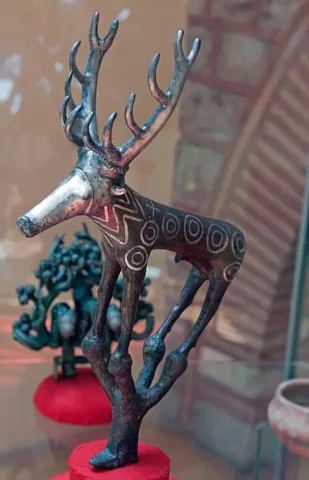
One procession began with priests associated with Inar(a) and included figures of wild animals made from precious materials. Among them were a silver panther, a silver wolf, a golden lion, two boars made respectively of silver and lapis lazuli, and a silver bear. The procession also featured hunting equipment, hunters, and representations of stags.
The king and queen watched the display before proceeding toward the temple of Halki, the Grain Goddess, and later to a ceremonial station associated with Miyatanzipa, the goddess of growth. Hittitologist Alfonso Archi interprets this sequence as a symbolic movement from wild nature toward the cultivated world that sustained human settlements.
The identity of the deity leading the animal procession requires caution. Older festival manuscripts use the name Inar, probably referring to the Hattian goddess, while later versions employ the sign dKAL, denoting a protective deity. These changes suggest that her earlier functions became associated with other protective gods. The procession therefore provides evidence of Inara’s religious tradition, but not every detail in the later accounts can be attributed exclusively to her.
Inara and the Defeat of Illuyanka
Inara’s best-known myth tells how she helped the Storm God defeat Illuyanka, a powerful serpent that had already beaten him in battle. The story survives in two distinct versions within the Hittite text CTH 321, associated with the purulli festival. Inara appears in the first version, where her plan makes the Storm God’s victory possible.
The conflict begins at Kiškilušša, where Illuyanka defeats the Storm God. The defeated deity appeals to the other gods for help, and Inara responds by preparing an elaborate feast. She fills large vessels with wine and two kinds of beer, marnuwant and walhi.
Inara then travels to Ziggaratta, where she recruits a mortal man named Hupasiya. He agrees to help on the condition that she sleep with him. She accepts and hides him near the place where she intends to trap the serpent.
After adorning herself, Inara calls Illuyanka out of its underground lair and invites it to eat and drink. The serpent emerges with its offspring, and they consume the food and drink provided at the feast. When they fail to return to their holes, Hupasiya comes out of hiding and binds the serpent with a rope. The Storm God then arrives and kills his enemy, with the other gods standing beside him.
The Hittite wording does not establish whether the serpent was unable or unwilling to return underground after the feast. Either way, Inara’s strategy succeeds: Hupasiya restrains Illuyanka before the Storm God faces it again. The god delivers the fatal blow, but the victory depends on the intervention of both Inara and her mortal helper.
How Does the Second Version Differ?
The second account begins with another defeat of the Storm God, but this time Illuyanka takes his heart and eyes. The god then marries the daughter of a poor man and fathers a son. When the boy grows up, he marries the serpent’s daughter.
The Storm God instructs his son to request his stolen heart and eyes from his wife’s family as a marriage gift. The son obtains both organs and returns them to his father, restoring the god’s strength.
The Storm God then confronts Illuyanka near the sea. His son, now connected to the serpent’s household through marriage, stands with the creature and calls upon his father to include him in the attack rather than spare his life. The Storm God kills both the serpent and his own son.
Inara has no recorded role in this account. The two versions preserve different ways of overcoming the serpent, not consecutive episodes of one narrative. The first relies on Inara’s feast and Hupasiya’s assistance, while the second depends on marriage, the recovery of stolen organs, and the death of the Storm God’s son.
Inara and Hupasiya: What Happened to Her Mortal Helper?
After Illuyanka’s defeat, Inara built a house for herself on a rocky outcrop in the land of Tarukka and settled Hupasiya there. She warned him not to look through the window while she was away in the countryside, explaining that he would see his wife and children.
After twenty days, Hupasiya looked outside and saw his family. When Inara returned, he began to lament and begged to go home. The surviving text records his request, but the following lines are too damaged to establish how the goddess responded.
Several published reconstructions suggest a violent ending in which Inara kills Hupasiya, while some also describe the destruction of the house. Neither event is securely established by the surviving words. In his 2007 commentary, Hittitologist Harry A. Hoffner Jr. challenged these interpretations, arguing that Hupasiya was more likely rejected as Inara’s consort and sent home. He also noted that the house appears again shortly afterward, when Inara transfers it to the Hittite king, making its supposed destruction difficult to reconcile with the narrative.
Hoffner further interpreted the house as Inara’s temple rather than a private residence built for Hupasiya. In this reading, Hupasiya’s position as her consort carried a sacred obligation comparable to priestly service. His desire to return to his family therefore represented a rejection of his special relationship with the goddess.
This religious interpretation remains a scholarly proposal, not an explicit explanation in the myth. The preserved account establishes that Hupasiya disobeyed Inara and wanted to return to his family, but it does not reveal whether he was punished, released, or met another fate.
Inara in Other Hittite Myths
Inara appears in a separate group of Hittite mythological fragments classified as CTH 336. These texts include an account of her disappearance and other damaged narratives involving the mother goddess Hannahanna, bees, and protective deities. They preserve aspects of Inara’s mythology absent from the Illuyanka story, although their fragmentary condition makes it difficult to establish how the episodes were connected.
In CTH 336.3, Inara speaks with Hannahanna, who urges her to remain and offers to give her land and a man. The Storm God, meanwhile, notices that his daughter is missing and sends a bee to find her. The bee reaches Hannahanna and delivers the news that Inara’s father is concerned about her absence.
Hannahanna then places portions of animals into a fleece or hunting bag. The damaged lines that follow contain references to a hunter and killing, but their meaning is uncertain. Nothing in the surviving passage establishes how Inara’s absence ended.
Read Also
Tarhunna: The Storm God of the Hittites
Explore the Storm God’s powers, worship, and role in the battle against Illuyanka.
Hittite Mythology: Gods, Monsters and Sacred Stories
Discover the wider world of Anatolian myths, including disappearing gods and divine conflicts.
Hattusa: The Lost Capital of the Hittite Empire
Explore the temples, religious life, and archaeological remains of the city protected by Inara.
Other fragments preserve related episodes involving divine messengers. In one, Hannahanna sends a bee to a protective deity with instructions to sound a goat’s horn. The resulting sound frightens the War God. Another describes a bee bringing a hunting bag while Hannahanna prepares three basins associated with a tree, a wooden vessel, and fire. The deity Miyatanzipa also appears in this scene, sitting beneath the tree. The purpose of these actions is not preserved.
A further damaged passage describes Hannahanna sending a bee to search for a missing goddess, possibly Inara, and includes instructions involving wax. Its connection with the other fragments cannot be established securely.
The recurring use of bees recalls the better-preserved myth of Telipinu, whose disappearance disrupts agriculture and livestock until divine intervention restores order. Inara’s surviving fragments do not establish comparable consequences for her absence. They place her within the wider Anatolian tradition of disappearing deities, but leave both the circumstances of her departure and her eventual return uncertain.
Inara, Kingship and the Purulli Festival
The Illuyanka myth is closely connected with purulli, a major Hittite religious festival. The text opens with the words of Kella, a priest of the Storm God of Nerik, and states that the festival is celebrated when the land flourishes and enjoys protection. Although purulli is often described as a spring or New Year festival, the surviving text does not establish its precise date or explicitly identify it as a New Year celebration.
Near the end of the first Illuyanka narrative, a damaged passage describes Inara transferring her house and the river of the watery abyss into the hands of the Hittite king at Kiškilušša. The river is generally understood as referring to subterranean waters. The passage connects this transfer with the celebration of the first purulli festival, although parts of its wording remain disputed.
Harry A. Hoffner Jr. interpreted the transfer as the king assuming responsibility for Inara’s sanctuary and the underground waters associated with it. Franca Pecchioli Daddi proposed a broader meaning, viewing the episode as a symbolic representation of the establishment of Hittite kingship. In her interpretation, control over subterranean water, essential to agriculture, becomes part of the religious authority entrusted to the king.
Amir Gilan offered a different explanation. He argued that the story was intended to account for the origins of a particular purulli celebration associated with Kiškilušša and probably Nerik. Rather than explaining the foundation of Hittite monarchy, the narrative may have established the religious importance of a local cult before the authorities at Hattusa.
The surviving evidence does not settle these interpretations. It establishes a narrative connection between Inara’s sacred possessions, the king, and purulli, but does not demonstrate that the festival involved a reenactment of the serpent’s defeat. Nor does the myth describe a drought resulting from the Storm God’s earlier defeat.
What Do We Know About Inara, and What Remains Uncertain?
Inara’s place in Hittite religion is supported by more than mythology. Temple references and records of offerings attest to her worship, while the surviving myths show a goddess capable of acting independently. Together, these sources establish her religious importance, even though they do not provide a complete picture of her cult.
Much remains unresolved. The fate of Hupasiya is unknown, the accounts of Inara’s disappearance are fragmentary, and similarities between her name and those of later protective gods complicate attempts to trace her changing identity. The evidence reveals a goddess with roots in Hattian religion whose influence extended into Hittite religious life, but the full history of her worship remains beyond recovery.
Academic Sources & Primary Texts
This article draws on Hittite mythological texts, festival records, scholarly translations, and academic research into Inara’s religious identity, worship, and relationship with the Storm God. Ancient texts are identified using the Catalogue des Textes Hittites (CTH).
Primary Hittite Texts
- CTH 321: The Illuyanka Myth.
Corpus of Hittite Mythological Texts. TITUS, Goethe University Frankfurt.
Read scholarly translation
German translation of the two surviving Illuyanka narratives, including Inara’s feast, Hupasiya, and the connection with the purulli festival. - CTH 336.3: Myths of the Goddess Inara.
Corpus of Hittite Mythological Texts. TITUS, Goethe University Frankfurt.
Read scholarly translation
Fragmentary account involving Inara, Hannahanna, the Storm God, and the bee sent to search for the missing goddess. - Hittite KI.LAM Festival Texts.
Kimball, Sara E., Winfred P. Lehmann, and Jonathan Slocum. Hittite Online, Lesson 10. University of Texas at Austin.
Read text and commentary
Translated festival passages documenting ceremonial processions, cult objects, priests, and animal representations.
Academic Studies & Translations
- Hoffner, Harry A., Jr. (1998).
Hittite Myths. Second Edition. Writings from the Ancient World 2. Scholars Press.
Publisher’s edition
Principal English translations of the Illuyanka myth and the fragmentary myths of Inara. - Hoffner, Harry A., Jr. (2007).
“A Brief Commentary on the Hittite Illuyanka Myth (CTH 321).” In Studies Presented to Robert D. Biggs, Assyriological Studies 27, pp. 119-140. Oriental Institute, University of Chicago.
Read academic commentary
Detailed textual analysis of the myth, the disputed fate of Hupasiya, and the religious interpretation of Inara’s house. - Archi, Alfonso (2019).
How a God of Nature Became a Tutelary God of the King.
Read academic study
Examines the Hattian goddess Inar, wild animals, protective deities, and the historical relationship with In(n)ara and Kurunta. - Singer, Itamar (1983).
The Hittite KI.LAM Festival. Part One. Studien zu den Bogazköy-Texten 27.
View academic publication
Comprehensive study of the three-day festival, ceremonial processions, cult objects, and royal participation. - Güterbock, Hans G. (1960).
“An Outline of the Hittite AN.TAḪ.ŠUM Festival.” Journal of Near Eastern Studies 19(2), pp. 80-89.
View journal article
Study of the festival calendar, temple ceremonies, offerings, and royal ritual participation. - Gilan, Amir (2013).
“Once upon a Time in Kiskilusa: The Dragon-Slayer Myth in Central Anatolia.”
View academic publication
Reassessment of the Illuyanka narrative and its possible relationship to local religious traditions and the purulli festival.
Research note: Several texts concerning Inara survive only in damaged fragments. Where translations or scholarly interpretations differ, this article distinguishes preserved evidence from proposed reconstructions.
Copyright & Content Rights
© 2026 History & Myths. All rights reserved.
The original writing, article structure, research synthesis, and editorial analysis presented here are protected by copyright. Reproduction or republication of substantial portions without permission is not authorized.
Ancient Hittite myths, historical facts, and original ancient texts are not claimed as the property of History & Myths. Modern scholarly translations, publications, and third-party images remain subject to their respective rights and licenses. Brief quotations are welcome with proper attribution and a link to the original article.