Hannahanna: The Hittite Mother Goddess and Her Myths
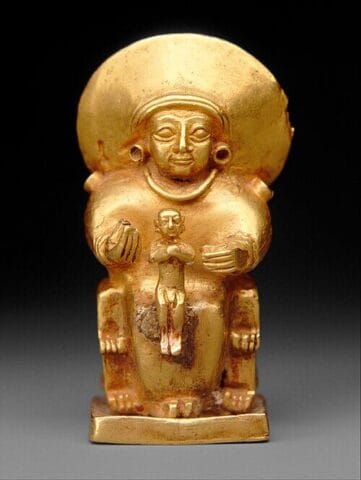
Hannahanna was a mother goddess in Hittite religion whose name means “Grandmother.” Associated with childbirth and fertility, she appears in Anatolian myths as an elder deity whose advice could succeed where the efforts of more powerful gods had failed. Her best-known intervention came during the disappearance of Telipinu, when she sent a bee to find the missing god after the other deities had searched in vain.
Hannahanna also appears in fragmentary myths involving the goddess Inara, while another surviving text concerns her own disappearance. References to mother goddesses in Hittite birth rituals provide further evidence of her religious significance, although identifying her in every such text remains difficult. These sources reveal a divine figure associated with motherhood, wisdom, and restoring order, while leaving important questions about her worship unanswered.
Who Was Hannahanna in Hittite Religion?
The name Ḫannaḫanna is formed by repeating the Hittite word ḫanna-, meaning “grandmother.” Her mythological appearances belong to the religious traditions of ancient Anatolia, where Hittite scribes preserved and adapted beliefs associated with the earlier Hattian culture. Although these connections are evident, the surviving texts do not establish where her worship originated.
Hannahanna also appears in ritual, festival, and divination texts, rather than mythology alone. These records show that she held a place in religious practice beyond the stories of disappearing gods, even though the extent and geographical distribution of her cult remain difficult to reconstruct.
Hannahanna’s Authority Among the Gods
Hannahanna’s influence appears most clearly when other gods seek her advice. In Telipinu and the Daughter of the Sea (CTH 322), the Sea demands a bride-price after Telipinu takes his daughter as his wife. The Storm God turns to Hannahanna, uncertain whether he should pay. She advises him to meet the demand, and he gives the Sea one thousand cattle and one thousand sheep. The episode presents her as a trusted adviser whose judgment carries weight even with a major deity.
Her counsel is also sought in the myth of the Storm God’s disappearance (CTH 325). After the gods fail to locate him, his father approaches Hannahanna and Gulsa, a goddess associated with fate. Hannahanna offers to instruct a bee to continue the search, despite doubts about its ability to succeed. The surviving text breaks off before the outcome can be fully established.
In these accounts, Hannahanna provides direction when other gods are uncertain how to act. Her authority rests on counsel and initiative, although the surviving myths do not establish her as ruler of the Hittite pantheon.
Read Also
Hannahanna and the Search for Telipinu
In the Disappearance of Telipinu (CTH 324), Hannahanna intervenes after the Sun God’s eagle and the Storm God himself fail to find the missing deity. She sends a bee to continue the search, despite the Storm God’s doubts that such a small creature could succeed.
Hannahanna’s instructions are unusually specific. The bee must sting Telipinu’s hands and feet to wake him, wipe him with wax, purify him, and bring him back. It eventually finds him sleeping in a meadow, but the sting only intensifies his anger. Instead of returning peacefully, Telipinu brings further destruction upon the land.
Finding the god is therefore only the first step toward ending the crisis. Further rituals, including those performed by the goddess Kamrusepa, are needed to remove his anger and restore order. Hannahanna’s intervention succeeds in locating Telipinu, but his return requires more than awakening him.
Hannahanna in the Myths of Inara
A fragmentary Hittite myth (CTH 336.3) places Hannahanna in conversation with Inara, the daughter of the Storm God. Hannahanna urges her to stay and offers her land and a husband. When the Storm God discovers that Inara is missing, he sends a bee to search for her. The bee reaches Hannahanna and reports his concern. Hannahanna then places animal parts into a hunting bag, but the damaged text does not explain what she intends to do with them.
Other fragments describe Hannahanna directing divine messengers. In one account, she sends a bee to a protective deity with instructions to sound a goat’s horn. Another describes a bee returning with a hunting bag while Hannahanna prepares three ritual features whose precise nature remains uncertain. Because these passages survive separately and in damaged condition, their relationship to one another and the outcome of Inara’s disappearance cannot be established.
The Disappearance of Hannahanna
A damaged Hittite composition (CTH 334) concerns Hannahanna’s disappearance and return, although much of its narrative must be reconstructed from incomplete passages. The surviving text describes mist covering windows, smoke filling houses, and fires dying in their hearths. Cattle and sheep suffer, while partly restored lines describe mothers neglecting their children and animals turning away from their young. Nothing preserved explains what provoked the goddess’s anger.
Much of the text concerns rituals intended to appease her. One incantation directs her anger into the Dark Earth, where bronze vessels with lead lids are said to contain whatever enters them. Another invokes a hawthorn tree that catches tufts of hair and wool from passing animals, asking it to draw away Hannahanna’s anger in the same manner.
A further ritual compares her troubled spirit to smoldering brushwood. The deity Hapantali kindles wood in a hearth, and sacred water is poured onto the fire. Rising vapor enters Hannahanna’s body to drive out her anger. A damaged passage suggests her joyful return, but the surviving evidence preserves the rites of reconciliation more clearly than the events leading to her disappearance.
Hannahanna, Motherhood, and Birth Rituals
Hannahanna’s connection with childbirth is documented in Hittite ritual texts, not simply inferred from her title as a mother goddess. In a birth ritual preserved on tablet KUB 30.29, a midwife prepares two stools and three cushions for a woman in labor. During the delivery, an incantation names several gods and the places assigned to them. Hannahanna receives no particular city or sanctuary. Instead, humanity itself is described as her allotted domain.
Another ritual fragment (KUB 30.30) invokes Hannahanna following childbirth. It asks her to make a newborn boy strong, while the corresponding words concerning a girl are damaged. Her involvement therefore extended beyond delivery to the child’s well-being after birth.
Hannahanna was not the only deity invoked during childbirth. Kamrusepa and groups of mother goddesses also appear in Hittite birth rituals. Most surviving instructions come from formal religious contexts, however, so they cannot establish how frequently ordinary families performed these ceremonies.
Was Hannahanna the Same as Other Mother Goddesses?
Hittite scribes sometimes wrote Hannahanna’s name using the Sumerian signs DINGIR.MAḪ, meaning “Great Goddess” or “Mother Goddess,” and sometimes dNIN.TU, associated with the Mesopotamian birth goddess Nintu. These alternative writings reflect connections between Anatolian and Mesopotamian religious traditions, but they do not settle whether the goddesses originally shared the same identity.
Hittite texts also distinguish between a singular Mother Goddess and groups of Mother Goddesses, written DINGIR.MAḪ.MEŠ. The latter appear alongside the Fate Goddesses in rituals concerning childbirth and the destiny of newborn children. Their collective role should not automatically be attributed to Hannahanna alone.
Scholars disagree about the relationship. Piotr Taracha has argued that Hannahanna was essentially the Mesopotamian Nintu under a Hittite name, while other researchers regard her as an Anatolian goddess whose identity became associated with Nintu. The surviving evidence supports a close religious connection, but her precise origins remain disputed.
Conclusion
Hannahanna’s role in Hittite religion extended beyond sending a bee to find Telipinu. Other myths show gods seeking her judgment, while ritual texts connect her with childbirth and the well-being of newborn children. Her own disappearance was remembered as a crisis requiring ritual intervention. Although the surviving records leave questions about her origins and relationship to other mother goddesses unresolved, they establish her distinctive place in Anatolian religious tradition.
Academic Sources & Primary Texts
This article draws on Hittite mythological texts, birth rituals, and modern scholarship to examine Hannahanna’s religious identity, her role among the gods, and her relationship to other mother goddesses.
Primary Texts and Ancient Records
- Hittite mythological texts.
Catalogue of Hittite Texts.
Akademie der Wissenschaften und der Literatur, Mainz.
Relevant compositions include CTH 322, 324, 325, 334, and 336, documenting Hannahanna’s appearances in myths of divine marriage and disappearance. - TITUS.
“CTH 334.1.1: The Disappearance of Hannahanna.”
Corpus of Hittite Mythological Texts, Goethe University Frankfurt.
Cuneiform text edition preserving passages concerning the goddess’s anger and the rites intended to appease her. - TITUS.
“CTH 336.3: Myths of the Goddess Inara.”
Corpus of Hittite Mythological Texts, Goethe University Frankfurt.
German translation of the fragmentary account involving Inara, Hannahanna, the Storm God, and the bee. - Kimball, Sara E., and Jonathan Slocum.
“The Telepenus ‘Vanishing God’ Myth.”
Hittite Online, Lesson 2. University of Texas at Austin.
A Hittite text selection with linguistic commentary and discussion of Hannahanna’s role in the search for Telipinu.
Academic Studies
- Hoffner, Harry A., Jr. 1998.
Hittite Myths.
2nd ed. Edited by Gary M. Beckman. Writings from the Ancient World 2. Atlanta: Scholars Press.
Especially pp. 14–33, covering Telipinu, the Storm God, Hannahanna, and Inara. - Kellerman, Galina. 1987.
“La déesse Ḫannaḫanna: son image et sa place dans les mythes anatoliens.”
Hethitica 7: 109–147.
A specialized study of Hannahanna’s identity and her place in Anatolian mythology. - Beckman, Gary M. 1983.
Hittite Birth Rituals.
2nd rev. ed. Studien zu den Boğazköy-Texten 29. Wiesbaden: Harrassowitz.
An edition and analysis of Hittite childbirth rituals, including KUB 30.29 and the identification of mother goddesses. - Taracha, Piotr. 2010.
“Anatolian Ḫannaḫanna and Mesopotamian DINGIR.MAḪ.”
In Investigationes Anatolicae: Gedenkschrift für Erich Neu, edited by Jörg Klinger, Elisabeth Rieken, and Christel Rüster, 301–310. Studien zu den Boğazköy-Texten 52. Wiesbaden: Harrassowitz.
A study of Hannahanna’s identification with Mesopotamian mother goddesses.
Research Note:
Several myths involving Hannahanna survive only in damaged fragments. Reconstructed passages and proposed identifications with other goddesses are distinguished from directly preserved evidence wherever possible.
Written by
H. Moses
| All rights reserved © 2026
History & Myths