The Kumarbi Cycle: The Hurrian Gods’ Struggle for Heaven
The Kumarbi Cycle is a group of ancient Hurrian myths, preserved mainly in Hittite-language tablets from Hattusa, about the struggle for kingship among the gods. The Song of Emergence traces the succession of Alalu, Anu, and Kumarbi before describing the extraordinary birth of the storm god Teššub. Other songs recount Kumarbi’s attempts to challenge Teššub’s rule, particularly through the sea monster Hedammu and the stone giant Ullikummi.
The surviving poems are fragmentary and may not have formed a single continuous narrative. Their original sequence is also uncertain. The account of divine succession, especially Kumarbi’s overthrow of Anu, shares close parallels with Hesiod’s Greek Theogony. These similarities have made the Hurrian stories central to scholarly discussions of how Near Eastern mythological traditions reached ancient Greece, although the precise routes of transmission remain debated.
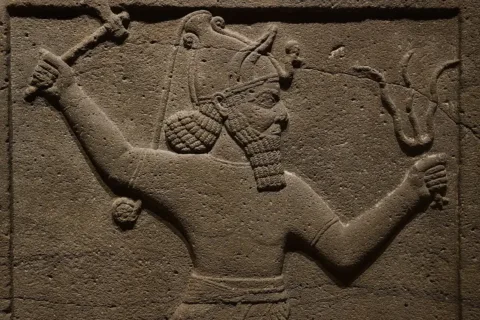
What Is the Kumarbi Cycle?
The Kumarbi Cycle is a modern scholarly name for a group of related mythological poems, not a single ancient epic. Hittite scribes called individual compositions “songs,” a designation found in their tablet colophons. The opening poem, Song of Emergence (CTH 344), was traditionally known as the Song of Kumarbi or Kingship in Heaven. It describes the early succession of divine rulers and the emergence of the storm god Teššub.
Other poems commonly associated with the cycle are the Song of LAMMA (CTH 343), Song of Silver (CTH 364), Song of Hedammu (CTH 348), and Song of Ullikummi (CTH 345). Their surviving fragments share characters and conflicts, but no ancient list establishes the full extent or original order of the collection.
While Song of Emergence is generally accepted as the starting point, the sequence of the remaining works is disputed. Scholars have also questioned whether they formed one continuous narrative or several partly independent groups of stories.
The Hurrian Origins and Hittite Preservation of the Myths
Most surviving manuscripts of the Kumarbi songs come from Hattusa, where Hittite scribes copied and adapted Hurrian religious literature. The tablets date mainly to the fourteenth and thirteenth centuries BCE, when Hurrian traditions had gained a strong presence at the Hittite court through contacts with Kizzuwatna and northern Syria.
Although most of the poems survive in Hittite, fragments in Hurrian have also been recovered. These include portions of the Song of Hedammu and Song of Ullikummi, along with a fragment of the Song of Silver found at Kayalıpınar, ancient Šamuha. A passage preserved in both Hurrian and Hittite versions of Ullikummi shows that the Hittite composition was reworked rather than translated word for word.
The songs’ earlier history is harder to establish. They are generally associated with Hurrian literary traditions, but scholars disagree about where they were first composed and whether their earliest written versions were in Hurrian or Akkadian. Some may also have taken shape within the Hittite scribal tradition. A colophon on a manuscript of the Song of Emergence identifies it as a copy of an older, worn tablet, confirming an earlier stage of textual transmission without revealing when the story was first composed.
Who Was Kumarbi, the Father of the Gods?
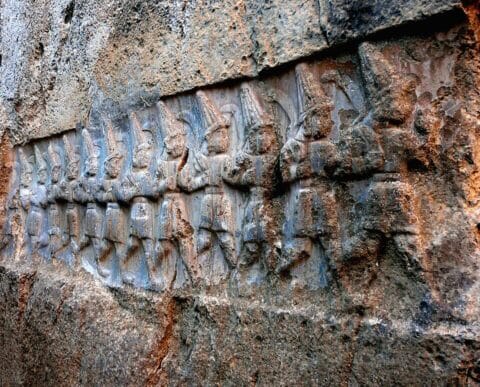
Kumarbi belonged to an older generation of Hurrian deities. The Song of Ullikummi calls him the “father of all gods,” a title expressing his ancestral authority rather than implying that every deity was literally his offspring. Although Teššub holds heavenly kingship in the later songs, Kumarbi retains the status of a senior divine figure.
Kumarbi’s mythological home was Urkeš, identified with Tell Mozan in northeastern Syria. Archaeologists Giorgio Buccellati and Marilyn Kelly-Buccellati have proposed that the city’s great temple was dedicated to him. Their interpretation rests partly on an inscription of the ruler Tiš-atal, which names a deity using the cuneiform writing conventionally read as Nergal. They argue that this designation may represent Kumarbi in the Hurrian context. Since the inscription does not explicitly name him, the temple’s dedication remains uncertain.
Kumarbi was also identified with the Mesopotamian Enlil and the Syrian god Dagan in regional theological traditions. These associations reflected their comparable standing as ancestral gods rather than identical mythological histories. His identification with Dagan also helps explain why Šalaš, Dagan’s consort, appears as Kumarbi’s partner in Hurrian religious texts.
The Song of Emergence: Alalu, Anu, and Kumarbi
The Song of Emergence (CTH 344) opens with an invocation to the ancient gods before recounting the succession of heavenly rulers. Alalu occupies the throne, while Anu, foremost among the gods, serves as his cupbearer. In the ninth year of Alalu’s reign, Anu defeats him in battle and takes the throne. Alalu escapes to the Dark Earth.
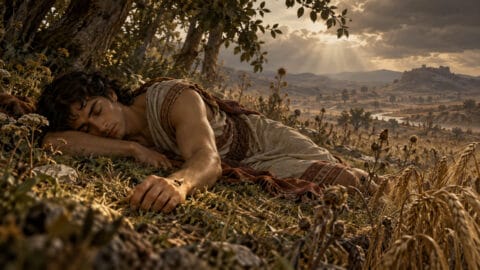
Anu rules for another nine years, with Kumarbi, a descendant of Alalu, serving as his cupbearer. In the ninth year, Anu battles Kumarbi but is forced to flee. He rises toward heaven like a bird, only for Kumarbi to seize him by the feet and drag him down. Kumarbi bites off Anu’s genitals, swallows them, and laughs in triumph.
Anu warns that Kumarbi has unknowingly become pregnant with three gods: Teššub, the future Storm God, the Tigris River (Aranzaḫ), and Tašmišu. He predicts that these offspring will bring Kumarbi suffering, turning his apparent victory into the beginning of another struggle for heavenly kingship.
The Birth of Teshub and the Struggle for Heaven
Kumarbi attempts to rid himself of Anu’s offspring by spitting out some of the seed he has swallowed. Mount Kanzura receives it and becomes pregnant with Tašmišu. Kumarbi then travels to Nippur, where the remaining pregnancy presents an unusual problem: how can the gods emerge from a male body?
In the damaged passages that follow, the gods discuss possible routes of birth. A deity designated KA.ZAL emerges after Kumarbi’s skull is split open. Many scholars identify this figure with Teššub, although the interpretation is disputed. Furious, Kumarbi demands that Ea surrender his newborn son so he can devour him. Instead, he is given a diorite stone, which damages his teeth when he bites it. A later passage describes Kumarbi’s skull being closed again, while other damaged lines concern the births of the Tigris River (Aranzaḫ) and Tašmišu.
The narrative then moves toward a struggle over heavenly kingship, but much of the account is lost. In a surviving exchange, Teššub angrily speaks of his divine opponents and curses other gods. His sacred bull Šeri warns him against this hostility, particularly toward Ea. The damaged continuation suggests that Teššub’s claim to power was not yet secure. Although later Kumarbi songs present him as the reigning Storm God, the Song of Emergence does not preserve a complete account of his accession.
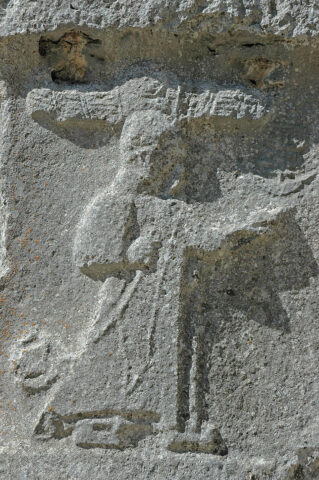
Tarhunna: The Storm God of the Hittites
The Song of LAMMA: Another Claimant to Divine Kingship
In the Song of LAMMA (CTH 343), a protective deity defeats Teššub and briefly takes his place as ruler of heaven. LAMMA fires arrows at Teššub and his sister Šauška, striking the goddess, before seizing the reins of the Storm God’s chariot. With the apparent support of Ea and Kumarbi, he gains heavenly kingship. His identity remains uncertain because the text uses the Sumerian designation dLAMMA. Volkert Haas proposed identifying him with Kurunta, an Anatolian protective god associated with deer and hunting, but this interpretation is disputed.
Once enthroned, LAMMA refuses Kubaba’s advice to pay respect to the primeval gods. His refusal reaches Ea, who also learns that humans have stopped presenting bread and drink offerings to the gods. Ea and Kumarbi consequently withdraw their support. The problem is not simply LAMMA’s arrogance: he has failed to maintain the obligations expected of a divine ruler.
Ea sends a messenger to rebuke LAMMA for neglecting his duties, including his failure to convene the divine assembly. He then instructs his messenger Izzummi to contact Nara-Napšara in the underworld and arrange for the animals of the earth to be mobilized against the deposed king. The final passages are fragmentary, but they indicate that Teššub takes part in the effort to overthrow LAMMA. The precise sequence of his removal from power cannot be fully reconstructed.
The Song of Silver: Kumarbi’s Ambitious Son
The Song of Silver (CTH 364) follows a son of Kumarbi who grows up without knowing his father’s identity. Silver strikes another boy with a stick and is mocked for being fatherless himself. Distressed by the insult, he confronts his mother, who reveals that his father is Kumarbi and that Teššub and Šauška are his divine siblings.
Silver travels to Urkeš, Kumarbi’s residence in northeastern Syria, but finds that his father has left the city and is wandering in the mountains. The narrative then becomes fragmentary. One passage suggests that Silver has gained power over the gods, while Teššub and Tašmišu discuss the threat he poses. Their conversation does not establish whether a battle between Silver and Teššub took place.
In another surviving episode, Silver drags the Sun and Moon down from heaven. The two deities bow before him and plead for their lives, warning that killing them would leave the lands he rules in darkness. His response is only partly preserved.
The song’s ending is lost, and Silver’s place in the Kumarbi Cycle remains disputed. Although his divine ancestry and challenge to the heavenly gods connect him with the wider succession traditions, the surviving text does not establish how he gained power or whether Teššub eventually defeated him.
The Song of Hedammu: The Sea Monster and Šauška
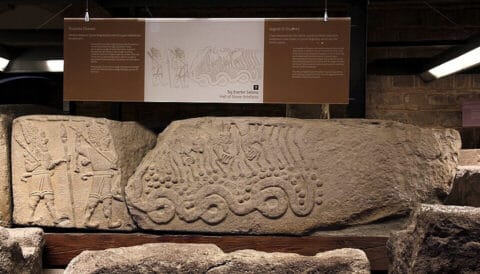
In the Song of Hedammu (CTH 348), Kumarbi conspires with the Sea God, who gives him his daughter Šertapšuruḫi in marriage. Their son Hedammu is a monstrous sea serpent intended to challenge Teššub’s rule. As Hedammu grows, he devours animals and humans, threatening the population that sustains the gods through sacrifices and offerings.
Šauška, Teššub’s sister and the Hurrian counterpart of Ištar, discovers the monster and rushes to warn the gods. Teššub weeps at the news, while Ea confronts Kumarbi over the destruction of humanity. He warns that without people to provide bread, drink, and sacrifices, the gods would have to cultivate the land themselves. Kumarbi angrily rejects the rebuke.
When Teššub prepares to fight Hedammu, Šauška chooses another approach. She bathes, anoints herself with oil, and travels to the seashore with her attendants Ninatta and Kulitta, who accompany her with music. Her beauty and singing arouse Hedammu’s desire and draw him toward her. She also uses intoxicating drink to weaken the serpent, turning his attraction into a means of overcoming him.
The surviving text breaks off without describing Hedammu’s final fate. His defeat is generally inferred from the narrative, but no complete account of his death or the conclusion of the confrontation has survived.
The Song of Ullikummi: Kumarbi’s Stone Giant
The Birth and Growth of Ullikummi
In the Song of Ullikummi (CTH 345), Kumarbi leaves Urkeš and travels to a place called the Cold Spring, where he has intercourse with an enormous rock. The rock gives birth to a stone child, whom the Fate Goddesses and Mother Goddesses place on Kumarbi’s knees. He names him Ullikummi and declares that his son will rise to heaven, destroy Kummiya, Teššub’s city, and crush the Storm God and his brother Tašmišu.
To conceal the child, Kumarbi sends his messenger Impaluri to summon the Irsirra deities. They carry Ullikummi to the Dark Earth, first presenting him to Enlil, who recognizes him as a threat to the gods. They then place him on the right shoulder of Upelluri, a primordial giant who supports heaven and earth. Made of diorite, Ullikummi grows at an extraordinary rate. Within fifteen days, he stands in the sea like a towering pillar, reaching toward the temples of heaven.
The Sun God notices the giant and hurries to warn Teššub. When the Storm God climbs Mount Hazzi with Tašmišu and Šauška to see the creature, he is overwhelmed and begins to weep.
How Did the Gods Confront Ullikummi?
Šauška first attempts to overcome Ullikummi through her beauty and music, approaching the seashore and singing to him. A great wave rises from the water and warns her that the giant is blind, deaf, and incapable of responding to her charms. Unlike Hedammu, Ullikummi cannot be distracted by seduction.
Teššub prepares his war chariot and sacred bulls for battle, summoning storms, winds, and lightning. Seventy gods join the assault, but they cannot defeat the stone giant. Ullikummi advances to the gates of Kummiya, where his enormous body blocks Ḫebat, Teššub’s wife, from seeing her husband or receiving news of the battle. Fearing that Teššub has been killed, she sends her attendant Takiti to investigate.
With the gods unable to stop Ullikummi, Tašmišu advises Teššub to seek help from Ea. The wise god approaches Enlil and then Upelluri, asking about the creature standing on the primordial giant’s shoulder. Upelluri explains that he scarcely noticed when heaven and earth were placed upon him and later separated. Only recently has he felt something pressing painfully against his right shoulder.
Ea turns Upelluri’s shoulder and discovers Ullikummi standing upon it. He orders the ancient gods to retrieve the copper cutting tool once used to separate heaven from earth. With this instrument, Ullikummi is severed from Upelluri, breaking the connection that had protected his extraordinary strength.
Ea then tells Tašmišu that the gods can confront the giant again. Teššub renews the attack, but the surviving narrative breaks off before the final outcome is recorded. Ullikummi’s complete defeat is therefore not preserved in the extant tablets.
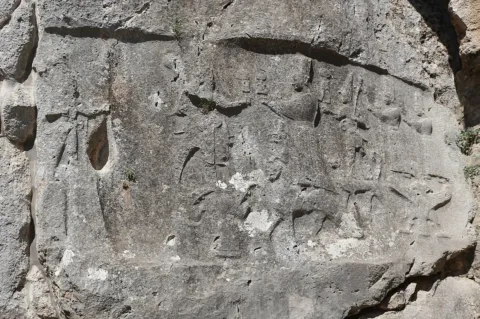
Other Songs and the Uncertain Limits of the Cycle
The Song of the Sea is another possible member of the Kumarbi Cycle. Hurrian fragments identified as KUB 45.63 and VBoT 59 are classified under CTH 346, while a separate Hittite fragment may preserve part of the same story. The surviving evidence points to a conflict between Teššub and the Sea, although the relationship between these versions remains uncertain.
The possible Hittite version describes the Sea unleashing a flood that threatens heaven. Kumarbi attempts to appease the Sea with offerings, while Šauška appears as the bearer of tribute. A separate ritual associated with Mount Hazzi (CTH 785) refers to the performance of a song celebrating Teššub’s victory over the Sea. This connection provides evidence that the narrative had a place in religious ceremonies, but does not establish its original position among the Kumarbi songs.
Another possible member is Ea and the Beast (CTH 351), a damaged Hittite composition in which an unidentified animal delivers a prophecy to Ea. The speech appears to foretell the rise of a powerful god who will overthrow earlier divine rulers and confine his enemies to the underworld. Scholars have proposed identifying this future ruler with Teššub, although neither he nor Kumarbi is named securely in the preserved passages.
Other fragments describe the heavenly kingship of the ancient god Eltara, an encounter between Šauška and Mount Pišaiša, and a separate episode involving Kumarbi and Mount Wašitta. Their connections with the better-preserved songs remain uncertain, and none provides sufficient evidence to reconstruct a continuous narrative.
What Does the Kumarbi Cycle Reveal About Divine Kingship?
The Kumarbi songs portray heavenly kingship as a position that can be seized but never taken for granted. Alalu, Anu, and Kumarbi each lose power to a challenger, while Teššub faces repeated attempts to overthrow him. Divine ancestry offers no guarantee of an uncontested reign.
The Song of LAMMA adds a different dimension to kingship. LAMMA loses the support of Ea and the older gods after neglecting his responsibilities, particularly the continuation of human offerings. In the Song of Hedammu, Ea raises a similar concern when he warns Kumarbi that destroying humanity would leave the gods without sacrifices. Both episodes present the welfare of the divine community as a concern that can outweigh the ambitions of individual rulers.
Ea’s shifting allegiances further complicate the struggle. He initially supports LAMMA but later turns against him, while in the Song of Ullikummi he helps Teššub by recovering the ancient tool used to separate heaven from earth. His knowledge of the primordial order proves more effective against Ullikummi than the combined military strength of the gods.
These conflicts are not presented as a straightforward struggle between good and evil. Kumarbi’s opponents have competing interests, and Teššub depends on divine assistance to defend his position. The songs offer different perspectives on power, succession, and royal obligations rather than a single, consistent doctrine of legitimate kingship.
How Did the Kumarbi Cycle Influence Greek Mythology?
The strongest Greek parallel to the Kumarbi Cycle appears in Hesiod’s Theogony, composed around 700 BCE. Both traditions describe successive generations of gods struggling for heavenly kingship. The sequence of Anu, Kumarbi, and Teššub resembles that of Ouranos, Kronos, and Zeus, although the family relationships and circumstances of their victories differ.
The similarities extend to specific events. Kumarbi bites off and swallows Anu’s genitals, becoming pregnant with a new generation of gods. In Hesiod’s account, Kronos castrates his father Ouranos with a sickle, but does not swallow his genitals. Both traditions also feature a stone substituted for a divine child. Rhea gives Kronos a stone to swallow in place of the infant Zeus, while Kumarbi is apparently given a diorite stone when he demands his newborn son. Unlike Kronos, Kumarbi bites the stone and damages his teeth.
The differences are equally important. Kumarbi overthrows the god who displaced his ancestor Alalu, whereas Kronos attacks his own father. Teššub subsequently faces repeated challenges from Kumarbi’s monstrous offspring. These conflicts invite comparison with Zeus’s battles against divine opponents, particularly Typhon, but the stories differ in their characters, events, and outcomes.
The close parallels suggest that Near Eastern succession traditions contributed to the development of Greek mythology. Ian Rutherford identifies northern Syria, Cilicia, and Cyprus as possible routes of transmission, while Amir Gilan has emphasized the potential importance of performances associated with Mount Hazzi on the Syrian coast. The precise route remains unknown, and there is no evidence that Hesiod directly consulted a Hittite manuscript.
Conclusion
The Kumarbi songs portray heavenly kingship as a power repeatedly challenged, whether by rival gods or the monstrous offspring of Kumarbi. Yet the surviving texts do not form a complete, securely ordered epic. Their damaged passages leave important questions about the succession of rulers and the outcomes of individual conflicts unanswered.
Preserved within Hittite literary culture, these Hurrian traditions offer a rare view of how ancient Near Eastern societies imagined the struggle for divine authority. Their parallels with Hesiod’s Theogony also point to wider connections between Near Eastern and Greek mythology, although the precise routes of transmission remain uncertain.
Academic Sources & Primary Texts
Primary Texts and Translations
- Hoffner, Harry A., Jr. Hittite Myths. 2nd ed. Edited by Gary M. Beckman. Writings from the Ancient World 2. Atlanta: Scholars Press, 1998. Includes translations of the Hurro-Hittite Kumarbi songs.
Publisher. - Hesiod. Theogony. Translated by Hugh G. Evelyn-White, 1914. Especially lines 154–210 and 453–506, concerning Ouranos, Kronos, and Zeus.
Perseus Digital Library.
Academic Studies
- Güterbock, Hans Gustav. “The Hittite Version of the Hurrian Kumarbi Myths: Oriental Forerunners of Hesiod.” American Journal of Archaeology 52, no. 1 (1948): 123–134.
DOI. - Archi, Alfonso. “The West Hurrian Pantheon and Its Background.” In Beyond Hatti: A Tribute to Gary Beckman, edited by Billie Jean Collins and Piotr Michalowski, 1–21. Atlanta: Lockwood Press, 2013.
Full text. - Bachvarova, Mary R. From Hittite to Homer: The Anatolian Background of Ancient Greek Epic. Cambridge: Cambridge University Press, 2016.
Publisher. - Gilan, Amir. “‘Let Those Important Primeval Deities Listen’: The Social Setting of the Hurro-Hittite Song of Emergence.” In Gods and Mortals in Early Greek and Near Eastern Mythology, edited by Adrian Kelly and Christopher Metcalf, 19–36. Cambridge: Cambridge University Press, 2021.
DOI. - Rutherford, Ian. Hittite Texts and Greek Religion: Contact, Interaction, and Comparison. Oxford: Oxford University Press, 2020.
Publisher. - Giusfredi, Federico, and Valerio Pisaniello. “Hurrians and Hurrian in Hittite Anatolia.” In Contacts of Languages and Peoples in the Hittite and Post-Hittite World, vol. 1, The Bronze Age and Hatti, 259–283. Leiden: Brill, 2023.
Open-access chapter.
Copyright & Editorial Notice
© 2026 History & Myths. All rights reserved. This article is an original historical and mythological study based on published academic research and surviving ancient texts. Interpretations of fragmentary sources and disputed scholarly reconstructions are identified where relevant. Reproduction or republication without permission is prohibited, except as permitted by applicable copyright law.