Pirwa: The Hittite Horse God and His Mysterious Symbols
Pirwa was an ancient Anatolian deity whose worship is documented at Kanesh (Neša) in the early second millennium BCE and later in Hittite royal records. His connection with horses is well established: Hittite texts describe his image standing on a horse, while a religious institution dedicated to him was involved in raising and training these animals.
Yet Pirwa’s role extended beyond horses. Descriptions of his cult images include a whip and a possible weapon, suggesting martial associations. These same records have also shaped a longstanding debate over his gender, with recent scholarship providing stronger evidence that Pirwa was a male deity.
Who Was Pirwa in Hittite Religion?
Pirwa, also known as Perwa or Peruwa, was an Anatolian god whose worship appears in Hittite, Hattian, and Luwian religious traditions. Most evidence comes from cult inventories, festival texts, and royal records, although a fragmentary myth involving Pirwa has also survived.
The origin of his name remains disputed. Some scholars connect it with the Hittite word peru-, meaning “stone” or “rock,” while others link it to parḫ-, meaning “to hunt” or “to rush.” The second interpretation may reflect his association with horses, but neither derivation has been established conclusively.
The Origins of Pirwa’s Worship at Kanesh
The earliest written evidence for Pirwa comes from Kanesh (Hittite Neša, modern Kültepe) in central Anatolia. Old Assyrian tablets from the 19th and 18th centuries BCE record his name as Per(u)wa, placing his worship well before the rise of the Hittite Empire.
One tablet, kt 87/k 320, mentions a priest named Ḫapuala who served Per(u)wa. The god’s name also appears in personal names associated with prominent officials and members of royal families, indicating his importance in the city’s religious life.
These records establish the early presence of Pirwa’s cult but reveal little about its rituals or when his worship first began.
A Surviving Myth of Pirwa
A fragmentary Hittite myth preserved in KUB 48.99 (CTH 337) presents Pirwa as a divine king. In the surviving passage, a goddess called the Divine Queen challenges Pirwa’s young companions to bring an eagle from the city of Ḫaššuwa. She promises a substantial reward, with Pirwa himself offering to make the successful participant wealthy.
The young gods gather and boast of their ability to complete the task. One of them, Ilali, declares that he will bring the eagle, but the tablet breaks off before the outcome is revealed.
- Craig Melchert interprets the story as a test of prowess and suggests that it may have been translated into Hittite from Hattian. The original language remains uncertain.
Why Was Pirwa Associated with Horses?
Pirwa’s association with horses rests on two kinds of evidence: descriptions of his cult images and records of horse breeding and training at his sanctuary. These establish a close connection with horses, although they do not tell us precisely what protection or benefits worshippers expected from him.
A further clue appears in KUB 35.145, where Pirwa bears the epithet parḫant-, meaning “chasing” or “hunting.” Scholars have linked it to speed and pursuit, possibly reflecting his association with horses, but its religious significance remains uncertain.
Although horses played an important role in Hittite chariot warfare, the evidence does not establish Pirwa as exclusively a god of warhorses or military activity.
Pirwa’s Statues, Symbols, and Weapons
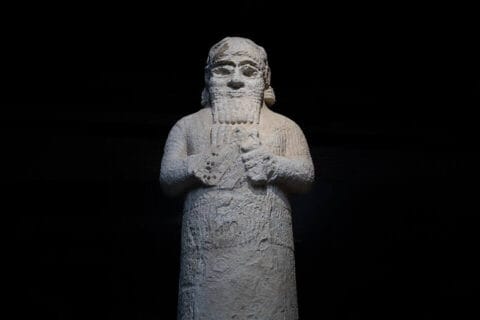
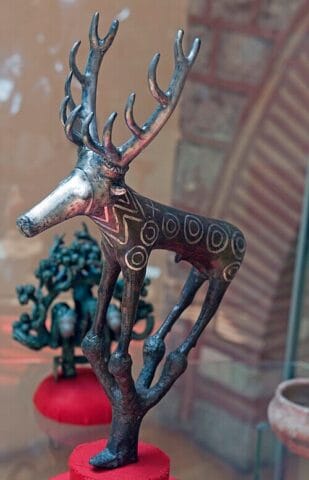
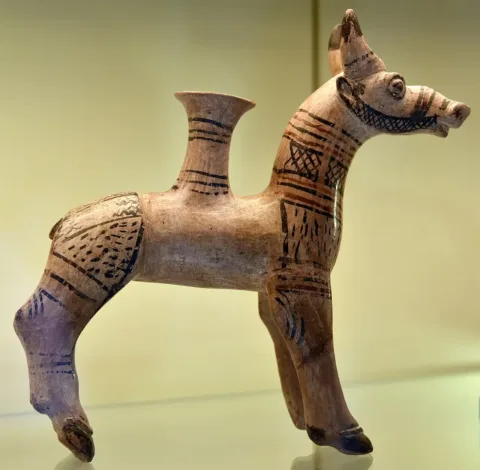
No securely identified statue of Pirwa survives, but Hittite texts describe his appearance in considerable detail. An inventory from Šippa (KUB 38.4) depicts him standing on a silver-plated horse. Another text, KBo 44.209+, describes a bronze-plated horse on a bronze base at Zipariya, with a wooden trough placed before the image.
His equipment is less certain. In a 2025 study, Birgit Christiansen reexamined a damaged passage in KUB 38.4 and argued that Pirwa held a striking weapon in his right hand and a silver whip in his left. The weapon may have been a spear, lance, or mace, but the text does not identify it precisely.
Other details remain open to interpretation. The word ašuša- may refer to the god’s earrings or rings belonging to the horse’s harness or the rider’s equipment. In the oracle text Çorum 6-1-96, Christiansen interprets a reference to a mountain as a feature of the statue rather than a geographical name. She also connects the obscure term karzana- with words for weaving tools, suggesting that it may have described a rod-like object or possibly a sword. Its actual form and function remain unknown.
Was Pirwa a Male or Female Deity?
Scholars have variously identified Pirwa as male, female, or a deity with both genders. The strongest evidence for a male identity comes from KBo 44.209+, which describes his cult image as an armed man standing on a horse.
Much of the uncertainty arose because Pirwa’s name frequently appears beside MUNUS.LUGAL, the Sumerian writing for “Queen.” Birgit Christiansen’s 2024 study argues that this usually refers to a separate goddess rather than a title of Pirwa. A seal from Kültepe depicting a male figure on an equid near a female deity has also been cited in support of a dual-gender interpretation, but the image does not establish that both figures represent Pirwa.
Christiansen therefore finds insufficient evidence to identify Pirwa as female or dual-gendered.
Pirwa’s Temples and the Training of Horses
Pirwa’s principal sanctuary was the NA₄ḫekur Pirwa, a rock sanctuary possibly built on elevated or rocky ground. Its exact location remains unknown. The institution managed agricultural activities, including crop cultivation and the raising of sheep, goats, and horses. It also functioned as a horse-training center.
A decree issued by King Hattusili III (KBo 6.28 + KUB 26.48, CTH 88) exempted the sanctuary from compulsory labor and deliveries of grain, straw, wool, wooden chariot components, and trained horses. These exemptions protected its resources from demands normally imposed by the royal administration.
The sanctuary was not entirely free of obligations. Its personnel could still be required to assist the army against enemies, although the decree protected them from other compulsory duties.
Read Also
- Hittite Mythology: Gods, Monsters and Sacred Stories
Explore the gods, sacred myths, and religious traditions of ancient Anatolia. - Inara: Hittite Goddess of Wild Animals and Protection
Discover another Anatolian deity whose worship is documented in Hittite religious texts.
Festivals, Offerings, and Ritual Worship
Pirwa received offerings during monthly and annual festivals. In the Festival of the Month (CTH 591), a singer from Kanesh performed a Hattian song for Pirwa of Šippa. The same festival included a billy goat offered to Pirwa and other deities (KUB 56.45). A separate ritual for vineyard growth (KUB 35.2) included a song addressed to him in Luwian.
Offerings included goats, rams, sheep, oxen, beer, and grain products. An oracle report, KBo 14.21 (CTH 565.1), records an annual obligation from the household of Ališarruma: one ox, eight sheep, beer, flour, and barley mash. An investigation revealed that the required offerings had not been delivered.
The report also documents neglected festivals and the measures taken to restore Pirwa’s favor. Priests were questioned about missing offerings, while divination determined whether proposed remedies were acceptable. These could include performing omitted ceremonies and providing additional food, drink, or animals as compensation.
A related cult inventory, IBoT 2.131, records another abuse: servants of the official Ḫattušakurunta took possession of a vineyard dedicated to Pirwa and cultivated it for themselves. The incident may also be reflected in KBo 14.21, although the connection is not certain.
Pirwa, the Hittite Kings, and Other Gods
Pirwa appears among the divine witnesses to two treaties issued by King Muršili II, one with Niqmepa of Ugarit (CTH 66) and another with Manapa-Tarḫunta of the Šeḫa River Land (CTH 69). He was also invoked in a prayer attributed to Muršili II. Although some scholars have proposed his presence in earlier treaties, Birgit Christiansen’s 2024 analysis finds no secure evidence for his inclusion before Muršili’s reign.
Pirwa was closely associated with Aškašepa and a goddess identified in religious texts by the Sumerian designation MUNUS.LUGAL, meaning “Queen.” In Muwatalli II’s prayer (CTH 381), Pirwa and Aškašepa appear alongside Ištar of Ḫattarina. Francesco Giuseppe Barsacchi suggests that this grouping reflects a later identification of the local “Queen” with Ištar. This remains a scholarly interpretation rather than a firmly established identification.
Conclusion
Pirwa’s cult endured from the Old Assyrian period at Kanesh into the Hittite Empire. His presence in royal treaties, the economic activities of his sanctuary, and descriptions of his cult images reveal a deity whose significance extended beyond his association with horses. Although some details of his imagery remain disputed, the surviving records provide substantial evidence for his place in Anatolian religious and royal life.
Sources & Primary Texts
This article draws on Hittite religious texts, cult inventories, royal decrees, and recent academic studies of Pirwa’s identity and worship.
Academic Sources
- Christiansen, Birgit (2024). “The Character and Gender of the Anatolian Deity Pirwa and Other Ancient Near Eastern Deities Associated with Horses.” In Gods and Languages in Ancient Anatolia, pp. 15–32. University of Barcelona.
Read the academic study. - Christiansen, Birgit (2025). “Interwoven Mysteries: Decoding the Enigmatic Connection between the Tack of the Horse God Pirwa and Weaving Equipment.” Journal of Cuneiform Studies 77, pp. 141–162.
View the published study. - Melchert, H. Craig (2021–2022). “A Myth of Pirwa.” News from the Lands of the Hittites 5–6, pp. XVII–XXXI.
Read the study. - de Martino, Stefano (2022). “The Decree Issued by Hattusili III for the NA4hekur Pirwa (KBo 6.28 + KUB 26.48).” In ana sulmani: Ancient Near Eastern Studies in Honour of Simonetta Graziani, pp. 203–226. UniorPress.
University repository. - Barsacchi, Francesco Giuseppe (2023). “Between Adoption and Assimilation: The Case of Ištar of Ḫattarina.” In Theonyms, Panthea and Syncretisms in Hittite Anatolia and Northern Syria. Firenze University Press.
Read the chapter.
Primary Hittite Texts
- KUB 48.99 (CTH 337): Fragmentary myth involving Pirwa.
- KUB 38.4 and KBo 44.209+: Descriptions of Pirwa’s cult images and equipment.
- KBo 6.28 + KUB 26.48 (CTH 88): Royal decree concerning Pirwa’s sanctuary.
- KBo 14.21 (CTH 565.1): Oracle inquiry concerning neglected offerings and festivals.
- CTH 66 and CTH 69: Treaties of Muršili II invoking divine witnesses.
- CTH 591: Religious festival texts associated with Pirwa’s worship.
Text classifications can be consulted in the
Hethitologie Portal Mainz, Catalogue of Hittite Texts (CTH).
Copyright & Attribution
© 2026 History & Myths. All rights reserved.
Original article and historical analysis by H. Moses.
Academic studies and ancient texts are credited in the Sources & Primary Texts section.
Images, where used, remain subject to their respective copyright terms and licenses.
Unauthorized reproduction of the original article is prohibited.