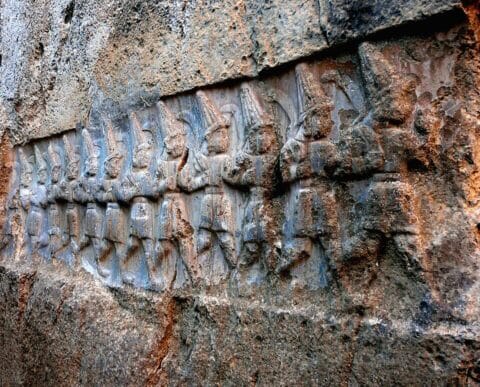
Telipinu: The Hittite Myth of the Missing God and the Dying Land
When Telipinu, the Hittite god associated with fertility and agriculture, vanished in anger, crops stopped growing, animals could no longer reproduce, and even the gods faced hunger. His disappearance brought the land to the brink of famine.
The gods searched for Telipinu, but a small bee finally found his hiding place. Finding him, however, did not end the crisis. His anger had to be calmed before the land could recover.
The story survives in several incomplete Hittite versions, and none reveals exactly why Telipinu became angry. Although the accounts differ in their details, they describe how the gods sought to restore the fertility lost through his disappearance.

Why Did Telipinu Disappear?
The surviving Hittite texts do not reveal what made Telipinu angry. The beginning of the main version, CTH 324.1, is damaged, leaving the cause of his disappearance unknown. When the readable account begins, he is already furious, putting his right shoe on his left foot and his left shoe on his right.
Telipinu leaves, taking grain, animal fertility, growth, and abundance with him into the wilderness. He hides in a marsh, where a plant called ḫalenzu grows over him. The text describes a god withdrawing in anger, not one who has died or been abducted.
How Telipinu’s Disappearance Brought Famine
Mist covered the windows, smoke filled the houses, and logs were smothered in the hearths. Even the gods at their altars were affected. Ewes rejected their lambs, while cows turned away their calves.
Barley and emmer stopped ripening. Cattle, sheep, and humans could no longer conceive, and those already pregnant were unable to give birth. Mountains and trees dried up, new shoots failed to appear, and pastures and springs ran dry. Famine spread across the land, threatening humans and gods alike.
The Sun God prepared a feast and summoned a thousand gods. They ate but remained hungry, and drank without quenching their thirst. Even the divine banquet could not satisfy them.
The Gods’ Search for the Missing Telipinu
The Storm God realized that his son Telipinu was missing and had taken everything good from the land. The great and lesser gods began searching for him.
The Sun God sent a swift eagle to search the high mountains, deep valleys, and distant waters. The eagle returned without finding Telipinu.
The Storm God then sought help from Hannahanna, the mother goddess, who urged him to search for his son himself. He reached a city gate but could not open it. His hammer and wedge broke in the attempt. He wrapped himself in his garment and sat down.
Hannahanna decided to send a bee. The Storm God doubted that such a small creature could succeed where the gods had failed, pointing to its tiny body and wings. Despite his objections, Hannahanna sent the bee to find Telipinu.
The Bee That Found Telipinu
In the third version of the myth (CTH 324.3), the bee searched the high mountains, deep valleys, and waters. Its honey and wax supplies were exhausted before it finally found Telipinu in a wooded meadow at Lihzina, a place name partly reconstructed from the damaged tablet.
The bee stung Telipinu’s hands and feet, causing him to wake.
CTH 324.2 also preserves Hannahanna’s instructions to wipe Telipinu with wax, purify him, and bring him back. However, the surviving account of his discovery confirms the sting, not the completion of these additional rites.
The first version (CTH 324.1) describes Telipinu hiding in a marsh but does not preserve the moment when the bee finds him.
Why Waking Telipinu Made Things Worse
In the third version of the myth (CTH 324.3), Telipinu awoke even angrier than before. He demanded to know why he had been disturbed in his sleep and made to speak while still furious.
His rage brought further destruction. He diverted rivers, tore at their banks, destroyed towns and houses, and killed people, cattle, and sheep. The gods were left wondering how they could stop him.
How Kamrusepa Calmed the Angry God
In the first version of the myth (CTH 324.1), Telipinu returns in a rage, hurling lightning and striking the earth. The goddess Kamrusepa uses an eagle’s wing to restrain his fury before performing a ritual to remove his anger.
She orders twelve rams to be selected from the Sun God’s flock and uses a sieve with a thousand holes, grain, and purifying fire. Her incantations compare Telipinu’s anger to burning brushwood that turns to ash. Just as the flames die out, his wrath must disappear.
The ritual directs his anger into the underworld. A gatekeeper opens seven doors and draws back seven bolts, revealing bronze vessels with lead lids and iron fastenings. Nothing placed inside can escape. Telipinu’s anger is to be confined there, unable to return.
The third version (CTH 324.3) instead calls for human intervention to calm the god. Much of this passage is damaged, leaving the precise ritual uncertain. The surviving texts do not establish these different accounts as successive events in a single version.
Telipinu’s Return and the Restoration of Fertility
Telipinu returned home and resumed caring for his land. Mist left the windows, smoke cleared from the houses, and the gods returned to their proper places at the altars. Fires burned freely in the hearths again.
Mothers accepted their children, ewes their lambs, and cows their calves. Telipinu also turned his attention to the king and queen, granting them life, strength, and a future.
The myth ends with an eya tree standing before Telipinu. A sheepskin bag hangs from its branches, containing symbols of abundance: sheep fat, grain, wine, the fertility of herds, cattle, sheep, long life, and descendants. The image brings the story to a close with the blessings that had vanished during the god’s absence.
What Do the Different Versions of the Myth Say?
The Telipinu myth survives in damaged Hittite texts, classified in the Catalogue of Hittite Texts (CTH). Four versions are identified under CTH 324.1 to CTH 324.4, along with additional fragments.
CTH 324.1 is the best-preserved version. It covers the disappearance, famine, Kamrusepa’s rituals, and the restoration of fertility, but a major gap interrupts the search for Telipinu.
CTH 324.2 preserves Hannahanna’s instructions to the bee, including the sting and purification with wax, followed by fragments of rituals and incantations.
CTH 324.3 gives a fuller account of the bee finding Telipinu and the destruction that follows his awakening. It also describes human intervention to remove his anger.
CTH 324.4 consists mainly of fragmentary offerings and incantations intended to appease the god.
These versions cannot be combined into a single continuous narrative without qualification. Hittitologist Galina Kellerman identified problems with earlier reconstructions that treated different accounts of Telipinu’s pacification as successive events. The surviving evidence does not establish that sequence.
Read Also
- Hittite Mythology: Gods, Monsters and Sacred StoriesExplore the wider world of Hittite myths, including disappearing gods and divine conflicts.
- Tarhunna: The Storm God of the HittitesDiscover the powerful storm deity and his place in Hittite religion and mythology.
- Who Were the Hittites? History, Origins and EmpireLearn about the civilization that preserved the myth of Telipinu on cuneiform tablets.
What Did the Myth of Telipinu Mean?
The myth reflects a Hittite religious belief that prosperity depended on divine favor. Its rituals were intended to remove Telipinu’s anger and restore his protection through offerings, purification, and incantations. The final blessing for the king and queen shows that the god’s favor extended beyond agriculture to royal well-being.
The story belongs to a wider Hittite tradition of disappearing-god myths, many of which were preserved alongside ritual instructions. Scholars have also linked Telipinu’s absence and return to the seasonal cycle of vegetation. However, the surviving narrative does not identify a particular annual festival at which it was performed.
Nor does the text describe a god who dies and rises again. Telipinu remains alive throughout. The crisis comes from his withdrawal, and its resolution depends on restoring his favor.
Academic Sources & Primary Texts
This article is based on published translations of Hittite cuneiform texts and academic research into the Telipinu myth. The surviving accounts are fragmentary, and differences between versions are identified where relevant.
Primary Texts & Text Catalogues
- Hethitologie-Portal Mainz.
Corpus of Hittite Mythological Texts, CTH 324.
Hittite mythological text catalogue.
Scholarly classification of the Telipinu myth, including its different versions and surviving fragments. - Corpus of Hittite Mythological Texts.
The Telipinu Myth, First Version (CTH 324.1).
TITUS, Goethe University Frankfurt.
Read scholarly German translation.
Principal surviving account of the disappearance, famine, purification rituals, and restoration of fertility. - Corpus of Hittite Mythological Texts.
The Telipinu Myth, Second Version (CTH 324.2).
TITUS, Goethe University Frankfurt.
Read scholarly German translation.
Preserves Hannahanna’s instructions to the bee and additional ritual passages. - Corpus of Hittite Mythological Texts.
The Telipinu Myth, Third Version (CTH 324.3).
TITUS, Goethe University Frankfurt.
Read scholarly German translation.
Important evidence for the bee’s discovery of Telipinu, his renewed anger, and the subsequent attempt to appease him.
Academic Studies & Translations
- Hoffner, Harry A., Jr. (1998).
Hittite Myths. Second Edition.
Edited by Gary M. Beckman. Writings from the Ancient World 2. Society of Biblical Literature.
Publisher’s edition.
Standard English translation of the Hittite mythological texts, including the Telipinu narratives. - Kellerman, Galina (1986).
The Telepinu Myth Reconsidered.
In Kanissuwar: A Tribute to Hans G. Güterbock on His Seventy-Fifth Birthday, pp. 115–123.
Read academic study (PDF).
Critical examination of the myth’s structure, ritual function, and the problems created by combining separate versions. - Woodard, Roger D. (2020).
The Disappearance of Telipinu in the Context of Indo-European Myth.
Culture and History of the Ancient Near East 107, pp. 583–602. Brill.
View academic chapter.
Comparative interpretation of Telipinu’s disappearance and its possible relationship to wider Indo-European traditions and vegetation cycles.
Research note: The Hittite tablets do not preserve a single complete narrative. Damaged passages and differences between versions limit what can be reconstructed with certainty. Interpretations concerning seasonal symbolism and comparative mythology are scholarly explanations rather than explicit statements in the surviving texts.
Copyright & Content Rights
© 2026 History & Myths. All rights reserved.
The original writing, organization, and editorial analysis in this article are protected by copyright. Unauthorized reproduction or republication of substantial portions of this content is prohibited without permission.
Ancient Hittite mythological texts are part of the historical record and are not claimed as proprietary material. Scholarly translations, publications, and research cited in this article remain subject to their respective authors’ and publishers’ rights.