Mezulla: The Hittite Goddess, Her Worship and Royal Role
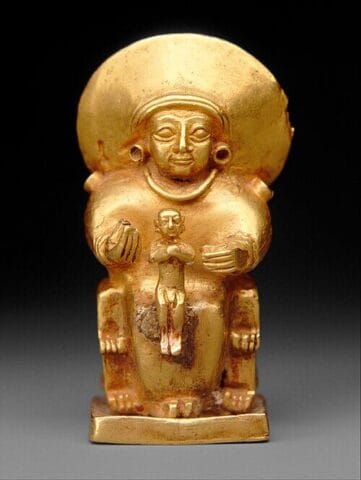
Mezulla (also spelled Mezzulla) was a goddess of Hattian origin, worshipped by the Hittites as the daughter of the Sun Goddess of Arinna and the Storm God of Hatti. She was also the mother of Zintuhi and acted as an intermediary between her divine parents and the royal family.
Her worship is documented from the Old Hittite Kingdom through the imperial period. Kings credited her with divine support during military campaigns, while Queen Puduhepa sought her intervention on behalf of her sick husband, Hattusili III. Mezulla had a temple at Arinna and received offerings during major religious festivals, although her specific divine domain remains uncertain.
Who Was Mezulla in Hittite Religion?
Mezulla belonged to the Hattian religious tradition of central Anatolia, which the Hittites incorporated into their state religion. Her name appears only rarely in surviving Hattian-language texts, and its original meaning remains uncertain. The Hittitologist Erich Neu proposed that Waazulla might represent an earlier Hattian form of her name, although this identification has not been conclusively established.
Other Hattian expressions identify Mezulla through her relationship with the Sun Goddess. Linguist Petra Goedegebuure interpreted Palatappinu as a combination of the Hattian word for “and” with either an expression meaning “her child” or the divine name Tappinu. Both readings refer to the Sun Goddess and her daughter Mezulla rather than a separate goddess named Palatappinu.
Mezulla’s parents occupied the highest positions in the Hittite state pantheon. Her own daughter, Zintuhi, bore a Hattian name meaning “granddaughter” and regularly appeared alongside her mother and grandmother in festival texts associated with Arinna. No securely identified source names Mezulla’s consort.
Read Also:
Mezulla and Hittite Kingship
Mezulla’s association with Hittite kingship dates back to at least the reign of Hattusili I in the seventeenth century BCE. His annals (CTH 4; KBo 10.2) record the distribution of spoils from Zalpa among the temples of the Sun Goddess of Arinna, the Storm God, and Mezulla. Following the conquest of Hassuwa, the king also transferred captured divine images and religious treasures to her temple.
By the late fourteenth century BCE, Mezulla appeared in royal accounts of divine assistance on the battlefield. In his annals (CTH 61), Mursili II credited her, together with the Sun Goddess of Arinna and the great Storm God, with marching before him during his campaign against Arawanna. This association with military success does not, however, establish warfare as her particular divine responsibility.
Mezulla also appears in Muwatalli II’s prayer to the assembly of gods (CTH 381) in the early thirteenth century BCE. The invocation names her alongside Hulla, Zintuhi, and the other deities of Arinna, as well as the mountains and rivers associated with the city. Her inclusion in this extensive royal prayer documents the integration of Arinna’s local pantheon into religious observances encompassing the entire Hittite kingdom.
Mezulla in Puduhepa’s Prayer
In the thirteenth century BCE, Queen Puduhepa appealed to Mezulla in a prayer seeking the recovery of her husband, Hattusili III (CTH 384; KUB 21.27+). She addressed the goddess as the beloved daughter of the Storm God and the Sun Goddess of Arinna, emphasizing that her parents listened to her words and would not refuse her requests.
Puduhepa asked Mezulla to convey her appeal to both deities and intercede on her behalf. In return, the queen promised a substantial reward, possibly consisting of towns and deported populations. The passage is damaged, however, and the identification of towns in the promised offering remains uncertain.
Mezulla was not the only intermediary approached by the queen. The same prayer contains separate appeals and vows to Zintuhi and the Storm God of Zippalanda. Puduhepa thus sought assistance from several members of the divine family, relying on their personal influence with its most powerful deities rather than addressing Mezulla as a goddess of healing.
Read Also:
The Temple and Worship of Mezulla
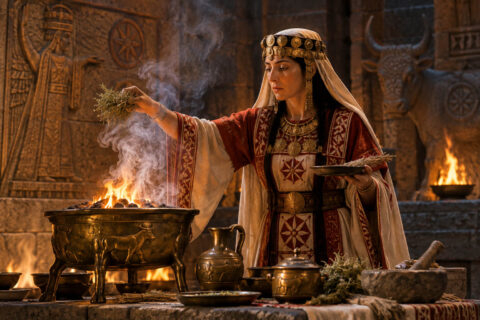
Mezulla had a temple at Arinna, where the king performed prescribed acts of worship. A festival text (KUB 58.72 ii 10–16) records a sequence of ritual gestures involving bowing and kneeling. Another document (KBo 39.62) describes the king performing a ceremonial drinking rite in her honor before the temple steps without ascending them.
Her sanctuary also served as a station on the king’s ceremonial route through Arinna. According to KUB 55.26, the king proceeded from Mezulla’s temple to that of the god Hulla. Whether her sanctuary occupied a separate building or formed part of the Sun Goddess’s religious complex remains uncertain.
Mezulla’s cult was not confined to Arinna. Ritual texts record offerings of bread and liver to local forms of Mezulla and the Sun Goddess associated with Šulupašši, Urauna, and Turmitta. The existence of dedicated temples to Mezulla in these towns, however, is not established.
Mezulla in Hittite Religious Festivals
Mezulla was honored during several major seasonal festivals. Texts from the spring AN.TAḪ.ŠUM festival (CTH 621) record drinking rites dedicated to her within the temple of the Sun Goddess of Arinna. Ritual drinking was a formal act of worship in which the officiant drank in honor of a designated deity.
The winter festival of the Sun Goddess of Arinna (CTH 598.1) also involved the royal prince. During one ceremony, he received bread from the chief of the cooks, bowed, and proceeded to the temple of the Sun God. Drinking rites honoring Mezulla, Telipinu, and other deities formed part of these observances.
Another passage describes a procession involving sheep belonging to Mezulla and Hulla. A ritual performer called out as each group passed, and once the animals had gathered, the chief of the cooks poured wine. The presence of sheep in Mezulla’s cult does not establish that she was specifically a protector of shepherds.
On the fifth day of the autumn nuntarriyašḫa festival (CTH 626), the king travelled to Arinna while the queen performed ceremonies at Tahurpa. The ritual sequence included drinking rites honoring forms of the Sun Goddess and Mezulla associated with six former Hittite queens: Walanni, Nikalmati, Asmunikal, Duduhepa, Henti, and Tawananna. Through these ceremonies, the cult traditions associated with former queens remained part of the official festival calendar.
On the twenty-third day of the same festival, offerings were made to Mezulla and the Sun Goddess of Arinna at Matilla before the king continued to a sacred stele in a grove.
How Was Mezulla Represented?
A description of Mezulla’s cult image survives in the testimony of a priest named Hutarli (KUB 38.37, reverse 8–10). He states that his father had a golden disc representing the Sun Goddess of Arinna and a silver disc representing Mezulla.
The religious significance of the different metals remains uncertain. Neither the use of silver nor the circular shape establishes Mezulla as a lunar or solar deity.
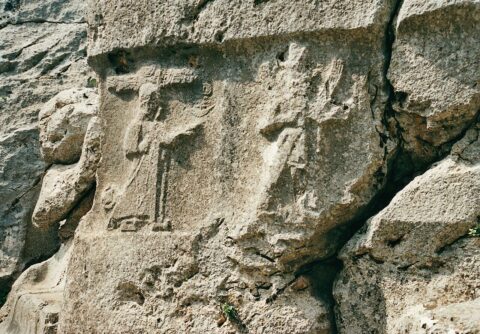
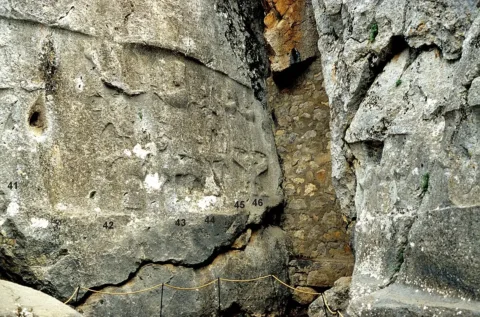
The identification of Mezulla in Hittite monumental art is more problematic. Two female figures standing on a double-headed eagle at the rock sanctuary of Yazılıkaya (reliefs 45 and 46) have been interpreted as Mezulla and Zintuhi. Other scholars identify them as the Hurrian goddesses Allanzu and Kunzišalli. The proposed identification is complicated by the parallels between the Hattian and Hurrian divine families.
The Yazılıkaya reliefs therefore cannot establish either Mezulla’s appearance in human form or the double-headed eagle as her sacred symbol.
Conclusion
Mezulla’s importance in Hittite religion is evident even though her specific divine functions remain poorly understood. Her position within the divine family made her an important intermediary in royal worship.
Sources & Primary Texts
- Singer, Itamar (2002). Hittite Prayers. Society of Biblical Literature.
- Steitler, Charles W. (2017). The Solar Deities of Bronze Age Anatolia: Studies in Texts of the Early Hittite Kingdom. Harrassowitz Verlag.
- Popko, Maciej (2009). Arinna: Eine heilige Stadt der Hethiter. Harrassowitz Verlag.
- Goedegebuure, Petra. Hattian Origins of Hittite Religious Concepts: The Syntax of ‘To Drink (to) a Deity’ (Again) and Other Phrases.
- Görke, Susanne and Alice Mouton (2014). Royal Rites of Passage and Calendar Festivals in the Hittite World, pp. 117–146.
- Taş, İlknur and Mark Weeden (2010). A Stele of Prince Anaziti in the Yozgat Museum. Journal of the American Oriental Society, 130(3).
- Zangger, Eberhard and Rita Gautschy (2019). Celestial Aspects of Hittite Religion: An Investigation of the Rock Sanctuary Yazılıkaya. Journal of Skyscape Archaeology.
- Hethitologie Portal Mainz. Digital Edition of Hittite Festival Texts, including CTH 598, CTH 621 and CTH 626.
- LAMAN: Hittite Text Corpus. Royal annals and prayers, including CTH 4, CTH 61, CTH 381 and CTH 384.
Principal Cuneiform Texts: KBo 10.2; KUB 21.27+; KUB 58.72; KBo 39.62; KUB 55.26; KUB 38.37.
Copyright & Image Credits
© 2026 History & Myths. All rights reserved. The original text, historical analysis, and editorial content of this article may not be reproduced or republished without prior written permission.
Third-party images remain subject to their respective copyright and licensing terms. Image credits and applicable licenses are provided in the accompanying captions.